
The League’s collapse foretold
During his visit to England, Hazrat Khalifatul Masih [II (ra), the then] head of the Ahmadiyya Community, drew the attention of the representatives of the League [of Nations] to the defects in its constitution, but the warning was unheeded. And the result is the recent tragedy at Geneva.
The fiasco has opened the eyes of all and the profoundly defective constitution of the League of Nations is now proved to be a reality. And it is admitted that:
“The League as it stands is impotent in the major questions whereupon ultimate peace depends.”
Now that the constitution of the League [of Nations] is under discussion, we again draw the attention of the authorities to the principles outlined by Hazrat Khalifatul Masih [II (ra)] in his book, “The Ahmadiyyat”. He is “the man who can spiritualise democracy,” and who “will save the world.”
“Races and Religions in the Punjab”
Sir Michael Francis O’Dwyer GCIE, KCIE, formerly Lieut-Governor of the Punjab, in his paper on “Races and Religions in the Punjab,” read before the Royal Society of Arts, says:
“In the 80 years of British rule, the Punjab has given birth in Hinduism to the latest serious challenge to Brahmin supremacy in the Arya Samaj, with its repudiation of idol worship and its cry of ‘back to the Vedas,’ and in Islam, to a similar revolt against tradition in the Ahmadiyya [Movement…], which seeks to bring Islam into line with the other great religions and in particular repudiates the doctrine of Jihad or propagation of the faith by the sword.
“In religious and social matters, the Pathan displays some of the fanaticism and retains some of the customs of that ancient Israel from whose lost tribes he claims descent. Of these, the most notable are the periodic redistribution of land already referred to, the sacrifice of animals and smearing the doorway with their blood to avert evil and the stoning to death of heretics.
Kabul persecution incident
“These practices have almost disappeared where the Pathans have come under the softening influence of British-Indian civilisation. But they still prevail outside that influence and only last year three members of the quietist Ahmadiyya sect, which in the Punjab is most loyal and law-abiding, were stoned to death in Kabul for heresy under the order of an ecclesiastical court confirmed by His Majesty, the Amir.
Islam and its sects
“But to return to Islam: the only two generally recognised forms are the Sunnis, who constitute 95 per cent of the Muhammadan population and the Shiahs, who are only two per cent and according to the census returns, are steadily decreasing. I refer especially to this point, as many years ago I had some difficulty in persuading the then Secretary of State for India that the vast majority of the Punjab Muhammadans were not, as he thought, Shiahs.
“While both Sunnis and Shiahs have a well-defined position in the Islamic world, both, at least in the Punjab, are tend to regard all other Islamic sects not as “fancy religions” but as dangerous, little, if at all better, than the unbelieving kafirs.
Ahmadiyya Movement in Islam
“Hence, their hostile attitude to the Ahmadiyya sect, founded some 40 years ago by Mirza Ghulam Ahmad of Kadian in the Central Punjab.
“The Mirza and his followers claimed that he was the Mahdi or Messiah expected alike by Islam and Christianity and the avatar or divine incarnation of the Hindus; that he was divinely inspired; that his mission was to put an end to war and civil strife by appeals to the religious instincts in man; and that in pursuance of that gospel of peace and love, the old Islamic doctrine of Jihad, the defence and propagation of the faith by the sword, should be repudiated.
Khilafat
“On the death of the founder, his mantle fell on successive khalifas and the present Khalifa, an enlightened gentleman, expounded the tenets of his creed at the Congress of Religions held in London in 1924.
Growth and missionary expansion
“The sect has made considerable progress among educated Muhammadans in the Punjab and though the total number of adherents as recorded in the 1921 census was only 23,000, it claims now to have a total of a quarter of a million in India and the surrounding countries.
“It has a strong missionary organisation and maintains a mosque at Southfields, near Wimbledon. My own experience of the Community in the Punjab is that, at a time of acute tension in the Muhammadan world, it remained steadfast in its loyalty and active in helping the British Government, keeping quite aloof from politics.
“The Rt. Hon. The Earl of Ronaldshay GCSI, GCIE, said:
“‘The examples given by Sir Michael O’Dwyer of the Arya Samaj in the case of the Hindus and the Ahmadiyya in the case of the Muhammadans and much more recently, of the Akali in the case of the Sikhs, were all protestant movements away from ritual and back in the direction of first principles and it was somewhat interesting to perceive that movements of that kind had taken place mainly in the northern part of India and chiefly in the Punjab. It seemed to suggest that there was a strong connection between the virility of a race and its tendency towards purity and simplicity.’
Preaching efforts in Hyde Park

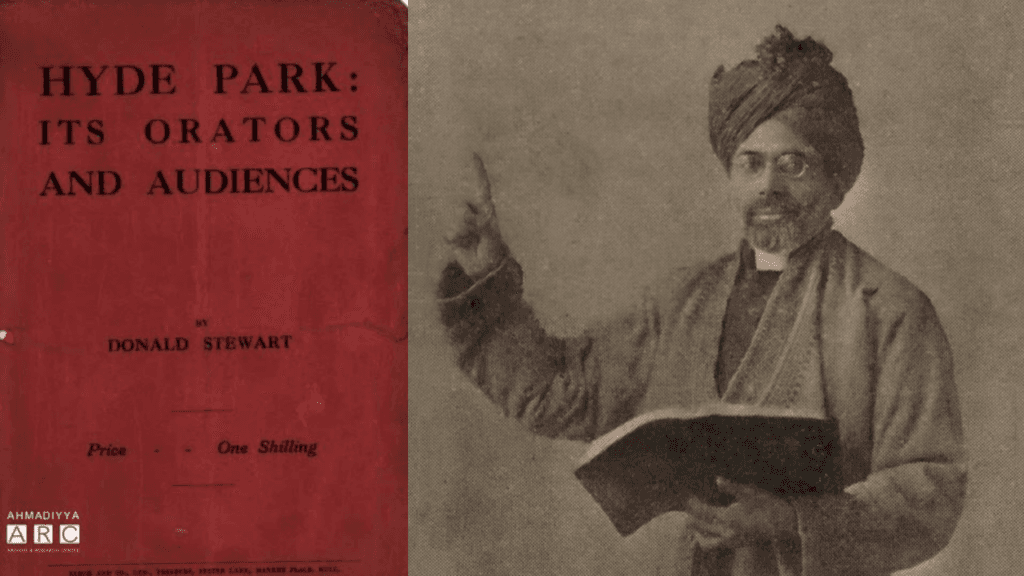
“Mr Donald Stewart, in his book Hyde Park: Its Orators and Audiences, referring to our lectures, says:
“Who is this somewhat picturesque individual who, by chanting in some foreign tongue a kind of incantation, is already attracting an audience? An Indian, apparently. Let us go and listen to him. It is but common courtesy to a stranger within our gates. The droning has now ceased and he begins to speak in good English and in a businesslike way!
Islam, Jesus and Kashmir
“Without wasting time, he informs us that his purpose is to explain the precepts and principles of the Mohammedan [Islamic] religion. There are, he says, three great religions closely related to one another – these being, those of the Jews, the Christians and the Mohammedans [Muslims]. But they are divided in their opinions regarding Jesus Christ. The Jews claim that he was an impostor; the Christians say he was the Son of God; while Mohammed said he was merely a prophet. Mohammed, who praised him, said that Jesus did not die on the cross, but merely swooned. His legs were not broken. Although placed in the tomb by Joseph of Arimathea, Jesus was taken from there by the Essenes – the brotherhood of monks to which he belonged – and after recovering, went out to the East, finally being buried in the Valley of Kashmir. In Kashmir, the people are very similar both in features and manners to the Israelites. Even the names of the towns are the same.
Core Islamic teachings
“Mohammedans believe there is a certain amount of good in all religions, although they also contain some errors. Christianity had departed from its early purity and simplicity. Mohammedans did not believe in the Trinity, but in one God – Allah. Just as Jesus came after Moses as a prophet, so did Mohammed come after Jesus. God sent prophets at various times and places. Mohammed taught: (1) that there is only one God; (2) the practice of prayer; (3) fasting; (4) self-sacrifice; and (5) pilgrimage to Mecca and the doing of good. There are no dogmas or mysteries in their religion – no pictures, crosses or crucifixes.
“It appears that the Mohammedans are not entirely in agreement amongst themselves, for the speaker says that he is not an orthodox Moslem. While the latter believes that the Messiah is still to come, he believes that Ahmad, the founder of the Ahmadia Movement, who died in the year 1908, was the promised Mahdi and Messiah.
“Our Oriental friend, having stated his case, is now prepared to answer questions and refute all calumnies regarding his beliefs.
Religious tolerance and brotherhood
“Upon being asked if it is not a fact that Mohammedans refuse to accept the Jew as a friend, he describes events that took place in the life of the Prophet that proved that the latter was an exceptionally good friend of the Jew. As for persecution, says he, we ruled in Spain for seven hundred years, where we had our observatories and our universities and the Jews had free worship. When the Christians drove the Moors out of Spain, the persecution of the Jews began. When the Roman priests came to the observatories, they found implements there and saying, ‘Devil, Devil,’ had them destroyed. Those who had read Sir Walter Scott’s novel “Ivanhoe” would remember that when the Jews were driven out of England, Rebecca had said that she would go for safety to Spain, which was then under Moorish rule and was the only country in Europe that gave freedom to the Jews.
“‘But what of the massacre of the Armenians by the Turks?’ he is asked.
“It is the duty of the Moslems, he answers, to protect all the people who live within their borders, as well as all religious buildings, whether they are churches, temples, synagogues or mosques. When Selim I, Sultan of Turkey, in the 16th century, had conquered Egypt, Syria and the Hejaz, with Medina and Mecca, he ordered the Christian temples to be destroyed. But Sheikul Islam (the head of the Mohammedan Faith) said: ‘Go and cancel that order.’
“If Turks persecuted, they did it as individuals. The Turks are condemned if they do anything wrong, but what of the Greeks and Christians generally? Christians of various nationalities had said to him: ‘I would like to kill you.’ Prejudice was to be found everywhere.
“We should cultivate friendship with all, even though we cannot agree and cannot all be of the same faith. If he wanted to go to Oxford Circus, he could go by various routes, but he would choose the best one. The Christians, by rejecting Mohammedanism [Islam] were bringing curses on themselves, as the Jews have by rejecting Christ.
“The Moslems did not say that a woman has no soul. They did not believe that she alone brought sin into the world, but man and woman both.
“‘The trouble with the Christians is that they take the language of the Bible literally,’ he replies, in answer to a questioner who quotes Christ’s saying: ‘I am the way, the truth and the life; no man cometh to the Father, but by me!’ When we say that Christ is the Lamb of God, we do not mean that he has four legs or a coat of wool!
Closing scene at Hyde Park

“But by this time, our Indian friend, as he turns out to be, is on the ground, having vacated his pedestal. And although a lengthy debate takes place amongst members of the audience as to what Christ really meant by the word ‘way,’ and the phrase ‘but by me,’ which in turn raises the question as to whether he could have been a God or the son of God, seeing that on the cross he cried out, ‘My God, why hast thou forsaken me,’ our follower of the Prophet participates in it for but a short time. He has been fasting for fifteen hours today and is feeling somewhat weary.” [Hyde Park: Its Orators and Audiences, pp. 5-6]
(Transcribed and edited by Al Hakam from the original English, published in the April 1926 issue of The Review of Religions)