
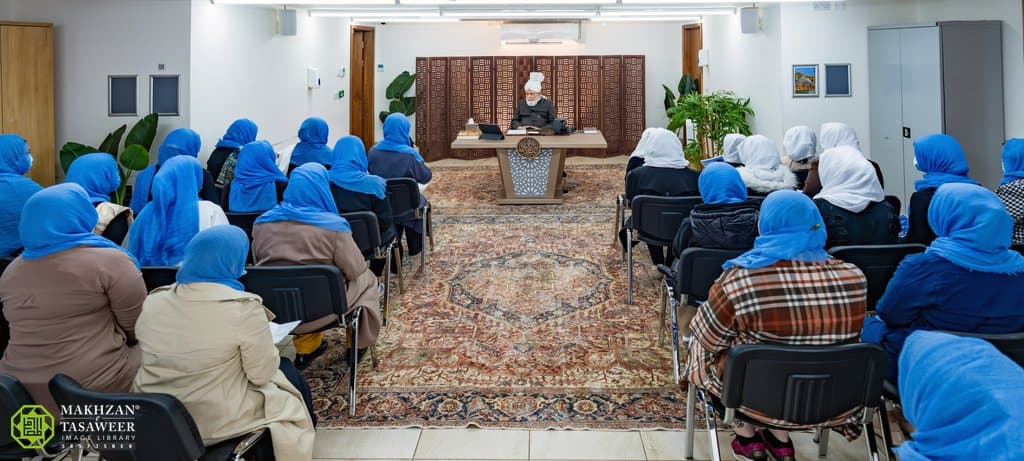
Islamabad, Tilford, 28 March 2026: 35 members of Lajna Imaillah and nasirat from Finland were blessed with a mulaqat with Hazrat Mirza Masroor Ahmad, Khalifatul Masih V (aa).
Upon arriving, Huzoor (aa) greeted those present and took his seat. Following brief introductions, the floor was opened for a question-and-answer session, during which attendees sought guidance on a range of religious and contemporary matters.
Making proper use of time in the digital age
A girl said that her parents did not allow her to use social media or messaging applications and had also advised her not to listen to music. She sought Huzoor’s (aa) guidance in this regard.
Huzoor (aa) said that her parents were doing the right thing. He noted that even governments had begun to recognise the harmful effects of excessive screen use and social media on children, mentioning that certain restrictions had also been introduced in countries such as Australia.
Huzoor (aa) explained that listening to music and spending time chatting on WhatsApp, etc., were, in reality, a waste of time. Instead, he directed her attention towards beneficial and constructive pursuits. He advised her to watch good children’s programmes and documentaries on MTA, to read books, to recite the Holy Quran and to observe the five daily prayers. Huzoor (aa) stated that if one filled one’s time with such worthwhile activities, there would be little opportunity left for idle and unhelpful habits.
Huzoor (aa) further advised the girl not to compare herself to her friends or follow what others were doing merely because it was common among them. Rather, he encouraged her to become an exemplary model for her friends.
The importance of reciting the Holy Quran daily
A nasirah asked why it was necessary to recite the Holy Quran every day and what benefit this brought.
Huzoor (aa) explained that the Holy Quran is the Word of Allah the Almighty, revealed to the Holy Prophet Muhammad (sa). He said that Allah the Almighty has instructed believers to read it and grants His bounties and grace through its recitation. He further explained that the Holy Quran enables a person to do good deeds, protects them from evil and serves as a means of purification.
Huzoor (aa) said that even children who do not yet understand the meanings of the Holy Quran still derive benefit from its recitation, for Allah the Almighty grants blessings through it and protects them from wrongdoing. Upon learning that the girl was nine years old, Huzoor (aa) advised her to begin learning the translation gradually. He especially directed her to learn the translation of Surah al-Fatihah, which is recited daily in salat and thereafter to learn the translations of the last three chapters of the Holy Quran.
Huzoor (aa) explained that in these chapters, as throughout the Holy Quran, Allah the Almighty has taught human beings what is good and what is bad, what leads to reward and what leads to punishment. He said that as children grow older, they should continue to learn the translation so that they may understand what Allah the Almighty has taught and derive ever greater benefit from it. At the same time, he said that even before full understanding develops, the blessings of reciting the Holy Quran continue to benefit a person. Huzoor (aa) said:
“As you grow older, as your age increases, as your years advance, learn its translation as well. Then you will come to know what is written in the Holy Quran. Then it will benefit you. And until you come to know it, even then, Allah the Almighty will continue to benefit you all the same – such is its blessing. Now, you recite Surah al-Fatihah every day, do you not, in your prayers? You offer five daily prayers, do you not? Memorise its translation and you will come to realise how many blessings it contains.”
Confidence and modesty in school attire
Another young girl said that she wore a long shirt and scarf to school, but that her classmates mocked her because of her clothing and kept their distance from her. She asked Huzoor (aa) what she should do in such a situation.
After asking her age and enquiring whether her school had a uniform, Huzoor (aa) was informed that there was no school uniform. He then advised that she could wear a shirt reaching to the knees along with tights. He said that it was not necessary for her to wear a shalwar to school and that trousers could also be worn if that made matters easier.
Huzoor (aa) said that there was no reason for her to develop any inferiority complex. He advised her to explain to others, where appropriate, that this was her dress and that just as others chose the clothing they preferred, she too had the right to wear what she liked. He made it clear that she should not feel embarrassed or pressured on account of the comments of others.
Huzoor (aa) further advised that when others made remarks, she should not be disturbed by them but should instead laugh such things off. He said that among her classmates, there would certainly be good girls as well and that she should form friendships with those of good character. In this way, she would find support and companionship.
Huzoor (aa) reminded her that an Ahmadi should be strong and should not be overcome by fear or weakness. He said that since she believed in Allah the Almighty and sought His pleasure, she should remain steadfast and not be afraid of people.
The arrangement of the Surahs and verses of the Holy Quran
In response to a question about who arranged the Surahs of the Holy Quran, Huzoor (aa) explained that the Quran was revealed gradually over different periods of time. He said that some Surahs were revealed in parts, with certain portions revealed before the Hijrah and other portions after it. As verses continued to be revealed on different occasions, Allah the Almighty guided the Holy Prophet (sa) regarding where each verse was to be placed. Huzoor (aa) stated that the Holy Prophet (sa) would then instruct those who were writing down the revelation to place each verse in its proper position within the relevant Surah. In this way, the Surahs were established and their arrangement was completed under divine guidance. Huzoor (aa) further explained that this arrangement carries wisdom, inasmuch as the subject matter of each Surah is connected and each verse has its own place, linking meaningfully with what comes before and after it. Thus, he said, the order of the Holy Quran was determined according to the guidance of Allah the Almighty conveyed to the Holy Prophet (sa).
Guidance regarding drawing living things
A question was then asked regarding whether it was permissible in Islam to make sketches of living things, including cartoon characters.
Huzoor (aa) explained that one should not sketch human beings. He said that when human figures are drawn by hand, they cannot be depicted accurately and the resulting distortion can easily lead to offence, dispute, etc.
Huzoor (aa) clarified, however, that taking photographs with a camera is permissible, as the camera captures details as they are. As for hand-drawn images, he said that animals, scenery and similar subjects could be drawn or painted. He mentioned that a person could draw things such as a lion, an elephant or a cheetah. He also indicated that if an imaginary figure was drawn, this would be permissible, provided it was done appropriately.
Remaining firm when incorrect religious teachings are presented
One attendee said that in school Islam classes, certain incorrect teachings were sometimes presented, such as the assertion that no Prophet could come after the Holy Prophet (sa) or the age of Hazrat Aisha (ra) at the time of her marriage. She added that when students wrote what they believed to be the correct Islamic teaching in examinations, marks were deducted. She asked Huzoor (aa) what should be done in such circumstances.
Huzoor (aa) first asked whether the teachers were Muslims and, upon hearing that they were, advised the questioner to raise such matters respectfully during the lesson itself. He said that when something incorrect was being taught, she should ask her question openly in class.
With regard to the issue of prophethood, Huzoor (aa) advised that reference could be made to the hadith in which the Promised Messiah has been described as a Prophet of God and that the teacher should be asked how that narration was to be understood if their explanation was correct. (Sahih Muslim, Kitab al-fitani wa ashrati s-sa‘ah) In this way, the teacher would be required either to answer the question or to confront the weakness in the claim being made.
Regarding the allegation about Hazrat Aisha (ra), Huzoor (aa) said that this had been raised by opponents of Islam and that historical analysis did not support the age often alleged. He stated that Hazrat Aisha (ra) was approximately 13 or 14 years old at the time of marriage and that this was the customary age in that era. He further said that it was not a forced marriage.
Huzoor (aa) directed that this issue should be studied in The Life & Character of the Seal of the Prophets as well as in the writings of Hazrat Musleh-e-Maud (ra). He also mentioned that an answer on this subject has already been published in Al Hakam and indicated that such material could also be used.
Huzoor (aa) then emphasised the importance of giving precedence to faith over worldly matters. He said that if marks were deducted for writing the truth, then one should still not abandon the truth. He reminded the attendee that to give precedence to faith means remaining firm upon what is correct and refusing to adopt falsehood for worldly advantage. Huzoor (aa) further advised that if a teacher responded harshly instead of answering a reasonable question, the matter could be taken to the headteacher.
Safety in an increasingly uncertain world
A question was then asked about whether Muslims should migrate if war were to break out in a country and what kinds of countries might be safer to move to.
Huzoor (aa) replied by drawing attention to the state of the world at present and asked where, in truth, complete safety could be found. He observed that many Muslim countries, including those in the Middle East, as well as countries such as Turkey and Pakistan were under threat. He also pointed out that European countries were not free from danger either, mentioning that Finland itself shares a border with Russia.
Huzoor (aa) said that while some countries in Africa might be comparatively safer than others, it was not possible to identify any country as completely secure. He therefore directed attention to the reality that ultimate safety lies with Allah the Almighty. For this reason, he advised that the real solution was to pray to Allah the Almighty for protection and safety.
Joining in prayers for peace
Another attendee asked whether it would be possible to establish a regular worldwide arrangement for the Jamaat to pray behind Huzoor (aa) once a week, specifically for peace and for an end to suffering in the world.
Huzoor (aa) explained that during Jalsas and other major functions, prayers were already being offered in which members of the Jamaat around the world joined. He said that in such prayers, supplications were regularly made for the peace of the world, for the betterment of mankind and for protection from the evils of Satan.
At the same time, Huzoor (aa) clarified that formal salat could not be organised in the proposed manner, as the proper requirements of congregational prayer were different. He therefore explained that the arrangement possible on a worldwide basis was that of silent prayer and collective supplication [du‘a], which was already taking place on many occasions.
Huzoor (aa) further stated that it was not sufficient to think that prayer on one designated day alone would fulfil this duty. Rather, every individual should make such supplications regularly in their own five daily prayers and during Jamaat functions. He noted that he had repeatedly instructed Ahmadis, including in his Friday sermon, to pray for the Muslim world, for global peace and for the betterment of Ahmadis. He added that when members say amin to his prayers, they thereby join in those supplications.
Tabligh through personal example
Towards the end of the mulaqat, guidance was sought regarding tabligh. It was mentioned that good relationships could be established with non-Ahmadi women and that many of them agreed with Islamic teachings when they were discussed, yet they did not appear inclined towards religion itself. Guidance was therefore sought on how their hearts might be drawn towards Islam Ahmadiyyat.
Huzoor (aa) said that the first requirement was to present one’s own example. Through good conduct and sincere friendship, one should demonstrate the true teachings of Islam in practical form. He explained that this in itself was tabligh: to convey the teachings of Islam and to manifest them in one’s conduct.
Huzoor (aa) said that when others, whether non-Muslims or non-Ahmadi Muslims, observed Ahmadis acting upon the true teachings of Islam, this would gradually influence them. They would begin to recognise that Ahmadis were following the right path and, at the very least, their opposition would diminish.
Huzoor (aa) reminded those present that Allah the Almighty has placed upon believers the responsibility of conveying the message, but that guidance itself rests with Allah. It is He alone Who opens hearts and enables people to accept Ahmadiyyat. Thus, the success of tabligh should not be measured merely by the number of bai‘ats. Rather, every Ahmadi should strive to become such a virtuous example that others recognise the beauty of true Islam through their conduct. Those whom Allah the Almighty sees to be sincere and good-natured will, in the end, be guided by Him.
Keeping one’s heart pure in an age of insincerity
A Lajna member asked how one should respond in a society where people often appear outwardly courteous and affectionate yet may inwardly harbour ill-thinking or hypocrisy or speak against others behind their backs. She asked what guidance Islam offers so that a person may keep their own heart pure and live with sincerity and good intention.
In reply, Huzoor (aa) said that the duty of a believer is to present their own righteous example. As for those who act with hypocrisy, that is a matter for Allah the Almighty, for human beings do not know the true state of another person’s heart. Huzoor (aa) explained that if a person behaves with riya’, that is, by showing off or acting merely for display, or performs deeds to please others rather than for the sake of Allah, then Allah does not approve of such conduct. He said that the reckoning of such people belongs to Allah in the next world and it is not for human beings to decide who is sincere and who is hypocritical by claiming knowledge of hearts. Referring to a hadith of the Holy Prophet (sa), Huzoor (aa) made clear that one is not entitled to judge what lies hidden within another person. Rather, a believer should keep their own heart clean, remain sincere, act with good intention and continue to show a practical example of purity and righteousness while leaving the matter of others to Allah the Almighty.
As the mulaqat came to an end, all attendees had the honour of receiving pens from Hazrat Amirul Momineen (aa).
(Summary prepared by Al Hakam)