
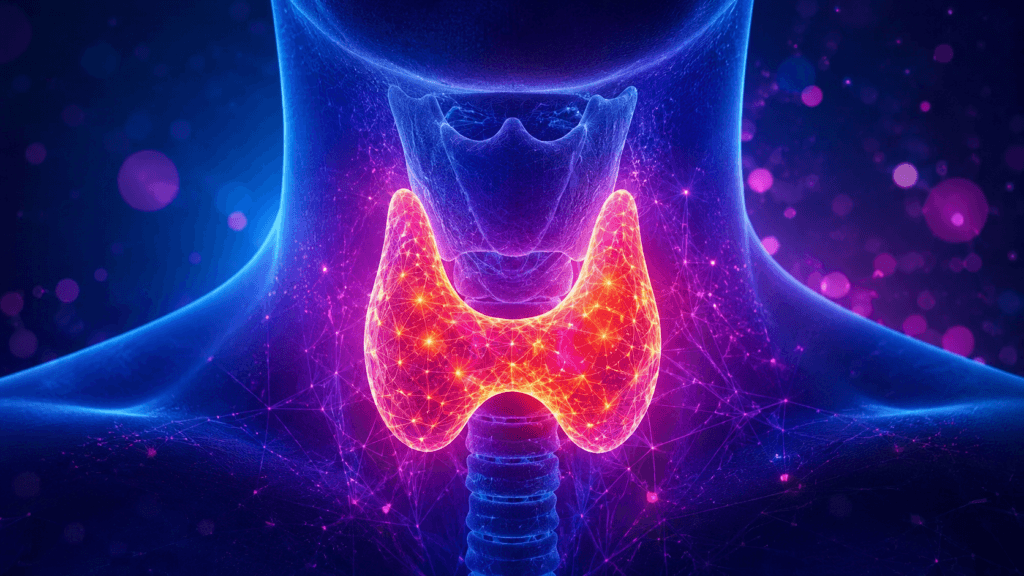
The thyroid is a small butterfly-shaped gland located in the anterior neck just below the Adam’s apple. Weighing less than an ounce, this super gland plays a crucial role in maintaining overall health, including regulating hormones, metabolism and energy production within the body.
Understanding its role and function becomes a vital step towards recognising its impact on the mental and physical health of an individual.
What is the function of thyroid gland?
The thyroid gland is an important part of the human endocrine system. In the brain, the hypothalamus (master gland) controls the thyroid gland through the Hypothalamic-Pituitary-Thyroid (HPT) axis by releasing thyrotropin-releasing hormone (TRH). This prompts the pituitary gland to produce thyroid-stimulating hormone (TSH), which in turn stimulates the thyroid to produce hormones called thyroxine (T3) and triiodothyronine (T4) into the bloodstream. These hormones are responsible for regulating heart rate, metabolic rate and body temperature; supporting growth and development; and controlling heart function. It also influences the digestive system, bone health and muscle strength. An imbalance in the synthesis of these hormones can cause either hypothyroidism (underactive thyroid/low levels of thyroid hormones) or hyperthyroidism (overactive thyroid/excess levels of thyroid hormones).
It is recently known that thyroid hormones can impact a person’s mood and overall emotional well-being.
Thyroid disorders and mental health:
- Thyroid and weight management
Unexpected weight gain or loss is associated with thyroid hormones as thyroid influences the body’s metabolism.
What is metabolism? Metabolism is a process of converting food into energy and is linked to the burning of calories by the body. One of the key aspects of metabolism is the basal metabolic rate which is the energy required to sustain basic bodily functions like breathing, blood circulation, cell regeneration, contraction of muscles, maintenance of body temperature and brain and nerve functions. The thyroid coordinates the body’s metabolism.
Basal metabolic rate affects energy balance, which is the relationship between calories eaten and calories used by the body while at rest; this accounts for up to 70 percent of daily calorie expenditure by individuals.
When the BMR is low, fewer calories are burned, which could lead to weight gain, and when it’s high, it could lead to weight loss.
However, in thyroid disorders, high levels of thyroid hormones, as seen in hyperthyroidism, can increase BMR, while low levels, as seen in hypothyroidism, can decrease BMR. Moreover, it is important to note that there are many other hormones, proteins and chemicals that also play a role in weight management.
Weight loss, weight gain and mood swings intricately influence our physical and mental well-being. Societal pressures to look a certain way contribute to poor body image and dissatisfaction, which can act as a precursor to anxiety and depression. It is crucial to keep in check thyroid-related weight struggles.
- Thyroid function and depression
Firstly, it is important to note that women are more likely to develop thyroid conditions than men. They are also more likely than men to get diagnosed with depression. Moreover, because of biology, they are more likely to be affected by hormone-related depression as well.
According to psychoneuroendocrinology, thyroid health influences emotion and cognition. Thyroid function research has established the connection between hypothyroidism and depression. Many studies have concluded that untreated hypothyroidism contributes to increased risk for depression.
Additionally, low thyroid hormones can lead to an imbalance of neurotransmitters like dopamine and serotonin, thereby causing feelings of sadness, stress, melancholy, tearfulness and self-image concerns due to physical changes resulting from weight gain. In general, you might experience a gradual loss of initiative, lethargy, lack of interest/motivation, memory and concentration issues and brain fog.
If thyroid diseases are present in families, recognising thyroid-related mood swings and frequent assessment of thyroid function are vital for correct diagnosis and early detection. Hypothyroidism is also known to be one of the leading causes of treatment-resistant depression.
Moreover, treating hypothyroidism can favour the response to antidepressants, thereby aiding in depression recovery. When considering thyroid hormones and mental health conditions, it is important to take into account thyroid hormone metabolism within the brain, as hypothalamic-pituitary-thyroid axis can provide important insights into the origins of mental illness. When it comes to depression, the HPT axis shares a bidirectional relationship – while dysfunction in HPT causes depression, depression and chronic stress itself can cause dysfunction in HPT axis.
- Hyperthyroidism and anxiety
Research indicates that an overactive thyroid can cause anxiety-like symptoms such as persistent restlessness, difficulty concentrating, sleep disturbances, gastrointestinal issues, hyperventilation, irritability, trouble relaxing, rapid heartbeat (tachycardia), weight loss and uncontrollable worry. Furthermore, excess thyroid hormones can affect the nervous system and increase stress responses, leading to emotional sensitivity and instability.
People with hyperthyroidism may experience abrupt tension and panic attacks and may become hyperactive and even sensitive to noise.
Recognising signs of thyroid-related irritability and restlessness and treatment-resistant anxiety disorder leads to proper and timely management of the underlying medical condition.
- Thyroid and eating disorders
Eating disorders are serious medical conditions that involve severe and often persistent disturbances in eating behaviours. Accompanied by distressing thoughts and emotions around food and body image, eating disorders have the capacity to cripple psychosocial functioning and overall health.
Thyroid hormones affect the expression of hypothalamic regulatory peptides (chemicals produced in hypothalamus that regulate food intake and satiety), thereby influencing appetite, food intake and mood regulation.
Additionally, in recent decades hypothalamic-thyroid axis dysfunction has been linked to obesity as a consequence rather than its cause, and changes in thyroid function have been associated with overeating. Hence, monitoring thyroid homeostasis is important to prevent and treat abnormal eating behaviours and cravings.
- Thyroid and sleep disturbances
Research has linked both hyperthyroidism and hypothyroidism to sleep dysfunction. Elevated levels of thyroid hormones can cause sleep difficulties such as prolonged sleep latency (time taken to transition from full wakefulness to sleep), difficulty in staying asleep, restless legs symptoms and hypersomnia (excessive daytime sleepiness). Some of the other reasons for poor sleep latency include changes in appetite, bowel movements and mood (e.g., anxiety, depression) as a result of thyroid hormone dysfunctions.
Furthermore, hypothyroidism may affect overall sleep quality. People with low thyroid hormone levels generally have lower sleep duration and lower satisfaction with sleep quality.
Some studies also show an association between hypothyroidism and obstructive sleep apnea. Going further, underactive thyroid-associated symptoms like muscle and joint pain, cold intolerance and constipation can exasperate existing sleep deficiencies.
Good quality sleep is an integral part of mental and emotional regulation; failure to attain good sleep on a daily basis can cause a myriad of emotional and physical problems. Untreated thyroid dysfunction can contribute negatively to an individual’s capacity to achieve restful sleep, thereby affecting his/her physical health and mental well-being.
It is also important to note that thyroid disorders affect multiple organs, including the reproductive system, and may consequently contribute to sexual dysfunction in both genders.
When should you get your thyroid checked?
When you experience one or more of the following symptoms, please get your thyroid checked by a general physician.
- You have a strong family history
- Have a lump in the base of your neck or have a swollen neck
- You experience persistent mood fluctuations without any previous history
- When you are constantly tired despite practicing good sleep hygiene
- You experience weight changes despite stable diet and exercise routine
- You have tremors, extreme sensitivity to heat or cold or palpitations
- You develop menstrual and bowel irregularities
- You have thinning of hair or dry skin
There is no alternative or replacement for starting medications when required. However, along with medications, comprehensive care methods can help in maintaining a healthy thyroid function:
- Limit intake of processed foods loaded with sugar, as excessive sugar can increase inflammation, which can exasperate symptoms of hypothyroidism. Moreover, recent research has indicated that probiotics, prebiotics and synbiotics (a mixture of probiotics and prebiotics) as part of a comprehensive plan can help manage hyperthyroidism. Fiber-rich whole grains and probiotics like curd, yogurt, buttermilk, kimchi, kombucha, kefir etc. can be a great addition to the daily food menu.
- Avoid intake of cruciferous vegetables such as cabbage, cauliflower, garden cress, radish and broccoli.
- Maintain a healthy body weight. A larger body weight requires higher production and distribution of thyroid hormones. Maintaining a healthy weight reduces metabolic strain and helps manage fluctuations caused by hypo- or hyperthyroidism by increasing cellular sensitivity to thyroid hormones.
- Exercise four times a week; consistency over intensity matters. Physical activity helps build muscle mass, which is vital to boost your metabolism and prevent lethargy and weight gain. A combination of aerobic exercises like swimming, cycling, running, and walking, along with bodyweight exercises such as squats, lunges and planks are helpful in managing symptoms.
- Practicing yoga helps in improving blood circulation to the thyroid gland and aids in managing physical stress while regulating endocrine system.
- Reduce cortisol levels with mindfulness meditation. High cortisol levels suppress the production of thyroid-stimulating hormone. Mindfulness meditations, when practiced daily, help reduce cortisol levels in the body, improve immune function, improve sleep and help manage restlessness and fatigue.
- Getting 7-8 hours of good quality sleep is crucial for healthy thyroid function. Establish a consistent bedtime routine, avoid stimulants like caffeine and nicotine post-6 pm and optimise the bedroom environment for an undisturbed sleep.
- Beliefs that every illness has its cure with the permission of Allah the Almighty and everything is possible with the will; God can help you navigate any dysfunction with confidence and right action.
Allah instructs us to keep reminding ourselves of the following teaching in the Holy Quran: “And when I am ill, it is He who restores me to health.” (Surah ash-Shu‘ara’, Ch.26: V.81)
Furthermore, the Holy Prophet (sa) has also said: “Seek treatment, O slaves of Allah! For Allah doesn’t create any disease but he also creates with it the cure, except for old age.” (Sunan Ibn Majah, Hadith 3436)
Islam promotes an optimistic outlook on physical and mental well-being. The Holy Quran urges believers to seek physical, mental and spiritual remedies for diseases and disorders.
Finally, thyroid-related mental health issues can significantly impact daily life, relationships, work performance and personality development. If you feel unusually anxious, restless and down in spirits in the absence of major life stress or mental health concern, then it is prudent to get blood tests measuring thyroid hormone levels such as thyroid-stimulating hormone, triiodothyronine (T3) and thyroxine (T4) as soon as possible.