
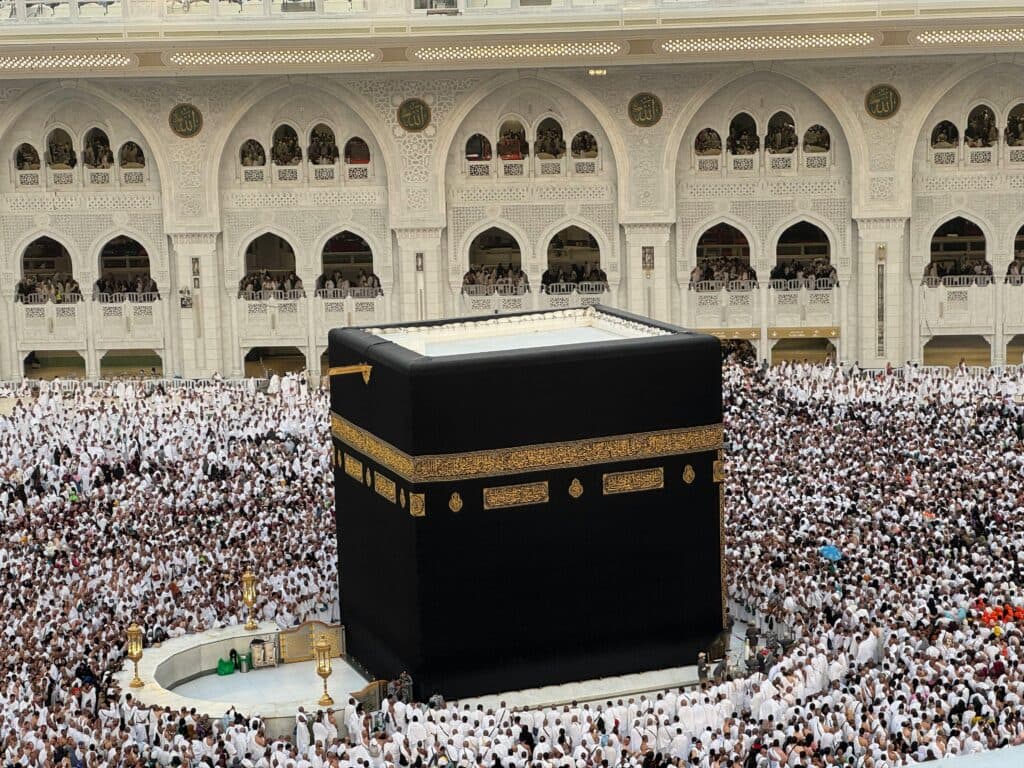
I’ve heard a lot of people describe how emotional they were when they first saw the Ka‘bah. You’ve probably heard people’s experiences as well. However, these experiences reach us through a survivorship bias, because the people who didn’t have such an inspiring experience would not be as motivated to tell their story. I ended up with expectations that set me up for disappointment. I’ll share how I suffered in that disappointment so perhaps you won’t have to.
When I first saw the Ka‘bah, I wanted to feel emotional. I wanted to feel all the emotions people had described, but I didn’t. Someone had told me that pictures cannot capture what it’s like to actually see the Ka‘bah for the first time. But when I saw it, I couldn’t help but think this is exactly what it is in pictures.
It’s not that I was unfamiliar with the feeling they were describing. I had seen in dreams that I was approaching the Ka‘bah and crying at seeing it for the first time. I knew the feeling, but I just didn’t feel it when I physically saw the Ka‘bah for the first time. Several of the people I was with felt overwhelmed at first seeing the Ka‘bah and stood crying and praying. I sat to the side feeling inadequate, and being with people who knew me made me self-conscious of that inadequacy. I came all this way and had a once-in-a-lifetime experience, and felt I wasted it.
When I began the tawaf, I thought it would be better. I was looking forward to expressing my love to Allah the Almighty by circling the Ka‘bah. But as I did tawaf, I became increasingly disappointed in myself as I realised that I wasn’t feeling what I thought I should feel. I was distracted by how to navigate the crowd, by people bumping into me, and by how uncomfortable and out of my element I was. By the time I finished tawaf, I felt confused by how chaotic it was, and how I felt I hadn’t gotten anything out of it. I didn’t know what was wrong with me. I tried to ignore a painful feeling I didn’t want to think about: the thought that I actually wanted to go home now and not stay for the rest of my days here. I kept thinking of something the Promised Messiah (as) had said:
“Some people go to Hajj. At that time there is great fervour and sincerity in their heart, but it has often been seen that the zeal and warmth with which they go, they do not return with that same zeal and sincerity. Rather, when they come back, they often become worse than before.
“It is easy to go with veneration, but it is hard to come back with veneration.
“Upon return, there is no significant change for the better in their morals; rather, that change becomes a change for the worse. Before they go, they think that there will be a magnificent manifestation of light in the Ka‘bah and blessings and light will be pouring forth therefrom and there will be a population of angels there, but when they go there, what they see is that the Ka‘bah – which they have pictured in their mind and imagination to be something else – is just a building […]
“There is absolutely no doubt that the House of the Ka‘bah is the site of manifestation of illumination and blessings and there is no question or doubt about its greatness. Its greatness is also mentioned in the earlier scriptures, but these manifestations, light, and blessings cannot be seen by the external eye. Another eye is needed for this. If that eye is open, then surely a person will see what kind of blessings are descending in the House of the Ka‘bah.” (Malfuzat, Vol. 7, pp. 426-427)
That night when I laid down, I pulled my blanket over me so no one could see my face and went to sleep in sadness. It had been a terrible day.
The next day I went for tawaf again. I thought that the previous day’s tawaf may have been affected by the fact that I was jet-lagged and disoriented, and also that I was with other people. This time, if I did it with privacy from people who knew me, and in a different state of mind, I’d be able to appreciate it better.
But as I made my second attempt, I felt similar to the way I had the previous day and my heart felt closed. I was trying to get involved, trying to force myself to feel what I was supposed to feel, but it wasn’t working. Eventually, at one point during tawaf I remember looking around and thinking, “I just don’t like this.” It wasn’t because of the jet lag or the fatigue or the people I was with, it was just because of me. The previous day I felt lost because I didn’t know what tawaf was, and today I realised I felt lost despite knowing what tawaf was. I prayed to Allah, “I can’t hide that I don’t like tawaf, but I can’t change it to be what I want it to be, so change me to be what you want me to be.” The only thing that made me emotional was expressing the helplessness of my condition in the two rak‘ahs after tawaf.
The fact that I didn’t like it made me want to do it more. I wanted to figure it out. As a start, I at least wanted to feel emotional during tawaf, but my heart wouldn’t budge. So I came up with a way that I knew would work, and prayed to Allah as a child would say in naive innocence, “If it is possible for me to force You to do something, then now I will force You to open my heart.” I decided to do the next Umrah on behalf of my mother.
Although I devoted my life for my own purpose, my mother had devoted my life before I was born and her sense of purpose in devoting me is much stronger than mine. I have never wavered in my Waqf, but I imagine if my resolve ever did waver, the strength of the resolve with which she sent me forward would not allow me to take one step back. For my trip to Umrah, she had bought my ticket and sent me with hopes and expectations. The thought that I was wasting my trip because of my weaknesses was hard to bear so far, but the thought that I was wasting the hopes and efforts with which she had sent me was a thought I could not bear. During this Umrah, I prayed for her and begged Allah the Almighty to accept my Umrah on her behalf for her sake, and that my failures not affect her.
In this Umrah, I experienced what I felt I had been missing and was emotional throughout. However, I also realised that my purpose is not just to feel emotional. While being emotional is one sign of acceptance from Allah, it is not our purpose. I needed true acceptance, not just a sign of acceptance that I could create from within myself; after all, even misguided people can become emotional when praying. The Promised Messiah (as) explained:
“Remember that if a person at one time happens to experience true immersion and fervour and pleasure in Prayer and remembrance of Allah, it does not prove that he has a true relationship with God, the رحیم [Rahim – Merciful] […] for there is a whole separate set of signs and indications that would prove the link.” (Barahin-e-Ahmadiyya, Part V, p. 271)
I was tired of chasing after a sensation. It was the crippling need for a sensation that had gotten me into this mess in the first place. Having heard so much about the emotions people felt upon seeing the Ka‘bah and performing the pilgrimage, I had focused too much on what I thought I was supposed to be feeling.
It was only after having felt the emotions I was looking for that I realised how short-sighted I was being. I submitted to Allah and prayed, “I’m tired of chasing after a sensation, I don’t want this need to feel a certain feeling anymore. I’m only looking for Your acceptance, whether it comes with a feeling or not.”
There is a pattern I always find myself repeating in spirituality, where I start by relying on my own efforts, then eventually reach a breaking point, then give up on relying on my efforts and helplessly submit to Allah. The starting point is always different, but the ending point is always the same – falling helplessly into submission to Allah the Almighty. The same repeated itself in my experience with Umrah. My confusion with Umrah only went away once I accepted that I was completely lost, that I needed Allah to catch me as I was falling.
This would be the end of the story if I were talking about Salat, because Salat is an expression of humility and submission. However, tawaf is fundamentally different from Salat and has a different ending point. Describing the difference between Salat and Hajj, the Promised Messiah (as) wrote:
“Worship is of two kinds: (1) one is humility and submission; (2) the other is love and self-sacrifice.” (Chashma-e-Marfat, Vol. 23, p. 99)
The height of Salat is in offering submission with humility in our prostration. However, the height of love is expressed in tawaf, which the Promised Messiah (as) described as such:
“And such a command was given so that a person may physically express the passion of love. Thus, those who perform Hajj circle around that House in such a manner as if they are intoxicated with the love of God. They remove their adornments, shave their heads, and taking on the appearance of spiritual ecstatics, perform loving circumambulation around His House. They kiss that stone while considering it to be the stone of God’s threshold. This physical fervor gives rise to spiritual warmth and love. The body circles around that House and kisses the threshold stone, while at that moment the soul circles around the True Beloved and kisses His spiritual threshold.” (Ibid., p. 100)
For Salat, we carefully look for a place of solitude, we dress comfortably and we make the optimal environment before we comfortably start our Salat. However, in the passion of love, we let go of control and none of these things matter. For example, when the final session of Jalsa Salana concludes, and after having spent hours sitting in Huzoor’s (aa) presence, when he says goodbye to us before leaving the hall, we feel a passion to express our emotions. At that time, we push forward and wave to him and try to express our love. In that moment we’re not bothered if we’re crowding into people or if people are bumping into us. We don’t worry about how we look in front of people at that moment – we just want to express our love.
Expressions of passion come naturally to some types of people and with difficulty to other types. In order to do tawaf as it is meant to be done, we have to let go of inhibitions in expressing our love for Allah.
In my last Umrah, aside from the prescribed words and prayers for specific parts of tawaf, I only expressed my love for Allah the Almighty. I raised my voice and told Allah that I loved Him as I circled the Ka‘bah, even though I felt shy in doing so. I raised my hands and freely begged Him for His love. I declared my loyalty and expressed how I was His and only His forever.
It was during this Umrah that I understood why men and women circle the Ka‘bah together. Before, when I was doing tawaf out of humility and submission, I was always aware of women around me and trying to avoid them or looking at them. However, when doing tawaf while only declaring love for Allah, there was no question of being distracted by any woman. To be declaring love for Allah on one hand and to be distracted by any other attraction are so opposed that they cannot possibly exist simultaneously. In this tawaf, there was no question of needing to avoid being distracted by women because their presence was no longer a factor.
In this way, tawaf of the Ka‘bah is a type of worship in Islam that cannot be replicated anywhere else in the world. It stands as an example of how the expression of love can create an exception to what is the rule everywhere else.
Looking back, the reason I had struggled so much with Umrah was because, up until then, I had been doing Umrah within my comfort zone. I had been doing Umrah in the way I do Salat: with humility and submission. However, expressing love requires confidence. Perhaps this is why the practice of raml (walking quickly to show one’s strength) during the first three circuits around the Ka‘bah continues for all time. Pilgrimage is a different type of worship from Salat. The only way to do it is to express our passion and love without inhibition. For someone like me, who is introverted and of a dry philosophical disposition, it was inevitable that I would struggle with Umrah. I had set myself up for disappointment the moment I compared myself with the experiences of people who have a disposition of love, people who are easily able to express their love spontaneously.
There are many people who feel an immediate affinity with tawaf, in the same way that there are many people who feel an immediate affinity with Salat or Fasting. However, there are also many of us who initially struggle with Salat or Fasting before we can see what others see. The same is true with tawaf.
Hazrat Musleh-e-Maud (ra) wrote:
“Then Allah the Almighty says: ‘And whoso performs a good work with willing obedience, it is better for him.’ (Surah al-Baqarah, Ch.2: V.185)
“Whoever performs any good deed with full cheerfulness and eagerness, even if at the beginning he does it with some effort and feels it as a burden on himself, the result will still turn out well for him. That is, such goodness will ultimately produce the best results for him. In the Arabic language, the word tatawwuʿ (تطوع) is used when a command is obeyed by placing a burden upon one’s self and when cheerfulness is expressed with effort (Mufradat). Thus, in the words ‘And whoso performs a good work with willing obedience, it is better for him,’ Allah the Exalted has drawn attention to the fact that a person who is unable to participate in a good deed with complete openness of heart should at least take part by compelling himself and by deliberately showing cheerfulness on his face. The result will be that Allah the Exalted will open for him the paths of goodness and blessings. In other words, as he continues to progress in good deeds, he will eventually reach such a stage that righteousness will become his nourishment, and acting upon righteous impulses will become as easy for him as it is for believers of the highest rank.” (Tafsir-e-Kabir, Vol. 2, pp. 186-187)