
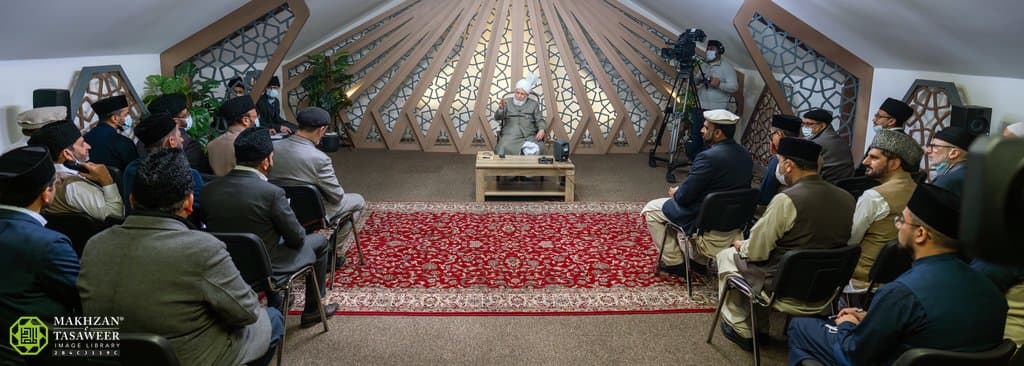
Islamabad, Tilford, 7 February 2026: The national majlis-e-amila of Jamaat-e-Ahmadiyya Germany was blessed with a mulaqat with Hazrat Mirza Masroor Ahmad, Khalifatul Masih Vaa.
Upon his arrival, Huzooraa conveyed salaam and invited the attendees to take their seats. He then asked the members to remove their masks so that their faces were visible. Huzooraa proceeded swiftly to personally identify the attendees one by one, verifying the portfolios of various office-bearers.
Huzooraa said that, rather than hearing the attendees, he wished to use the time to offer the guidance he felt was needed. He asked the office-bearers if they had thoroughly read the Laiha-e-Amal (Constitution). He stressed that every secretary must know their exact duties as outlined in the rulebook and must continually evaluate whether their daily work aligns with those requirements.
Matrimonial affairs and post-marriage tarbiyat
Addressing the Rishta Nata Department, Huzooraa noted that he receives requests seeking permission for Ahmadis to marry outside the Jamaat. Conversely, he observed a lack of reports from the Rishta Nata Department, detailing the number of successful matches arranged internally between Ahmadi boys and girls.
Huzooraa explained that when he grants permission for such marriages, it is often to prevent the individuals from falling into sin, but this is always granted on the strict condition that the non-Ahmadi partner is not a Mushrik.
Huzooraa highlighted a lack of follow-up after such marriages take place. He instructed that the Rishta Nata, Tarbiyat and Tabligh departments must work collaboratively to maintain contact with these couples. The Ahmadi spouse must be guided to display exemplary moral character to incline their partner towards Ahmadiyyat. Furthermore, the Tabligh Department should establish a friendly rapport with the non-Ahmadi spouse to gently introduce them to Islamic teachings without being overly strict from the beginning.
Tarbiyat and measurable outcomes
Huzooraa linked the overall health of the Jamaat to the effectiveness of the Tarbiyat Department. He stated that if the moral training of the Jamaat is solid, many administrative issues will naturally be resolved. He instructed that the heads of the auxiliary organisations (Sadr Khuddam-ul-Ahmadiyya, Sadr Lajna Imaillah and Sadr Ansarullah) must acutely observe the weaknesses within their respective memberships and formulate actionable strategies to address them.
Huzooraa strongly advised against superficial reporting. He noted that simply sending a circular about a Friday sermon or an event and reporting it as an achievement is inadequate. The administration must focus on the actual results. They must report the percentage of the membership engaged and the tangible improvements that occurred as a direct result of their efforts.
Financial administration, trust and audit discipline
A major theme of the mulaqat was the administration of Jamaat finances (Maal). Huzooraa stated that if the Tarbiyat Department, the missionaries and other related departments fulfilled their roles properly, the challenges faced by the Maal Department would dissipate.
Huzooraa observed that office-bearers only approach members when it is time to collect funds. He instructed financial secretaries and everyone else to cultivate friendly, ongoing relationships with the membership. They must know the financial standing of the members in their local branches, who is paying at the prescribed rate, who is not and the underlying reasons. Office-bearers must then distinguish between genuine financial constraints, which require sympathy and mere excuses, which require education and moral training.
Huzooraa drew a comparison with the Waqf-e-Jadid and Tahrik-e-Jadid departments, noting that their representatives often visit members towards the end of the year to meet targets and people willingly contribute. They should be engaging with the members on a personal level and cultivating friendly, ongoing relationships, not just focusing on year-end targets. He stated that Secretary Maal should be equally efficient and proactive.
Addressing recent banking challenges in Germany, Huzooraa spoke candidly and warned the amila not to simply blame the banks but to recognise their own weaknesses and to improve.
Huzooraa advised the amila to pay close attention to administrative order and compliance with procedures. He stressed that all responsibilities should be fulfilled through the designated office-holders and that no shortcuts or informal arrangements should be adopted. He said that when systems are not managed in a structured way, misunderstandings can arise and confidence may be affected – therefore, the amila must ensure clarity, proper oversight and consistent follow-through.
He also reminded them that members should be guided to appreciate the importance of financial sacrifice across all the established schemes; the standard of Wasiyyat contributions should also be improved.
Huzooraa admonished the amila members not to act as “officers” but as “servants”. He noted that a sense of superiority hinders progress, whereas a spirit of service invites blessings. He warned that a casual attitude towards administrative duties and audits causes long-term setbacks.
Social welfare and proactive planning
Addressing the Umur-e-Aammah Department, Huzooraa stated that the department’s role extends far beyond settling disputes or recommending disciplinary measures. They must actively assist and help people, such as asylum seekers, guiding them properly within the bounds of the law.
This was followed by a group photograph to mark the end of the mulaqat. However, Huzooraa then specifically called the Secretary Tabligh forward and imparted valuable guidance to him and to the Missionary-In-Charge.
Tabligh and service to humanity
Huzooraa urged a shift from individual, report-centred activity to a broad, coordinated, results-focused tabligh strategy. He emphasised mobilising the auxiliary organisations and capable individuals, expanding teams in every region and measuring success by outcomes rather than claimed “credit”. He also stressed depth and transparency in bai‘at of individuals – knowing each new entrant’s circumstances and intentions and ensuring clarity so that no misunderstanding arises. In view of worsening global conditions and rising hostility towards immigrants and religion, he called for a joint plan – by Umur-e-Aammah, Tarbiyat and Tabligh departments – to reassure wider society, protect Jamaat members and formulate a clear policy through the amila under the Amir, while replicating strong local examples without allowing pride to develop and tailoring methods to local mindsets (such as East and West Germany).
Huzooraa said:
“Involve as many people as possible in the field of tabligh; seek help from the various auxiliary organisations as well and also from those individuals who can help. Merely saying, ‘We have done tabligh, a report has been prepared by the Tabligh Department and our credit has been established’ – that is not credit. Credit is measured by how much result has been achieved.
“You are sending bai‘at reports these days as well, which is a good thing, but […] you should go into depth and have knowledge about every new person who has performed bai‘at – for what purpose they performed bai‘at, whatever that purpose may have been. There ought to be confidence within you, too, and you should also make it clear to the one performing bai‘at – so that there is no deception – that whatever is to be done, do it plainly and transparently.
“Then broaden your team. Tabligh cannot be done with just a few individuals. […] This is also something to assess: how many people have you involved [in your tabligh efforts] and what results are emerging from it?
“And these days, the state of the world indicates only this: for you, there is no ease ahead – only difficulties will come. As people’s worldly circumstances worsen, local people will turn against immigrants and against religion too; because of being opposed, their emotions will be further inflamed and they will even try to harm you. Therefore, do not think that circumstances will improve ahead; circumstances will only deteriorate. What plan of action have you prepared for that? It is the duty of Umur-e-Aammah, of Tarbiyat and of Tabligh as well – that all of them, together, should consider what the plan of action ought to be; how we are to satisfy outsiders as well and how we are to provide protection to our own people. Reflect upon all these matters in the amila and then the Amir Sahib should formulate a policy. […]
“[In a certain place] the murabbi is doing very good work; the same should be happening in other places too. It is the duty of the Missionary-In-Charge to instil that same [courage] in the other murabbis. They should develop courage and they should also possess knowledge. However, it must not become the case that the murabbis’ heads swell. They ought to have this spirit: we are to serve; Allah the Exalted is granting us the opportunity to serve and for this we must strive to achieve even better results, to cooperate with people and to include more people in the team and take their cooperation. ‘Only my name should appear, no one else’s’ – this thinking is wrong. Increase the tabligh team – expand it in every area. Murabbis should expand [their teams] and you [the Secretary Tabligh] should also expand your tabligh team.”
Huzooraa stressed that approaches must be tailored to the specific mentalities of different regions, such as East and West Germany. He reiterated that just distributing pamphlets is not an achievement in itself; true success lies in the results obtained and tabligh is done using all the various methods.
Huzooraa highlighted a recent incident where a power outage in Berlin affected 45,000 individuals. While Humanity First provided food and assistance, Huzooraa noted that the local Jamaat administration and the Umur-e-Aammah Department missed a vital opportunity. They should have been visibly present on the ground alongside Humanity First, demonstrating that Ahmadis are actively serving their local communities. He instructed the Missionary-In-Charge, the Tabligh Department and Umur-e-Aammah to seize such opportunities in the future.
Talim-ul-Quran, Waqf-e-Arzi, Waqf-e-Nau and Umur-e-Kharijiyyah
Huzooraa spoke briefly to the Secretary Talim-ul-Quran, encouraging him to increase the number of people regularly reading the Holy Quran and participating in the Waqf-e-Arzi scheme.
Addressing the Waqf-e-Nau department, Huzooraa issued a firm reminder regarding the scheme. He instructed the secretary to ensure that the bonds of dedication are formally renewed when the youth, both boys and girls, reach the ages of 15 and 21. Huzooraa expressed concern that, upon review, the moral, spiritual and educational standards of Waqf-e-Nau children are often no different from the general membership. He stressed that their standards should be noticeably higher and directed the department to work with a renewed spirit to achieve this.
He also addressed the Umur-e-Kharijiyyah Department, noting their meetings with 142 parliamentarians and encouraging comprehensive relationship building with all of them.
In the end, Huzooraa distributed pens to the members, conveyed his salaam and departed.
(Summary prepared by Al Hakam)