
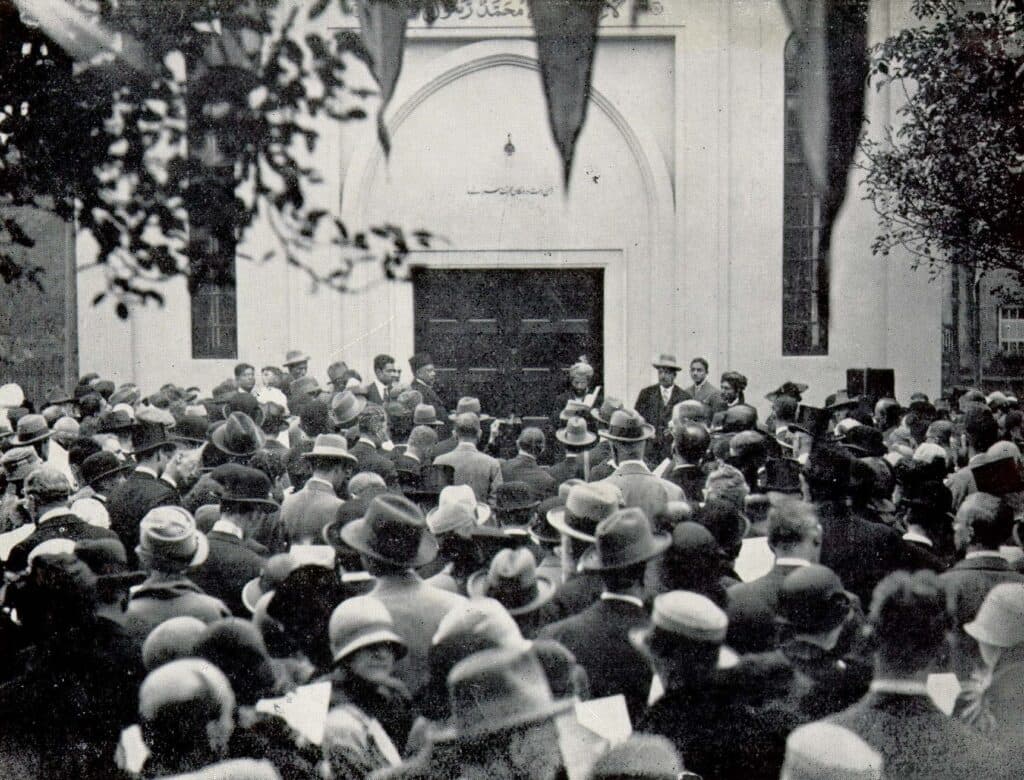
By a Christian Journalist
Opposite the imam [Hazrat Maulana Abdur Rahim Dard (ra)] and wearing a tarboosh of astrakhan [astrakhan fur hat], stood Khan Bahadur, whom the imam – his chant complete – requested (“with all my blessing and feelings of love and sympathy for the whole world”) to open the [Fazl] Mosque. Accepting the silver key, Khan Bahadur placed it in the lock, saying as he turned it:
“In the name of the Merciful God, I open this house of worship.”
Then was revealed the austere beauty of the Mosque’s interior. Crowned by the dome, the undecorated walls, by contrast with the rich blue of the carpet that hid the floor, looked almost whiter than in fact they were. In one respect it was unlike any other mosque; as a concession to England’s sun-starved climate the walls bore long, narrow windows to admit the light.
Not yet came “the call to prayer.” At the imam’s invitation, the company took seats beneath the marquees on the lawn, where addresses were delivered by the imam, Khan Bahadur and the Maharajah of Burdwan, and telegrams of congratulations were read from Muslims who had sent them from the ends of the earth.
Address delivered by the imam – Hazrat AR Dard (ra)
“We have assembled here today for a function which is unique in itself. It is the opening of a building which is erected to remember Him who is the Creator of all and to give expression to our feelings of devotion and worship of Him who is the Centre of all. When we stand in His presence, we forget all distinctions of age, rank, colour, East or West, for the nearer a man attains to Him the less he remembers the difference and the more he realises the unity of mankind.
“So the house which has been opened today is a sign of the unity and brotherhood of man; it assures us of the fact that our source and place of return is the same and that we should not fight with each other or create trouble merely owing to some apparent differences.
“Differences there have been in the world, and they will continue to arise. Never was there a time, nor will it ever be, when these differences would disappear; for so long as there is in man the capacity to progress and advance, he must needs differ. Whatever advance we notice in the world, it is all the result of this fact.
“So difference in this respect, as the Holy Prophet Muhammad, may peace and the blessings of God be upon him, has said, is the source of blessing and not a harmful thing.
“Evil creeps in only through over-zealousness in laying too much stress upon unity, culminating in intolerance. As a matter of fact, the cause of human brotherhood has never suffered more than at the hands of its warmest advocates whose zeal outran their sense of proportion, and who, consequently, adopted means which defeated their own object. The cause of unity has indeed suffered more at the hands of its friends than at the hands of its enemies.
“If difference is really as bad as it is painted, what is the function of toleration? Toleration and large-heartedness can only be exercised when there exist some differences. So what the world needs today is not so much the mitigation of differences as the circulation of toleration and breadth of view; that is to say, people should learn to live on terms of mutual love and fellow feeling, in spite of their differences of belief and opinions. There can be no doubt about the fact that there can be no real progress without the propagation of truth and that therefore everyone has a right to call people to truth (as one understands it), but it does not mean that one has a right to enforce his views upon others and to impose his will upon the tongues and actions of others before bringing about any change in their hearts. Nor should one begin to persecute others on the basis of mere differences of opinion.
“Sisters and Brothers! Mosques are built for fostering the spirit of love and mutual amity. In the terminology of Islam a mosque is called Baitullah (the House of God), i.e. it is such a place where no one has a right to disturb or evict another owing to differences of opinions, for it is the House of God and not the private property of any individual and God is as much the Lord of his opponent as his. Says the Holy Quran:
“‘Who can be a worse tyrant than him who prevents people from entering the mosques wherein the name of God is remembered?’ [Ch.2: V.115]
“Once a deputation from a Christian tribe waited upon our Holy Prophet Muhammad, may peace and the blessings of God be upon him. They were having a discussion with him on doctrinal points. The arguments grew long and it was their time to pray. They asked his permission to go out and say their prayers. He said there was no need for them to go out, for they could pray in the mosque where they were holding the discussion. So we know from the Holy Quran as well as from the life of the Holy Prophet (sa) that the doors of Muslim mosques are open to all those who want to worship God alone and that the Muslim mosques are the centres of unity.
“In the same spirit and with the same motives as I have described above, I want to proclaim it throughout the whole world through you who have kindly assembled on this occasion that this Mosque is built to worship and serve God alone, so that His love may become fully and firmly manifest and people may be drawn towards religion without which there can be no true progress.
“We shall not, God willing, prevent anyone from worshipping here, provided he does not infringe the rules which are necessary for the upkeep of this house of God and provided also that they do not interfere with the worship of those who are building it.
“I have faith and hope that the spirit of toleration and large-heartedness which the erection of this Mosque will create will help to remove all friction and strife and establish peace and unity and goodwill among men, and the days are not far off when people will give up all war and ideas of war, and they will learn to live in peace and harmony, and the whole world will realise that with God as our one Creator it is necessary for us to live as brothers and sisters, and instead of being a hindrance in the way of others’ progress, we will help and co-operate with each other.
“Just as a father does not like that his children should fight among themselves, so does not God like that His creatures should be busy fighting against each other.
“In fact, all quarrels and frictions are due to our straying away from God, so He, out of His mercy, sent the Promised Messiah, Ahmad, the founder of this Movement, may peace and the blessings of God be upon him, to draw people to God so that their attention, being drawn away from internal friction, may be drawn towards mutual understanding and harmonious living.
“The Ahmadiyya Movement is willing, with the grace of God, to make all sorts of sacrifices and endure all sorts of hardships, until the time when all racial and political wars are ended, and love reigns supreme. We hope that the good people of all nations, whatever their creeds and beliefs, will help the Ahmadiyya Community in their efforts to promote peace. The signs are already visible, as the assemblage here of distinguished people of various races and creeds clearly shows.”
At the conclusion of his address, Mr Dard read cablegrams that had been received from Muslims in all parts of India, the North-West Frontier Provinces, Mauritius, the American Ahmadiyya Movement, Scinde [Sindh], Sumatra and West Africa, in addition to messages from Lord Ashfield, Sir Harry Foster, MP, and Lord Leigh.
Address by Khan Bahadur Sheikh Abdul Qadir

“I am sure all of us share the feeling of disappointment at the absence of His Highness Prince Feisal [i.e. Faisal bin Abdulaziz Al Saud], who was expected to grace this occasion with his presence as a representative of his illustrious father, His Majesty the Emir Ibn Saud. His presence might have added to the historic significance of today’s function, and he could have carried with him to his sacred home the remembrance of having assisted at the opening of the first house of worship for Muslims in London, but perhaps Providence had a purpose of its own in the turn taken by events in this respect.
“Ali, one of the foremost companions and co-workers of the Prophet (sa) of Arabia, has left a remarkable saying. He says: ‘I recognised my God by the frustration of designs.’ I know of no other observation that expresses so succinctly yet so truly the argument for the existence of a Power outside and beyond ourselves.
“It is a fact well known to all students of history that Islam originated in humble surroundings. The great Arabian messenger (sa) who brought this life-giving message to the world was an orphan without many friends and had to depend for a long time on a small [community] of devoted adherents. The faith that he preached did not derive its strength from the high and the mighty, but gathered its power from its own innate force and began to draw the mighty to itself when it reached its prime. Who can say that the small mosque, the doors of which have been opened today, may not gain in strength by not depending on the aid of any worldly grandeur for the success of its opening function.
“Sensible as I am of the honour which the committee in charge of the Mosque have done me in asking me to perform the opening ceremony, it is not without diffidence that I have undertaken the task assigned to me. In the first place, a humble individual like myself can be but a poor substitute for a prince. In the second place, I am not among those who favour ceremonies. A function like this, however, has the merit of being conducive to publicity and publicity is not a thing to be despised in the present-day world.
“In this great town of London a small mosque like the one before you, pretty as it is in its simple design, would have remained in obscurity but for this function and the extraordinary interest aroused about it in the Press by the hitch that arose as to the presence of Prince Feisal. From one point of view, it is particularly gratifying to me that God has enabled me to take part in the inaugural ceremony of a mosque in London.
“Twenty years ago, when I was here as a student, I felt that the Muslims residing or sojourning in London should have a mosque. On the occasion of the Eid prayers which were then offered by Muslims openly in a public park for the first time and which I had the privilege of conducting, I expressed the hope that the small beginning thus made might lead some day to our possessing in London a house for Divine worship. I am naturally glad to find that dream materialised by the devoted zeal of Mirza Bashiruddin Mahmud Ahmad [ra], the distinguished head of the Ahmadiyya sect of Muslims at Qadian in the Punjab and by the selfless efforts of his followers.
“I am aware that this new sect of Muslims is not liked by some of the larger and older sects, and it is quite possible that the machinations of some of its opponents have stood in the way of our having Prince Feisal with us this afternoon. I venture to think, however, that we should not judge this work by any rigid standards of narrow sectarianism, but must look at it from a broader point of view.
“To me all the differences of creed appear absolutely negligible when the exigency of explaining and interpreting Islam to the great nations of the West is taken into consideration. No religion has been more maligned and misunderstood, and it is comparatively recently that Western scholars began to recognise that Muhammad (sa) was one of the greatest prophets of the world and the author of many useful and far-reaching reforms.
“To the task of bringing this truth home to the Western peoples, every Muslim, who has the necessary knowledge and equipment and desires to render some service to his religion, is called, no matter to what denomination he belongs. When I stayed for a number of years in England in my younger days, the feature of our life in this country that appealed to me most was that we regarded ourselves here as Indians and not as Hindus, Muslims or Christians, and similarly that Muslims here were simply Muslims and not Shias, Sunnis or Ahmadis.
“It is in this spirit that I am here and have opened a mosque built by Ahmadis, though I do not belong to this sect. On many occasions I have joined Ahmadis in offering prayers, and I have not noticed any difference between them and other Muslims, in the form or the substance of their prayers. They have the same Quran as the rest of their co-religionists. They are as reverent to the Prophet (sa) as any Shia or Sunni. They obey all the most important commandments of Islam. On certain points of doctrine or interpretation they differ from older creeds, but the West has hardly time to be concerned with such details, and they would be wise if they eschewed such details in their work in this land and concentrated themselves on those essential and cardinal principles which constitute at once the glory and the vitality of Islam. There is no religion which is not divided into sects and Islam is no exception to this rule. There is a proverb in Muslim countries that there are two and seventy sects, but this represents a very old calculation. Hafiz, who lived more than six centuries ago, alluded to this division when he sang:
“‘The seventy and two sects are excusable in their fight with one another. Having failed to see the truth, they have drifted into the path of fiction.’
“If an up-to-date inventory of sects were to be prepared now, they would probably represent a much larger number, but this should not discourage any votary nor encourage any opponent of our religion.
“The well-known solidarity of Islam in its essential features has withstood many a shock and its foundations can still stand some shaking without the huge edifice tumbling down.
“I am sure that Muslims in the British Isles and particularly those in London, will rise above sectarian differences and set an example of solidarity to the masses of their co-religionists. I hope they will take full advantage of the existence of this mosque and of the creation of a centre for spreading light on the doctrines of Islam. There are many earnest seekers after truth here, and it is our duty to share with them the light that was brought to the world by our great Prophet (sa), whose name is loved and respected throughout the Muslim world and is reverently called out five times a day from the minarets of every mosque on earth.
“A day may come, and I hope it will come, when this small mosque may expand into a large institution or when in addition to this a larger and more imposing building may be erected in a more central place in London. Such a mosque may be built by the efforts of the Muslims of India or by the cooperation of different Islamic countries. Or perhaps one day the British Government may realise the advantage of following the example set by France in building a magnificent mosque in Paris, by having a similar institution in London which may be worthy of this metropolis.
“The institution would be welcome when it comes and can be in the meantime a pleasant dream; but the success of Islam in this wide-awake part of the world, where people are inclined to examine everything critically, will not depend on the nature or the number of the mosques we have, but on what we do and how we behave.
“It would rest with those who represent us here as students, or professional men, as traders, or teachers of religion, to create a favourable or unfavourable impression about it. It will be by their everyday conduct, in the ordinary walks of life, in fulfilling their engagements, in the faithful performance of their duties and in their friendly treatment of their fellow men and women that they will be judged and with them will be judged their great religion.
“By building this mosque here and having a small nucleus of Muslim society in the greatest capital of the world, we have placed our faith on its trial, and we owe a duty to Islam and to God to make that trial a success. It is my fervent prayer, in which I hope you will all join, that Allah, the great Creator of the Universe, may help each one of us to tread the right path, the path of those whom He hath blessed and not of those who have incurred His wrath. Amin.
“Before I conclude, I wish to offer, on behalf of the Muslims assembled here, our warmest thanks to our friends belonging to other religions than our own, who have encouraged us by their presence on this auspicious occasion and have helped thereby to cement those bonds of sympathy and goodwill which bind together the multitude of nations and peoples living peacefully under the aegis of the British Crown, thus making for that broader fusion and union of nationalities, which will bring about, in practice, the realisation of the great ideal of the brotherhood of man, and so make this world of ours a happier and a better world.”
Speech by the Maharajah of Burdwan
The Maharajah of Burdwan said:
“When I received the invitation to attend this ceremony, I felt it was a duty which I should not only perform, but perform with sincere pleasure. In the past, the stigma has very often been placed on the Indian who leaves his native country to come to the West, that he forgets his religion and his religious fervour in the glamour of the West. It is a sign of the times that Indians who have to make a Western country their home for the time being should be alive to their religious needs and should realise that their own religion makes it necessary for them to have a house of prayer where they can assemble. It is, therefore, a matter of sincere pleasure to me to come here today to assist at the opening ceremony of the Mosque in London, and I take this opportunity of thanking the imam of the Mosque and my other brother Muslims assembled here for the opportunity afforded me.
“A great deal is made in the papers in England of the differences between Hindus and Muslims in India. But one thing they do forget, either in their desire to make mischief or to confuse the British mind, is that when there is a difference it is over religion and nothing of a mundane nature. Even then, it should not be forgotten that the better class of Muslims and Hindus know their duty to each other and that what is now taking place in India is only a passing phase. For the hearts of true Hindus and true Muslims are sound. (Cheers)
“In the same way as my friend Khan Bahadur from the Punjab has said that, belonging as he does to another sect of the religion of Islam, he thought it his duty to come and open this mosque, which is the crowning success of the Ahmadiyya Movement in this country, with the same spirit I have got up as a non-Muslim to congratulate the Ahmadis on the success of their enterprise in founding this mosque in London and to thank the Khan Bahadur for the catholicity he has shown by coming and opening the mosque. (Cheers)”
Thereafter, while the imam still thanked his distinguished guests for their addresses and while Sir Abbas Ali Beg was expressing his pleasure at having been present at so auspicious an occasion, arose the high, quavering note of the azan – the “call to prayer”, sent forth by Mr GF Malik [ra], from one of the Mosque’s four white minarets. To many present, sweetly familiar, that call must nevertheless have caused a novel thrill. For it floated from London’s first Mosque for the first time – a summons hereafter to be heard, in this suburb of the great Metropolis, five times in every day.
“To the open door of the Mosque pressed the worshippers – fez, turban, tarboosh and the headgear of the West testifying to Islam’s unifying power. But before entering the sacred precincts, they carefully cleansed themselves – face, lips, hands and feet in the octagonal pool that was fed by the fountain; and they entered the portals with stockinged feet. And then, following the leadership of the Maulvi AR Dard MA [ra], the imam, they prayed.
That was at 4 o’clock. Their devotions complete, Muslims joined non-Muslims friend beneath the kindly shelter of the marquees, there to partake of the imam’s hospitality and to give or receive sincere congratulations upon the consummation of a notable, courageous enterprise. To the colour lent to the sombre garb of the West by the bright hues of Eastern draperies was added the pleasant variety of many a lady’s dress – reminders of a note that had been struck throughout the afternoon’s by the imam’s quaintly courteous exordium – “Sisters and brothers.”
Thus terminated the greatest day in the history of Islam in England a day that spoke of the growing tolerance in both Eastern and Western minds, and forged a potent link between two of the many races that owe the King-Emperor their allegiance.
Among those present were:
The Consul-General for Bolivia; Col Antonesco, Military Attaché of the Roumanian Legation; Chargé d’Affaires to the Chinese Legation; Commander Vassiliades, Naval Attaché to the Hellenic Legation; Dr Antonio Reyes-Guerra, Consul-General of El Salvador; Captain L Norrgren, Consul-General for Finland; Comm A de Probizer, Royal Italian Consul-General; Vice-Consul for the Netherlands; the Consul of Lithuania; the Swedish Minister; Dr EO Meyneu, Secretary to the German Embassy; the Consul-General of Liberia; the Rt Hon Viscount Mersey; the Rt Hon Lord Vesty; the Rt Hon Lord Riddell; the Rt Hon Lord Ashfield, PC; the Rt Hon Lord Strathspey; Col Sir Arthur Holbrook, KBE, VD, MP; Sir Harry Brittain, KBE, CMG, MP; Sir Park Goff, KC, MP; Mr EA St Aubyn Harney, KC; Mr JD Cassels, KC, MP; Councillor Rear-Admiral Wonham, CBE, JP; Lieut-Colonel Ford, CBE; Sir Michael and Lady Dwyer; Sir William Simpson; Sir Henry Jackson, MP; Lieut-General Hutchinson; the Rt Hon JH Thomas, Esq, JP, MP; Mr AE Joseph, MP; Mr W Preston, MP; Mr AE Townend, MP; Mr PJ Hannon, MP; Col Vickers Dunfee; Lady Ross; Captain P Clow; Alderman AW Mathias, JP, Mayor of Wandsworth; Mr William Haywood, JP; Mr Leonard Shepherd, JP; Mr P Cullinan, MBE, DCM; Mr CB Grylls, CBE; Mr DA Nicholls, MA (Councillor for Wandsworth); Captain Gordon Canning; Mr NC Len; Miss A Broadhurst, MA, President NPL; Miss M Farquharson, Secretary NPL; Mr M Haffar, Manchester; and many other distinguished people.
(Transcribed and edited by Al Hakam from the original English, published in the October 1926 issue of The Review of Religions)