
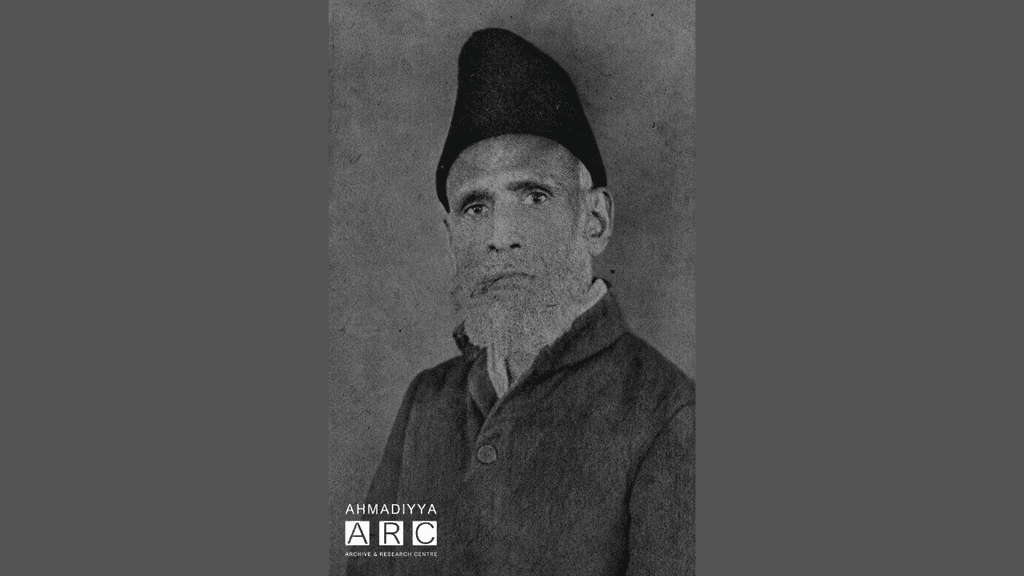
Hazrat Sheikh Yaqub Ali Irfani (ra) (1875-1957)
Pigott
The remembrance of the blessed era of the Promised Messiah (as) stirred a remarkable state in Irfani’s heart today, 30 August 1926. That scene and that state once again unfolded before my eyes: the time when the “Moon of Prophethood” [the Promised Messiah (as)] was seated in splendour on the Shah Nashin at the Mubarak Mosque [in Qadian] and discussions were taking place concerning Mr [John Hugh Smyth] Pigott, the London claimant to Messiahship. The Promised Messiah (as) challenged him and the challenge was published.
Pigott did not have the courage to face the challenge and matters of a most disgraceful nature were brought to light. Thereafter, he seemed to have been buried in a forgotten corner of obscurity. Now, however, he may have appeared once again. After years of failure and disappointment, he seems to have returned to London and claims that he heard a voice commanding him to come to London. At that time, Pigott had launched his movement under the name “Abode of Love”, but it ended in the destruction of the Abode of Love.
Now he seems to have returned to London once again and wishes to resume his activities. Work has also begun on the repair of his church. However, his followers have advised him not to appear before the public again or launch any kind of movement. There is strong opposition to him in the Abode of Love, and the majority opinion is against him.
Nevertheless, we are studying his movement with the greatest interest. I am trying to see this false and defeated claimant, for he is a sign of my master. I hope that, insha-Allah, I shall soon be able to acquaint my friends with an account of his activities.
Science and its influence on morality
The modern discoveries of science are causing the people of Europe to become averse to religion. The principal reason for this is that the religion they have been taught cannot withstand the challenge posed by science. It is a distinctive characteristic of Islam that the greater the progress made in science and the modern sciences, the more fully the excellence and perfection of Islam will be manifested.
A conversation with an atheist
On 22 August [1926], as was my usual practice, I went to the park in the evening. By chance, a man who was an atheist and a devoted worshipper of the achievements of science came and sat near me. He began the conversation in such a manner that I soon understood what kind of temperament and outlook he possessed. I did not attempt to interrupt him or challenge his arguments; rather, I listened with a degree of unresponsiveness. Eventually, he said:
“I am convinced that you will agree with me that if anything is worthy of worship, or if the world cannot continue without belief in God, then people ought to worship science alone. Such foolish people who, (God forbid), cannot live without the idea of God should be told that science itself is god.”
Continuing his argument, he said:
“I think a movement should be launched whereby, in future, the name ‘God’ is removed from books and replaced with ‘science’. Alternatively, dictionaries should indicate that ‘science’ and ‘God’ are synonymous.”
He was quite proud of this novel idea. At that point, I felt that remaining silent would be a sin and I began to engage him in conversation.
Irfani: “You have certainly given science a great deal of importance. If your proposal were adopted, what would scientists then be called? Would they, according to your idea, also be gods, or would they be the creators of God?”
Atheist: “If fools cannot find satisfaction without believing in God, then, certainly, scientists too may be regarded as gods.”
Irfani: “Then, according to your view, the beliefs of the ancient Greeks, Persians and Hindus were not correct when they regarded the forces and phenomena of nature as gods?”
Atheist: “No. I do not consider the very concept of God to be correct. All of those beliefs are relics of an age of ignorance.”
Irfani: “And yet, in this age of enlightenment, you wish to make essentially the same claim again?”
Atheist: “If people cannot live without believing in God, then let them believe in the god who manifests himself through the wonders of science.”
Irfani: “It seems that the inventions of science have made such a profound impression upon you that you have even forgotten the remarkable faculties and powers bestowed upon the human being.”
Atheist: “It is not merely I; every intelligent person will agree with me that science alone is worthy of worship.”
Irfani: “If by an intelligent person you mean one who agrees with every fool, then I shall be the first to accept the title of fool.” At this, everyone burst out laughing.
I continued: “If, however, by intelligence you actually mean the faculty of reflection and the power of judgement that guide a person towards what is correct, then no intelligent person could be so foolish as to mistake his servant for his master. As for you, I cannot say much, because in your dictionary the word ‘intelligence’ is apparently defined as ‘foolishness.” Again, the people laughed.
I added: “And I consider it a sin even to purchase such intelligence for a farthing [a historic British denomination worth one-quarter of an old penny, or 1/960 of a pound sterling].”
Atheist: “I regret that you are resorting to sarcasm. Remarks of this kind are contrary to the ordinary standards of civility expected in a conversation.”
Irfani: “I sincerely apologise to you. If I have uttered some cutting remark, I do not recall it. However, I am not yet a complete expert in your dictionary; I have only just learnt a few of its words. If I have failed to understand the meaning of ‘ordinary civility’ according to your dictionary, you should not be displeased. After all, my ignorance itself pleads with you to forgive me.”
Those present laughed heartily at my reply, while the atheist appeared embarrassed.
Atheist: “This too is an argument of the same kind. I have no dictionary of my own. Everyone understands ordinary civility.”
Irfani: “When I refer to your dictionary, I mean that you alter the ordinary meanings of words. For this reason, I regard it as an invention of your own, especially since you are a worshipper of science. I respectfully suggest that perhaps you are also altering the science of philology. And do you not remember that you yourself just said that ‘God’ and ‘science’ should be made synonymous in the dictionary? Therefore, I have not erred in referring to it as your dictionary.
“Moreover, you called all those who believe in God fools; I did not call you a fool. Although, as it is written in the Book of Solomon, ‘The fool has said in his heart, “There is no God.”’ [Psalm 14:1]” At this, voices of “Hear, hear!” began to come [from those around us].
“Do not let us become entangled in this particular argument, however, for it would merely become a dispute over words or terminology. It is quite possible that, in your usage, a fool is called an intelligent person, or an intelligent person is called a fool. It would therefore be better for us simply to consider the meaning intended and proceed from there. Allow me to ask you a question.”
Atheist: “I apologise to you. Please, ask whatever you wish to ask.”
Note: In ordinary conversation here, expressions such as “Please forgive me”, “Excuse me”, and “I am grateful to you” are very frequently used. Since people in every country enjoy humour, whenever someone utters a particularly striking or witty sentence or phrase, voices of “Hear, hear!” rise from the audience. I, too, have to follow this practice to some extent.
Irfani: “There is a difference between your point of view and mine. You regard the inventions of science as the master, whereas I regard them as servants. Therefore, I cannot elevate a servant to the position of a master, let alone to that of God.”
Atheist: “You do not acknowledge the benefits that science has bestowed upon us.”
Irfani: “That would be like you considering the servant who gets up in the morning and removes the chamber pot from your bedroom to be your master.”
Atheist: “No, he is not called the master, although he provides us with a service and makes our lives more comfortable.”
Irfani: “Then you have come down from your previous position and agreed with me that these sciences are our servants. Electricity serves us; the wind is for our benefit; water is for us; the sun performs its work for us. All of these are servants, not masters. The true benefactor is the One who created these things for our benefit, and that is God.”
Atheist: “Why, then, does this idea of God arise in you?”
Irfani: “Because He exists, and the nature of every human being desires that there be a God. Thus, it is the voice of human nature speaking everywhere.”
Atheist: “These are merely thoughts. Just as other thoughts arise, this one too has continued to arise because people have heard it repeatedly from the past. Why do thoughts of things that have never been heard of not arise?”
Irfani: “You are more familiar with this than I am, but the inventions that come about are themselves the result of ideas. If what you say is correct, then from where do inventors receive these ideas? And why does an actual reality emerge when they experiment on the basis of such an idea?”
Atheist: “There is a stream of thoughts and necessities become the stimulus for them.”
Irfani: “Very well. At the very least, this leads us to the conclusion that these thoughts are the result of a genuine and real stimulus. Therefore, if I call the idea of God the true voice of human nature, you should have no reason to disagree with me – provided, of course, that we do not become entangled in the question of intelligence and foolishness.” At this, the people laughed again, and voices of “Hear, hear!” were heard.
Atheist: “You resort to sarcasm and call me a fool.”
Irfani: “I apologise most respectfully for calling a person as intelligent as you a fool.” (Laughter) “If it gives you satisfaction, you may call me a fool in future, because I believe in God. I did not complain to you when you called the believers in God fools, even though their number is immeasurable and they are not all present here to answer you.”
Atheist: “We should not abandon ordinary civility in our conversation, nor should we say anything that hurts the feelings of others.”
Irfani: “I am grateful to you for giving me this valuable advice. But may I respectfully ask what code or rule of etiquette establishes when one person has the right to call another a fool in their absence and under what circumstances that person continues to be regarded as intelligent?” At this, voices of “Hear, hear!” again arose.
Atheist: “If you continue speaking in this manner, I consider it a great insult.”
Irfani: “I apologise once again. You regard everything I say as sarcasm and insult, which makes matters rather difficult for me. Nevertheless, I have no objection to apologising. Just tell me one thing: what effect has science had upon morality?”
Atheist: “Oh! Do you not know? Science has perfected morality.”
Science and the decline of morality
Irfani: “May I respectfully make an observation, based on what I have witnessed?”
Atheist: “Certainly, certainly.”
Irfani: “I wish to make it clear that all modern sciences and inventions are, in one respect, extremely useful and necessary.
“However, when I discuss their other aspect, my intention is not to insult science, scientists, or inventors; I am merely expressing an observation of my own. Therefore, I request that you consider my remarks in that light.”
Atheist: “Please go ahead. There is no objection.”
Irfani: “Thank you. I observe that the more sciences and inventions continue to emerge, the more morality appears to decline. What was the recent war – which you all now call a curse? Was it not also a demonstration of science and invention? It was, in effect, a case of science waging war against science. Poisonous gases, destructive artillery, torpedoes, submarines and aerial warfare – you are familiar with all the developments that took place during the war, the devastation they brought upon the world and the effects of which still remain.
“Moreover, an entire science has been developed around every kind of crime and wrongdoing. Science is used to determine how forged documents can be produced; how safes can be opened with ease for the purpose of robbery; and how indulgence in pleasure is presented in the guise of civilisation through the use of birth control.” At this, voices of “Hear, hear!” were heard.
“In short, is all the so-called civilisation of today – which includes every kind of revelry, drinking, dancing with unrelated women and so forth – not also the result of the achievements of your science? What, then, remains of morality? Merely words such as ‘I beg your pardon’, ‘Thank you’, and so forth?
“If this is what morality means, then we would have been better off remaining uncivilised if it meant avoiding these inventions. These inventions have produced merely an intellectual revolution and that lies outside the control of those who possess them.
“Intellectual training is one thing and training of the heart is another. Both, in their respective ways, establish the existence of God Almighty. Philosophers and inventors advance in intellectual training; therefore, such knowledge does not require either morality or purity of character. For example, in order to acquire knowledge of mathematics or engineering, it is not necessary for a person to be of good character. Such knowledge is simply the result of practising certain principles and rules. Anyone can learn it through effort.
“Spiritual knowledge, however, which is connected with the heart, cannot be attained without a higher, new and purified life, nor can a person attain perfection in it without such a transformation. This is why there is a distinction between philosophers and Prophets.
“Despite all the legitimate respect I have in my heart for a philosopher, I consider it an insult even to place one alongside a Prophet or to mention the two in the same breath. It would be like mentioning a sweeper in comparison with a king. A sweeper is useful and necessary in his own sphere, but he remains a sweeper. In the same way, these inventors and philosophers are useful to a certain extent, but from the moral and spiritual perspective, they cannot be accorded any rank or distinction.
“The Prophets of God are the sole possessors of these perfections and they are the ones who teach the world true and sound morality. You may agree with this or not, but consider the condition of your own country: what is its state despite all the inventions of science? How does your intelligent class – the class that is not ‘intelligent’ according to your own definition – regard the condition of society?
“You know that I apologise to you for expressing these views, which reveal my disagreement with you. But I am compelled to do so. I judge the greatness and distinction of a person or a nation by their morality, not by their inventions and sciences.”
Atheist: “You have considered only one aspect of inventions and left out the other.”
Irfani: “I acknowledged their benefits at the very outset. Therefore, you cannot make that objection. And I shall not discuss the matter any further. This much is sufficient for our intellectual digestion.
“Ladies and gentlemen, good night.”
(Translated by Al Hakam from the original Urdu, published in the 1 October 1926 issue of Al Fazl)