
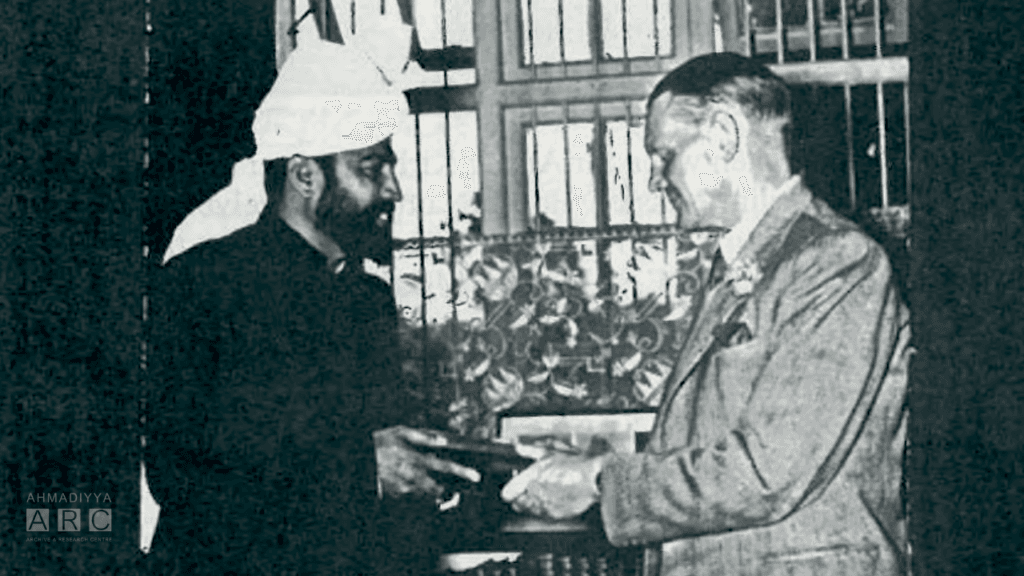
Some of the Companions of the Promised Messiah (as) had already reached the eastern regions of the African continent toward the end of the 19th century and the beginning of the 20th century, during his own lifetime. When Sheikh Mubarak Ahmad Sahib was formally sent to East Africa as a missionary from Qadian Markaz in 1932, he initially used to deliver his speeches in Arabic, while interpreters would convey the message to the people. Soon, however, he gained proficiency in Swahili and began to carry out the important work of Tabligh very effectively.
Need for translation
His most important and foundational achievement was the translation of the Holy Quran into Swahili. From the very beginning, he had realised that, without presenting the Holy Quran in the local language, the message of Islam could not be fully conveyed to the people of the land.
Despite the scarcity of resources and helpers, this resilient missionary rendered a remarkable service in representing and explaining Islam in the Swahili language.
Swahili language
Swahili is an important African language spoken along the coastal regions of East Africa. It is widely used in countries such as Tanzania, Kenya, Uganda, and the Democratic Republic of the Congo. The language also bears a strong influence of Arabic. Swahili is regarded as a major symbol of African unity and communication, and in several countries it holds the status of an official or national language.
This language, which developed under the influence of Arab traders, was initially written in the Arabic script. However, when European nations established their presence in Africa, they not only carried out various developmental activities but also reformed the Swahili language. The Roman script was introduced in place of the Arabic script. Christian missionaries compiled Swahili dictionaries in English and translated the Bible into this language.
Publication, review, and impact of the Swahili Quran translation
The publication of the Swahili translation of the Holy Quran holds the status of a significant milestone in the history of the Jamaat, as it greatly accelerated the propagation of Islam Ahmadiyyat in this region. This translation was published in 1953 in ten thousand copies. It was received with profound respect in the religious and academic circles of East Africa. Previously, only the Swahili translation of the Bible had been presented as a scholarly masterpiece. (Al Fazl, 29 July 1976, pp. 3–4)
In 1953, the first edition of this translation of the Holy Quran was published in Nairobi, Kenya, with 10,000 copies. The second edition, consisting of 5,000 copies, was printed in Pakistan, while the third edition of 10,000 copies was published in London. Later, another missionary serving in East Africa added indexes and other aids to facilitate reference to various topics. He had also been part of the initial project. (Al Fazl, 9 March 1952)
A review of the Swahili translation of the Holy Quran, along with other literature published by the Ahmadiyya Muslim Jamaat in the Swahili language, shows that the early missionaries of the Jamaat demonstrated remarkable proficiency in learning foreign languages and rendered outstanding services in the fields of writing and translation.
Hazrat Khalifa tul Masih II (ra) had a deep and special devotion to the service of the Holy Quran. Throughout his life, he remained particularly engaged in this field with exceptional attention and effort. It is recorded in Tarikh-e-Ahmadiyyat, that he initiated a scheme for translations of the Quran. (Tarikh-e-Ahmadiyyat, Vol. 8, p. 569)
The history of this important translation of the Holy Quran is narrated by the translator himself, as recorded in his autobiography Kaifiyat-e-Zindagi. The author recalls that he vividly remembered it was the first blessed day of Ramadan in the 1937. After the Fajr prayer, he began the work of translating the Holy Quran into Swahili. At that time, he states, he was residing in Tabora. When he undertook this task, he was alone and had no African companion to assist him in this matter, except for a primary school teacher, Saeedi Kami, who was not familiar with the Arabic language and who, after some time, discontinued his help and left.
Nevertheless, he continued the work of translation with consistency. Day after day, week after week, and year after year passed until the time finally came when the translation of all thirty parts was completed.
In 1943, when the manuscript of the Quran translation was fully typed, it was sent for review to an important institution of East Africa, the Inter-Territorial Language Committee for Swahili, which had been appointed by the government for the development and standardisation of the Swahili language. The institution forwarded two copies to its experts for critique and revision, requesting them to provide their considered opinions on both the translation and the language.
In April 1944, the Secretary of the institution sent back several pages of detailed feedback from these experts. Their unanimous opinion was:
“On the whole, the translation is very good.”
The experts suggested changes at certain places, which were accepted, while at other points their proposed corrections or opinions had to be rejected due to their lack of familiarity with the Arabic language.
After this initial review, the manuscript was sent to some other learned and expert African scholars of the Swahili language so that they might offer their opinions purely regarding clarity and linguistic accuracy.
After some time, around 1945, respected Sheikh Amri Abedi, who had remained with Sheikh Mubarak Ahmad Sahib for a long period, studying the translation of the Holy Quran, learning Arabic, and gaining proficiency in other religious matters, developed, by God-given ability, the competence to review it critically. He then undertook a careful study, comparison, and correction of the text, paying special attention to its conformity with the Arabic original, and offered many useful suggestions.
A few years later, other missionaries, who were well-versed in Quranic and Islamic theology and had acquired a strong command over both Arabic and Swahili, also examined this translation with great care and offered their opinions and suggestions. By the grace of Allah, all the African scholars and our learned missionaries were pleased with the Swahili translation and impressed by its eloquence.
The translators also added explanatory and interpretive notes to the translation, as they strongly felt that such notes were necessary after completing it. Thus, toward the end of 1949, several hundred notes were written, particularly keeping the following three objectives in view: (1) In East Africa, where non-Muslims, especially Christians, had raised objections in their journals, magazines, and books against certain verses or teachings of the Holy Quran, or against the sacred life of the Holy Prophet (sa), appropriate answers should be provided.
(2) Alongside presenting the teachings of the Holy Quran, a comparison should be made with the teachings of other world religions to demonstrate the superiority of Islamic teachings.
(3) Many innovations and customs, contrary to Islamic Shariah and the noble example of the Holy Prophet (sa), had entered among Muslims due to a lack of proper understanding of the Quran; therefore, their harmful nature should be clarified, and the true teachings and realities should be highlighted.
Many of these notes were written by Sheikh Mubarak Ahmad Sahib and some by his colleague missionaries. Most of these notes were prepared with the benefit of the commentaries and explanations given by the Promised Messiah (as), particularly those of Hazrat Khalifatul Masih (ra). Their study, Sheikh Mubarak Ahmad Sahib stated, leaves a deep impact on the human mind and makes it evident that the Holy Quran fulfils all the needs of mankind, and that this Great Book possesses such a powerful force that it can raise people from humiliation to the highest peaks of honour and greatness.
At the beginning of his translation of the Holy Quran, Sheikh Mubarak Ahmad Sahib expressed heartfelt gratitude to those friends who assisted him and provided special support in this work. He wrote that it is incumbent upon him to especially mention those colleagues who, over the past two to three years, have supported him with profound concern, keen interest, full dedication, and love. Among them are Sheikh Amri Abedi and Maulana Muhammad Munawwar Sahib (Faazil).
He also shared that the two above-mentioned companions greatly assisted him in revising this translation and commentary, completing the notes, proofreading, and performing other related tasks concerning the tafsir.
Similarly, Maulana Inayatullah Sahib Khalil and Maulana Jalaluddin Sahib Qamar helped in compiling hadith and other necessary material, while Qazi Abdul Salam Bhatti Sahib, in particular, provided invaluable assistance in reviewing the final proofs of the Arabic text. (Kaifiyat-e-zindagi pp. 83–87)
Along with this Swahili translation of the Holy Quran, a deeply inspiring preface by Hazrat Musleh-e-Maud (ra) was also published, which he graciously wrote at the request of the respected translator. The Ahmadiyya Mission in East Africa also published this remarkable preface separately in the form of a pamphlet in an edition of fifty thousand copies and distributed it widely.
This translation of the Holy Quran had an extraordinary impact across the entire Swahili-speaking region. Newspapers gave it wide coverage and publicity. Not only did the general public benefit from it, but many Christians also accepted Islam as a result. Remarkably, when this translation reached prisons, some thoughtful and educated inmates also embraced Islam.
May Allah greatly bless the sacrifices, efforts, and works of the missionaries. Ameen.