
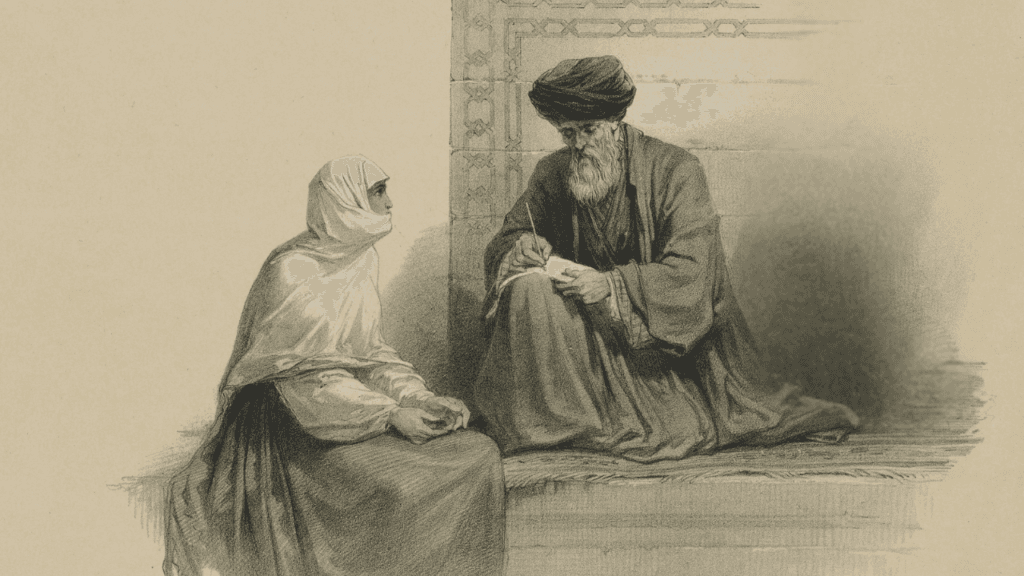
Many people today assume that Islam deprived women of their rights and restricted their intellectual and social participation. However, historical evidence from the Islamic Golden Age (8th-14th centuries) presents a very different reality: Muslim women were scholars, educators, university founders, patrons of science and contributors to literature and public welfare.
Before the advent of Islam, many Arab societies treated women as property and even considered them part of inheritance. If a man died, his relatives would have the right to “inherit” his wife and one of them could marry her or give her in marriage if they wished and they would be more entitled to dispose of her than her own relatives. (Sahih al-Bukhari, Kitab at-tafsir, Hadith 4579)
Islam challenged these practices and established clear rights and dignity for women, as reflected in the Quranic prohibition: “O ye who believe! it is not lawful for you to inherit women against their will; nor should you detain them wrongfully that you may take away part of that which you have given them.” (Surah an-Nisa, Ch.4: V.20)
The pursuit of knowledge in Islam is not restricted to men alone. The Holy Prophet (sa) emphasised this principle when he said: “Seeking knowledge is an obligation upon every Muslim.” (Sunan Ibn-e-Majah, Kitab al-muqaddimah, Hadith 224) This principle was also reflected in practice, as the Prophet (sa) dedicated specific sessions to teach women who sought knowledge from him.
A woman came to the Messenger (sa) of Allah and said, “O Messenger of Allah! Only men benefit from your talks, so please fix a day for us to teach us the knowledge which Allah has taught you.” The Messenger (sa) of Allah fixed a day and directed them to assemble. When they gathered, the Prophet (sa) went to them and taught them what Allah had taught him. (Riyad as-Saliheen, Kitab ‘iyadat al-marid, Hadith 954)
Women shaping the Islamic golden era
Women played a powerful and often underappreciated role in shaping the Islamic Golden Age. Far from being silent observers, many women were scholars, patrons, educators, business leaders and transmitters of knowledge. Their influence helped shape intellectual, social and cultural life across the Muslim world.
Let us now examine the Islamic Golden Age and explore the remarkable contributions made by Muslim women during this period.
Women in academia
One of the most remarkable women in academic history is Fatima al-Fihri, the founder of the al-Qarawiyyin Mosque and University in Fez, Morocco, established in 859 CE. Over time, this institution became one of the most prominent centres of learning in the Muslim world, attracting scholars who studied theology, law, mathematics, astronomy and philosophy.
Fatima al-Fihri’s work stands today. She embodied the values of philanthropy, education and community service, inspiring countless individuals. Her story highlights the importance of women’s contributions to society and the impact one person can have on the world.
Another noteworthy example is Sutayati al-Mahmali, a distinguished mathematician in Abbasid Baghdad. She was known for her expertise in algebra and complex inheritance calculations. At a time when mathematics was advancing rapidly in the Muslim world, she was recognised among scholars for her analytical skills and precision.
In the field of astronomy
Another prominent figure is Maryam al-Ijliya, also known as Maryam al-Asturlabi, a 10th-century astronomer from Aleppo, present-day Syria. She was renowned for her mastery in crafting astrolabes – complex instruments used in astronomy for determining the positions of celestial bodies, measuring time and aiding navigation.
Maryam’s expertise lay in crafting astrolabes, complex instruments used for astronomical calculations that helped determine celestial body positions, time and latitude, including navigating astrolabes that were essential for navigation, allowing users to determine their position and direction, as well as timekeeping astrolabes that could be used to determine prayer times and the direction of Mecca.
Her work demonstrates the significant contributions women have made to science and technology throughout history. Her legacy serves as an inspiration for future generations of scientists and engineers.
Humanitarian service and social welfare
Such remarkable contributions were not limited to scholarship alone. Women were also influential in governance and public service. Zubaidah bint Jaʿfar, the wife of the Abbasid Caliph Harun al-Rashid, is remembered for her extraordinary contributions to public welfare. During one of her pilgrimages to Mecca, she observed the severe water shortages affecting pilgrims and residents. In response, she financed a massive water project, constructing canals and aqueducts that brought water from distant springs to Mecca. This famous route became known as Darb al-Zubaydah.
Thus, the history of the Islamic Golden Age demonstrates that Muslim women were not passive figures but active participants in scholarship, science, philanthropy and public life. Their achievements challenge modern misconceptions and highlight the intellectual and social opportunities that existed for women within Islamic civilisation.