
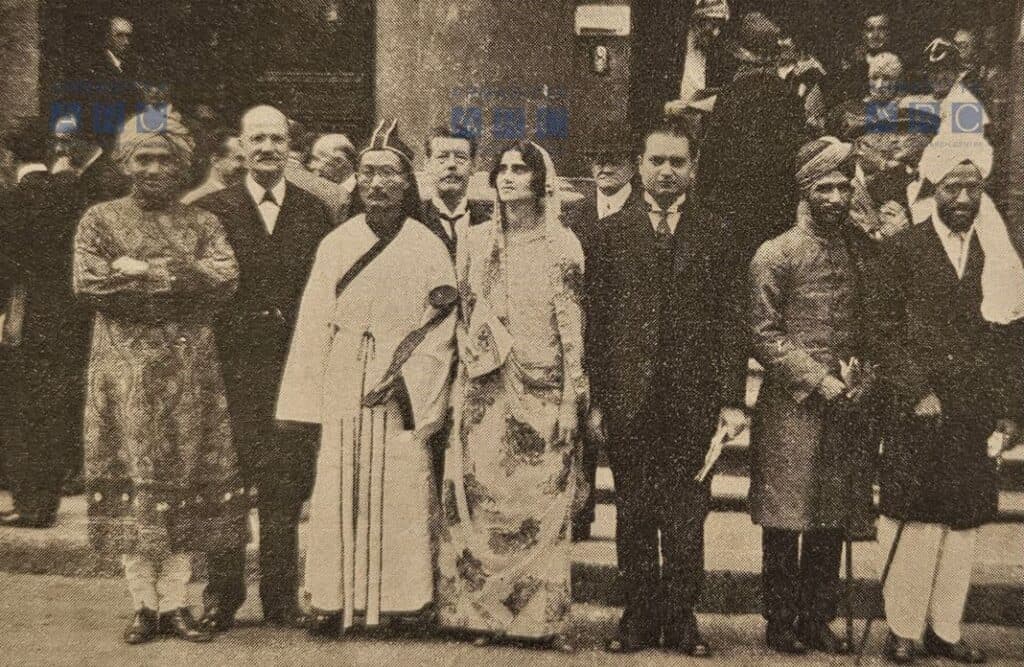
Hazrat Maulana Abdur Rahim Dard (ra) (1894-1955)
Freedom and Christianity
The Rev William Wilson Cash says in the “Church Missionary Review” for September 1926:
“An Arab can visit England, say his prayers in the street if he wishes, call his people to prayer in Woking and Putney without any fear of trouble. Why? Because in England the Christian Faith prevails and it stands for liberty of conscience for all, regardless of creed.”
Did Christianity establish religious liberty in England?
It is no doubt true that there is religious liberty in England, everyone should thank the English Government for this; but the Reverend gentleman should excuse us if we point out that nothing could be further from the truth than to assert that it is due to the prevailing of the Christian faith in England.
“The empty pews” and the vehement denouncing of the distinctive doctrines of Christianity in broad daylight by means of the “dailies” of England are surely signs of something which must be quite the reverse.
However, let us take for granted that even a Jew born in England is Christian. But the Reverend gentleman cannot throw dust in the eyes of the world. The establishment of religious freedom in England is surely not due to Christianity. Christianity and freedom are quite incompatible, says Shaftesbury.
The clergy, as a body, have ever been identified with retrogression. The history of the world has been, indeed, blackened by the intolerance and fanaticism of the Christians.
Religious persecution and Christianity
Take the case of England alone. People were imprisoned, branded, mutilated, scourged and exposed in the pillory. Many Catholics under false pretences were tortured and hung. Anabaptists and Arians were burnt alive. The Presbyterians were hunted like criminals over the mountains. Their ears were torn from the roots. They were branded with hot irons. Their fingers were wrenched asunder by the thumbkins. The bones of their legs were shattered in the boots. Women were scourged publicly through the streets. Multitudes were transported to Barbados, infuriated soldiers were let loose upon them and encouraged to exercise all their ingenuity in torturing them.
Pick up, in short, any book on history and you will read:
“Persecution among the early Protestants was a distinct and definite doctrine, digested into elaborate treatises, indissolubly connected with a large portion of the received theology, developed by the most enlightened and far-seeing theologians and enforced against the most inoffensive as against the most formidable sects. It was the doctrine of the palmiest days of Protestantism. It was taught by those who are justly esteemed the greatest of its leaders.”
Baxter, on the other hand, pronounced universal toleration to be “soul murder.” He says:
“Popery, Mahometanism, infidelity, and heathenism are the way to damnation; but liberty to preach up and to practise them is the means to make men Papists, Mahometans, infidels and heathens; therefore this liberty is the way to men’s damnation.” (A Holy Commonwealth, 2nd Preface)
The persecution of Jews and Muslims in Spain
Let us take the case of Spain and see how the faithful followers of Christ reflected “the spirit and teaching” of their master in that country.
Mr Paul Daniel Alphandery, Professor of the History of Dogma, Paris, the most eminent authority on the subject, says:
“Clement IV, in a brief of 1266, exhorted James I of Aragon to expel the Moors from his dominions. In 1278, Nicholas III blamed Peter III for having made a truce with them. One of the canons of the Council of Vienna (1311-1312) denounces as intolerable the fact that Mahommedan prayers were still proclaimed from the top of the mosques and under the influence of this Council, the Spanish Councils of Zamora (1313) and Valladolid (1322) came to decisions which soon led to violent measures against the Mudegars (Mussulmans of the old Christian provinces).
“Already, in 1210, massacres of Jews had taken place under the inspiration of Arnold of Narboune, the papal legate; in 1276 fresh disturbances took place as a result of James I’s refusal to obey the order of Clement IV, who had called upon him to expel the Jews from his dominions.
“In 1278, Nicholas IV commanded the General of the Dominicans to send friars into all parts of the kingdom to work for the conversion of the Jews and draw up lists of those who should refuse to be baptized. It was in vain that a few princes such as Peter III or Ferdinand of Castile interfered; the Spanish clergy directed the persecution with ever-increasing zeal.
“In the 14th century the massacres increased and during the year 1391 whole towns were destroyed by fire and sword; while at Valencia eleven thousand forced baptism took place.
“In the 15th century the persecution continued in the same way; it can only be said that the years 1449, 1462, 1470 and 1473 were marked by the greatest bloodshed. Moreover, the Mudegars were also subjected to these baptisms and massacres en masse.”
The Holy Prophet’s (sa) charter for the protection of Christians
Is this the “idealism” of Christ? Poor Jesus of the Bible! Little did he know that his disciples, after denying him in his life and giving him up into the hands of his bitterest enemies, would also bring upon his name eternal disgrace. Contrast with it the well-known charter granted to the Christians by the Master of the Prophets, peace and blessings of Allah be upon him, the greatest manifestation of the Mercy of God.
“The Prophet (sa) undertook himself and enjoined on his followers to protect the Christians, to guard them from all injuries and to defend their churches and the residences of their priests. They were not to be unfairly taxed; no bishop was to be driven out of his bishopric; no Christian was to be forced to reject his religion; no monk was to be expelled from his monastery; no pilgrim was to be detained from his pilgrimage; nor were the Christian churches to be pulled down for the sake of building mosques or houses for the Muslims.
“Christian women married to Muslims were to enjoy their own religion and not to be subjected to compulsion or annoyance of any kind on that account. If the Christians should stand in need of assistance for the repair of their churches or monasteries, or any other matter pertaining to their religion, the Muslims were to assist them.” (History of the Saracens, p. 14)
Christianity and the conduct of its followers
The son of Mary was not, unfortunately, placed ever so high in life. The crown of thorns could not invest him with the power of granting any charters which might be called the monuments of enlightened tolerance. It is because of this, we think, that his followers resisted every attempt that was made to establish religious freedom.
The growth of religious liberty was at all times directly opposed to the Church and its triumph was a measure of her depression.
Rationalism and the rise of religious tolerance
William Edward Hartpole Lecky, in his monumental work, “Rationalism in Europe”, says that the triumph of toleration and the triumph of civil liberty have been “achieved by laymen in direct opposition to the Church and in the moment of her extreme depression.” He further concludes that the extinction of the spirit of intolerance, both in Catholic and Protestant countries, is due to the spirit of rationalism. He says:
“We have seen that in both cases, the clergy were the untiring enemies of this the noblest of all the conquests of civilisation and that it was only by a long series of anti-ecclesiastical revolutions that the sword was at last wrung from grasp.”
So we may be indebted, no doubt, to the spirit of rationalism and to the English Government, but we are positively sure we do not owe a little to Christianity for anything. All praise, in fact, is due to God the Lord of the worlds!
Though Christians do not mind making Christ bear the burden of their sins, yet we think it would be absolutely unjust to hold him responsible for their misdeeds. It is true, no doubt, that a tree is known by its fruit, but it would be unwise to blame a religion simply for the corruption of its adherents. Christianity might not be a bad religion even when Christians are. So may Islam be a perfect religion however un-Islamic the Muslims might at times make themselves. – AR Dard
(Transcribed and edited by Al Hakam from the original English, published in the September 1926 issue of The Review of Religions)