
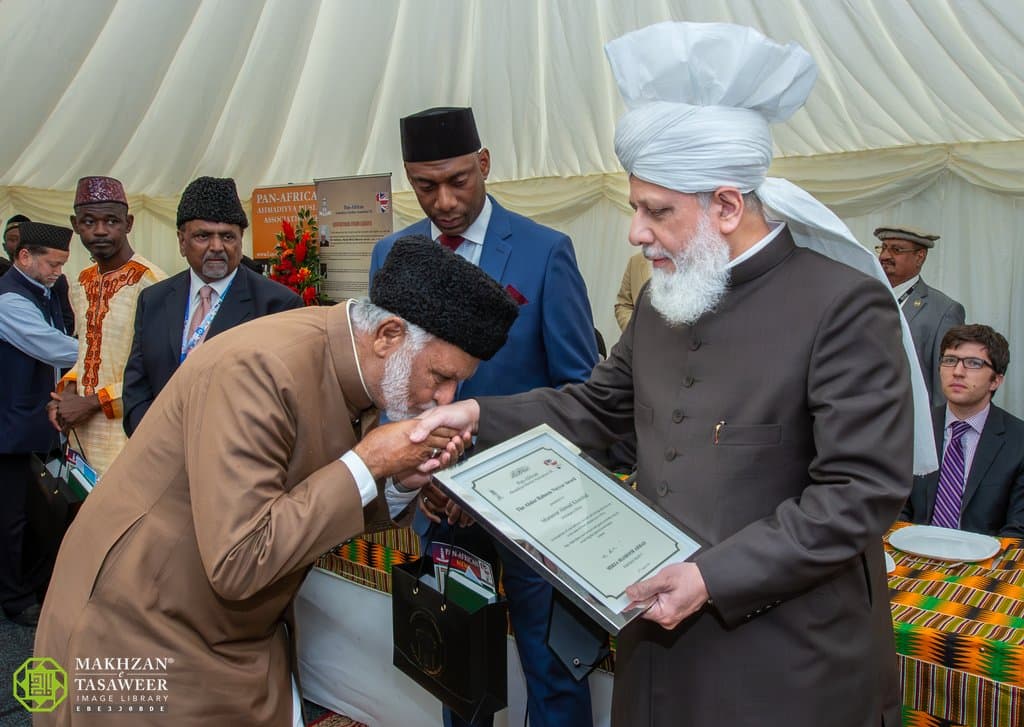
They say that time does not stop, but life continues. This is a truth that only becomes fully apparent after the demise of a loved one. My father, the late Munawar Ahmad Khurshid Sahib, was a missionary, a devotee of Khilafat, a teacher, a visionary and a mentor. For his children, he was simply “Abbuji”. Friends and family members have often asked me to write about him. I always hesitated, not knowing where to begin, but I pray that this piece will serve as a means of keeping Munawar Ahmad Khurshid Sahib in your prayers.
Those who remember Khurshid Sahib will recall a man who met others without a trace of worry on his face, with a radiant smile that touched the hearts of so many. Yet behind this smile was someone who was very unwell: He had been on dialysis for over 10 years and had to visit a dialysis centre three times a week. He would wake in the early hours of the morning and a taxi would take him to the centre, where the entire process would take around five hours. He had undergone open-heart surgery and continued to struggle with serious health issues. Not long before his demise, he also had a finger amputated due to gangrene.
But Abbuji was never fazed by any of this. If ever asked how he was, he would often jokingly reply, “I am fine, but more importantly, I am concerned about your health.” He remained very cheerful and his infectious smile, kindness and love for others were constant features of his life.
The more I reflect on Abbuji’s love and care for the Jamaat of the Promised Messiah (as), the more I realise how deeply he understood the personal struggles of others. As a senior missionary, he felt that it was his primary duty to provide help and comfort to those around him. For this reason, he would put his own worries aside and make the other person the focus of his attention.
The love and concern he showed to others were returned to him in equal measure. One incident from those years has remained with me ever since.
I was still in Jamia when Abbuji suffered a heart attack. When I went to visit him in hospital, he was fast asleep, clearly still under the effects of his medication. Standing next to his bed was a member of his local Jamaat, quietly praying for him, with tears streaming down his face. After a while, he gently kissed Abbuji’s forehead.
I graduated in 2013 and have served as a field missionary since then, but this incident remains etched in my mind. It was at that moment that I truly understood that Ahmadiyyat is indeed one family.
A moving dream

The day Abbuji passed away, I received a message from a dear friend and missionary, Abdullah Dibba Sahib. I sought his permission to include this message in the article.
“Assalamu Alaikum wa Rahmatullah, my good brother!
“I literally woke up from a dream in which someone told me on a phone call that my father had passed away. I was terrified but smiling. And I wondered why I was smiling.
“Then I opened my eyes and realised that it was a dream. A few minutes later, I picked up my phone because I was still a little nervous. And the first thing I see is a message from Tahir Khalid Sahib about the passing of Maulana Sahib. ‘Innaa Lillahi wa Innaa Ilayhi Raji‘un’.
“Immediately, I said to myself, ‘Indeed, a father of mine has passed away.’ He lived a great life that has to be celebrated.”
Abdullah Dibba Sahib is a missionary of the Jamaat from the Gambia, a small country in West Africa, where Abbuji served as a missionary for many years. Abbuji was a fatherly figure to many, a constant presence in people’s lives despite his ill health.
Unexpected journey to Pakistan
Given his health issues, it was difficult for him to travel and, as such, his journey to Pakistan, where he passed away, was all the more surprising. My mother recalls how he would watch videos online of the place where he grew up and longed to return there; none of us expected him to make the journey.
I recall calling him shortly before his departure to Pakistan. Naturally, I was worried about his health, but he simply replied that it was time to offer his salaam at the graves of his late parents.
He was due to fly back from Lahore and had travelled from Rabwah to Lahore in preparation for his return when he became unwell. He was rushed to hospital and later transferred back to Tahir Heart Hospital. He passed away soon after.
Beloved Huzoor’s (aa) tribute
On 31 March 2023, when beloved Huzoor (aa) mentioned Abbuji in his Friday sermon, I found myself in awe of the man Huzoor (aa) was describing. My mind went back and forth, reflecting on what a great devotee of Khilafat he was and how fortunate we, his children, were to have witnessed the life of this great servant of Ahmadiyyat so closely. In his Friday sermon, beloved Huzoor (aa) paid tribute to his life of service in the following words:
“At present, I would like to speak about a few deceased members, the first of whom is a missionary of the Jamaat who fulfilled his devotion with exceptional faithfulness. He was an exceedingly humble man who had the opportunity to serve for a long time, living up to the true standard of rendering service. His name is Munawar Ahmad Khurshid Sahib and he served as a missionary in Western Africa. He passed away a few days ago.” (“Ramazan and The Holy Quran”, Friday sermon, 31 March 2023, www.alislam.org)
Our mother commented on the sermon, saying, “It seems that I didn’t know your father well enough.” This feeling resonated deeply within all of us. Many missionaries remarked that he was a simple person. It was only after Huzoor (aa) shed light on his services that we came to realise the qualities of Khurshid Sahib. As we walked out of Masjid Mubarak that day, it all felt surreal.
A miracle and a promise fulfilled
In his Friday sermon, beloved Huzoor (aa) also referred to the remarkable circumstances surrounding our father’s birth:
“All the children born to the parents of Munawar Ahmad Khurshid Sahib would fall ill and pass away. When he [Munawar Ahmad Khurshid Sahib] was born, he also fell ill. There was no hope in sight and so his grandfather, Mian Abdul Karim Sahib, who was a Companion [of the Promised Messiah (as)], decided to dedicate the child’s life to God’s way. His reasoning was that if God required the child, He would save him. Nonetheless, in the same instance, a doctor who lived in a far-off village came to their village. He administered treatment, and through a miracle, Allah the Almighty cured him.” (Ibid.)
As my grandparents feared the worst and thought that their son might also pass away, as the children before him had, they pledged that if he survived, they would devote his life to the service of Islam. This shows the strength of their faith and trust in Allah.
When Abbuji completed his basic studies, my grandmother fulfilled the pledge she had made to Allah, despite the concerns of many people who felt that he should not go to Jamia Ahmadiyya and should instead assist his father on the family farms. My grandmother remained firm, saying that she had not forgotten her oath to Allah and that nothing would stand in the way of his service to Islam.
As Abbuji was the eldest child, much was expected of him. In an environment where poverty was common and life was a struggle, the promise made to Allah was nevertheless upheld and Abbuji devoted his life to the service of Islam Ahmadiyyat.
Simplicity and sacrifice
Even in places where he could have stayed at nearby hotels, he preferred to rest in mosques, often without electricity and while enduring mosquitoes through the night.
A mu‘allim from the Gambia once told me that he had travelled with Khurshid Sahib to a very remote village where the hosts could only offer unfiltered water, served in a single cup shared by both guests and hosts. The mu‘allim admitted that he felt hesitant to drink from it, mostly out of concern for hygiene. However, when he saw Khurshid Sahib drink from the same cup without the slightest hesitation, it gave him the courage to do the same. Incidents like this reflected Abbuji’s simplicity and humility, as well as the respect he showed for the people and customs of the communities he served. It was this perseverance and sacrifice that led many to accept the message of Ahmadiyyat.
A blessed dream
Beloved Huzoor (aa) further narrated:
“His father-in-law, Muhammad Khan Darwesh Sahib, also saw a dream about him that he was on a towering and brilliant minaret. Upon this, the darwesh told him that he would illuminate the minaret of Ahmadiyyat and render great services. Thus, Allah the Almighty enabled him to do so.” (Ibid.)
Huzoor (aa) then drew attention to the hardships he endured in the field:
“There were some places where even motorcycles, etc., were not available, so he travelled long distances on donkey carts and visited various villages.
“In fact, some of the missionaries who are currently serving there now, say that when they went to these villages, the people mentioned that a long time ago, Maulana Munawar Ahmad Khurshid Sahib used to visit them and did so in very difficult circumstances. And so, he would travel to these areas and preach there.” (Ibid.)
It might seem remarkable that someone would travel on a donkey cart in the scorching heat to propagate the message of Islam Ahmadiyyat, but Abbuji undertook many such journeys. Hifazat Naveed Sahib, a missionary of the Jamaat, arrived in a village where he believed the message of Islam Ahmadiyyat had not yet reached. When he got there, he was met by an elderly gentleman who said that he was already an Ahmadi and went on to recall that a missionary had arrived 20 years earlier on a donkey cart with the message of Ahmadiyyat. He had accepted Ahmadiyyat there and then lost contact with other Ahmadis for 20 years; such was his conviction that, despite not meeting another Ahmadi for the next 20 years, he remained steadfast in his belief in the truth of the Promised Messiah (as).
Abbuji used to recount a story about his first Eid in the Gambia, while serving in a distant town far from the capital. His family was still in Pakistan and, as Eid approached, he wanted to travel to the city to meet other Ahmadis and celebrate with them. He stood by the dirt road for hours, waiting for a car or any other form of transport. Eventually, a truck carrying livestock stopped and the only available space was among the animals.
I sometimes picture someone on Eid day sitting among livestock and travelling for many hours just to arrive and meet his friends and Jamaat members.
Abbuji never recounted these incidents to highlight the hardships he faced. Rather, they were always lessons for us – that humility and the opportunity to serve the Jamaat are great blessings from Allah, which He bestows upon His servants.
Obedience to Khilafat
Highlighting his deep obedience to Khilafat, beloved Huzoor (aa) said:
“The spirit of obedience to the Khalifa of the Time was deeply rooted within him. I have observed this as well: when he came here [to the UK], he had been very ill for the last 10 years, but despite his ill health, whenever he was assigned any work, he would immediately try to fulfil it.” (Ibid.)
Abbuji lived a life of complete obedience to Khilafat. A remarkable example of this came when, as he was approaching the age of 70, he was assigned a new task by Huzoor-e-Anwar (aa). By this stage, Abbuji had already undergone major bypass surgery and multiple angiographies and, later, suffered from gangrene, which resulted in the amputation of one of his fingers. Most difficult of all, he was undergoing dialysis three times a week.
It was during this period that he was instructed to go to Spain and deliver the message of Islam Ahmadiyyat to people who had migrated there from West Africa. I saw a renewed passion awaken in him. He became completely engrossed in the task ahead and his illnesses no longer seemed to hinder him. He travelled to various cities across Spain for this purpose. The Jamaat arranged dialysis for him at each destination and he continued his mission as though he were a young man, fully fit and able.
Here, I must also mention my mother. Given Abbuji’s fragile health and the number of medications he had to take throughout the day, our mother accompanied him on every trip to Spain. She travelled with him from city to city and remained by his side while he met people and spoke to them about Ahmadiyyat, ensuring that he remained well enough to continue. Amiji cared for Abbuji with great devotion until the very end. Together, they were fully devoted to the task given to Abbuji by Huzoor-e-Anwar (aa).
Further emphasising this spirit of obedience, beloved Huzoor (aa) said:
“Nonetheless, he rendered a great service in Spain and established a jamaat there as well. He had a true passion to propagate the teachings of Ahmadiyyat, the true Islam. It is absolutely true that, alongside this, he was very humble. When I asked him to go to Spain, he went without presenting any excuse, even though he was unwell at the time.”
Opening a shop: A creative approach to tabligh
Huzoor-e-Anwar (aa) referred to an incident shared with him by Raja Burhan Ahmad Sahib, a professor at Jamia Ahmadiyya UK:
“Towards the latter part of his life, when he was very ill and was having to undergo dialysis daily, he met me once at a wedding and said, ‘I have opened a shop.’ I asked him what he meant by opening a shop and he said, ‘I am at home and so I have placed a table outside and in the summer, I put out some water along with Jamaat literature. If they require it, I provide water to those passing by and give them some literature along with it.’ He did not sit idle during his illness, but even then, he found a new way of preaching.” (Ibid.)
An excellent muballigh
A muballigh is a preacher. Abbuji was highly effective in conveying the message of Islam Ahmadiyyat. He fully followed the guidance of the Holy Quran to deliver the message with wisdom.
Huzoor-e-Anwar (aa) referred to what Salman Salmi Sahib from Spain wrote to Huzoor (aa):
“‘During his visits to Spain, I had the chance to accompany him on many tabligh endeavours. The astonishing thing I saw was that he would be able to strike up a conversation with any African passerby and get to know them. In a short space of time, he would be able to form a good connection with them. He would then say that the individual was from such-and-such a village and the villages around that area are such-and-such and that those people are very sincere. He knew influential people of different areas. Since he would be conversing in various African languages, people would be inclined to listen to him. They would be astonished and also happy. After two or three meetings, he would form a bond with them and then give them the message of the Jamaat.’ He says that he would not preach to them in the first meeting; he would first establish a personal connection and then, on the second or third visit, he would preach to them about Ahmadiyyat. He says that through his personal connections and his morals, the groundwork would be completed and then later people would readily pledge allegiance.” (Ibid.)
A few months before his demise, I met a Senegalese man and began speaking with him about Senegal while I had Abbuji on a video call. Abbuji asked him where he was from and he mentioned the capital city. Abbuji then told him that, from his features, he could tell that he was actually from another part of the country. This completely took him by surprise. Abbuji then asked him to name his village and a few elders from the area. Abbuji went on to say that he knew one of those elders and the man’s expression of sheer disbelief was unforgettable.
I met him again on another occasion and the first thing he asked me was whether he could speak to Abbuji once more.
Typing with one finger
Dialysis is a very painful and lengthy process that requires repeated visits to hospital several times a week, often for many hours at a time. As Abbuji’s kidneys were no longer functioning properly, he had to endure this demanding procedure several times a week.
Even in this state, he remained eager to continue his work as a missionary. He began learning to type with the help of various Jamia students because he wanted to write a book based on his experiences in Africa. Such was his passion that he would search for each letter on the keyboard, press it and continue this process for hours on end. Slowly but surely, the book was completed and later published. Abbuji was never one to sit idle.
As his proficiency in typing grew, he went on to write multiple books and articles. It still surprises me to this day how he went from slowly searching for each letter on the keyboard to eventually publishing several books.
A fatherly figure
As a teacher in Jamia Ahmadiyya, he primarily taught the history of Islam and Ahmadiyyat to students. Teaching was not merely a responsibility for him; it was something he approached with great sincerity and care.
It was only after he passed away that many missionaries reached out to me and said that he had played a key role in their personal growth. Several shared how, during their years in Jamia, they would often approach him when facing personal or academic challenges. In their times of difficulty, they found in him a compassionate teacher who listened patiently, offered sincere advice and encouraged them to remain steadfast in their service to Islam.
For many of them, Abbuji was not only a teacher in the classroom but also a mentor who helped shape their character and outlook as future missionaries. Even years after graduating from Jamia, they remembered him with deep affection and gratitude for the guidance he had given them during their formative years.
Duty to the very end
Abbuji had just suffered an almost fatal bout of pneumonia in November 2022. Whilst he was in hospital in London, all his family came to visit him, as his health had deteriorated greatly. One day, as he began to feel better and was able to sit up, he asked for the thesis of a Jamia student that he had been assigned to review and began marking it. It was surreal for me to witness first-hand that, after such a difficult phase in his life, the first thing that came to his mind was the responsibility he still had to fulfil.
A blessed end

يَا أَيَّتُهَا النَّفْسُ الْمُطْمَئِنَّةُ ارْجِعِي إِلَىٰ رَبِّكِ رَاضِيَةً مَّرْضِيَّةً فَادْخُلِي فِي عِبَادِي وَادْخُلِي جَنَّتِي
“O soul at rest, return to thy Lord, thou well pleased with Him and He well pleased with thee. So enter among My chosen servants and enter My Garden.” (Surah al-Fajr, Ch.89: V.28-31)
There could be no better way to conclude than with the prayer offered by beloved Huzoor (aa):
“May Allah the Almighty continue to grant the Jamaat such loyal and devoted missionaries who render services selflessly and fulfil their tasks. May Allah elevate his rank [in paradise].” (Ibid.)