
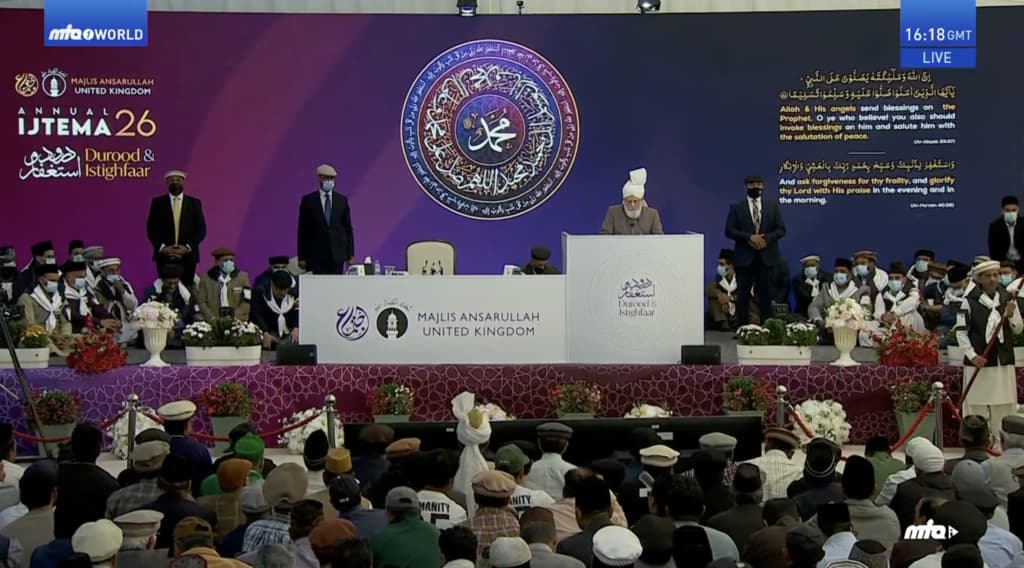
Hook Lane, Puttenham, Guildford, 20 September 2026: Hazrat Mirza Masroor Ahmad, Khalifatul Masih V, may Allah be his Helper, blessed the Majlis Ansarullah UK Ijtema 2026 with his presence and addressed the gathering.
The concluding session commenced with the recitation of the Holy Quran (Surah al-Baqarah, Ch.2: V.285-287) by Feroz Alam Sahib, followed by its translation by Dr Abayomi Ibrahim Motojo Sahib.
Huzoor (aa) then proceeded to the podium for the Ansarullah pledge, which was collectively repeated by all members present.
This was followed by the recitation of a Qaseedah of the Promised Messiah (as) in praise of the Holy Prophet Muhammad (sa) by Munir Odeh Sahib. Mir Anjum Pervaiz Sahib subsequently presented its translation. Najam Qureshi Sahib then recited an Urdu poem of Hazrat Musleh-e-Maud (ra).
Following this, Sadr Majlis Ansarullah UK, Sahibzada Mirza Waqas Ahmad, presented a report highlighting the activities and proceedings of the 48th Ansarullah Ijtema UK. The theme of this year’s ijtema was Durood Sharif and Istighfar, highlighting the significance of seeking Allah’s forgiveness and invoking blessings upon the Holy Prophet (sa). A brief video was also shown, featuring various highlights from the event. By the grace of Allah, attendance this year reached 53 percent of the total tajnid, with 3,689 Ansar attending – an increase of 264 attendees compared to last year.
Thereafter, the Alam-e-Inami prize for the best Majlis of 2026 was announced, for which Huzoor (aa) was requested to award the prize.
Hazrat Amirul Momineen (aa) then took to the podium and conveyed his salaam to the gathering. He began by reciting tashahhud, ta‘awwuz and Surah al-Fatihah, before delivering his address. A brief summary of the key points of his address is given below:
Responsibility of Ansarullah
Huzoor (aa) said Ansar are always reminded that those who are called Ansarullah constitute that part of the Jamaat which, in terms of age and experience, has reached the latter stages of life or has entered the group that is approaching the final stage of life. Beyond that lies the next world.
Therefore, every Nasir should reflect upon the purpose of life: we must understand it for ourselves, for our children and for our future generations. We need to understand our responsibilities. We must assess the extent to which, after becoming Ahmadis, we are fulfilling the covenant we have made and the extent to which we are advising and striving to ensure that it is fulfilled within our homes.
Ansar of the Promised Messiah (as)
By joining the auxiliary organisation of Ansarullah, we proclaim, “We are the Helpers of Allah.” We should reflect upon the fact that those who first made this declaration in the Holy Quran pledged that they would be helpers in spreading the mission of the Messiah, conveying his message and supporting him.
Now, an even greater responsibility rests upon the Ansar of the Promised Messiah (as) to fulfil this covenant. We must act, with all our strength and capabilities, according to the conditions upon which we have taken the bai‘at.
We should also protect and purify our homes from the impurities of the world and make every possible effort to purify society as well. We must strive with all our strength to raise the flag of the Holy Prophet (sa).
Fulfilling the pledge of bai‘at
Allah the Almighty states that covenants will be questioned about. We should always keep this before us. The greatest covenant we have made is that, having entered into the bai‘at of the Promised Messiah (as), we will employ all our abilities to abstain from every evil, adopt all virtues, increase our spirituality, attain the nearness of Allah and strive with all our strength and capabilities. We should do so with the conviction that through these efforts, Allah will bestow His grace upon us.
We should examine the pledge we have made and ensure that it was not merely a covenant for the sake of making a covenant, but that we made it with the intention of fulfilling it. Every Ahmadi, particularly every nasir, should always keep this matter firmly in view.
Continually reflecting upon our pledge
Every Ahmadi and every nasir should continually pay attention to these matters. It should not be the case that once Huzoor (aa) delivers an address, the matter ends there, but in fact, we should listen to it, continue to reflect upon it and hear it again when it is broadcast on MTA. We must act upon our pledge of bai‘at and consider what the Promised Messiah (as) expects of us after we have entered into his bai‘at.
We should enter into the bai‘at with the realisation that we are entering among the latter-day people. Therefore, we must abandon our former pursuits, the wrong activities and worldly desires and turn all our attention towards Allah. Only then will the pledge of bai‘at be fulfilled. In other words, in every matter, the right of Allah the Almighty must take precedence.
Progress in faith and spiritual knowledge
Are we trying to live our lives with this understanding? The Promised Messiah (as) stated that if one has taken bai‘at at his hand and accepted him as the Hakam [judge] and Adl [just arbiter], then one should progress in faith and spiritual knowledge.
We should strive to act upon the instructions of the Promised Messiah (as) and for this purpose, we should also study his books. We should reflect upon whether, during the past year, we have tried to make the words of Allah and His Messenger (sa) a part of our lives, while also striving to fulfil our pledges.
If we have not done so or if our efforts do not meet this standard, then this is a matter for serious reflection. Otherwise, the claim, “We are Ansarullah”, remains merely an empty claim.
Abandoning worldly pursuits
The Promised Messiah (as) stated that we should remove the garments of our false pursuits and turn all our attention towards Allah the Almighty. God Almighty established this Jamaat and manifested hundreds of signs in its support. Those who enter this Jamaat must remove the garments of false pursuits. This includes all those things that are the frivolities, customs, innovations and erroneous practices of the present age.
We must abstain from all such things and abandon them. Only then can we truly be called Ahmadis. The distorted age of 1,000 years, during which religion was corrupted, should not be followed in its corrupted form. Rather, we should reform it, seek the commandments of Allah the Almighty from the Holy Quran and strive to act upon them.
The age of the Promised Messiah (as)
The third age is the age of the Promised Messiah (as), in which the teachings of the Holy Prophet (sa) will be revived. Therefore, we should turn our attention towards this matter. This was a prophecy and the Promised Messiah (as) stated that if you have entered into his bai‘at, then you must act upon all the things that he has instructed you to do. Fundamentally, these are the very matters contained in the conditions upon which we have taken his bai‘at.
Huzoor (aa) stated that he had already explained them in detail and that they were available in book form. He had also repeatedly drawn attention to them in his sermons and addresses. Therefore, we should listen to them carefully again and again and then strive to act upon them.
Establishing the Tawhid
The Promised Messiah (as) particularly drew attention to the fact that the Jamaat should profess the Tawhid [Unity of God] and that there should be a special emphasis on repentance towards Allah, the remembrance of Allah and the rights owed to one’s fellow believers.
Only when all these qualities are present can we truly be called Ahmadis and true ansar – that is, true helpers who spread the message of the Promised Messiah (as) throughout the world and who raise their generations according to this way.
Rights of Allah and true worship
The Promised Messiah (as) stated that the greatest right of Allah the Almighty is that He should be worshipped. This worship should not be performed for any personal objective or to derive some benefit. Even if there were no fear of Hell or hope of entering Paradise, Allah should still be worshipped. Rather, one should worship Him with the profound love that a creature ought to have for its Creator.
If we examine ourselves in this regard, there is a great deficiency among us and our worship does not meet this standard.
Sympathy for all of mankind
The Promised Messiah (as) stated that it is also the duty of an Ahmadi to show sympathy towards mankind. If we raise the slogan, “Love for all, hatred for none”, then, as the Promised Messiah (as) stated, even one’s heart should be free from enmity towards an enemy. One should pray for one’s enemies and strive to bring them towards the right path. Only then will this sympathy for mankind become a means of removing hatred.
Allah the Almighty states, “Pray unto Me; I will answer your prayer.” God does not say that if you pray for an enemy, He will not accept your prayer. Praying for an enemy is itself a practice of the sunnah, as demonstrated by the prayer of the Holy Prophet (sa) for Hazrat Umar (ra).
We have no personal enmity with anyone. We should pray for everyone and pray that Allah guides every person to the right path. We should preach with this very thought. Only then will there be blessings in our efforts and new avenues will open.
Reflecting the attributes of Allah
The Promised Messiah (as) stated that we should also remember that if we maintain a relationship with him, we should become a people regarding whom Allah the Almighty states that the one who associates with them does not become unfortunate. This is a summary of the teaching expressed through the injunction, “Adopt the attributes of Allah.” We should always reflect upon the extent to which our good deeds have an impact upon others.
Studying and acting upon the Holy Quran
The Promised Messiah (as) stated that we should apply the teachings of the Holy Quran to ourselves and repeatedly read it. We should understand its commandments and apply them to our own lives.
Ansar, in particular, should be attentive to reading the Holy Quran, studying its translation and reading its commentary, so that we may acquire as much knowledge of it as possible. We will find every kind of guidance in the Quran and we should also convey this teaching to others.
Manifesting the qualities of Islam Ahmadiyyat
We should manifest the excellences of Islam Ahmadiyyat before people. This will make it evident that Islam is not as it is sometimes understood; rather, it is a religion that draws one towards the nearness of God, directs one’s attention towards His worship and draws attention to the rights owed to His creation. It provides solutions to all the various economic and social problems. It draws attention to the upbringing of orphans and their rights and it directs people towards fulfilling the rights of the poor.
Removing doubts through knowledge
Nowadays, doubts sometimes arise among some young people, however, if a person possesses complete knowledge, one’s doubts can be removed. Therefore, the Promised Messiah (as) states that we should have firm conviction that we are truthful and that the claim of the Promised Messiah (as) is certainly true, that it is in accordance with the prophecies of the Holy Prophet (sa) and that it is in accordance with what Allah the Almighty has stated in the Holy Quran. If we read the Holy Quran, further arguments will continue to present themselves before us.
Performing prayer with understanding and humility
The Promised Messiah (as) states that we should offer prayer in the manner in which the Holy Prophet (sa) offered it. Once, the Holy Prophet (sa) instructed a Companion four times to go back and offer the prayer again. We, too, should offer our prayers calmly and with understanding and we should supplicate before Allah the Almighty. The supplications that we make should be offered in our own language, apart from those supplications that are prescribed from the sunnah.
Reflecting upon Surah al-Fatihah
The Promised Messiah (as) also instructed us to recite Surah al-Fatihah carefully and in the best possible manner. Allah the Almighty has taught the manner of supplication in it and has placed this prayer at the beginning of the Quran. Its recitation in prayer is obligatory and the essence of supplication lies in prayer itself.
The Promised Messiah (as) stated that one should fulfil the rights of one’s fellow human beings and the rights of Allah the Almighty. Then one should say: “Thee alone do we worship and Thee alone do we implore for help. Guide us in the right path, the path of those upon whom Thou hast bestowed Thy blessings.”
We should follow the path of those upon whom Allah has bestowed His blessings, including the paths of the righteous and the martyrs upon whom He has bestowed His favour. Allah the Almighty has instructed us to follow the example of the prophets and the greatest example is that of the Holy Prophet Muhammad (sa).
Taking advantage of the spiritual fountain
The Promised Messiah (as) stated that we should not become proud or complacent, thinking that we have attained everything that we were meant to attain. He said that you have come close to the water that will save you from destruction, but to drink from it requires the grace of Allah the Almighty. Therefore, seek the grace of God that He may enable you to drink from this water and in order to drink from it, fulfil the rights of Allah and the rights of His creation.
Allah the Almighty has provided the opportunity by sending the Promised Messiah (as) in this age. We should now benefit from this opportunity. Only those who bring about a transformation in their actions will benefit from it.
Strengthening faith through understanding and prayer
Many people come and then fall away, eventually leaving the Jamaat. This is because they do not pray to Allah the Almighty, do not understand true faith, do not delve deeply into it and do not properly understand the message of the Promised Messiah (as). They come, observe it and when they do not derive some personal benefit, they leave.
The one who will truly benefit is the person who goes deeply into these matters and understands them, strengthens their faith, seeks Allah’s help and endures the temporary difficulties of this world.
The Promised Messiah (as) stated that he certainly knew that whoever drank from this fountain would not perish, because it is life-giving.
The Oneness of God
The Promised Messiah (as) stated that we should believe Allah to be One and without partner, just as we affirm in the declaration of faith. In other words, there is none worthy of worship except Allah the Almighty and He has no partner. This is such a beautiful statement that if the Jews, Christians, polytheists and idol-worshippers were taught it and understood it, they would never have been corrupted or ruined.
We should not associate anyone with Allah as a partner. We should also fulfil the right of His worship, bow before Him and fulfil His rights.
Giving the love of Allah precedence
The Promised Messiah (as) stated that one should give the love of Allah the Almighty precedence over one’s parents, one’s wife, one’s children, one’s own self – in short, over everything. For this reason, Allah the Almighty states in the Holy Quran that one should remember Allah as one remembers one’s fathers and indeed remember Him with even greater and more intense love. If we truly recognise the attributes of Allah the Almighty, we will safeguard ourselves from associating partners with Him and will draw closer to Him.
Becoming spiritually distinct
The Promised Messiah (as) stated that after entering his Jamaat, one should become an entirely different person and possess an entirely distinct character.
One who holds firmly to God is never in need of anyone. Hard times cannot overcome such a person. When God is one’s Friend and Helper, even if the entire world becomes their enemy, it does not matter. Even when a believer encounters difficulties, they are never truly overcome by distress, for the angels of God take such a person into their protection like a mother taking a child into her lap.
Purifying the heart
The Promised Messiah (as) stated that we should purify our hearts. When we purify our hearts, then, in the present state of the world, Allah the Almighty will save us and His angels will take us into their protection.
The situation of the world today is before us. We can see how the world is moving towards destruction and a very great calamity appears to be approaching. The world does not understand this. Great nations quietly assume that if they wage war and emerge victorious, it will be to their advantage. But if such a war takes place, they do not realise that these nations themselves will be destroyed.
Turning towards God for the salvation of the world
If Ahmadis wish to save themselves, or if they wish to save the world, then we must establish a relationship with Allah the Almighty and make people aware of Him. If they wish to be saved from punishment and destruction – whether destruction comes as a result of human errors, through wars or through the punishment of Allah – the only means of salvation is to turn towards God, fulfil His rights, fulfil the rights of His creation, advance towards righteousness and establish a righteous and peaceful society.
Making the purpose of bai‘at a reality
Therefore, we should reflect upon whether we are striving to achieve this objective. If we are not striving to achieve the purpose for which we took the bai‘at, then we have not understood the reality of that bai‘at and cannot benefit from it.
As the Promised Messiah (as) stated, one will derive no benefit: one may have come close to the fountain, but may still fail to benefit from it. Therefore, in order to derive benefit, it is essential that we mould our actions according to the teachings of God, according to His commandments and according to the sayings of the Holy Prophet (sa).
May Allah the Almighty grant us the ability to do so. May we become true Ansarullah who establish the Tawhid [Unity of God] in the world and play our part in raising the flag of the Holy Prophet (sa) throughout the world.
At the end, Hazrat Khalifatul Masih V (aa) led everyone in silent prayer and also mentioned that ansar from Belgium were [virtually] joining the UK gathering, as their own ijtema was also taking place.
(Summary prepared by Al Hakam)