
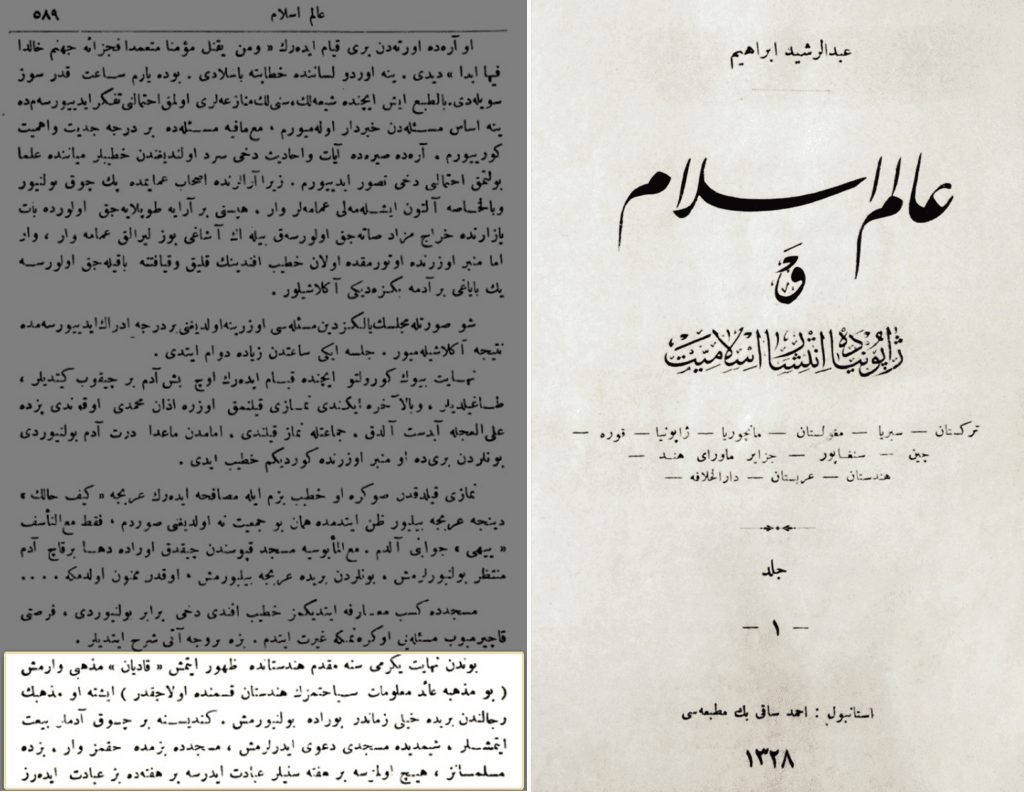
During the first decade of the 20th century, many influential Muslims from the Ottoman Empire were engaged in Pan-Islamic campaigns in East Asia, including China and Japan.1 Mentioning these Pan-Islamic efforts in the East Asian territories, Dr Hee Soo Lee, Director of the Korea Institute of Islamic Culture, has particularly named Abdurreshid Ibrahim (1857-1944) as “one of the patriotic Pan-Islamist of Russian Turkistan” who came to Japan “to initiate certain Islamic propagation.”2
To describe his visit to China, Japan and some other neighbouring territories, Abdurreshid Ibrahim started publishing a travelogue in 1328 Hijri (1910 CE) titled Aalam-i-Islam wa Japonya’da Intishar-i-Islamiyyat (literally, the Islamic world and the spread of Islam in Japan).
In this travelogue, narrating events of his September 1909 visit to Hong Kong, he mentions a very interesting incident in relation to the Ahmadiyya Muslim Jamaat.3 Before narrating details of this incident, it is important to present a brief introduction to the early years of Ahmadiyyat in Hong Kong and the persecution it faced, which will be beneficial in understanding the significance of this travelogue.
Ahmadiyyat in Hong Kong
The seed of Ahmadiyyat had been sown in Hong Kong during the Promised Messiah’s (as) lifetime, through Hazrat Qari Ghulam Mujtaba (ra). Looking at the old issues of Al Hakam (Urdu), we find Ghulam Mujtaba Sahib’s (ra) own account about his acceptance of Ahmadiyyat.
He states that during his stay in Hong Kong as an employee, Allah the Almighty created such means that he was able to receive the books of the Promised Messiah (as). In 1899, the Promised Messiah’s (as) book Izala-e-Auham was sent to him and he read it along with another person. While reading, they both would ponder and express that this person has made a huge claim. Thereafter, in 1901, he received the first edition of Durr-e-Sameen as well.4
He later visited Qadian and pledged allegiance at the Promised Messiah’s (as) hands. Upon returning to Hong Kong, he wrote articles in local English newspapers and preached the message of Ahmadiyyat. As a result, he had to face severe opposition from the non-Ahmadi Muslims.5

The dispute over the mosque and cemetery
While the local people were accepting Ahmadiyyat in the early 1900s through this companion of the Promised Messiah (as), a dispute arose regarding the mosque and cemetery. The non-Ahmadi Muslims wanted to ban Ahmadis from using that mosque and also created commotion upon the burial of Ahmadi Muslims at the local cemetery.
The anti-Ahmadiyya sentiment in Hong Kong has been mentioned by Dr YB Mathur, in his work titled Muslims and Changing India, who wrote that “during the first decade of the twentieth century the Muslims of Hong Kong refused to permit Qadianis to make use of their mosque and the cemetery on the ground that they were not Muslims.”6
Abdurreshid Ibrahim’s visit to Hong Kong
With this context, Abdurreshid Ibrahim’s visit to the mosque in Hong Kong becomes very significant. A more interesting aspect is that right at the time when he visited the mosque, the Promised Messiah (as) and Qadian were being discussed there. Hence, Abdurreshid Ibrahim’s travelogue became a means to spread the name of Qadian far and wide.

It is important to mention that Abdurreshid Ibrahim’s “connection with Sultan Abdülhamid II prompts some scholars to argue that Abdürreşid İbrahim” was strongly “supported by the Sultan for missionary purposes as well as for maintaining the continuation of local Muslim communities’ allegiance to the Caliph.” Moreover, it is believed that “his two-volume travelogue is perhaps the most-detailed account of the Far East ever written by an Ottoman about these lands.”7
The travelogue and Qadian
Mentioning his journey to various places around China, Abdurreshid Ibrahim has mentioned a town named خانکان, i.e., Hong Kong.
Abdurreshid Ibrahim begins the narration by mentioning that upon arriving in Hong Kong, he went to a mosque where many people had gathered. From the loud voices, he could sense that there was an uproar and dispute. When he entered the mosque and greeted everyone with “assalamu alaikum”, everyone looked serious and did not respond to his greetings. Many people had gathered around the khatib (imam) who was speaking from the pulpit. Some people were inside and others outside the mosque, nearly all of them Indians.
The author states that the khatib was delivering his speech in the Indian language. Although he could not understand everything that was being said, since many of the words were of Persian, Arabic and Turkic origin, he was able to sense to some extent that the sermon was discussing differences in matters of religious doctrine. He wrote that the following verse of the Holy Quran was also quoted during the discussion:
وَمَنۡ یَّقۡتُلۡ مُؤۡمِنًا مُّتَعَمِّدًا فَجَزَآؤُہٗ جَہَنَّمُ خٰلِدًا فِیۡہَا
“And whoso kills a believer intentionally, his reward shall be Hell wherein he shall abide.” (Surah an-Nisa, Ch. 4: V. 94)
The author states that he presumed there was a discussion about Shi‘a and Sunni divisions. The gathering lasted for more than two hours and after the adhan for the Asr prayer, everyone went to perform ablution. After the prayer, he asked the khatib about the details of the discussion that was held in the mosque, but the khatib refrained from telling anything.
The author then left the mosque and just outside, he found a man who knew Arabic. There, the author was briefed about the matter.
He was told that around 20 years ago, the Qadiani religious movement emerged in India and many people are joining it. One of the prominent figures of that sect (Hazrat Qari Ghulam Mujtaba [ra]) has been living in Hong Kong for a very long time and has converted many people. Now, they are claiming the mosque, saying: “We, too, have a right in the mosque; we are also Muslims.” With such arguments, they had appealed to the British Government, which had said that if the entire town’s population gathered to vote, the mosque would be handed over to the party getting the majority.
The author then mentions that the Muslims present in Hong Kong were predominantly Indian traders, with a majority being Isma‘ili Shi‘as and some Shafi‘i Sunnis. The imam followed the Hanafi school of thought. If they were to remain divided, it was feared that the Ahmadis would soon prevail by gaining a majority of votes. For this reason, the Sunnis and the Shi‘as gathered to confront the Ahmadis. Thus, despite having disagreements, they unanimously decided to stand together in opposition to the Ahmadis.8
Hazrat Musleh-e-Maud (ra) has mentioned this travelogue of Abdurreshid Ibrahim in his paper for the 1924 Conference on Some Living Religions Within the Empire, and stated:
“There is no regular mission in China, but a book named, The Muslim World [Aalam-i-Islam] printed at Istanbul in Turkish, written by a famous traveller, Sheikh Abdur Rashid Ibrahim, who is one of the learned men of Qazan […] mentions that members of the Movement are to be found in that country also.”9
The dispute escalated

Following this development, the dispute over the mosque escalated and hence, this situation initiated a correspondence between the British authorities in Hong Kong and the Indian Government. The Ahmadiyya Archive & Research Centre has been able to obtain this record.
In a letter dated 26 June 1912, the Colonial Secretary in Hong Kong wrote to the Indian Government’s Home Department and forwarded a copy of a letter from the “Board of Trustees of the Mosque and Guardians of the Mahommedan Cemetery” in Hong Kong, along with some comments from the Deputy Superintendent of Police. The Colonial Secretary also inquired, “what the position of the followers of Mirza Ghulam Ahmed is in India, whether a similar situation to the one which has arisen here, has ever arisen in India and if so what action was taken in the matter by your Government.”10
The letter from the non-Ahmadi Muslims in Hong Kong mentioned Hazrat Qari Ghulam Mujtaba (ra) and wrote:
“Mr. Gholam Mustapha [sic.] and the other Ahmediyyas had been publicly called upon to recant three years ago [in September 1909, when Abdurreshid Ibrahim visited Hong Kong] but did not do so. The Trustees of the Mosque and Guardians of the Cemetery acting on behalf of the Community, have decided to prohibit their use of the Mosque and the Mahomedan Cemetery.”11
The letter continues by narrating details of the meeting held at the mosque on 9 June 1912, which was also attended by Ghulam Mujtaba Sahib (ra). It was stated that the majority had voted in favour of banning Ahmadis from the mosque and the cemetery.12
The Home Department instructed the Colonial Secretary that “pending reference to the Indian Government as to the status of the Ahmediyya Sect, the Government is not prepared to agree that these persons should be debarred from the use of the Mosque and Cemetery.”13
Thereafter, on 6 November 1912, the Home Department again wrote to the Colonial Secretary and said that “the Ahmadis have prescriptive right by reason of their recital of the Kalima to use Mahomedan mosques as individuals, if not as a sect.”
He concluded by stating:
“So long as Ahmadis conduct themselves discreetly and inoffensively their exclusion from mosques and graveyards would not be countenanced, and the resolution adopted by the orthodox Mahomedan community at the general meeting in Hongkong appears to go further than anything attempted by their co-religionists here [in India].”14
In light of this order, the Colonial Secretary in Hong Kong sent a letter, dated 3 December 1912, to the Chairman of the Boards of Trustees of the Mosque and Guardian of Mohammedan Cemetery, and conveyed the Government’s order. Its copy was sent to Jamaat-e-Ahmadiyya as well.15

Ahmadiyya mission in Hong Kong, 1935
As evident from the above-mentioned incident and a brief introduction to Ahmadiyyat in Hong Kong, the Promised Messiah’s (as) message was spreading in Hong Kong as early as 1899.
With the spread of Ahmadiyyat in Hong Kong, the opposition was also intensifying. However, Hazrat Qari Ghulam Mujtaba (ra) faced the opposition with great courage and availed every opportunity to spread the message of Islam Ahmadiyyat.
In July 1921, the very first issue of The Moslem Sunrise mentions “Mr. Ghulam Mujtaba (ra)” as a missionary in China.
A decade later, the formal mission was established in Hong Kong. After the launch of the Tahrik-e-Jadid scheme in 1934, Hazrat Musleh-e-Maud (ra) sent Sufi Abdul Ghafur Sahib Bhervi to Hong Kong, who reached there on 27 May 1935 and the Ahmadiyya Mission was established there.16
Endnotes
1. Risale-i Nur As the Model Text of Asian Value System, by Hee Soo Lee, Millah, Vol. V, No. 1, August 2005, p. 40
2. Ibid.
3. Alam-i-Islam, 1328 Hijri, Istanbul, pp. 588-590
4. Al Hakam, 21-28 December 1934, pp. 9-10
5. Ibid.
6. Muslims and Changing India, Trimurti Publications Private Limited, New Delhi, 1972, p. 107
7. “Ottoman Travellers’ Perceptions of the Far East in the Early Twentieth Century”, Mustafa Serdar Palabıyık, Bilig: Türk Dünyası Sosyal Bilimler Dergisi, Issue Number 65, Spring 2013, p. 289
8. Alam-i-Islam, 1328 Hijri, Istanbul, pp. 588-590
9. Ahmadiyyat or the True Islam, p. 7
10. “Position of Ahmadis in India”, National Archives of India, Home Department, Political – Branch A, Nov-1912, No. 46-47
11. Ibid.
12. Ibid.
13. Ibid.
14. Ibid.
15. The Review of Religions, Vol. 15, No. 7, July 1916, p. 268
16. Tarikh-e-Ahmadiyyat, Vol. 7, p. 246