
The following heartrending tale of suffering has been told by two sons of the Sahibzada Abdul Latif (ra), the martyr, who was most barbarously stoned to death in Kabul for a difference of religion.
On our frontispiece appears a photo of these two sons of the martyr, may he rest in peace, who are at present in Qadian, where they have arrived with brother Nek Mohammad Khan, who was sent by Hazrat Khalifatul Masih [II (ra)] to Bannu to extend a cordial welcome to them on his behalf. (The Review of Religions, June 1926)
As told by the martyr’s two sons
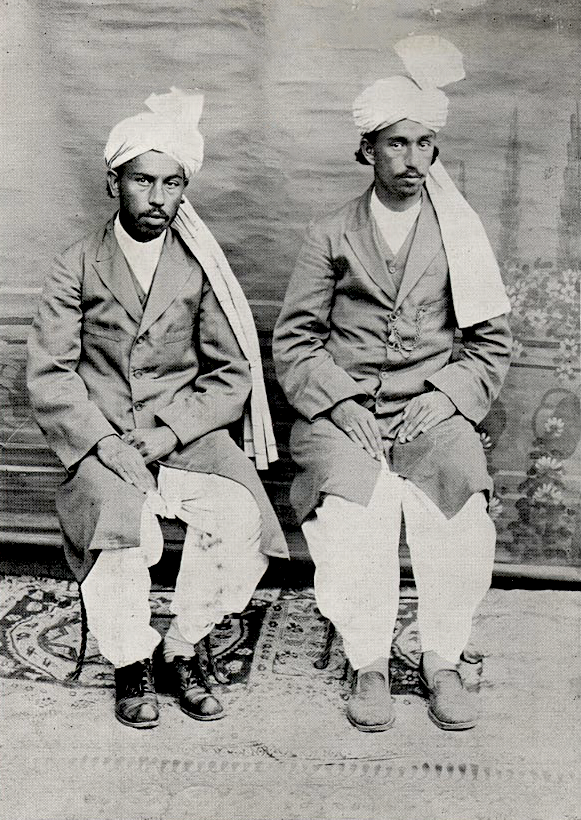
Image: Sayyad abul hasan and sayyad mohammad tayyab, the two sons of Hazrat Sahibzada Abdul Latif (ra)
After the stoning to death of Sayyad Abdul Latif (ra), his whole family, consisting of about one hundred persons in all, was taken to Kabul under the guard of an armed company of the military.
Exile to Turkistan
It was the beginning of winter and they were kept under custody in Tochi Bagh for about six weeks, after which they were deported to Turkistan. As they were not well protected against the inclemency of the weather, they had to undergo severe hardships and privations on this journey.
On arrival in Turkistan, the martyr’s family was allotted a piece of land, the income from which was too small to support them all, but fortunately they were helped by another member of the family who happened to be in the district of Bannu (under the British government) at the time of their arrest and thus had escaped.
Years of hardship
Those hundred souls lived in Turkistan in miserable conditions for about seven years, at the termination of which the leading people of Khost applied to the government for their restoration on the ground of their being a family of Sayyads who deserved every respect and honour in the country and also on the ground that the family did not know anything about Ahmadiyyat, for which their leader had been stoned.
A return without justice
Habibulla Khan, the then Amir of Afghanistan, granted this petition and permitted the family to return and live in their native country from which they had been banished, but the estate which had been confiscated was not returned.
After six months, however, the property of those who did not believe in Ahmadiyyat was given back to them. To the sons of the martyr, however, nothing was restored on the ground, as stated by Nasrulla Khan, that their property was too large.
Under constant suspicion
At this point, as there was a large number of people in that district who held the family in great respect, the government thought it expedient again to take them, about fourteen souls in all, to Kabul and keep them there under custody so that their well-wishers, seeing them in miserable plight, might not create mischief.
The rooms in which they were kept were too small and could not accommodate them all and an application was therefore made to the government to make separate arrangements, at any rate for their servants. The application, however, was refused and they had to arrange for their own lodgings themselves. They were also required to present themselves at the police station twice a week and a strict watch was kept over them at all times as if they had been great criminals. And for five years, these unhappy sufferers were kept there in these humiliating circumstances.
Imprisoned and chained
At the end of this period, a certain Fazal Karim Gujrati of the Punjab came to Kabul and being an Ahmadi, he was arrested by the government, and on being asked if he knew any other Ahmadis in the city, he mentioned the five sons of the martyr and other relations who were staying with them as guests. Whereupon, to add to their disgrace, they were all arrested forthwith, sent to the gaol (jail) and put under chains.
Denied their mother’s farewell
So inhuman and barbarous was the treatment that was meted out there to these poor and innocent victims of intolerance and fanaticism that they were not even allowed to see the face of their dying mother. At their request, moreover, to be allowed to perform the funeral ceremony (there being no one else to do it), only the eldest son was allowed to go and bury her!
Under such cruel tortures, then, they passed eight consecutive months, during the whole of which time they were never properly fed.
Freedom at a price
At last, however, to buy their freedom, they managed to pay 300 rupees to a secretary of Sardar Amanulla Khan, who, on his recommendation, finally released the helpless prisoners.
Suffering and loss
The cruelties perpetrated upon them during this period of confinement can be gauged to some extent by the fact that Sayyad Mohammad Umar, one of the sons of the blessed martyr, could no longer bear the hardships of the gaol (jail) and eventually fell so ill that he died.
The health of all was permanently injured and Sayyad Mohammad Said, the eldest son, also died a year after his release. Within two weeks of his death, Amir Habibulla Khan was murdered and Amir Amanulla Khan sat on the throne of Afghanistan.
A brief restoration
In the beginning of the reign of Amanullah Khan, their countrymen of Khost, under the leadership of one Babrak Khan, again tendered an application for the complete freedom of these hapless people and the Amir not only granted it but also ordered that their estate should be restored to them.
Thus, restored to their native country, the remainder of the family passed about four years in comparative peace. Unfortunately, however, a rebellion broke out in the country against Amanulla Khan and being grateful, well-wishers to him, they began actively to help the government.
Persecution renewed
During the disturbances, the rebels took their chance and, in the absence of this family, set fire to their houses, burned their orchards and generally destroyed their property. The plea for the rebellion was Ahmadiyyat and as they were well known as Ahmadis, to appease the insurgents, the government imprisoned Sayyad Mir Akbar, Sayyad Abul Hasan, Shaikh Abdus Samad and Amin Gul. The last two were, however, released after a week and the rest remained in gaol (jail) for about nineteen months.
Escape and capture
The rest of the family was removed to Durgai, where there was no disturbance and as the people of that place favoured the Amir, there was peace.
However, through the efforts of Sayyad Mohammad Tayyab, who had already been released, another application was made by the influential people of Khost in favour of the family, with the result that the military secretary of the Amir publicly ordered their release but at the same time issued different instructions privately to the governor (Mohammad Gul by name) in charge, countermanding the order. He did, in fact, issue secret instructions that Mohammad Tayyab and Abdus Salam should be arrested with their families and removed to Kabul.
At this point, the governor promised Mohammad Tayyab that he would enquire from the authorities as to which of the two orders was valid and that he would then let him know the result. As he considered it unsafe to stay there in these circumstances, Mohammad Tayyab decided to escape, and he accordingly joined his relations the same night.
To his surprise, however, he found there three officers of the mounted police who had already come to arrest Abdus Salam. He therefore prepared secretly to leave the place immediately with his relations and the imprisoned brothers had also been advised to do the same thing.
At midnight, therefore, when the guard was occupied elsewhere, they all effected their escape. When the guard found the house empty, they set off in pursuit and, with the help of the village people, succeeded in catching them in the morning at Gurbaz.
A life under surveillance
The whole party was made to return to the village, where women and children were released on the security of a gentleman named Bahram and the men were removed to the Khost cantonment, where Abdus Salam was imprisoned.
After a few days, when the then governor of Khost had been transferred, the prisoners applied to the new governor to be allowed to return to their homes and Abdus Salam was very kindly at once released. As regards the others, the papers were sent to higher authorities, who referred the matter to the leading people of Khost, who in their turn reported that the men were quite innocent.
Consequently, they were all allowed to return. Hardly a month had passed, however, before orders were again issued for their arrest and removal to Kabul. Abul Hasan was accordingly arrested and arraigned before the cantonment magistrate of Khost, who remanded him on bail to bring up his brothers as well.
The final departure
On his return, the whole family assembled and conferred as to what should be done. They at last decided to leave Afghanistan forever, in view of the fact that they had been regarded with suspicion for so long. Accordingly, the whole family quitted the country on 2 February 1926 and settled at Bannu, where they were fortunate enough already to own some estate.
(Transcribed and edited by Al Hakam from the original English, published in the June 1926 issue of The Review of Religions)