
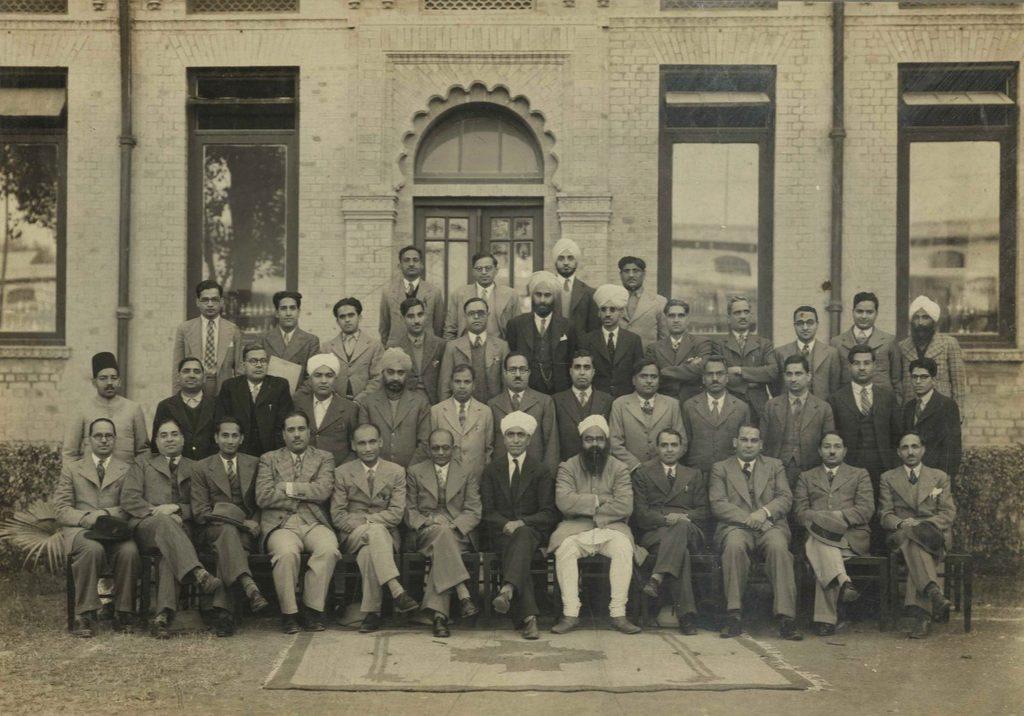
Introduction and Inauguration of the Fazl-e-Umar Research Institute
The Fazl-e-Umar Research Institute was established in Qadian, the headquarters of the Ahmadiyya Muslim Jamaat, in 1946. It was founded under the guidance of Hazrat Mirza Bashir‑ud‑Din Mahmud Ahmad, Khalifatul Masih II (ra). The Institute’s purpose was to promote advanced research in science and industry, with the broader objective of encouraging scientific learning and contributing to the development of industry in India.
The formal inauguration of the institute in Qadian took place on 19 April 1946 at 5:00 p.m., in the blessed presence of Huzoor (ra), who personally attended the ceremony. The distinguished scientist Dr Shanti Swarup Bhatnagar was invited as a guest speaker on this historic occasion.
At the ceremony, the institute’s first director, Chaudhry Abdul Ahad Sahib, presented an address of welcome to the honoured guests. Following this, Shanti Swarup Bhatnagar delivered the inaugural lecture.
It is noteworthy that at that time the institute was regarded as a unique and exemplary scientific institution established by Muslims in united India. The inauguration received considerable attention in the press. Among the newspapers that reported the event were the prominent Muslim newspaper Inqilab, the English daily The Statesman and the internationally renowned scientific weekly Nature, published from London.
After the migration from Qadian to Pakistan, Hazrat Musleh-e-Maud (ra) also formally inaugurated the Fazl-e-Umar Research Institute in the new Markaz in Pakistan in the town of Rabwah on 25 June 1953. (Adapted from Tarikh-e-Ahmadiyyat, Vol. 9, pp. 75-78)
Dr Shanti Swarup Bhatnagar
Shanti Swarup Bhatnagar was born on 21 July 1894 in Bhera, in the district of Shahpur, into a Kayastha family. After completing his early education, he enrolled at Dyal Singh College, Lahore, in 1911, where he passed his Intermediate examination with first division.
During his student years, he was an active member of the Saraswati Stage Society of Dyal Singh College. In 1916, he obtained a BSc in Physics from Forman Christian College, Lahore. He later completed his MSc in Chemistry in 1919, further establishing the academic foundation that would lead to his distinguished scientific career.
Dr Bhatnagar is acknowledged as the father of research laboratories in India due to his establishment of numerous chemical laboratories across the country. Following India’s independence in 1947 and with the support of Prime Minister Jawaharlal Nehru, the Council of Scientific and Industrial Research (CSIR) was founded and Dr Bhatnagar served as its first chairman. (Shanti Swarup Bhatnagar: A Pensive Pioneer of Indian Science and Technology, www.gonitsora.com)
Jawaharlal Nehru once expressed his admiration for Dr Bhatnagar, saying, “I would like to pay a tribute to Dr Bhatnagar, who I think, has done, I say this with all respect to others, more than anyone else for the scientific development in India. I can truly say that but for Dr Bhatnagar, you could not have seen today the chain of national laboratories in India.” (Shanti Swarup Bhatnagar: Builder of Scientific and Industrial Foundations of Modern India)
Shanti Swarup Bhatnagar passed away on 1 January 1955 in New Delhi at the age of sixty.
Dr Chaudhary Abdul Ahad, PhD

Dr Chaudhary Abdul Ahad, PhD, was born on 11 November 1911. He received his education at the University of Agriculture in Lyallpur (now Faisalabad). Choosing a life of service over a promising career, he dedicated himself to serving the Jamaat. In 1944, he became the Director of the Fazl-e-Umar Research Institute, where he devoted his efforts to furthering its work and fulfilling his responsibilities to the Jamaat. Dr Chaudhary Abdul Ahad passed away on 2 August 1975 at the age of 64.
Opening speech by Dr Chaudhary Abdul Ahad, PhD
Dr Abdul Ahad, Director of the Institute, in his welcome address, said:
“The prosperity of India in the industrial field depends upon the achievements, at a fairly early stage, of two objectives. First, that our industries should be able to hold their own in the domestic market as against the products of countries that have hitherto held a lead in these matters; and secondly, that our industries should be able to compete in the market of the world on equal terms with the products of other countries. The achievement of these objectives depends upon the progress which India is able to make in the domain of scientific and industrial research.
“This Institute has been founded under the directions of Hazrat Khalifatul Masih to carry on scientific and industrial research of an advanced type. The principal aim of the Institute is to promote the study of science and help in furthering the development of industry in India by providing such facilities as may enable workers to produce original research work of high quality.
“Every effort is being made to equip the present Laboratories with up-to-date scientific appliances and a technical library has been provided for the use of the workers. Special arrangements are being made to provide facilities for the study of various reactions under the conditions of high and low pressure treatments. Complete equipment for micro-chemical analysis has been ordered for analytical work. Provision has also been made for the purchase of an electron microscope for biochemical research; an ultra-centrifuge and a spectrograph for quantitative analytical work.
“For the present our technical programme embraces the following lines of work:—Advanced academic research on the properties and nature of protoplasm and living matter, alkaloids and active principles of plants, synthetic drugs, biochemistry of proteins, oils, fats and carbohydrates, paints, varnishes, printing inks and lacquers, insecticides, fungicides and adhesives. Arrangements have been made for pilot plant investigations on the refining and hydrogenation of vegetable oils and on paints, varnishes, printing inks, etc. and for the manufacture of proteinic foodstuffs.
“An initial capital grant of Rs. 2,50,000 was sanctioned by Hazrat Khalifatul Masih as the first instalment for the equipment of our temporary laboratory. Donations have been received from private individuals in the amount of Rs. 50,000.
“Arrangements are being made to provide facilities for post-graduate training for scholars from Indian universities.” (Journal of Scientific and Instrumental Research, June 1946, Vol. 4, pp. 767-768)
Speech by Dr Shanti Swarup Bhatnagar
On the occasion of the Opening Ceremony of the Fazl-e-Omar Research Institute, Qadian, on the 19th April 1946, Dr Sir Shanti Swarup Bhatnagar, O.B.E., F.R.S., Director, Scientific and Industrial Research, Government of India, declared:
“When the Hon’ble Justice Sir Zafarullah Khan spoke to me in Delhi of the step which the Ahmadiyya community, under the inspiration of Hazrat Khalifatul Masih, had taken in providing funds for the Fazl-i-Omar Research Institute, I felt deeply touched. It appeared to me as a symbol of the acceptance of the method of science by a great religious leader. Sir Zafarullah humorously remarked that in choosing me for this honour, he had specially in mind the spiritual elevation of an old friend whom science had cut off completely from religion. I readily accepted the invitation as I did not wish to miss the opportunity of seeing this forward little town. I also very thoroughly appreciate the honour which this ceremony has offered me of coming into contact with Hazrat Khalifatul Masih. This is a privilege which I had cherished for a long time and its fulfilment today will never be forgotten by me. It will be a source of inspiration to me in my own arduous task of developing scientific and industrial research in India.
“In selecting Dr Abdul Ahad as the first Director of the Fazl-i-Omar Research Institute, your choice has fallen on one who combines in him the zeal for scientific research with great devotion to religion. I am much impressed by his vast knowledge of contemporary science. I am particularly happy that he has quoted in his speech the last words in a recent broadcast of mine on the subject of the Scientists’ Utopia: “It looks certain that in the utopia of scientists God and Science will be brought into a fertile union in which the idea of God instead of being diluted will be enriched.” This is my conviction and also the belief of a great many top-rank scientists of the world. The scientist today is not the hot-headed, blasphemous and conceited fellow which he used to be some time ago. Physics has merged into metaphysics. The pride of the scientist has been humbled to such an extent that he no longer contends that science can explain even all that meets the eye. Amongst the prominent scientific workers of the world, one would hardly find one who may be considered a complete atheist. Numerous proofs that both science and religion are devotees of truth and righteousness can be quoted. The fact, Sir, that you, the religious head of a powerful community, have decided to make the Fazli-Omar Research Institute a part of the education of your programme of the religious development of your people, is nothing else but an indication of the direction in which the wind is blowing. Religious leaders no longer look upon science as antagonistic to their creeds. Such a unification of religion and science and such contacts between religion and science as your Institute will establish are no doubt to be very much appreciated. The spirit of tolerance and forbearance gets developed not by remaining aloof but by intimate contacts and social mixing and I, therefore, wish this Institute a long life of great usefulness.
“Religion has sought in all ages to unite people and to bring them in tune with the spiritual side of the Universe. It has been established, however, that the physical well-being of man is important for even the development of his soul and mind and it has, therefore, been the policy of religious leaders lately to see that their followers have a better and higher standard of living. Nothing can raise the standard of living of people more than science and education and I have no doubt that the future and present generations of Qadian will remember with gratitude the philanthropists and workers associated with the founding of this Institute of which you have asked me to perform the inaugural ceremony to-day.
“I hope the scope of this Institute will be broad enough and that it will include in its activities all those branches of learning which may have a direct bearing on the economic well-being of the people of this town and incidentally of the whole country. Subjects such as nutrition can be tackled by you with great advantage and the nearness of such industrial centres as Sialkot and Amritsar will give you ample opportunities of attracting industrial research of local interest. I must, however, warn you that research institutes are very expensive hobbies and that unless sufficient funds are at your disposal, your activities are likely to suffer. I hope that your community and the local and Central Governments and the Industry will come to your aid. To bring into being such an institution and then not to provide sufficient funds is like the underfeeding of a sturdy baby or the treatment of a patient suffering from malaria with insufficient quinine.
“Your Institute is perhaps the second of its kind in India. I think the first one, if I am not mistaken, is the Technical Institute at Dyal Bagh in Agra, which owes its origin to the far-sightedness of the late Sir Anand Swarup, one of the leaders of the Radha Swami Movement. That Institute has done yeoman service to the cause of technical education and industrial development in India. I do hope and pray that your efforts may result in even greater achievement.
“There are two things which I particularly wish to emphasise on this occasion. Firstly, that no applied research can flourish if isolated from pure research. The huge physical body of applied research is kept alive and fit by a constant supply of new blood in the shape of fundamental research of a pure character. Let not the enthusiasm of those interested in immediate results of a purely utilitarian character carry you away from the path of your right duty to science. India needs both pure and applied research and you should never deviate from this happy combination. Applied research may be compared to the social urge of building mosques and temples, but what use is a mosque unless the individuals and masses are imbued with the true spirit of prayer? Pure research supplies the urge for new developments and new fields of applications and it should not be allowed to be neglected, even though we might insist upon greater expenditures being allotted to applied work.
“The second thing which I consider necessary is the proper education of the scientist. In America the emphasis on humanities had decreased to such an extent that the much dreaded monster-scientist was beginning to be envisaged. Fortunately, the Americans realised that the labour-saving devices of science will soon give so much leisure to man that his brain will become a devil’s workshop and, therefore, they have begun to lay greater emphasis on the compulsory introduction of courses of study in humanity in the scientists’ and engineers’ curricula. You are in a fortunate position because you will always be in surroundings largely dominated by religious and cultural atmospheres. This will prevent you from developing the purely utilitarian type of mind which the applied science may tend to make you. But it may be that your success in applied science may create so much wealth that it may blind you to the study of humanities. This you will have to take special steps to prevent.
“I have no doubt that the kindly and humane spirit of Hazrat Khalifatul Masih will long guide you and that this Institute will grow into a mighty organisation for the good of humanity. With these few words I have great pleasure in declaring the Fazli-Omar Research Institute open. I wish it God-speed. May it result in the happy blending of science and religion and thus contribute to the forces which are tending to unite us all into One World.” (Current Science, May 1946, Vol 16, Issue 5, pp. 118-119)
Remarks by Hazrat Musleh-e-Maud (ra)
Recalling the visit of the distinguished scientist Shanti Swarup Bhatnagar to Qadian, Hazrat Musleh-e-Maud (ra) once stated:
“I remember that in 1946, when we invited Dr Sir Shanti Swarup Bhatnagar, Director of Scientific and Industrial Research, Government of India, to Qadian for the inauguration of the Research Institute, he said in his speech that today the pride of the scientist has been humbled to such an extent that he can no longer claim that science is capable of fully explaining even those things that are visibly before us. When there are so many mysteries in the heavens and the earth and despite all its progress, science has so far been able to explain only a very small portion of the material world, then how can it be correct to declare the creation of man— for whose service this vast universe has been created— to be meaningless?” (Tafsir-e-Kabir, Vol. 3, p. 91)
On the above-mentioned occasion, Hazrat Musleh-e-Maud (ra) also delivered a brief address at the inauguration. In it, Huzoor (ra) said:
“Dr Bhatnagar Sahib has just mentioned in his remarks that the establishment of such an institute is no ordinary matter… It should be remembered that this institute is not merely a worldly institution. Rather, it has been established to give practical shape to an idea that the Founder of the Ahmadiyya Movement had expressed from the very beginning. He said that God has both a word and a deed.
“This scientific research institute has been established so that through our efforts we may try to bring science closer to religion… I now conclude my speech and thank all the friends who have come on this occasion, particularly Dr Sir Bhatnagar, for honouring us with his presence and bringing us great joy by visiting us.” (Al-Fazl, 3 May 1946)
Regarding the financial difficulties of funding such an institute, Hazrat Musleh-e-Maud (ra) is recorded by the review of Religions stating the following: “Hazrat Khalifatul Masih once remarked to Dr Abdul Ahad, Director of this Institute, the monies required in the service of the Movement are never raised by the Community; they are always supplied by God Almighty out of His limitless bounty. Therefore, though Sir S. S. Bhatnagar warned us against the very high cost of ventures of this kind, we have no need to be afraid of the future beyond steeling ourselves to meet our responsibilities manfully whenever we are called upon to do so. The rest we can confidently leave in the hands of God. (Review of Religions, June 1946, pp. 101-102)