
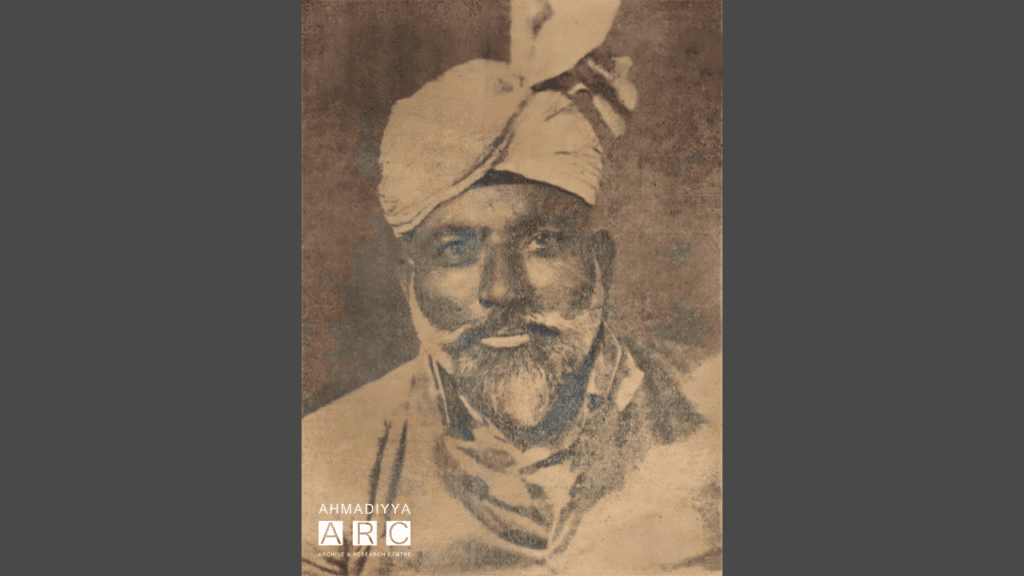
A year of missionary work
It has now been nearly a year since I took up residence on the island of Sumatra. If I am asked what work has been accomplished during this period, or to what extent the message has been spread, I can only say that whatever has been achieved is solely the result of the prayers of my master, Hazrat Khalifatul Masih II [ra].
The challenge of language
The foremost obstacle to the work of tabligh [preaching] was my lack of knowledge of the Malay language. Although I spoke with great enthusiasm and earnest desire, I was unable to express that zeal as effectively as I wished. It was therefore difficult for me to convey my intentions clearly or to present my message in the manner I desired.
The beginning of the mission
I departed from Qadian in August [1925] and initially established my residence in Tapa Tuan [or Tapak Tuan] where I began my missionary work. Gradually, I conveyed the truth to the people and proclaimed to them the glad tidings of the advent of the Promised Messiah (as). Receptive noble souls responded to this message and, in time, entered into the fold of the Promised Messiah (as).
The formation of a jamaat
Thereafter, I continued to present to them the arguments in support of the Ahmadiyya Muslim Jamaat and explained its distinctive characteristics. Through the prayers of my master, these efforts were nurtured and bore fruit. As a result, people’s attention increasingly turned towards this message and within the course of a few months, a jamaat was established.
Opposition from the religious scholars
At this stage, the religious scholars began to oppose me with great intensity. As a result, those who only a few days earlier had regarded me with great respect, welcomed me warmly and spent long hours in discussion with me, changed their attitude.
When they saw that the scholars had declared me a disbeliever and an apostate, they too turned against me and began proposing that I be expelled. Petitions were even submitted to the government requesting my removal, alleging that I was corrupting their religion.
Boycott and social exclusion
Meanwhile, Allah the Almighty continued to strengthen the jamaat. When the scholars realised that their religious decrees had failed to halt its progress, they resorted to social boycott. They proclaimed that anyone who accepted Ahmadiyyat should not be allowed burial in the communal cemetery upon death. Even now, this announcement is being widely publicised.
Despite these measures, a number of individuals emerged who had come to understand their responsibilities, the truth of the message, and its supporting arguments. Some of them even engaged the scholars in religious debates.
Expansion to Padang
When I became convinced that, God willing, the work in that area could now continue successfully, I departed, leaving behind a jamaat of approximately 70 members. At the time of writing this letter, that number has already grown to more than 100 Ahmadis. I then travelled to Padang in February [1926].
Renewed hostility and continued progress
Since the scholars in Padang had already heard of my success elsewhere and were deeply agitated by it, I was greeted upon my arrival with accusations of being a disbeliever, Dajjal, and an apostate. Consequently, the very first letter I received in this region consisted entirely of these denunciations.
The scholars also sought to prevent people from listening to me by every possible means, fabricating false allegations and spreading unfounded claims in order to discourage them. They repeatedly instructed the public not to attend to anything I had to say. Under such circumstances, one can readily understand how difficult the work of tabligh had become.
Nevertheless, through the prayers of Hazrat Khalifatul Masih II [ra], a number of people came forward to support me and began openly accepting Islam Ahmadiyyat.
Plans to launch a newspaper
I now intend to launch a newspaper, which, God willing, will begin publication in July [1926]. Without a newspaper, our voice cannot reach distant audiences, nor can the truth be conveyed effectively to the people.
Many individuals are reluctant to visit me openly, despite their desire to hear the message. It is for this reason that the publication of a newspaper has been proposed.
Those who know the Malay language are encouraged to subscribe and thereby support this effort. Likewise, if any friends know individuals who are proficient in Malay, their addresses should be sent to me. Should any friend wish to contribute an article, it will be published.
In conclusion, I earnestly appeal to all Ahmadi friends that we are very weak and stand in great need of your prayers. Here, not only are the non-Ahmadis opposed to us, but even the Paighamis [Lahori Jamaat] are hostile, and indeed, their opposition is even more severe than that of others. – Rahmat Ali, Padang, Sumatra
(Translated by Al Hakam from the original Urdu, published in the 20 July 1926 issue of Al Fazl)