
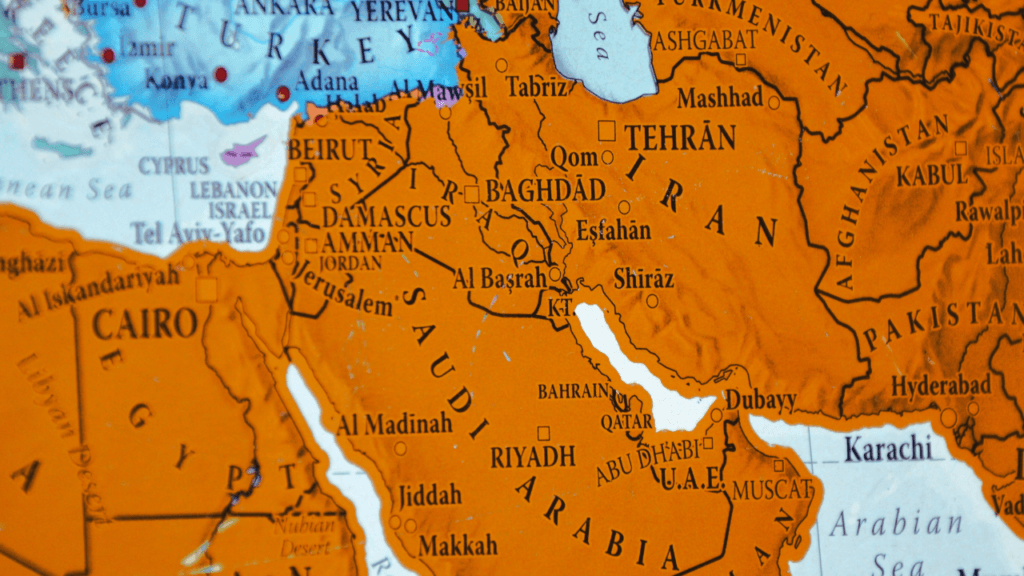
In a recent interview with Tucker Carlson, US Ambassador to Israel Mike Huckabee stirred international debate by invoking biblical scripture to justify expansive territorial claims. Referencing Genesis 15:18, Huckabee asserted that the land “from the river of Egypt to the great river, the Euphrates” was divinely promised to the descendants of Hazrat Ibrahim (as), a vast region encompassing parts of modern Egypt, Israel, Palestine, Jordan, Lebanon, Syria, Iraq and even Saudi Arabia. His casual remark: “It will be fine if they took it all”, has been interpreted by critics as endorsing aggressive expansionism under the banner of Christian Zionism, a theological framework that links Jewish control of these lands to the second coming of Christ.
This perspective, while rooted in sincere faith for some, risks exacerbating geopolitical tensions in an already volatile Middle East. As followers of the Ahmadiyya Muslim Community, we are called to foster interfaith understanding and peace, as emphasised by Hazrat Mirza Ghulam Ahmad (as), the Promised Messiah and Mahdi. Rather than viewing the covenant of Hazrat Ibrahim (as) as a mandate for exclusive occupation by one group, a broader and more spiritually grounded interpretation reveals it as a promise of divine blessings fulfilled through the spiritual descendants of Hazrat Ibrahim (as), i.e. those who uphold monotheism and his prophetic legacy across Judaism, Christianity and Islam. Hazrat Ibrahim (as) is not the father of one specific ethnic or religious group but of the faith in the One God, a unifying force that blesses all nations. Today, this fulfilment is evident: the promised lands are inhabited predominantly by believers in the One God, with Muslims forming the overwhelming majority, and ancient paganism eradicated. This article explores this inclusive reading, drawing on Biblical texts from both the Old and New Testaments, historical context and Islamic insights to promote harmony among Jews, Christians and Muslims.
Biblical foundations
The promises to Hazrat Ibrahim (as) form the cornerstone of this discussion, appearing prominently in the Book of Genesis. These verses, part of the Abrahamic covenant, underscore themes of blessing, multiplication and inheritance, promises that extend far beyond one people to encompass all who share in faith.
Genesis 12:3 declares: “And I will bless them that bless thee, and curse him that curseth thee: and in thee shall all families of the earth be blessed.” (KJV) This is a universal pledge, extending God’s favour to “all families of the earth” through Hazrat Ibrahim (as).
Genesis 15:5 addresses the proliferation of descendants: “And he brought him forth abroad, and said, Look now toward heaven, and tell the stars, if thou be able to number them: and he said unto him, So shall thy seed be.” (KJV) At the time, Hazrat Ibrahim (as) was childless and nomadic, surrounded by polytheistic societies.
The territorial aspect appears in Genesis 15:18: “In the same day the Lord made a covenant with Abram, saying, Unto thy seed have I given this land, from the river of Egypt unto the great river, the river Euphrates.” (KJV) Genesis 17:4-5 renames him Abraham, “father of many nations”, and Genesis 17:20 blesses Ishmael (as) as well: “And as for Ishmael, I have heard thee: Behold, I have blessed him, and will make him fruitful, and will multiply him exceedingly; twelve princes shall he beget, and I will make him a great nation.” (KJV) Genesis 22:18 reaffirms: “And in thy seed shall all the nations of the earth be blessed; because thou hast obeyed my voice.” (KJV)
Joshua 24:2-3 recalls the origins of Hazrat Ibrahim (as): “Your fathers dwelt on the other side of the flood in old time, even Terah, the father of Abraham, and the father of Nachor: and they served other gods.” (KJV) This highlights Hazrat Ibrahim’s (as) call out of idolatry to pioneer monotheism.
A broader interpretation of ‘descendants’
The Hebrew term zera‘ (“seed” or “offspring”) need not be confined to biological heirs. The legacy of Hazrat Ibrahim (as) is spiritual: he rejected idolatry and submitted to the One God. His true heirs are those who emulate this faith: believers who recognise Hazrat Ibrahim (as) as a great prophet and adhere to his teachings of Tawhid (the Oneness of God). This encompasses Jews, Christians and Muslims, all of whom trace their spiritual roots to the belief of Hazrat Ibrahim (as).
New Testament affirmations
The New Testament elevates this spiritual dimension. Romans 4:11-12 calls Hazrat Ibrahim (as) “the father of all them that believe,” whether circumcised or not. Romans 4:16-17 affirms: “but to that also which is of the faith of Abraham; who is the father of us all”, (KJV) Galatians 3:7-9 states: “Know ye therefore that they which are of faith, the same are the children of Abraham.” (KJV) Galatians 3:29 adds: “And if ye be Christ’s, then are ye Abraham’s seed, and heirs according to the promise.” (KJV) Hebrews 11:8-10 praises the faith of Hazrat Ibrahim (as), and James 2:21-23 connects righteousness to faith and deeds.
These passages portray Hazrat Ibrahim (as) as the father of faith for all believers, promoting unity in monotheism.
Historical fulfilment: From pagan lands to a monotheistic majority
Around 2000 BCE, the region from the Nile to the Euphrates was dominated by polytheism. Today (based on 2020 Pew Research Center estimates, with stable trends into 2025–2026), it is overwhelmingly monotheistic: Muslims form approximately 92% of the population, Christians around 4%, and Jews around 3% (almost entirely in Israel). Organised paganism or polytheism is negligible (<0.1%). This transformation, from polytheistic dominance to Abrahamic faiths, reflects the promise’s realisation: the spiritual descendants of Hazrat Ibrahim (as) now inhabit the land as the majority, united in belief in the One God.
The spiritual essence of the promise: Righteousness over territory
While the covenant mentions land, its core is spiritual and ethical. The true inheritance is tied to righteousness, faith and good deeds, not exclusive political control.
Deuteronomy 9:4-6 warns the Israelites: the land is given “Not for thy righteousness, or for the uprightness of thine heart, dost thou go to possess their land: but for the wickedness of these nations […] for thou art a stiff-necked people.” (KJV) Romans 4:13 explains: Hazrat Ibrahim (as) became “heir of the world […] through the righteousness that comes by faith.” (KJV) Matthew 3:9 challenges ethnic presumption: “and think not to say within yourselves, We have Abraham to our father: for I say unto you, that God is able of these stones to raise up children unto Abraham.” (KJV) Hebrews 11:9-10 shows Hazrat Ibrahim (as) viewed the land as temporary, yearning for a heavenly inheritance.
The promise calls us to emulate the righteousness of Hazrat Ibrahim (as): rejecting idolatry, trusting God, and performing good deeds. Political land claims divorced from this ethical foundation risk distorting the covenant’s intent.
Challenging exclusive land claims
Christian Zionism often interprets the covenant through end-times prophecy, prioritising territorial sovereignty. While respecting the faith behind this view, we invite reevaluation in light of the Bible’s emphasis on righteousness. The land is stewardship tied to moral conduct (Leviticus 18:28), not unconditional entitlement. True descendants are defined by spiritual fidelity, not geography. Exclusive claims can fuel division, whereas focusing on shared faith and good deeds builds bridges among Abrahamic communities.
An Islamic and Ahmadiyya perspective
The Quran describes Hazrat Ibrahim (as) as “Abraham was neither a Jew nor a Christian, but he was ever inclined to God and obedient to Him, and he was not of those who associate gods with God.” (Surah Aal-e-‘Imran, Ch.3: V.68) His followers are “Surely, the nearest of men to Abraham are those who followed him, and this Prophet and those who believe; and Allah is the friend of believers.” (Surah Aal-e-‘Imran, Ch.3: V.69) The Quran also conditions the covenant: “And remember when his Lord tried Abraham with certain commands which he fulfilled. He said, ‘I will make thee a Leader of men.’ Abraham asked, ‘And from among my offspring?’ He said, ‘My covenant does not embrace the transgressors.’” (Surah al-Baqarah, Ch.2: V.125)
Finally, the Quran promises: “And already have We written in the Book of David, after the exhortation, that My righteous servants shall inherit the land.” (Surah al-Anbiya, Ch.21: V.106)
Implications for peace
Reinterpreting the covenant through righteousness fosters reconciliation. Collaborative efforts among Jews, Christians and Muslims, for justice, compassion and peace, honour the legacy of Hazrat Ibrahim (as). This aligns with Micah 6:8 “but to do justly, and to love mercy”, and the Quran’s call to “Vie, then, with one another in good works.” (Surah al-Ma’idah, Ch.5: V.49)
Conclusion
The covenant of Hazrat Ibrahim (as) is a divine call to monotheism, righteousness and blessing for all nations. Its fulfilment is seen in the spiritual transformation of the promised lands and in lives devoted to faith and good deeds. By embracing this inclusive vision, Jews, Christians and Muslims can unite as the true progeny of Hazrat Ibrahim (as), building peace rather than division. May we all strive to be among the righteous servants who inherit the earth through submission to the One God.