
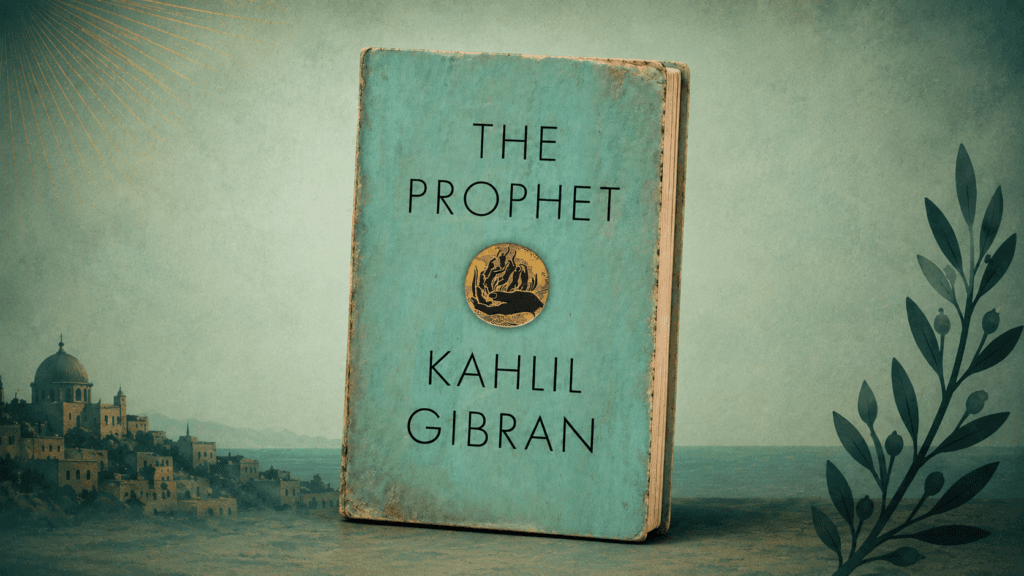
There comes a time when the mechanical and mundane routines of our day-to-day lives, though they may feed our schedules and pockets, leave the soul quietly famished. Stumbling into a thought-provoking, perspective-shifting book at such a time leaves a deep impact. This is what The Prophet, by the Lebanese-American writer Kahlil Gibran, does.
First published in 1923, The Prophet has not only endured but thrived through its relevance and appeal on topics such as love, family, work and community. But although it continues to inspire, its aphoristic style raises questions on whether this seemingly timeless wisdom can coexist with modern complexities, especially considering the fact that it was written over 100 years ago, which, in terms of our digital age and progress, is a primitive time.
The book aims to feed the soul and encourages the reader to reflect, in a way that modern-day self-help books claim to do. But it does so in a much more impactful manner. Rather than repeating the same jargon and advice of other self-help books, The Prophet provides advice ornamented in enjoyable fables, leaving a stronger impression on the mind than if it were merely explained.
However, for those who are well-versed in their spiritual scriptures, this book can come across as a fanciful spinoff of their sacred texts and teachings, being more aphoristic rather than profound.
The story
Set in a fictional world, a “Prophet” by the name of Mustafa is allowed to return to his homeland after years of exile on the island of Orphalese. When the inhabitants, who had grown quite fond of the wise and sagacious spiritual teacher, see the ship that will take him home approaching their shores, they gather around and implore him to impart some final wisdom before his departure.
The questioners and the questions
One by one, people from all walks of life address the “Prophet” and ask him about a certain topic, usually one that they have a vested interest in. In turn, Mustafa responds with advice and guidance in the form of short sermons, with plenty of quoteworthy statements.
When a rich man asks him to speak to them of “Giving” (i.e., charity), the “Prophet” explains that it is better to give unasked rather than when asked, for it is better to give through understanding. He goes on to state that “All you have shall one day be given; Therefore give now, that the season of giving may be yours and not your inheritors.” (The Prophet, Kahlil Gibran, 2002, p. 27). It is true, no one takes any wealth with them into the next life, so it is a great opportunity to gain blessings by being charitable in the present moment.
Having said that, such advice should be taken with caution and proper comprehension. Taken to an extreme measure, this advice would go against the teaching of Prophet Muhammad (sa) that you should leave some wealth and inheritance for your children so that they do not end up as beggars. (Sahih al-Bukhari, Kitab-ul-nafaqat, Hadith 5351)
When an orator asks him to speak on the topic of freedom, the “Prophet” responds by telling him that the very thing he calls freedom is in fact a chain, for “when the shadow fades and is no more, the light that lingers becomes a shadow to another light.” (The Prophet, Kahlil Gibran, 2002, p. 55)
The constant struggle and chase for something better, something bigger or something more expensive can blind a person into constantly moving the goalpost further and further. The goal eventually becomes another restraint in the pursuit of the next one.
Although this seems like a sagacious teaching, it’s worth contextualising. Would a person struggling in modern-day slavery-like conditions merely agree that there is no point in chasing freedom since it will replace their current shackles? The answer might be very different for each and every individual.
Further on, when an old priest asks him to speak on the topic of religion, the “Prophet” asks him if he has spoken about anything other than religion. “Your daily life is your temple and religion. Whenever you enter into it take with you your all.” (Ibid. p. 88)
That is to say, do not separate religion from the rest of your daily routine and character. It should be part of every single movement, thought and action throughout the day.
The overall sentiment would appeal to and conform to the Islamic theological and ethical framework.
In essence, all of the advice he had provided to the people of Orphalese constituted what we would term as “religion” – this concept is not so far removed from that of Prophet Muhammad (sa), who said: “The deen [religion] is sincere advice.” (Sahih Muslim, Kitab-ul-imaan, Hadith 55a)
This is the lesson the reader might take with them when they read through the advice that a mother holding a child is given when she asks for advice on children, or a ploughman when he asks about work, or a lawyer when he asks about law – all of which are only a handful of examples.
The final remarks
In any case, when all is said and done, the “Prophet” acknowledges the patience of the ship’s captain, and after some closing remarks in the form of another sermon, he consoles the tearful crowd with the words: “A little while, a moment of rest upon the wind, and another woman shall bear me.” (The Prophet, Kahlil Gibran, 2002, p. 108)
This might remind the reader of the verse, “Surely, the case of Jesus with Allah is like the case of Adam.” (Surah Al-e-Imran, Ch.3: V.60), in which prophets of God keep appearing throughout human history, with similar traits, characteristics and teachings. The message and the source are the same, though the bearer may look different.
The reader’s perspective
Gibran’s beautifully written poetic style of writing provides the reader with a certain joy and pleasure, and the lessons within, although published just over 100 years ago, can remind one of the sermons and teachings of Prophet Jesus (as) and Prophet Muhammad (sa).
It cannot be ignored, though, that a confusion between profundity and aphorism is present throughout the book. Is being able to eloquently orate well-meaning advice in an oversimplified manner always the best method, or might it come across as an aphorism, or, in cruder words, the author’s lack of elucidation?
Despite that, consisting of only about 100 pages, The Prophet can be read in just a single sitting, or if the reader wishes to reflect on the wisdom contained, it might take days to ponder over entire pages and chapters.
Judging from the direction that civilisation is heading in this age of technology, AI and material progress, “soul-food” such as this book will be increasingly sought after.
Hence, an already bestselling book which has sold over 100 million copies, The Prophet is likely to continue its streak of never having been out of print and further Gibran’s standing, who is already considered the world’s third best-selling poet in history after Shakespeare and Lao-tzu.
For readers seeking the pleasure of lyrical rhythm and gaining wisdom, The Prophet endures, but for those looking for practical guidance, it may seem like an oversimplification entirely.