
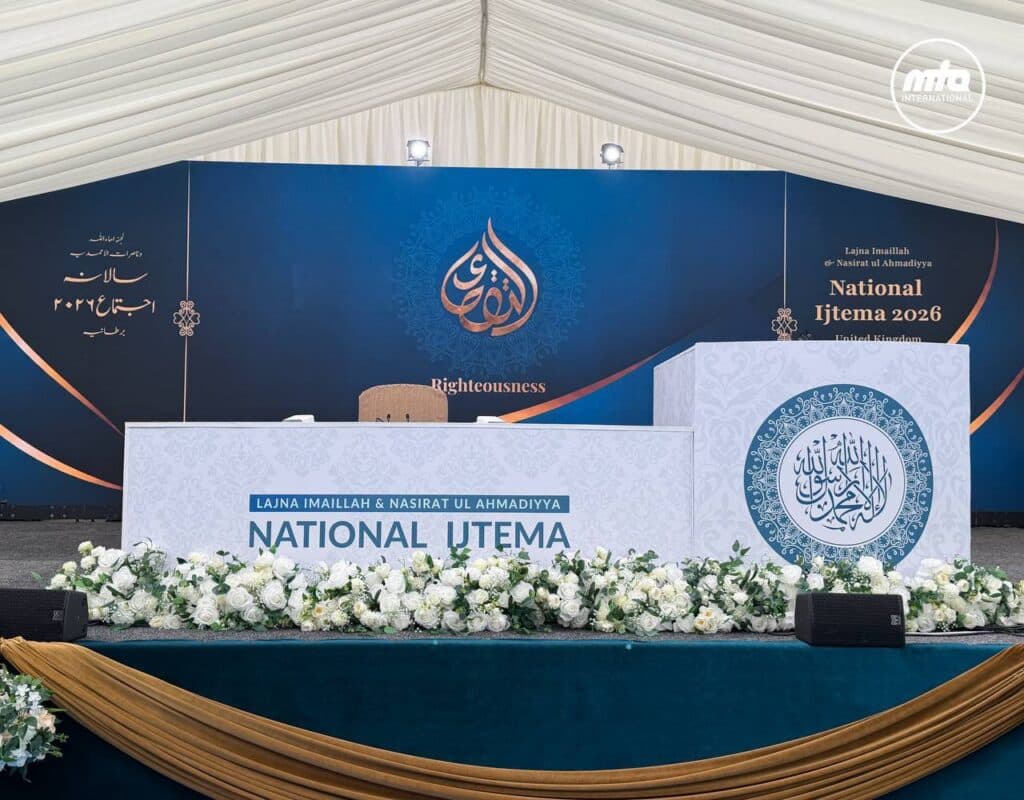
Puttenham, Guildford, 19 September 2026: Hazrat Mirza Masroor Ahmad, Khalifatul Masih V, may Allah be his Helper, arrived at 15:32 GMT, conveying salaam to everyone. A recitation of a portion of the Holy Quran (Surah al-Hashr, Ch. 59: V.19-22) was recited, commencing the formal proceedings of this blessed gathering. After the English translation of the verses was presented, Huzoor (aa) took to the podium for the Lajna Imaillah pledge, which was repeated in unison by all members present. Thereafter, an Urdu poem composed by the Promised Messiah (as) was beautifully presented followed by its English translation. (Barahin-e-Ahmadiyya Part V [English], p. 25)
Sadr Lajna Imaillah UK subsequently presented a report of the ijtema. She expressed gratitude to Huzoor (aa) for gracing the occasion and highlighted that the theme for this year’s ijtema was “taqwa”, i.e. righteousness. She noted that various talks and presentations were delivered on topics including “Taqwa in the Digital Age and Social Media.”
Academic competitions were also held and academic excellence awards for university students had been distributed the previous day to those whose names were announced at Jalsa Salana UK 2026. Awards for GCSE and A-Level students were scheduled for the following day. Two special awards were given to those students of Al-Hafizoon who finished memorising the Holy Quran this year.
This year’s ijtema attendance was 8,806 as compared to 7,496 last year. Sadr Lajna Imaillah UK concluded her report by offering thanks to all those who had contributed to the success of the ijtema and once again expressed heartfelt gratitude to Huzoor (aa) for his blessed presence and humbly requested his prayers for the future progress of Lajna Imaillah UK. A video presentation was then shown, capturing key aspects of the ijtema and showcasing the new features introduced this year.
At 15:57 GMT, Hazrat Khalifatul Masih V (aa) took to the podium again to deliver his address. The following is a summary:
After praying that the attendance of Lajna at the ijtema proves beneficial, Huzoor (aa) stated that he would like to speak about the responsibilities and characteristics of a true believer.
Remember and fulfil your pledge
Huzoor (aa) said that the basic principle of Islam is that every individual is accountable to Allah the Almighty for their actions. As Ahmadi Muslims, we have all taken the bai‘at of the Promised Messiah (as) and so have pledged to abide by all of Allah’s commands. In terms of fulfilling one’s pledges, Allah says: “And fulfil the covenant; for the covenant shall be questioned about.” (Surah Bani Isra‘il, Ch.17: V.35)
Consequently, with a sense of deep anguish and urgency, every Ahmadi, man and woman, must strive to fulfil the conditions of bai‘at. If an Ahmadi fails to do so, they fail to discharge the rights of being an Ahmadi. The paramount objective of the advent of the Promised Messiah (as) was to draw humanity closer to Allah the Almighty. So, having taken this bai‘at, we must strive to inculcate every quality and virtue that serves as a means of attaining Allah’s nearness and pleasure.
Our ultimate return is to Allah; all of us will stand before Allah and be held directly accountable for our actions. Instead of presuming that Allah will be satisfied with us merely because we have accepted the Promised Messiah (as), we must seek to bring about a profound moral and spiritual transformation within ourselves.
Huzoor (aa) said, “A faith that is devoid of practice remains hollow and cannot lead to salvation.” Islam teaches us that every person reaps what they sow. Thus, on the Day of Judgment, each person will stand alone before Allah, with only our good deeds accompanying us. Allah says: “And no bearer shall carry the burden of another.” (Surah al-An‘am, Ch.6: V.165)
Fulfil the right of Allah’s worship
Salat is the ultimate instrument for purifying a person’s soul and protecting a person from all that Allah dislikes or prohibits. It both guards us in this life and is the means of our salvation in the next.
Our challenge is to ensure that we remain firm in our faith at those times when we think that no one is watching, or when we are in the company of people who do not share our religious values. A true believer remains ever fearful of displeasing Allah, irrespective of whether they are on their own or in public. Our fear of Allah should be born out of our love for Him and our appreciation of the limitless blessings He has bestowed upon us.
Looking after children
Allah requires a mother to fulfil the rights of her children. She must love, care for them and fulfil their physical and emotional needs. In terms of their character, a mother must strive to instill high moral values in her children. Above all, children must feel that their home is a sanctuary of security and love so that they may grow into well-adjusted, confident individuals who contribute positively to society and are free from any inferiority complex.
Although a woman is the guardian and protector of her home, regrettably, some Ahmadi mothers are failing to prioritise the well-being of their children as required. Such children end up seeking companionship outside of the home or increasingly online and are extremely vulnerable to bad company, which invariably affects their behaviour and moral standards.
Thus, Ahmadi women should always remember that Allah has placed upon them the primary responsibility of ensuring the moral, spiritual and physical upbringing of their children.
Guard your honour
Huzoor (aa) addressed the older girls present and reminded them that Islam teaches them to guard their honour and modesty in order to be counted among those who are truly obedient to Allah the Almighty, whether at home or outside.
Huzoor (aa) stated: “Increasingly, as you get older, there will be times when you are not with your parents, elders, or in the company of other Ahmadis. On such occasions, always remember that Allah is with you and that He is knower of the unseen. Thus, always observe Islamic standards of modesty in your attire, maintain dignity in your interaction, pursue higher education and seek to fulfill your true potential. All the while, ensure that you shield yourselves from the immoral corruption of modern society.”
Offer istighfar and sadaqa
No matter how much a person tries to do good, shortcomings naturally remain. Thus, alongside striving towards righteous deeds, we must continuously recite istighfar and seek the forgiveness of Allah for our weaknesses. True istighfar is a means of drawing closer to Allah and purifying a person’s spiritual state.
A person who sincerely repents remains ever mindful of their past mistakes and strives to abstain from all things, no matter how small, that may incur the displeasure of Allah. In fact, they develop a deep aversion to everything that the Quran prohibits or that Allah dislikes. Thus, we must recite and study the Holy Quran daily to understand what Allah desires from us.
Another excellent method of seeking Allah’s forgiveness and mercy is to offer charity and assist people who are in need or suffering in any way. Treat people with kindness and ensure that your words and actions cause no distress or harm to others. In terms of your close relations, we must strive to strengthen the ties of kinship by treating our relatives with love, generosity and compassion.
Family disputes and their solution
It is a source of deep regret and sorrow to observe that disputes between in-laws and spouses are becoming increasingly prevalent within our Jamaat. A root cause of these family breakdowns is that the threshold of patience and tolerance between a husband and wife appears to be diminishing by the day, ultimately leading to divorce.
Huzoor (aa) regrettably noted that though men and women frequently fail to discharge the rights owed to one another, ultimately, it is children who are the innocent parties who suffer the most when marriage breaks down. Thus, those Ahmadi couples who fail to make every effort to safeguard the unity of their homes do not just hurt themselves but are guilty of inflicting immense emotional harm upon their children.
Apart from a few genuine cases where separation becomes necessary, it has been noticed that husbands and wives are choosing to separate simply due to a lack of patience and maturity, which is ultimately rooted in a lack of piety. Instead of permitting their egos to overwhelm them, both a husband and a wife ought to bow down before Allah in a state of absolute humility, seeking His forgiveness and help whenever domestic problems arise.
How do we know if Allah has accepted our repentance?
Huzoor (aa) said that if a person abandons their past mistakes or weaknesses and is now striving to do good deeds with the fear of Allah ingrained in their heart, it means that their repentance was sincere and has been accepted. Huzoor (aa) said we should assess ourselves daily – to what extent were we able to perform good deeds? To what extent were we able to save ourselves from the immoralities and vices of the world and stay on the right path?
A believer may claim to have true faith, but the real test is whether their actions correspond to their words.
Speaking the truth and rejecting falsehood
Allah the Almighty has equated falsehood with shirk and states in the Quran:
“O ye who believe! be strict in observing justice, [and be] witnesses for Allah, even though it be against yourselves or [against] parents and kindred.” (Surah an-Nisa’, Ch.4: V.136)
It is not easy to act upon the highest standard of truth required by the Quran; many people lie or conceal the truth in order to preserve their self-interests. Yet Allah says that if your faith is strong and you desire peace, you must set aside your personal interests and act with absolute integrity.
Speaking the truth can lead to true peace
The world today has become consumed by violent conflicts and reckless wars. Suppression of truth and a constant wave of lies and misinformation are being spread in order to serve Western interests. If honesty and justice were to prevail on all sides, many of the conflicts taking place would quickly disappear and peace and reconciliation would occur.
In terms of a person’s family life, if a husband and wife speak truthfully and acknowledge their mistakes instead of letting their pride overwhelm them, their arguments or conflicts will quickly come to an end and their homes shall become true havens of peace.
Our religion teaches us that truth is the foundation of justice and the means of attaining the favour of Allah the Almighty. In a marriage, if one party commits a small mistake, instead of ignoring it or gently addressing it, the other party responds in a hostile and disproportionate way. This, in turn, ignites a bitter cycle of escalating anger and resentment.
Shunning vanity and vulgarity
The Holy Quran states: “And when they pass by anything vain, they pass on with dignity.” (Surah al-Furqan, Ch.25: V. 73)
In this verse, Allah says that a defining characteristic of a believer is that when encountering anything vulgar or indecent, they pass by with dignity and refuse to engage with it. Social media, the internet, television and other forms of media are all replete with indecent and toxic content that can easily subvert people from the path of righteousness and drive them towards sinful behaviour. All Ahmadis must protect themselves from these corrosive influences.
In particular, Ahmadi women have a duty to ensure their homes are free from these malign influences. If a mother remains free from moral vices, she will naturally be in a stronger and better position to safeguard her husband and children from such things. Otherwise, the vile and profane content that exists online and in the media has the potential to corrupt not just the lives of individual families, but the social and moral fabric of entire societies.
We must therefore act righteously, strive to do good works, save ourselves from all forms of indecency and vice and be positive examples for others. Above all, we must establish a close bond with Allah the Almighty. Only then can we fulfil our objective of establishing peace in the world and sharing the excellencies of Islam through tabligh.
Many mistakenly view Islam as an oppressive or man-made faith. It is therefore our profound duty to demonstrate that Islam is a divine religion designed to establish universal peace and to liberate humanity from all forms of conflict and disorder. Unquestionably, Ahmadi women have a monumental role to play in this noble mission.
Accordingly, we must learn the true teachings of Islam and ponder over the signs of Allah the Almighty. Allah the Almighty states: “And those who, when they are reminded of the Signs of their Lord, fall not deaf and blind thereat.” (Surah al-Furqan, Ch.25: V. 74)
Here, Allah the Almighty says that the hallmark of a true believer is that when reminded of the signs of Allah, they do not turn a deaf ear or a blind eye. Instead, they listen attentively, increase in faith and act upon Allah’s commands with even greater conviction.
As an Ahmadi, whenever or wherever we hear or learn good things, we must seek to incorporate them into our daily lives and elevate our own moral standards and those of our homes and communities.
Expectations of the Promised Messiah (as)
The Promised Messiah (as) wrote:
“O ye people who consider yourselves members of my community! You will be counted as such in heaven when you truly tread upon the ways of righteousness.” (Noah’s Ark, pp. 24-25)
So we must continue to reflect upon our spiritual and moral state. To what extent are we fulfilling the rights of the bai‘at of the Promised Messiah (as) and fulfilling his teachings? To what extent are we fulfilling the rights of the worship of Allah? To what extent are we acting upon the commands of the Holy Quran and the instructions of the Holy Prophet (sa)? To what extent are we loyal to the institution of Khilafat and the Jamaat? To what extent are our deeds based in piety? And to what extent are we treating others with love, empathy and compassion? To what extent are we fulfilling our duty to raise our children in the best possible way and ensuring their moral and spiritual development?
Huzoor (aa) prayed that may Allah enable everyone to scale the highest spiritual heights and to live their lives as devoted and faithful servants of Allah the Almighty. May Allah continue to bless Lajna Imaillah in all respects. Amin! Huzoor (aa) then led all attendees in du‘a (silent prayer). Thereafter, Hazrat Amirul Momineen (aa) affectionately listened to a few taranas (choral poems) of Lajna Imaillah and Nasirat.
(Report prepared by Al Hakam)