
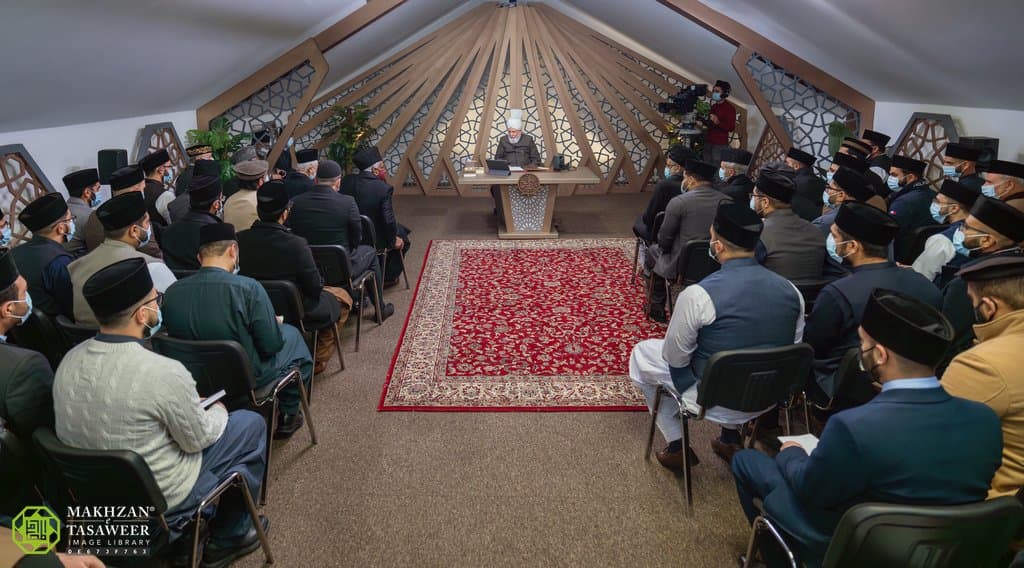
Islamabad, Tilford, 24 January 2026: Missionaries serving with Jamaat-e-Ahmadiyya UK had the blessed opportunity of a mulaqat with Hazrat Mirza Masroor Ahmad, Khalifatul Masih Vaa. The group comprised 60 missionaries in total, with 41 serving in the field and 19 assigned to various offices.
The proceedings began when Huzooraa graced the hall with his presence, greeted the attendees and led everyone in a silent prayer.
A revolution
Huzooraa commenced the meeting by enquiring from the Missionary-In-Charge regarding the composition of the group and whether the performance of the field missionaries was satisfactory. “They were making efforts”, he replied. Huzooraa remarked that one must strive throughout one’s life, emphasising the need for tangible results.
Turning to a young missionary who had graduated from Jamia Ahmadiyya UK in 2012, Huzooraa noted that about 13 years had passed since his graduation. Huzooraa asked what revolution he had brought about in that time. Huzooraa observed that graduates of Jamia UK are educated in the West, have no language barrier and understand the local culture well; therefore, significant results were expected. Huzooraa asked if any such results had manifested.
Tabligh
Huzooraa enquired about the personal tabligh contacts of the missionaries. He asked the Missionary-In-Charge if each missionary had at least 20 contacts. When it was reported that the average was significantly lower, between two and five, Huzooraa asked those with at least 10 contacts to raise their hands.
During a conversation with a missionary, Huzooraa asked about local demographics. The missionary said there was a significant African diaspora community nearby. Huzooraa expressed surprise that he had not established sufficient contacts within that community and emphasised the need for proactive planning and outreach.
Huzooraa enquired of another missionary about his annual bai‘at figures. The missionary reported, “By the grace of Allah, this year 31 bai‘ats have been achieved.” Huzooraa then asked what role he had played in these conversions. The missionary mentioned that in his office, at least four tabligh sessions took place with each person and literature was given before the bai‘at. When Huzooraa asked whether the conversions were through the Tabligh Department or personal contacts, the missionary replied, “Mostly, members of the Jamaat bring them individually; sometimes these individuals come on their own.”
Huzooraa observed that with 41 missionaries in the field, even if each maintained 10 personal contacts, there would be over 400 tabligh contacts. He instructed that a comprehensive tabligh plan be developed and given to the missionaries to ensure better results.
Speaking to another missionary, Huzooraa asked about the number of bai‘ats he had achieved in the past year. When asked about the total over the last decade, the missionary was unsure but gave an estimated figure. Huzooraa expressed dissatisfaction with this lack of data and results. He attributed the shortcomings in tabligh to sloth.
Later in the meeting, Huzooraa recalled his longstanding guidance that, if the Jamaat consistently introduced its message to a meaningful portion of the country’s population each year (about five to 10 per cent), a clear impact could become visible within a few years. He observed that public awareness still required strengthening in many places and therefore urged systematic planning and sustained outreach efforts.
Tarbiyat and teaching children the Holy Quran
Huzooraa highlighted tarbiyat issues, particularly regarding family life. He noted that marital disputes are increasing, with couples seeking divorce or khul‘ even after 20 or 25 years of marriage. Huzooraa stated that missionaries must play an active role in resolving these domestic issues.
Huzooraa noted that attendance at congregational prayers was low and urged missionaries to persistently follow up with members personally to foster a change. He added that the tarbiyat of children is not solely the responsibility of the auxiliary organisations but is a primary duty of the missionary. Huzooraa referenced his earlier sermons regarding the teaching of the Holy Quran, stating that it is unacceptable for a missionary to claim that teaching the Quran is not their job. Huzooraa emphasised that giving a brief five-minute dars is not sufficient; missionaries must ensure members learn the Holy Quran.
Huzooraa said:
“Do you think the tarbiyat of [children] and teaching them the Holy Quran is only the work of Ansarullah or Khuddam-ul-Ahmadiyya or Lajna? It is true that every auxiliary organisation has a system of Talim-ul-Quran or the teaching of the Holy Quran, as well, but it is also the duty of the murabbis. I drew attention to this in a Friday sermon a few months ago, too, that you should pay attention to teaching the Holy Quran. Otherwise, people have [their children] taught by non-Ahmadis or they write to me asking where they should have them taught. […] If it is not your job, then whose job is it?”
Later in the meeting, Huzooraa also drew attention to the fact that many Ansar were still unable to recite the Holy Quran properly and urged missionaries to come forward and make arrangements to teach them as well.
When speaking to another missionary about tarbiyat matters, Huzooraa said:
“[For tarbiyat], you have to persistently follow up with people. Send them repeated messages, [containing] the injunctions of the Holy Quran, the sayings of the Holy Prophetsa from the ahadith, the words of the Promised Messiahas and the advice of the Khulafa. And keep reminding them how essential congregational salat in the mosque is.”
Later in the meeting, with regard to tarbiyat, Huzooraa emphasised that the foremost objective was to strengthen and draw closer one’s own people first, as only then could the message be conveyed effectively to others.
Huzooraa cautioned that if tarbiyat was neglected, apparent outward progress would not be sustained. He explained that moving forward without consolidating those already within the Jamaat was like repeatedly advancing without securing what had already been gathered, resulting in little lasting gain and the same cycle being repeated without real progress.
Friday sermon-based weekly planning
Addressing the Missionary-In-Charge, Huzooraa further directed that his Friday sermons should be used as the basis for weekly planning and focused tarbiyat work.
Huzooraa instructed that, after each sermon, its key points should be extracted and a weekly action plan prepared in line with those points. He directed that the most important themes be shared with all missionaries, with clear guidance that, during that week, emphasis must be placed on those particular matters. To ensure this was done consistently, he instructed that a dedicated team be established at the Markaz to prepare this material and send it out regularly.
Huzooraa further directed that, once this plan had been prepared, the missionaries should be given clear instructions that this was the plan and that they should work accordingly. He also instructed that, alongside messaging the missionaries, a brief summary of two or three lines should be circulated to Jamaat members as well.
Later in the meeting, Huzooraa also urged all missionaries to take notes of the Friday sermon themselves so that its guidance could be retained and acted upon more effectively.
Huzooraa reminded the missionaries that it was not a matter of simply attending a monthly meeting or leading the five daily prayers, as this, in itself, was not an achievement.
Call for spiritual reformation
Huzooraa then drew attention to the importance of offering Tahajjud regularly and reminded the missionaries that they must strive to be role models in their worship.
He also urged them to offer at least two nawafil daily for the progress of the Jamaat, for its members and for their respective areas. Huzooraa noted that, alongside personal supplications for one’s family and loved ones, it was essential to pray consistently for the Jamaat so that Allah’s blessings may descend.
Understanding the spirit of waqf
Huzooraa urged the missionaries to fully recognise the gravity of their responsibilities, reminding them that they had been entrusted with a great task. He said:
“Understand your responsibilities. A [great] task has been entrusted to you. Merely writing in a letter to me, asking, ‘[Pray that Allah] may make us the sultan-e-naseer of Khilafat,’ does not make one a sultan-e-naseer just like that. For this, one must exert oneself to the utmost, offer sacrifices and partake in a jihad. Only then will you attain that which is your objective. The Promised Messiahas has said that the Companions used to go forth for jihad and they even sacrificed their lives. But today, that jihad is not [in that form]; rather, whatever jihad there is in this age, you must discharge it properly. You are among those who have presented yourselves, saying that we shall remain at the forefront in this jihad, we shall guide others too and we shall establish our own example. When this happens, only then can you bring about the revolution for which you have dedicated your lives. Otherwise, it will be an attempt to deceive Allah the Exalted, but Allah the Exalted cannot be deceived. […] If you have dedicated yourselves for the sake of Allah, then you must also offer sacrifices for it. The very name waqf signifies sacrifice. […] There may be issues concerning children, one has to fulfil their rights and there are the rights of one’s wife that one has to fulfil, but along with that, also see where and to what extent we are fulfilling the right of our true objective. If you are fulfilling that true right, then your progress can be, at the very least, tenfold.”
Strengthening tarbiyat, knowledge and accountability
Huzooraa reiterated the need for sustained attention to teaching children the Holy Quran. He also urged missionaries to strengthen their own religious knowledge so that they could guide young members effectively, address contemporary influences with confidence and provide satisfactory answers when members sought help.
He also reminded those assigned to office duties that administrative work did not lessen their core responsibilities and that Tahajjud, the five daily prayers, recitation of the Holy Quran, its translation and tafsir, study of Jamaat literature and personal spiritual discipline must remain central.
Huzooraa also noted that some missionaries efficiently prepared written points after his Friday sermon and that this was commendable and he encouraged others to adopt the same practice.
Huzooraa encouraged missionaries to adopt an organised daily programme that included Tahajjud, congregational prayer, regular tilawat with translation, purposeful study and clear priorities throughout the day, including tabligh, tarbiyat, strengthening contacts and reconnecting with those Jamaat members who had become distant. He advised that, before retiring at night, each missionary should assess what had been done for the Jamaat, for learning and for personal reformation.
Huzooraa said:
“Offer Tahajjud and when the days grow long, even then try to offer it. Not merely ‘try’; rather, offer it – it is essential – because it is then that the reward of Tahajjud is greater. Regarding the narrating of the aspect of Allah’s love in the Holy Prophet’ssa life, [which I have been mentioning in my Friday sermons], one purpose I had in view was this as well: that when divine love is kindled, a zeal and passion will arise and then people will themselves strive for it. And you who are missionaries will strive all the more and will make this most excellent example [uswah-e-hasanah] a part of your practical lives – indeed, will make every effort to do so. Only then can successes be attained; otherwise, whether we have 41 missionaries in the field or 4,000 missionaries in the field, if they are to remain seated at home, there will be no benefit; they will only be a burden upon the Jamaat and there is no other advantage. Therefore, take account of yourselves [daily].”
Huzooraa also directed that progress should be reviewed through regular reports and daily diaries.
Huzooraa drew attention to the tahrik of prescribed azkaar and prayers recited in fixed numbers and enquired about the regular observance of it. He emphasised that, as representatives of Khilafat, missionaries should first embody these disciplines themselves so that they could credibly encourage the same spirit within the Jamaat members.
Concerning house visits, Huzooraa acknowledged the ongoing efforts and urged that the pace and follow-up be strengthened through firmer oversight and clear accountability.
He said, “Devise a comprehensive, concrete programme – one that makes it evident that you are truly prepared to bring about a revolution.”
Benefitting from Jamaat media
Huzooraa drew attention to regularly benefiting from the various Jamaat platforms, stating, “Now, through the media – through Al Fazl, through Al Hakam and through MTA – whatever I say to anyone in order to explain things reaches the people.”
He noted that, alongside his sermons, MTA also regularly broadcasts the guidance of past Khulafa and the Promised Messiahas. Huzooraa urged that missionaries be encouraged to develop the habit of listening to MTA daily – at least for an hour – just as people routinely follow other channels. He added that with multiple MTA channels and a full schedule – available live and on-demand across devices and in different languages – benefitting from it ultimately depends on one’s own interest and passion; otherwise, life simply continues to pass by without meaningful change.
Serving with sacrifice and gratitude
Huzooraa drew attention to the material circumstances of the UK missionaries and observed that, through the allowances and support provided, they were not in a position of any hardship in worldly terms. He noted that they were not facing any such difficulties, especially when compared with those serving in some other countries, where missionaries often have to manage in far more constrained circumstances.
In light of this, Huzooraa urged the missionaries to show gratitude for Allah’s blessings by striving to increase their efforts beyond what they had done before. He reminded them that, given the level of support available, they should devote the time and sacrifice required for the sake of Allah, rather than becoming absorbed in routine domestic matters and other worldly preoccupations.
Huzooraa said:
“Even from a worldly point of view, it cannot be said that we are in a very bad state. And in some countries, our missionaries are in a very poor condition and making ends meet is difficult; they cannot even get through 10 days on their allowance. So, as an expression of gratitude, you should pay even greater attention than before to working harder, that we are better off than people – better off than the missionaries in other places and better off than ordinary people as well. Therefore, the amount of time we ought to give and the sacrifices we ought to make for the sake of God Almighty – those we should make.”
Huzooraa also added, “All of this is a matter of zeal and passion. If it is present, the work will be accomplished; if it is absent, it will not.”
Huzooraa remarked that, in his view, some of the more senior missionaries, who had graduated from Jamia Ahmadiyya UK and had served in the UK for many years, should perhaps be assigned for periods of around three years to serve in Africa. He indicated that newly graduated missionaries could be deployed within the UK, while senior graduates should be sent to more remote areas of Africa, including villages, so that they could experience firsthand the hardships and demands of service in challenging conditions.
Huzooraa clarified that he was not suggesting that those serving there were performing their work to perfection, but he observed that they were, at the very least, enduring hardships and learning to bear difficulties. He emphasised that true gratitude for Allah’s favours and blessings is shown by striving to increase one’s efforts and working harder than before.
Questions and answers
Following the review of their activities, the missionaries were permitted to ask questions.
A missionary asked about the permissibility of using prayer beads (tasbih) or electronic counters, noting that some people find it difficult to keep count of large numbers of prayers.
Huzooraa clarified that there is no harm in using them. He explained that while the Promised Messiahas discouraged counting in a different context, he also prescribed specific numbers for certain prayers to be recited. Without counting, one cannot know if the prescribed number has been reached. Huzooraa said that one can use beads or electronic ring counters at home, provided it is not done for show. However, Huzooraa emphasised that the essence of prayer is focus and attention.
A question was raised regarding the consumption of meat from fast-food chains in the UK. The missionary noted that some Ahmadis insist one cannot eat there even after reciting bismillah and impose this view on others.
Huzooraa laid down the principle: if it is known with certainty that the animal was killed by full stunning or shock without any slaughter or bleeding, then it should not be eaten. However, Huzooraa noted that generally, even with machine slaughter, the throat is cut and bleeding occurs. If the name of anyone other than Allah is not invoked and the blood is drained, it is generally considered halal. Huzooraa advised that unless there is clear knowledge that the animal was not slaughtered and bled, one may eat after reciting bismillah.
A missionary asked if a dedicated team of missionaries could be formed with an independent portfolio to respond to the growing online opposition against the Jamaat.
Huzooraa replied that the UK Tabligh Department is already efficient and making efforts. He said that, rather than creating separate platforms, missionaries should support the existing UK Tabligh Department to avoid disjointed efforts. He further noted that those who are more knowledgeable and better equipped in this area should join and support the central team, so that the response remains unified and effective. He added that he had already issued guidance on this in an earlier circular.
Huzooraa also highlighted the need for wisdom, noting that modern attention spans are short. He suggested creating short video clips for social media featuring excerpts of the Promised Messiahas to counter misconceptions. Huzooraa said that a misconception was being propagated that, God forbid, Ahmadis do not believe in the Holy Quran or disrespect the Holy Prophetsa. Huzooraa said such misconceptions should be cleared using contemporary methods.
Huzooraa added:
“And let me also make this clear: do not imagine that merely by working you have done your duty and pleased Allah. No – alongside this, you must also pay attention to supplications and salat. Begin every task with supplication and seek help from Allah the Almighty; then there will be blessings.
“[In my sermons] I have been giving examples of the Holy Prophetsa for the past two or three weeks. What [need was there for supplication when] Allah the Almighty’s promises were there? […] Yet, despite all those promises, he remained deeply engrossed in zikr and would weep and supplicate before Allah. In the accounts of the Promised Messiah’sas life as well, this very point is found: despite everything, he gave his attention to supplications. So do not forget these things – and then work.”
A missionary asked how to remain steadfast and work effectively if the local amila’s cooperation is limited.
Huzooraa advised that a missionary’s primary tasks are tarbiyat and tabligh. These should be organised through the respective secretaries. If cooperation is not forthcoming, the matter should be raised at the amila meeting or with the Missionary-In-Charge or the Amir. Huzooraa reminded them that the goal is reformation, not conflict and one should not interfere unnecessarily in other departments but should remain focused on their core duties.
Regarding Christians who claim their prayers are answered by Jesusas and ask why they need Islam, Huzooraa advised that while we revere Jesusas as a Prophet, one must examine the reality, the results and the quantity of these alleged miracles. Huzooraa noted that extraordinary events can happen even to atheists or through psychological effects, but this does not validate their beliefs. A true relationship with Allah is proven through consistent signs and the acceptance of prayers that are free from shirk or associating partners with God.
The missionary also asked what to do if prayers are not being answered despite a long period of supplication.
Huzooraa advised self-reflection on the quality of one’s worship. He explained that a delay often signals a greater potential for acceptance. He said:
“This means that there is some weakness within you. If an answer is not forthcoming, then there is some weakness. Are you truly fulfilling the due right of worship to Allah the Exalted, fully and properly? And at times, an answer comes late.
“You do relate that incident: a man kept praying for 30 years, yet it was not being accepted. One day, in the presence of his disciple, an answer came that his prayers would not be accepted. The disciple said, ‘Then leave it now.’ He said, ‘I have been praying for 30 years. Where else shall I go?’ Thereupon Allah the Exalted said that the prayer had been accepted. Indeed, all the prayers of those 30 years had been accepted.
“The Promised Messiahas also explained this philosophy: the longer the delay in the acceptance of prayer, the greater the potential of acceptance becomes. Then there is this: a person should examine their own condition. Have I fulfilled that right [of worship]? Are my nawafil, my zikr-e-ilahi, my salat and my attention towards Allah the Exalted as they ought to be? Is it that, having offered only a cursory [worship], you say, ‘That’s it. I have said it, so now I must receive an answer’? It is not necessary that any [revelatory] answer should be granted. Sometimes, the heart is granted reassurance. This, too, is the answer.
“And if, in some particular matter, an answer is not forthcoming, then pray thus: ‘O Allah! If this is not better for me, then remove it from my heart. If it is better, then create reassurance within my heart and also make it manifest to me.’
“Prayer has its time; it has its method and it can also take some time. To say, ‘I have given a limited time, 10 days, 15 days, a month; now Allah the Exalted should give an answer,’ then Allah the Exalted is not bound by us. When the Sharia was being revealed to the Holy Prophetsa, did it continue to descend without interruption? At times, a long interval occurred and the disbelievers began to mock. Then Allah the Exalted sent down verses again. Allah the Exalted has His own ways; therefore, one should continue to beseech Allah the Exalted, ever asking.”
The meeting concluded with group photographs, after which Huzooraa graciously presented pens to the missionaries as gifts.
(Summary prepared by Al Hakam)