
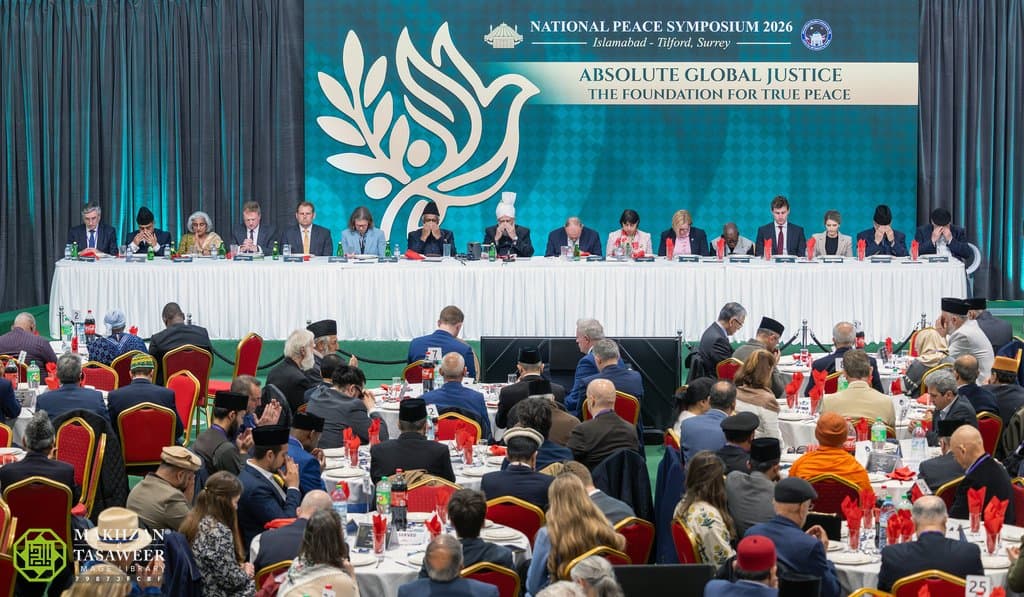
Islamabad, Tilford, UK: On 16 May 2026, Hazrat Mirza Masroor Ahmad, Khalifatul Masih V, may Allah be his Helper, graced the Ahmadiyya Muslim Jamaat UK’s National Peace Symposium 2026.
The event commenced with a recitation from the Holy Quran – Surah an-Nisa, verses 135-136, followed by their English translation. Amir Jamaat-e-Ahmadiyya UK, Rafiq Ahmad Hayat Sahib, then gave the welcome speech and an introduction to the Peace Symposium. This event marks the 19th National Peace Symposium hosted by the Ahmadiyya Muslim Jamaat UK. This year’s theme is: “Absolute Global Justice – The Foundation for True Peace.”
Rafiq Ahmad Hayat Sahib introduced Hazrat Amirul Momineen’s (aa) efforts to establish world peace and his efforts to help humanity throughout the world. Hazrat Khalifatul Masih V (aa) frequently meets with faith leaders and heads of state and has delivered keynote addresses at the United States Congress, the European Parliament, the UK Parliament, the Dutch Parliament and the Conference of World Religions in London.
Following the welcome and introductory remarks, Gregory James Stafford MP, Sir Edward Jonathan Davey MP and Seema Malhotra MP each spoke on the current state of the world, ongoing conflicts, and the challenges of achieving lasting peace and international stability. They acknowledged the efforts of the Ahmadiyya Muslim Jamaat in establishing peace and justice across the globe.
Subsequently, the announcement of the Ahmadiyya Muslim Prize for the Advancement of Peace highlighted the contributions of the 2025 recipient: Grégoire Ahongbonon. A presentation video was then shown, after which he received the award from Hazrat Amirul Momineen (aa). Thereafter, he expressed happiness and conveyed his gratitude to all present.
Hazrat Khalifatul Masih V (aa) then took to the podium to deliver the keynote address. A summary of this address is presented below:
Huzoor (aa) extended his heartfelt gratitude to all the distinguished guests who had joined for the gathering.
Hazrat Amirul Momineen (aa) remarked that such symposiums have been organised continuously for decades. This year, when the organisers proposed holding this Peace Symposium once again, some people questioned what practical benefit has emerged from these efforts.
Many politicians and religious leaders across the world have expressed concern regarding the prevailing state of injustice and instability. At this critical juncture, peace and security must be prioritised above all else. The question is indeed legitimate: what benefit has resulted from more than two decades of Peace Symposiums?
However, Islam teaches us that we must continue striving tirelessly for positive transformation in the world. What endeavour could be nobler than striving for the survival and preservation of humanity itself?
If war, disorder, hatred, injustice and unrest are not addressed, then civilisation, culture and human progress will gradually deteriorate. Humanity will witness catastrophic destruction whose consequences will extend far beyond the present generation and continue to affect generations yet to come.
The catastrophic consequences of war
Approximately 70 million people lost their lives during the Second World War, many of whom were innocent women, children, and civilians. It was by the grace of Allah that the devastation remained geographically limited.
However, Japan – the only country to have suffered two nuclear attacks – continues to bear the consequences decades later, with studies indicating that the effects persisted across generations.
In 1945, the United States was the sole possessor of nuclear weapons. Today, however, numerous nations possess such arsenals. God forbid that even one or two nuclear weapons be deployed in any conflict – the resulting devastation would far exceed human imagination.
Many influential individuals now openly acknowledge that the world is moving towards circumstances whose consequences could be horrifying beyond precedent. Such turmoil and provocation may lead to destruction unseen in human history.
Consequently, sincere voices are attempting to urge nations towards patience, restraint and reconciliation. We labour throughout our lives for the welfare of our families and children – why then should innocent lives be sacrificed in the pursuit of war?
Those promoting conflict are not merely preparing for war against others; they are, in reality, preparing destruction for their own children and future generations.
Global voices warning against escalation
Recently, various commentators, analysts and intellectuals have voiced similar concerns. Last year, Ireland’s then President, Michael D Higgins, affirmed that humanity has entered an era in which threats of war are rapidly increasing. Rather than diplomatic initiatives being pursued, such efforts are being sidelined, while a mentality encouraging bloodshed is becoming increasingly widespread.
Similarly, the Prime Minister of Slovakia has openly stated that discussions surrounding war and military preparedness have become alarmingly normalised. Regarding Ukraine, he observed that one standard is applied, whereas entirely different standards are employed concerning Gaza and Iran. He further remarked that he could not comprehend why the contemporary world appears so eager for war, despite the immense anxiety and instability such attitudes create.
The Islamic principle of universal justice
The fundamental teaching of Islam is that a person should desire for others what he desires for himself. Huzoor (aa) stated that if humanity were truly to uphold this golden principle, the world would become a paradise of peace, mutual understanding and harmony.
Concerning the conflict involving Iran, even Germany’s Vice Chancellor has publicly spoken against war. Huzoor (aa) remarked that while he appreciates all those who speak against warfare, practical measures remain almost non-existent. Mere rhetoric, regardless of how appealing it may sound, cannot establish peace and security.
During his visit to Türkiye, the Pope similarly warned that a “Third World War” was gradually being fought in stages, placing the future of humanity at stake. Huzoor (aa) observed that many people are now acknowledging the very warnings he has been issuing for years – namely, that humanity is sleepwalking towards darkness and destruction.
Double standards and the failure of global leadership
The Prime Minister of Spain recently stated that one illegality cannot be remedied through another illegality. Wars often begin through a chain of smaller reactions and retaliations. If injustice is committed by one party, the other must not respond with further injustice.
Today, many powerful states place themselves above international law, driven primarily by self-interest. Yet unlawful actions do not remain isolated – they spread and their consequences become uncontrollable.
Injustice is like a deadly virus that spreads rapidly. If major powers assume that their actions will never invite accountability and that they may disregard law, morality, civilisation and human life without consequence, then the global disorder and instability we witness today are inevitable outcomes of such thinking.
The duty of governments is to alleviate the suffering of their people and improve their quality of life – not to make life increasingly difficult. Unfortunately, many contemporary politicians have failed in this regard. They use war as a means to conceal their failures, while some even derive financial benefit from conflict, deceiving their populations in pursuit of economic interests. Instead of investing resources in hospitals and human welfare, trillions are being spent on instruments of destruction.
Militarism and the crisis of international institutions
A prominent American intellectual observed that particularly in the West – and especially in the United States – excessive reliance is placed upon military power. Rather than pursuing diplomacy, force is often treated as the primary solution. Regarding Iran, the situation remains extremely tense, and if not contained, the world may soon face a severe economic crisis.
Islam teaches that both the oppressor and the oppressed must be assisted: the oppressed through support and justice, and the oppressor by restraining him from oppression. Islam also emphasises proportionality and restraint, discouraging vengeance and escalation.
Another American scholar urged humanity to learn from history, noting that major international institutions and legal systems appear increasingly ineffective.
Just as the League of Nations failed during the 1930s, the United Nations also appears unable to fulfil its intended role. The concentration of veto power in the hands of five nations represents a fundamental structural flaw. If diplomacy is abandoned, the only remaining outcome is war.
Recently, Canadian Prime Minister Mark Carney remarked that the world is increasingly operating under the logic that the strong dictate outcomes and the weak suffer the consequences. Yet coercion and force may produce temporary gains while yielding disastrous long-term consequences.
Exploitation, hypocrisy and the abuse of human rights narratives
Huzoor (aa) highlighted that many powerful and developed nations sustain their dominance through injustice and exploitation, while remaining silent regarding the oppression committed by their allies.
At times, wars are justified under the pretext of protecting women’s rights, despite the fact that countless women and girls themselves become victims of those very conflicts.
A Spanish parliamentarian remarked regarding the Iran conflict that the rhetoric of women’s rights is frequently instrumentalised to preserve geopolitical dominance and justify military intervention. Similar justifications were presented in relation to Syria, Iraq, Lebanon, Afghanistan, and Iran, despite the devastating humanitarian consequences suffered by civilians.
Misrepresentation of Islam
As Muslims, we recognise that there are individuals who commit violence and disorder in the name of Islam. The media often amplifies their actions, leading to false portrayals of Islam itself.
However, it is fundamentally incorrect to blame Islam – or any religion – for the misconduct of individuals acting contrary to its teachings.
The mission of the Ahmadiyya Muslim Jamaat
The promotion of peace, harmony and mutual understanding remains among the foremost objectives of the Ahmadiyya Muslim Jamaat. We shall continue organising such events, even if the message reaches only a small number of people.
Huzoor (aa) stated that he has personally written to numerous world leaders, urging them to work for the betterment of humanity. He mentioned writing to the Prime Minister of Israel. He also highlighted writing to the President of Iran and various Muslim leaders, inviting them – in light of the teachings of the Holy Quran – towards justice, fairness and mutual understanding.
Huzoor (aa) further stated that he continues to convey the same message to the President of the United States and the President of China, urging them to reflect upon the increasing global tensions and the growing threat facing humanity itself.
Regrettably, the escalating chaos, unrest and instability in the world demonstrate that these warnings are not being adequately heeded.
Racism, prejudice and the need for justice
Nations are increasingly consumed by conflict, while minorities are frequently targeted within states. Racism and prejudice are becoming more widespread. Rather than recognising the virtues and strengths of other nations, societies increasingly focus upon perceived faults and hostilities. Misconceptions regarding Islam are similarly spread through sections of the media.
Yet Islam’s teachings transcend time and place. The Holy Quran commands believers to uphold justice firmly, even if doing so requires bearing witness against one’s own parents, relatives or nation.
The Holy Quran further teaches that neither wealth nor poverty should influence justice and that personal desires must never lead one away from fairness. In other words, social status holds no value before Allah. True worth lies in sincerity, truthfulness and steadfastness in bearing honest witness.
Allah the Almighty further commands that hostility towards others must never cause believers to abandon justice, for justice is closest to righteousness. Islam thus requires fairness not only towards allies but even towards opponents and adversaries.
Islamic teachings regarding conflict resolution
Regarding conflict between nations, the Holy Quran teaches that if two parties fall into dispute, efforts should first be made towards reconciliation and peace. If one party continues aggression, then collective action may be taken to restrain it. However, once aggression ceases, no further vengeance or oppression should follow.
This principle is designed to establish lasting peace, regardless of whether the parties involved are strong or weak, oppressors or oppressed. Islam fundamentally advocates justice and fairness.
Islam also teaches that wisdom should be accepted regardless of its source. If a truthful and wise statement is heard from a Christian, a Jew or even an atheist, it should be embraced.
Such openness not only improves individual character but also fosters peace and harmony within society.
A warning and prayer for humanity
Huzoor (aa) stated that, in light of everything presented, he firmly believes that certain individuals and nations driven by greed for the wealth and resources of others fail to recognise that the overwhelming majority of humanity still desires peace. Therefore, every individual must play his or her role, and the need for such efforts grows more urgent with each passing day.
He expressed deep fear that if these wars continue, the scale of destruction and loss of life will surpass anything previously witnessed in human history. The devastation will not remain confined to a single generation – future generations will also bear its consequences.
Hence, it is our collective responsibility to leave behind a world in which our children and future generations may live in peace. Our actions today must ensure that future generations are not forced to suffer because of our failures. Otherwise, they will rightly hold us responsible for leaving behind a world consumed by flames and conflict.
Huzoor (aa) emphasised that peace cannot be achieved merely through holding symposiums; meaningful and practical action is essential. Nevertheless, he expressed his sincere hope and prayer that this Peace Symposium may become a first ray of light leading humanity towards positive transformation.
May humanity come to understand the urgency of this moment, rising above differences of belief, ideology and religion, and striving collectively for justice and compassion.
May the dark clouds of war that hover above humanity disperse, revealing once again a bright and peaceful sky founded upon love, tolerance, brotherhood and sacrifice.
At the end, Huzoor (aa) once again thanked all those who attended the symposium and expressed his deep appreciation for their participation. Hazrat Amirul Momineen (aa) then led everyone in silent prayer to conclude the event.
(Summary prepared by Al Hakam)