
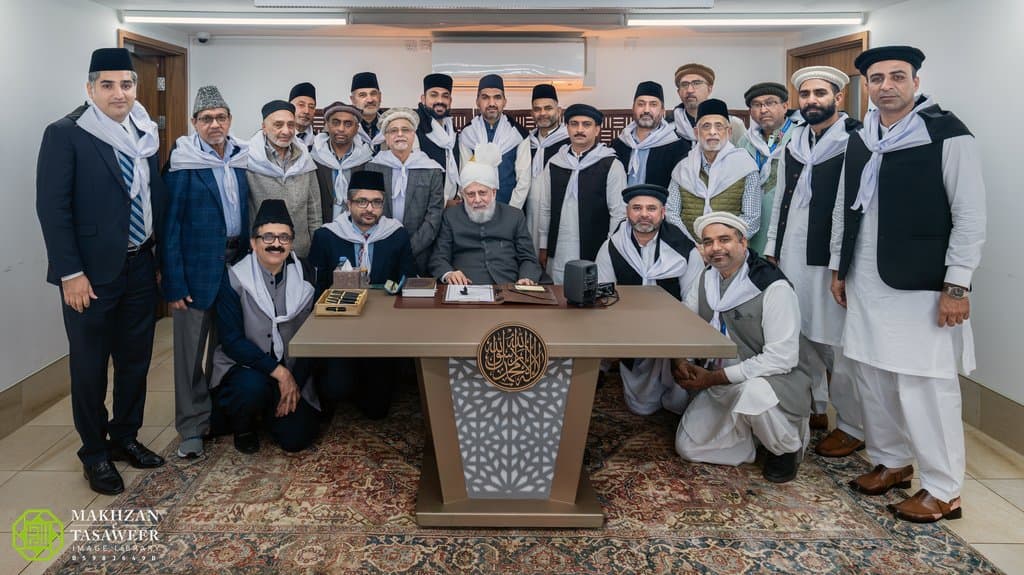
Islamabad, Tilford, UK, 8 June 2026: Members of Majlis Ansarullah from the Great Lakes and Western New York regions of the United States were blessed with a mulaqat with Hazrat Mirza Masroor Ahmad, Khalifatul Masih V (aa).
During the meeting, each nasir had the opportunity to introduce himself, after which members sought guidance from Huzoor (aa) on matters relating to the Holy Quran, modern distractions, marriage, paradise, forgiveness, Quran classes and ethical business.
Developing a living relationship with the Holy Quran in an age of distraction
A question was asked about how, in an age of excessive information, constant distraction, artificial intelligence, social media and mental stress, one can develop a living, personal and transformative relationship with the Holy Quran, rather than a merely academic or formal one.
Huzoor (aa) explained that in every age, there have been factors that distracted people according to their circumstances, environment and mental capacities. People have always faced things that turned their attention away from faith or drew them towards worldliness. Huzoor (aa) said that what is called mental stress often arises when worldly desires increase and people’s preferences change. When those desires are not fulfilled, frustration and anxiety follow.
Referring to artificial intelligence, Huzoor (aa) said that AI is a separate matter and is not in itself the root of distraction. However, if a person does not know the answer to something and immediately turns to AI, this can create problems. Huzoor (aa) mentioned that an experiment had been carried out in which a missionary asked AI a religious question. When the answer was wrong and the missionary pointed out that the correct answer was found in Hadith, the AI accepted that its answer had been mistaken. Huzoor (aa) therefore advised that one should not rely entirely upon AI, especially in matters of religious knowledge.
Huzoor (aa) said that people’s priorities have changed. Some seek mental peace by remaining absorbed in worldly matters, whereas the Holy Quran teaches:
اَلَا بِذِکۡرِ اللّٰہِ تَطۡمَئِنُّ الۡقُلُوۡبُ
It means that hearts find peace in the remembrance of Allah. (Surah ar-Ra‘d, Ch.13: V.29) He explained that those who remember Allah, understand the teachings of the Holy Quran and act upon them will find guidance. The Holy Quran contains answers and where a matter is not immediately understood, one should read the commentaries and seek Allah’s help.
Huzoor (aa) gave the example of Dr Abdus Salam, who said that he had found hundreds of Quranic verses related to science that guided him in his research. Huzoor (aa) said that educated people can search and reflect in this way. For ordinary people, it is sufficient that they offer the five daily prayers properly and supplicate within them. If a person fulfils Allah’s rights, asks Him sincerely and acts upon His commandments, Allah will grant guidance.
Worldliness, changed priorities and rising divorce
A nasir asked about an apparent increase in divorces among people in middle age, particularly after the age of 40 and how ansar can help reduce this trend.
Huzoor (aa) said that whether divorce takes place early in marriage or later, the root issue often returns to the same matter: people forget religion, lose attention towards Allah and become absorbed in personal and worldly desires. Their preferences change and they begin to follow the trends of worldly people.
Huzoor (aa) observed that in Western and developed countries, divorce rates are very high. Huzoor (aa) said that within the Jamaat, the rate is still much lower, but it has gradually increased and remains a matter of concern. Huzoor (aa) said that when he first began warning about this issue, the rate was around three or four per cent, whereas it has now risen gradually.
Huzoor (aa) said that after 15, 20 or even 25 years of marriage, some women say that their rights were not fulfilled and that they remained patient until the children grew older, but can no longer continue. Huzoor (aa) said that once children are born, parents should not think only of their personal interests. They should be willing to make sacrifices for the sake of their children. Even when children are older, some are still at an age where the separation of their parents affects them.
Huzoor (aa) explained that if attention turns from worldliness towards faith, the divorce rate will decrease. If, after coming to Western or developed countries, people begin to think only of earning the world, they will face the same results as worldly people. Therefore, the Tarbiyat Department should repeatedly remind members to establish a relationship with Allah, to make Allah everything in their lives and to worry about the next generation.
Huzoor (aa) said that sometimes problems arise not merely from the existing relationship between husband and wife, but because a person becomes attracted elsewhere due to the surrounding environment. For this reason, moral training is needed. He explained that Allah has placed boundaries and modesty between men and women and if people remain within those limits, their lives will remain better.
When the questioner added that children sometimes ask their mothers why they continue to endure cruelty, Huzoor (aa) said that this again comes back to the same point. When worldliness enters and religion is absent, a husband may be cruel to his wife and the wife may say that she endured it for 15 or 20 years for the sake of the children, but can no longer do so. Huzoor (aa) said that the tarbiyat and moral training of husbands and men is the responsibility of Ansarullah. They must be brought towards faith.
Huzoor (aa) said that merely standing and making a pledge that one will give precedence to faith over the world is not enough unless one understands what that means. To become servants of the Gracious God (‘Ibad-ur-Rahman) is not only to offer prayers, but to act upon all the commandments of Allah. He explained that when one recites that Allah alone is worshipped and His help alone is sought, it signifies complete submission to Allah’s commandments and seeking His help to act upon them. This understanding must be developed through continuous teaching and effort. Huzoor (aa) said that he continues to make efforts in this regard and if members also make a consolidated effort, the result will be multiplied and beneficial.
The two gardens and the additional two gardens in Surah ar-Rahman
A member asked about the verse in Surah ar-Rahman, which states that for the one who fears standing before his Lord, there are two gardens (Surah ar-Rahman, Ch.55: V.47) and then later mentions two additional gardens. (Surah ar-Rahman, Ch.55: V.63) He asked what the additional two gardens signify.
Huzoor (aa) explained that one broad meaning is that Allah multiplies a person’s reward in the Hereafter. Just as Allah says in different places in the Holy Quran that He increases and multiplies the reward of good deeds, the glad tiding of two gardens is also increased in the next world.
Huzoor (aa) advised that the commentaries of the Holy Quran, including Tafsir-e-Saghir and other Jamaat commentaries, should be read for further explanation.
Huzoor (aa) said that one meaning is that a person who fears Allah receives a form of paradise in this world as well. When a person fears Allah, Allah’s grace descends upon them, their prayers are accepted and ease is created for them. A believer regards this as a kind of paradise.
Huzoor (aa) said that some people may then raise the question that the Holy Prophet (sa) described the world as a prison for the believer, so how can it also be called paradise? (Sahih Muslim, Kitab az-zuhdi wa r-raqa’iq, Hadith 5242) He explained that from a purely worldly perspective, a person may consider religious restraint to be a form of difficulty. However, when a believer sees Allah’s grace, the acceptance of prayers and the ease Allah creates, that believer experiences this as paradise.
Huzoor (aa) said that in addition to the paradise experienced in this world and the promised paradise in the Hereafter, Allah further multiplies the reward in the next world. Thus, the additional gardens refer to the increased and doubled reward that Allah grants by His grace.
The Jamaat’s daily progress is itself a sign of Allah’s grace
A member requested that Huzoor (aa) narrate an incident of Allah’s special grace after being blessed with the mantle of Khilafat, so that the faith of the members may increase.
Huzoor (aa) answered
“Such incidents occur every day – what should I tell you? The progress of the Jamaat is itself made up of such incidents, is it not? And as for the increase in faith, that should come about from this very point: if Allah the Almighty can take service from a person like me and cause the Jamaat to progress, then this means that the Jamaat is true. These are the incidents.
“The Jamaat is spreading across the world and it is progressing. People are also increasing in faith. They are in Africa, in Europe, in Asia, in the Arab countries, in the Far East, in South America and in [North] America. So, these are the incidents that occur day after day.
“As for other incidents, I continue to relate them. People write such incidents to me and there are countless incidents in some of the reports of progress that I mention on the second day at Jalsa. Listen carefully to the speech and you will come to know.”
Encouraging attendance at Quran classes
A nasir requested prayers that Allah may create love for the Holy Quran and the books of the Promised Messiah (as) in the hearts of all Ahmadis in Oshkosh and that they may act upon those teachings. He also asked how he could practically encourage members to attend Dars-e-Quran sessions held twice a week after Asr for 20 minutes.
Huzoor (aa) said that creating love for the Holy Quran is the responsibility of the Secretary Talim-ul-Quran, the Secretary Tarbiyat, Majlis Ansarullah, Majlis Khuddam-ul-Ahmadiyya, the Jamaat and the relevant secretaries. They must explain to people that the Holy Quran is the means of their survival: by reading it, understanding it and acting upon it.
Huzoor (aa) pointed out that the classes amount to only 40 minutes in an entire week, while a week contains 168 hours. If a person gives just 40 minutes to reading the Holy Quran, it will improve their worldly life, their faith and their hereafter. This realisation must first be created.
Huzoor (aa) said that verbal claims are not enough. People pledge that they will give precedence to faith over the world, but claims alone do not achieve anything. The Promised Messiah (as) taught that if one has truly entered into bai‘at, then one must become a true believer. (Malfuzat, Vol. 8, UK, 1985, pp. 297-298)
Huzoor (aa) said that Allah instructed the Holy Prophet (sa) to remind people and that he was a warner and reminder. (Surah al-Ghashiyah, Ch.88: V.22-23) Therefore, members too should continue reminding others and explaining the importance of the Holy Quran and the books of the Promised Messiah (as).
Huzoor (aa) suggested that, since people have phones and use social media, short excerpts of two, three or four lines from the books of the Promised Messiah (as) should be sent to them, especially passages that create love for the Holy Quran, love for Allah and the desire to gain religious knowledge. If these reminders are sent repeatedly, then just as drops of water eventually wear through stone, they will soften hearts to some extent, even if people have become immersed in worldliness. Huzoor (aa) advised that one should continue making efforts and should not become tired.
Forgiving others and leaving matters to Allah
A question was asked about people who believe that if someone has wronged them, Allah will not forgive that person until they themselves forgive them. Some people then spend their entire lives refusing to forgive, even though Allah is Forgiving and Merciful and loves forgiveness. Guidance was sought on how such people can be advised.
Huzoor (aa) said that Allah states that He forgives all sins except shirk. (Surah an-Nisa, Ch.4: V.117) If Allah wishes to punish someone in the Hereafter, He may punish them to the extent He wills, but ultimate judgement and forgiveness belong to Him. Therefore, people should be told that if they forgive and forget matters in this world, that is better.
Huzoor (aa) said that the Holy Quran also teaches that forgiveness is better. (Surah ash-Shura, Ch.42: V.41) If punishment is required, then it should be proportionate and according to the law, not through personal vengeance. (Surah an-Nahl, Ch.16: V.127) However, if the matter is a small emotional grievance or minor personal hurt, then it should simply be ignored and left to Allah. Huzoor (aa) said that such matters should be entrusted to Allah.
Honesty, humility and faith while doing business
A member who had served for more than 20 years in the United States Air Force and was approaching retirement said that he had started a halal farm business to serve his family and community. He sought guidance on maintaining humility, strengthening faith, balancing family responsibilities and continuing to serve humanity in a meaningful way.
Huzoor (aa) said that if a person is doing business, then the first purpose is to earn a livelihood and there is nothing wrong with that. The Companions (ra) of the Holy Prophet (sa) also engaged in business and trade and some became very wealthy. When they passed away, some left considerable wealth, yet they did not forget faith.
Huzoor (aa) said that whatever worldly work a person does, they must not forget religion. The obligations owed to Allah should remain foremost. He referred to a Persian saying which translates to “Hands engaged in work, heart attached to God.” A person may be working and thinking about work, but the fear of Allah should remain in the heart.
Huzoor (aa) said that whatever business is undertaken must be conducted with honesty and without deception. Referring to farming, he gave the example that one should not artificially inflate poultry or present unhealthy practices as though they were healthy. If meat is being sold as organic, then it must genuinely be organic. One should not use chemicals or other means and then make misleading claims.
Huzoor (aa) said that honesty must be maintained in business. A person should also not become so involved in business that they forget the five daily prayers, neglect the rights of their wife and children or fail to fulfil the rights owed to the Jamaat. If these matters are remembered, then the business can become a means of blessing and the person can also fulfil their obligations to Allah, their family and the Jamaat.
Conclusion
As the mulaqat concluded, the ansar had the opportunity to have a group photograph with Huzoor (aa). They also received pens as gifts.
(Summary prepared by Al Hakam)