
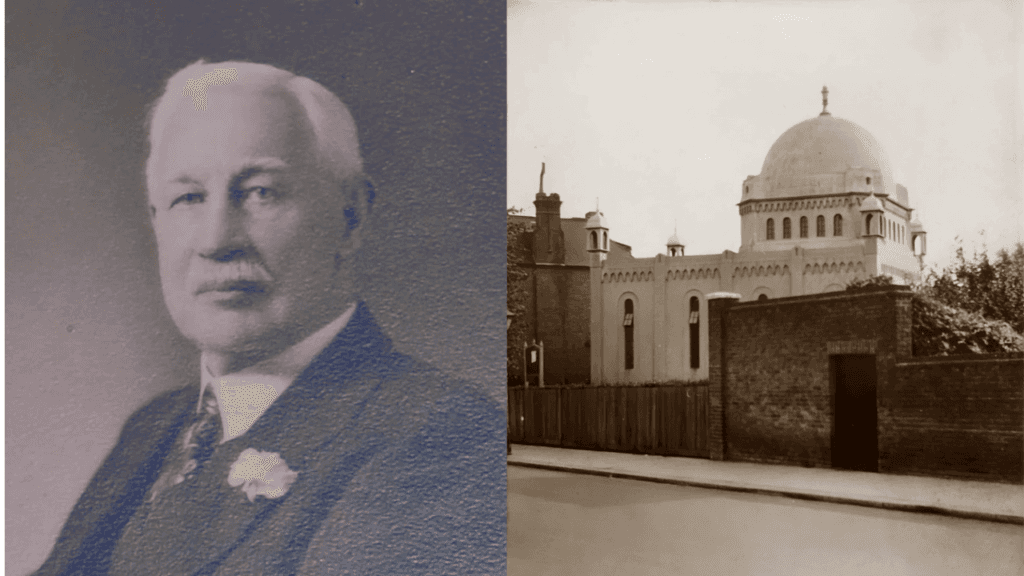
Islam in London
Not only East and West, but romance and reality meet as never before in the coming of the handsome young Emir Feisal [i.e. Faisal bin Abdulaziz Al-Saud], Viceroy of Mecca and son of the King of the Hedjaz – a “sheik” before whom all the creations of Valentino and Novarro are mere shadows – and his opening next Sunday of London’s first mosque.
If one wants to get a full sense of all that it means, one should visit the Mosque itself, as I did yesterday. This plain but beautiful little white-domed building, nestling half-hidden in an old orchard amidst surroundings one is tempted to call indescribably “suburban”, may come as something of a shock to those whose idea of a mosque is associated with the arabesques of Granada or the splendours of Cairo and the Golden Horn.
It is best seen from the slope of West Hill, Wandsworth, itself a more or less opulent boulevard, with memories of Wandsworth’s other days. Some artist of genius might possibly do justice to the vision.
About the foreground linger remnants of rural charm – a grass-grown lane deep in nettles, but strewn at the moment with broken umbrellas and outworn corsets. To the right an old country mansion stands dismantled, in well-wooded grounds, round the wall of which the electric railway sweeps in quite a fine curve.
The muezzin’s call
It is not until one has taken one’s fill of this suburban landscape – so typical, for good or ill! – that one notices under the very brow of the hill the white dome of the Ahmadiyya Mosque. The minarets are there, one at each of the four corners. They will be used by the “muezzin” to call the faithful to prayer, but are out-topped by several neighbouring villas.
Nowadays, when so many of our churches and chapels flaunt what is called a “Byzantine style”, there is little to distinguish the Ahmadiyya Mosque, with its unorthodox glazed windows, from some Christian conventicles. Blended of plainness and good taste, it is now practically finished, though the garden pool and fountain for ablutions have still to be filled.
With the help of a couple of British workmen, lunching leisurely against its white walls, I discovered the “imam” – or incumbent – of the Mosque. Mr Dard is an Indian Muslim, turbanned and black-bearded. He might, for everything except his gold spectacles, have walked out of the “Arabian Nights.” With much dignity and courtesy he showed me over, sending for the key a bright little dark-eyed rogue of a Muslim boy who looked as if he should make his fortune on the films.
Over the door are inscriptions in Arabic and Persian. They tell us that “Allah alone is to be worshipped and Muhammad is His prophet.” The significance of this, the “imam” explained, is not arrogance on Muhammad’s [sa] part, but, on the contrary, a disclaiming of worship.
Within I found the deep-piled blue carpet, upon which no shoe may tread, already laid down and reverentially roped off. There is electric light, and radiators are promised, but no decorations of any kind were to be, or will be, seen and no seats save those at the entrance for the taking off of shoes. The idea of sitting to worship brought a hint of a smile to the face of my Oriental friend. Nothing to suggest ritual of any kind was there, save the tiny little chancel or niche, orientated to Mecca, where the “imam” himself will lead the worshippers in prayer.
Islam and Judaism
The Mosque, so he told me, will be open to Jews and Christians as well as Muhammadans. “Between Islam”, he claimed, “Judaism and primitive Christianity there is no essential difference. We all believe in one God, and before Him and Him only – we prostrate ourselves.”
Upon many things the “imam” enlightened me, among them the fact that the Ahmadiyya is a sect, founded in 1889 by Hazrat Mirza Ghulam Ahmad, [peace be upon him], whose tenets are all towards tolerance. They are against [so-called] Holy Wars and every sort of oppression. They accept, as sympathetic with themselves, the prophets of all religions in which one God is worshipped.
There are, the “imam” told me, altogether about two thousand Muhammadans in London. As the Southfields mosque can only hold two hundred at most, it is not likely to prove too large.
As I had come along West Hill, a sight had greeted my eyes which set me thinking. It was a “crocodile” of some score or so of blithe English girls stepping along cheerily in uniform – all health, hope, and hockey. “What would the mosque do for them?”
The “imam” reassured me. “Women will be allowed”, he said, “to enter and to worship in the mosque, though not with men. Women with us have a higher status than the West has ever given them; though we consider that Western nations go to extremes.”
The popular belief that the Quran promises no future life for women seems to be an entire fallacy. It is written in Surah an-Nisa’ that “whosoever doeth the things that are right, whether male or female, being a believer these shall enter Paradise.” (4:125)
Whirling away on the electric, I pondered whether the headmistress, if she were among the blest, would altogether sanction those promised “gardens of delight” where:
“[There will wait on them youths, who will not age],
With goblets and ewers and [and cups filled out of a flowing spring] …
[And there will be fair maidens with wide, lovely eyes],
[Like pearls, well concealed and protected],
As a reward for that which they have done.
Therein shall they hear no vain discourse nor accusation of sin,
But only the saying, Peace! Peace!” [56:18-27]
Anyhow, who can pretend now that a London suburb is without romance? – The Referee, 26 September 1926
(Transcribed and edited by Al Hakam from the original English, published in the October 1926 issue of The Review of Religions)