
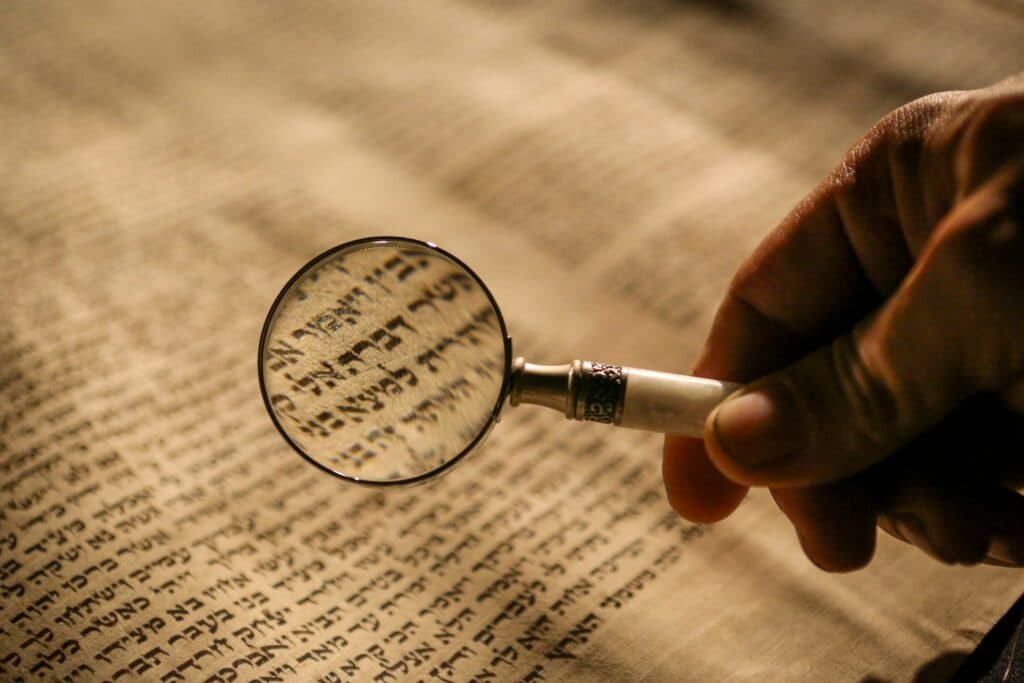
The name “Immanuel” occupies an important place in Jewish and Christian scripture and, in a distinct way, in Ahmadiyya Muslim literature. Literally meaning “God is with us”, it appears in the Book of Isaiah and is later cited in the Gospel of Matthew in connection with Jesus (as). In Ahmadiyya literature, the same name also appears in relation to the prophecy of Musleh-e-Maud (ra).
This article examines the meaning and pronunciation of Immanuel, its Biblical context, its Christian interpretation and its significance in Islamic Ahmadiyya thought. It argues that while Isaiah’s prophecy had an immediate historical setting, the highest spiritual manifestation of “God is with us” is found in the Holy Prophet Muhammad (sa), while, within Ahmadiyya literature, the title Immanuel is explicitly associated with Hazrat Musleh-e-Maud (ra).
Meaning of ‘Immanuel’
“Immanuel” is a Hebrew name meaning “God is with us”. It is also transliterated as “Emmanuel” or “Imanu’el”.
A lexical analysis of the Hebrew word עמנואל shows that it is composed of two parts:
- עמנו (‘immanu) means: “with us”
- אל (El) means: “God” or “the Mighty Being”
Thus, taken together, עמנואל (Immanuel) means: “The Mighty Being (i.e., God) Who is with us.”
It is therefore not merely a personal name but a meaningful and descriptive expression of divine nearness, help and support.
The question of pronunciation
The prophecy of Musleh-e-Maud was first published as a supplement in the newspaper Riyaz-e-Hind, Amritsar, on 1 March 1886. In that early publication, the scribe appears to have written the word “Immanuel” as “ʿAnmuwaʾil” (عنموائیل). This seems to have occurred either through a scribal mistake or through an attempt to reproduce the unfamiliar foreign name in Arabic-Persian script. As a result, in some Ahmadiyya literature, the pronunciation of the word has occasionally caused confusion.
In Aina-e-Kamalat-e-Islam, the Arabic text reads:
إِنَّا نُبَشِّرُكَ بِغُلَامٍ، اسْمُهُ عنموائيل وَبَشِيرٌ
“Inna nubashshiruka bighulamin ismuhu ʿAnmuwaʾil wa Bashir…”
The relevant passage appears in Ruhani Khazain, Vol. 5, p. 577. However, in Anjam-e-Atham, the same prophecy appears in a clearer form:
إِنَّا نُبَشِّرُكَ بِغُلَامٍ حَلِيمٍ، مَظْهَرِ الْحَقِّ وَالْعلَاءِ، كَأَنَّ اللهَ نَزَلَ مِنَ السَّمَاءِ اسْمُهُ عمانوایل يُولَدُ لَكَ الْوَلَد
“Inna nubashshiruka bighulamin halimin mazhar al-haqqi wa al-‘ula ka’anna Allaha nazala min as-sama’. Ismuhu Immanuel. Yuladu laka al-walad…”
The Urdu translation alongside this passage states:
“We give you glad tidings of a gentle boy who will be a manifestation of truth and exaltation, as if God has descended from heaven. His name is Immanuel, which means: God is with us […]” (Ruhani Khazain, Vol. 11, p. 62)
For this reason, the publisher of Ruhani Khazain notes that the earlier form appears to be a scribal error and that the correct reading should be “Immanuel”. The note directs readers to Anjam-e-Atham for the clearer form.
The same point was also clarified by Hazrat Khalifatul Masih V (aa) in his Friday sermon of 21 February 2014. Huzoor (aa) stated that although the word appears in one place as “ʿAnmuwaʾil”, in Anjam-e-Atham, where the prophecy is written in full Arabic, it appears as “Immanuel”; therefore, the original form is indeed “Immanuel”. (Khutbat-e-Masroor, Vol. 12, p. 108)
This establishes that the correct pronunciation and meaning intended in the prophecy is Immanuel: “God is with us.”
Immanuel in Jewish scripture
The name first appears in the Book of Isaiah in the Hebrew Bible. According to the traditional Jewish division of the Hebrew scriptures, Isaiah belongs to the Nevi’im, or Prophets.
In Isaiah 7, it is stated:
“Therefore the Lord himself shall give you a sign: Behold, a young woman shall conceive, and bear a son, and shall call his name Immanuel.” (Isaiah 7:14)
The name appears again in Isaiah 8:
“And the stretching out of his wings shall fill the breadth of thy land, O Immanuel.” (Isaiah 8:8)
The immediate context of Isaiah 7 is important. The prophecy is addressed to King Ahaz at a time of political fear and danger. Two hostile powers threatened Judah and Isaiah gave Ahaz a sign that the danger would soon pass. The sign was that a young woman would conceive and bear a son and before that child reached the age of moral discernment, the lands of the two kings feared by Ahaz would be laid waste.
Thus, in its immediate historical context, the prophecy contains its own timeframe: conception, birth, early childhood and the removal of a near political threat. The name Immanuel – “God is with us” – therefore expressed divine support and reassurance in that specific moment of crisis.
Immanuel in Christian literature
In Christian literature, Immanuel is most prominently cited in the Gospel of Matthew. Matthew writes:
“All this took place to fulfil what the Lord had spoken by the prophet: ‘Behold, a virgin shall conceive and bear a son, and they shall call his name Immanuel.’” (1:22-23)
Matthew then explains the meaning of the name as “God with us”.
Among the Gospel writers, Matthew is especially known for linking events in the life of Jesus (as) to passages from the Old Testament. In this instance, however, several important questions arise.
First, who was to name the child? Would his mother give him this name or would people in general do so? In the Book of Isaiah, it states that she shall name him, whereas in Matthew it says they shall name him. This difference clearly suggests that the Gospel writer may have altered even a small phrase to serve a theological purpose. If Mary (as) had indeed given this name to her son, then historical proof would be required. Yet, earlier in the same chapter, it is mentioned that an angel of the Lord appeared to Joseph and instructed him to name the child Jesus – and Matthew himself records that the child was named Jesus.
Even if one overlooks this variation, the Gospels do not record Jesus (as) being called Immanuel during his lifetime. Christians generally describe it as a title or attributive name, rather than his actual personal name.
Another important issue concerns the translation of the Hebrew word used in Isaiah. In very brief terms, it may be said that the Christian world has often mistranslated the Hebrew term to apply this prophecy to Jesus. Instead of translating it as “a young woman shall conceive,” it has been rendered as “a virgin shall conceive.” Matthew translated the Hebrew word “almah” as “virgin” so that it would point toward the doctrine of the virgin birth of Jesus, thereby supporting his claim. However, “almah” does not specifically mean “virgin”; rather, it means “a young woman of marriageable age”, whether married or unmarried. Had Isaiah intended to specify a virgin, he would have used the Hebrew word “bethulah.”
In this regard, the editor of the well-known commentary by Arthur S Peake writes:
“The rendering ‘Virgin’ is unjustifiable… the word employed here, almah, means young woman […].” (A Commentary on the Bible, ed. Arthur S Peake MA, DD, Thomas Nelson & Sons Ltd., London, p. 442)
Furthermore, when the Revised Standard Version rendered Isaiah 7:14 as “young woman” instead of “virgin”, it led to strong protests, as some Christian readers felt that this weakened the direct application of the verse to the doctrine of the virgin birth. Some Christian groups even declared this translation to be undermining fundamental Christian beliefs.
It is also noteworthy that among the four canonical Gospels, only Matthew includes this claim, while the other three omit it – suggesting that they did not consider this argument convincing.
The Gospel writer Luke, in the opening of his work, states that many accounts had already been written, but he made a careful effort to investigate and verify matters before recording them.
Finally, even if – purely hypothetically – it is accepted that this prophecy referred to Jesus (as), the Gospels themselves indicate that he did not claim such a status in any literal sense of divinity. At a critical moment in his life, Matthew records that Jesus (as) cried out:
“My God, my God, why have You forsaken me?” (Matthew 27:46)
A being who is “God with us,” or who is himself God, how could he say that God had forsaken him? Rather, Christians themselves believe that Jesus was crucified by the Jews and regarded as accursed – raising further theological questions about this interpretation.
The immediate meaning of Isaiah’s prophecy
If the relevant chapter of the Book of Isaiah is read carefully and in full, it becomes clear that rather than foretelling the name and signs of some distant promised figure, it was in fact addressing a contemporary situation.
Historically, the prophet Isaiah prophesied for about sixty-four years during the reigns of three kings of Judah – Uzziah, Ahaz and Hezekiah. The verses in question relate to an immediate circumstance of that time. The text itself states that the Lord spoke again to King Ahaz, asking him to seek a sign. Thereupon, Isaiah declared that God Himself would give a sign:
A young woman would conceive and bear a son and she would call his name Immanuel. Before the child reached the age of moral discernment – being able to distinguish between right and wrong – the land of the two kings whom Ahaz feared would be laid waste.
This passage clearly provides a timeframe: from the conception and birth of a child up to the age when he can distinguish good from evil. Within this limited period, a specific sign was to be fulfilled – namely, the downfall of the kingdoms that posed an immediate threat to Judah. Thus, the prophecy pertains to a near and historical event, not primarily to something occurring centuries later, such as the birth of Jesus (as) or the doctrine of a virgin birth.
In short, there is no mention in this chapter or verse of the birth of Jesus or of any distant future event.
The author of the Gospel of Matthew appears to have introduced a subtle yet significant alteration to the wording of Isaiah by stating, “they shall call his name Immanuel.” In Isaiah, however, the name “Immanuel” (meaning “God is with us”) is simply the name given to the child, reflecting a hopeful expression by the mother – that God would be with them.
By contrast, this slight modification in Matthew could imply that people would describe the child as “God with us”, thereby opening the door to the doctrine of the divinity of Christ. In this way, what appears to be a minor textual variation may actually represent a theological development toward the belief in the divinity of Jesus.
Moreover, the famous second-century Christian thinker Justin Martyr, in his well-known debate with his Jewish interlocutor Trypho, recorded in Dialogue with Trypho, also reflects that the Jews were not convinced that Isaiah 7 contained a prophecy about Jesus (as) under the name “Immanuel”.
The Islamic understanding of ‘God is with us’
From an Islamic perspective, the meaning of Immanuel – “God is with us” – reaches its highest and most perfect manifestation in the person of the Holy Prophet Muhammad (sa).
Islam does not understand “God is with us” as incarnation or literal divinity. Rather, it signifies divine help, nearness, protection and support granted to the chosen servants of Allah.
The Holy Quran itself records a moment in the Cave of Thawr when the enemies of Islam reached the very mouth of the cave during the Hijrah. Hazrat Abu Bakr (ra) became anxious, but the Holy Prophet (sa) reassured him with the words:
لَا تَحۡزَنۡ اِنَّ اللّٰہَ مَعَنَا
“Grieve not, for Allah is with us.” (Surah at-Taubah, Ch.9: V.40)
This is the very essence of Immanuel: God is with us.
At that moment, Allah sent down His tranquillity and aided the Holy Prophet (sa) with unseen forces. The Quranic declaration is not merely theoretical; it is historical, spiritual and deeply personal.
The same divine nearness is seen at the Battle of Badr, where the Holy Quran states:
وَمَا رَمَیۡتَ اِذۡ رَمَیۡتَ وَلٰکِنَّ اللّٰہَ رَمٰی
“And thou threwest not when thou didst throw, but it was Allah Who threw.” (Surah al-Anfal, Ch.8: V.18)
Here too, the Holy Prophet (sa) is shown as the perfect recipient of divine help. His life repeatedly demonstrates that Allah was with him in every trial, every danger and every victory.
Therefore, if the phrase “God is with us” is understood in its deepest spiritual sense, no person in history embodies it more perfectly than the Holy Prophet Muhammad (sa).
The Promised Messiah (as) and the manifestation of divine nearness
In the Latter Days, the Promised Messiah, Hazrat Mirza Ghulam Ahmad (as), appeared as the true servant and spiritual reflection of the Holy Prophet (sa). His mission also manifested the divine attribute contained in the name Immanuel.
The Promised Messiah (as) challenged Christian claims regarding the divinity of Jesus (as), arguing that words of divine nearness and manifestation cannot be used to prove Jesus’ divinity. If such expressions were taken literally, then similar and even stronger expressions found in his own revelations would also have to be interpreted in the same way.
He writes, in essence, that the words of the Gospel cannot establish the divinity of Jesus (as); and if such words are taken as proof of divinity, then his own revelations would appear to prove divinity with even greater clarity. The point was not to claim divinity for himself – God forbid – but to expose the weakness of an argument that treats metaphorical or revelatory expressions of divine nearness as literal proof of Godhead. (Kitab al-Bariyya, Ruhani Khazain, Vol. 13, p. 104)
Thus, in the person of the Promised Messiah (as), the meaning of “God is with us” appeared as divine support granted to the perfect servant of the Holy Prophet (sa).
Hazrat Musleh-e-Maud (ra) and the title Immanuel
Within Ahmadiyya literature, Hazrat Mirza Bashir-ud-Din Mahmud Ahmad (ra), known as Musleh-e-Maud – the Promised Reformer – is explicitly associated with the name Immanuel in the wording of the prophecy itself.
His life and Khilafat continuously manifested divine support. Here is just one example: When in 1953 the Pakistani court likened the systematic attacks of the enemies against Ahmadiyyat to the St Bartholomew’s Day massacre, at that most critical moment, Hazrat Musleh-e-Maud (ra) said:
“Pray and seek help from Allah the Almighty. All power lies with Him. […] Have you ever seen during the past forty years that God Almighty has abandoned me? Will He, then, abandon me now? The whole world may abandon me, but insha-Allah, God will never abandon me. Know well that He is hastening to my aid. He is near me. He is within me.
“There are dangers and they are many, but with His help, they shall all be removed. Keep your inner selves under control and adopt righteousness. God Himself will take care of the work of the Jamaat. Humbly, Mirza Mahmud Ahmad, 3 March 1953.” (Weekly Farooq, 3 March 1953, as cited in Sawaneh-e-Fazl-e-Umar, Vol. 4, p. 352)
Such words signify divine nearness, help and support, not incarnation or divinity. They show that the essence of Immanuel – “God is with us” – was manifested in the life of Hazrat Musleh-e-Maud (ra).
Conclusion
The name Immanuel is a declaration of divine nearness, help and manifestation.
In Isaiah, it signified God’s support in a moment of political fear. In Matthew, it was employed as part of a Christian theological reading of Jesus (as). Yet the reality contained in the words “God is with us” was manifested, in its most perfect and unqualified form, in the person of the Holy Prophet Muhammad (sa).
The Promised Messiah (as) appeared as the most devoted servant of the Holy Prophet (sa) and through him the divine promise of latter-day support was renewed. In his Promised Son, Hazrat Musleh-e-Maud (ra), this sign shone with particular clarity. His birth was not only the fulfilment of the revelation granted to the Promised Messiah (as), but also accorded with the prophecy of the Holy Prophet Muhammad (sa) regarding the latter-day Messiah: يَتَزَوَّجُ وَيُولَدُ لَهُ – “He will marry and an illustrious son will be born to him.” (Mishkat al-Masbih, Kitab al-fitan, Hadith 5508)
Thus, the life and more than half a century of Khilafat of Hazrat Musleh-e-Maud (ra) stand as a remarkable testimony to divine support, intellectual triumph and the fulfilment of revelation. In him, the title Immanuel appeared not as an abstract label, but as a living sign that God was with the Jamaat of the Promised Messiah (as), in service of the mission of the Holy Prophet Muhammad (sa).