
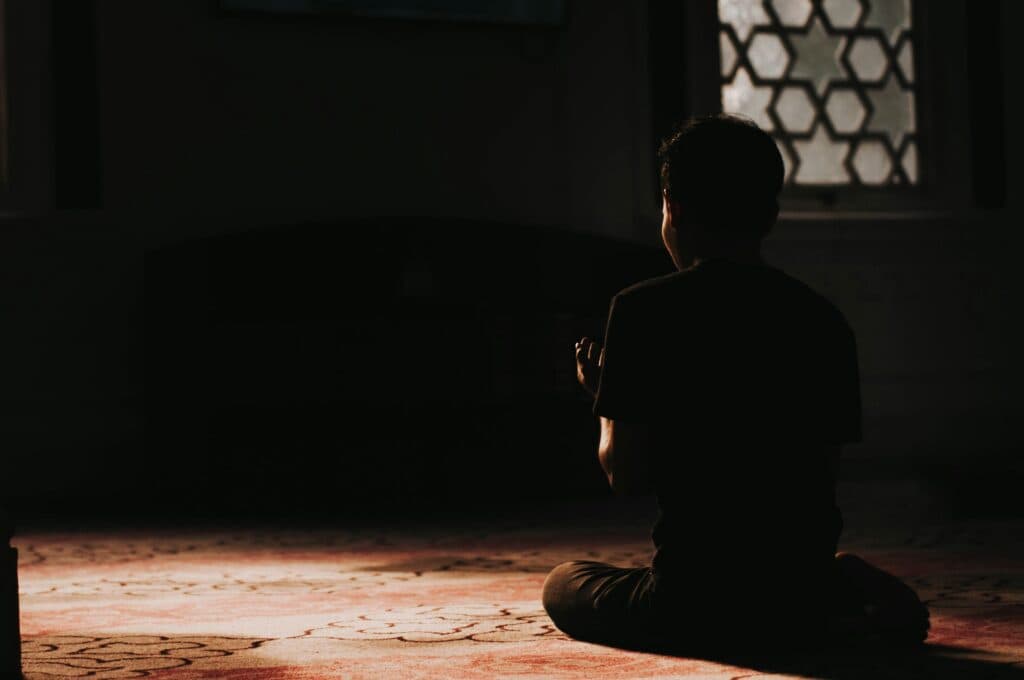
Allah the Almighty states in the Holy Quran:
وَیَخِرُّوۡنَ لِلۡاَذۡقَانِ یَبۡکُوۡنَ وَیَزِیۡدُہُمۡ خُشُوۡعًا
“They fall down on their faces weeping, and it increases humility in them.” (Surah Bani Isra’il, Ch.17: V.110)
To begin with, we weep in times of loss, agony, tears of joy or even when something we’ve been longing for comes before our eyes. Then, why weep before our Lord who already knows what is within our hearts?
The above verse does not imply that weeping before Allah is a sign of weakness; rather, it is a sign of humility and fear of God. The heart is then inclined towards the nearness of the Lord, which enables us to fully submit ourselves, fulfilling the sole purpose of our creation.
The Holy Prophet (sa) once described: “A person who remembers Allah in seclusion and his eyes are then flooded with tears.” (Sahih al-Bukhari, Kitab al-azan, Hadith 660)
Tears are a sign of sincerity and devotion to Allah, knowing that our Lord is the only Being who has an answer to all our needs. For one to be truly ardent before their Lord is when the eyes begin to speak and the heart begins to tremble.
When we weep before Allah, we weep in a state of fear and humility, as the Holy Prophet (sa) once said:
“There are two eyes that shall not be touched by the Fire: An eye that wept from the fear of Allah and an eye that spent the night standing on guard in the cause of Allah.” (Jami‘ at-Tirmidhi, Kitab al-jihad, Hadith 1639)
It is not physical tears alone that will draw us closer to Allah; rather, it is the state of the heart which truly reflects the purpose of our worship.
Speaking of salat, the Promised Messiah (as) states:
“What is salat? It is a supplication addressed to the Lord of Honour without which a person cannot be truly alive, nor can he procure any means of security and happiness. When God Almighty bestows this grace upon a person, it is only then that he obtains true comfort. From that moment he will begin to feel pleasure and delight in salat. As he derives pleasure from delicious food, he will begin to derive pleasure from his weeping and crying in salat. Before he experiences that condition in his salat, it is necessary that he should persist in salat as he swallows bitter medicine so that he may be restored to health. In the same way it is necessary for him to persist in salat and in making his supplications while he derives no pleasure from them. In such [a] condition he should seek pleasure and delight in salat with the supplication:
“‘Allah! Thou knowest how blind and sightless I am, and at the moment I am like the dead. I know that in a little while I shall be called and shall present myself before Thee and no one will be able to stop me. But my heart is blind and unenlightened. Do Thou cause to descend upon it such a flame of light that thereby it may be inspired with Thy love and devotion to Thee. Do Thou bestow upon me such grace that I shall not be raised up sightless nor join the blind.’
“When he supplicates in this manner and persists in the supplication, he will see that a time will arrive when something will descend upon him while he is engaged in such a type of prayer which will melt his heart.” (Malfuzat [Urdu], Vol. 4, pp. 321-322, as cited in The Essence of Islam, Vol. 2, pp. 297-298)
Is there any spiritual benefit in this? The Holy Prophet (sa) once said: “Allah will give shade to seven (types of people) under His Shade (on the Day of Resurrection). [One of them will be] a person who remembers Allah and his eyes are then flooded with tears.” (Sahih al-Bukhari, Kitab al-azan, Hadith 660)
What more could a person ask for? To come into the shade of their Lord is the goal.
When man commits a sin, he thinks to himself, how will anyone forgive me? What shall I do? What will my God think of me? Man begins to panic, taking stress to a whole new level, not knowing that it is indeed God who will forgive him for his sins. The Promised Messiah (as) answers this; he states:
“Think not, you are sinners. Will your prayers be heard? Do not think like this. Man makes mistakes, but a time comes when he is able to overpower his sinning self. This power to overpower the sinning self is also built into the nature of man. Water puts out fire. This is part of its nature. Howsoever you may heat it, when water drops on fire it must put it out. That is natural. So is man a purifier by nature. Every man has this purifying property. Do not feel defeated because you have been involved in sin. Sin is like a stain on the surface of a piece of cloth. It can be washed away. Your habits, your dispositions may be dominated ever so much by your passions. Pray to God, weeping, crying; He will not let your prayers go waste. He is full of compassion.” (Badr, 17 January 1907, Vol. 6, No. 3, pp. 15-16]
Weeping before God shows Him that man has a strong desire to be released from the trials and tribulations he is going through.
Keep in mind that the pinnacle of Prayer is the prostration (sajdah) position, where man keeps a private connection with his Creator and is able to say whatever he feels because, deep down, he knows it is truly only God who can answer his prayers and needs.
God Almighty says in the Holy Quran:
“Pray unto Me; I will answer your [prayer].” (Surah Mu’min, Ch.40: V.61)
We must understand that the only condition God has here is for His servants to pray or call unto Him and He will answer the prayer. What could be simpler than that? He gives man no limits nor any choices, but an open-ended connection between man and his Lord.
Going back to the question which was raised in the beginning, ‘Why weep before our Lord who already knows what is in our hearts?’ The answer is that Prayer is not about giving information to Allah, but it is about turning the hearts towards Him.
The Promised Messiah (as) states:
“Supplications are not accepted until the heart is clean. If your heart harbours a grudge even for a single person with respect to any worldly matter, your supplication cannot be accepted.” (Malfuzat [English], Vol. 9, p. 178)
Thus, it is of utmost importance for the acceptance of prayers that all personal grudges and malice are forsaken and heartfelt supplications are carried out; seek the help of Allah the Exalted to attain a permanent purification of the heart.
This leads us to one vital lesson taught to mankind: whether we are experiencing sorrow, loss, happiness or joy, our hearts should always turn towards Allah.
“Those who believe, and whose hearts find comfort in the remembrance of Allah. Aye! It is in the remembrance of Allah that hearts can find comfort” (Surah ar-Ra’ad, Ch.13: V.29)
In times of sorrow, pain, joy or even relief, it is God who is the ultimate healer of all our problems. When the heart feels the need to connect with someone special, someone who will fill the gap in their life, the heart knows the only comfort it will find is in the remembrance of Allah. Therefore, the desire then becomes greater and the feeling becomes stronger and our body begins to build emotion, weeping, letting our hearts out and simply putting out everything we can think of before our Creator, because truly it is only he who understands our needs. May Allah enable us all to build a strong and heartfelt connection with our Lord. Amin!