
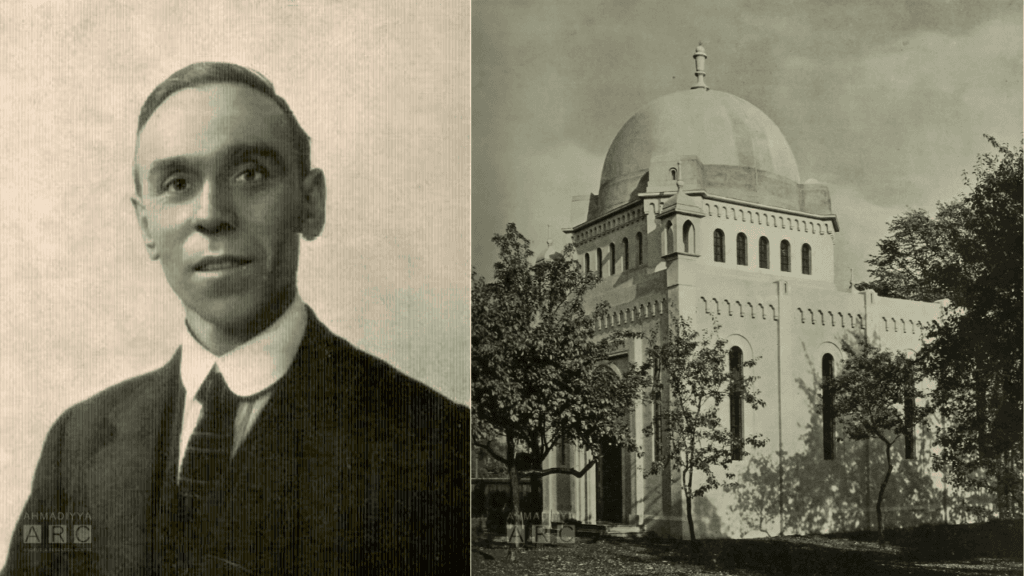
What led me to Islam?
I am naturally religious and read a good deal. Everyone has read the New Testament in the Bible, but many do not know that these Gospels are only a few out of many Christian Gospels, the others being called ‘apocryphal’ and even spurious by the accepted Christian Church.
The truth is, apparently, that such Gospels as did not teach exactly the doctrine of the reigning Church were destroyed and those Christians who read them were persecuted as heretics. All this occurred before the Holy Prophet Muhammad, peace be upon him, was born.
The Christians of the 1st and 2nd centuries must have been in close touch with the sources of the Gospels and yet they believed very differently from what the Church teaches today.
Personally, I believe that their faith and the faith of Jesus of Nazareth was Islam. In that very old Gospel to the Hebrews (by the Church called ‘apocryphal’), it was taught and believed by that early Christian community, the Ebionites, that Jesus was only a “man” and was chosen as a prophet by God. So, by the choice of God, he was called the son of God from the holy ghost that came unto him from above in the likeness of a dove. These early Christians also deny that he was begotten of God the Father, but say that he was created like one of the archangels and that he came and taught the word as set out in the Gospel according to the Hebrews.
The Ebionites also repudiated the apostle Paul as an apostate.
Again, in that ancient Gospel, the Book of James, it is told how Jesus came to be born of the virgin Mary by the ministrations of the angel Gabriel, much in the same way as is described in the Holy Quran. (Book of James, chapters 11, 12 & 14; Epistle of the Apostles, chapter 14; Gospel or History of Joseph, verses 5-6; and Acts of Paul, chapter 7, verses 4-6 & 12-19).
Again, according to the true Islamic teachings, God will not punish mankind forever and ever unto all eternity in Hell Fire, but when man is purified through sufferings by the mercy of Allah the All-Merciful, he will at length attain to Heaven and enter into communion with God and this is what the early Christians also believed.
In the Second Book of Sibylline Oracles, it is written in verses 310 to 318:
“He shall grant them to save men out of the fierce fire and gnashing of teeth; he will gather them again out of the everlasting flame and remove them into another life, eternal and immortal.”
These things are also stated in the Apocalypse of Peter and in the Coptic Apocalypse of Elias.
Again, I notice the present-day Church stigmatises the Gospel of Barnabas as a forgery and the work of a renegade Italian of the 16th century, because it testifies directly in prophecy to the Prophet Muhammad, may peace and blessings be upon him. Yet the Gospel of Barnabas is named in the Gelasian Decree (6th century) of Books as one not to be received by the Church. How, then, can it be a forgery of the 16th century?
I believe that all the Gospels have some truth in them, that the Church has picked out what suited her, and that wholesale alterations have been made in the Gospels until it is impossible to sift falsehood from truth.
Anyone can verify all the above references to the Gospels in the Apocryphal New Testament, translated by Montague Rhodes James and published in Oxford at the Clarendon Press, 1924.
You will not wonder, therefore, that after so much study I am convinced that the teaching of Jesus was pure Islam, and that the religion most pleasing to God today is Ahmadiyyat in Islam, a natural, pure religion, which all men can comprehend and science confirms.
As a fitting end to this article, I will close with a few lines from the Gospel of Bartholomew, chapter 5, verses 7-9:
“Bartholomew saith: ‘Oh Lord and if any sin with the sin of the body, what is their reward? And Jesus saith: ‘It is good, if he present his baptism blameless. A single marriage belongeth to sobriety… Verily I say unto thee, he that sinneth after the third wife is unworthy of God, and virginity is best.” – William R Barker
Dr Zwemer’s false assertion corrected by a new convert
As our readers are aware, the pages of our magazine, [The Review of Religions] are open to the advocates of all religions, and we think that it is a pity that the same policy is not adopted by our Christian contemporaries.
Our energetic sister Miss Hidayat Budd (Holland) sent an article a few days ago to be published in The Moslem World, but the editor refused to publish it.
So far, we need not perhaps complain, but there is a fact which cannot be left unnoticed. Dr Zwemer, the editor of the journal, in the course of his letter to Miss Budd, says:
“I fear that the picture of Muhammad the Prophet [sa] given by the Ahmadiyyas in their literature is not true to the facts. May I ask you to investigate the subject for yourself?”
It would have been better if Dr Zwemer had declared himself as an avowed enemy of Islam Ahmadiyyat, but doubtless he had not the courage to make this vain assertion in the open forum.
We do not mind; indeed, we respect an open enemy, but Dr Zwemer will excuse us if we point out that this method of doing things is hardly consistent with the spirit which he is sometimes so eager to display on ceremonious occasions.
Let him be frank always, so that there may be fair play. We challenge Dr Zwemer to come forward and prove the truth of his assertion, and in default of this, we advise him to refrain from misrepresenting the teachings of other faiths.
We need say nothing as regards the second portion of his quotation, as we give below the reply which our sister, God bless her, has promptly sent to him […]:
Miss Hidayat Budd’s reply
Dr SM Zwemer, Cairo, Egypt.
[From] Amsterdam, 2 May 1926.
Dear Sir,
With the present, I beg to acknowledge receipt of your letter of the 22nd ult. [22 June 1926], from which I note that space does not allow you to publish my letter in your quarterly.
In reply to your requesting me to investigate the subject of Muhammad’s [sa] character for myself, please allow me to inform you that this, of course, was done by me before I openly accepted Islam, since it is not my custom to first accept a thing and then start to examine afterwards whether it was right or not.
Before I accepted Islam, I had studied this religion and the life and character of its Prophet [sa] for more than four years, and, since I was not acquainted with any Muslim literature at that time, I was obliged to study these exclusively from the books written by the opponents of this religion.
Thus, I had to form my opinion only and exclusively from these sources. Then, quite by accident, I came into contact with one of the missionaries of the Ahmadiyya Movement of Qadian and after studying their literature again and finding it to agree with the opinion which I had formed already myself since long of this religion and its Prophet [sa], I accepted Islam openly.
So, in my case, the Ahmadiyyas cannot be made a ‘reproach’ of having led me astray by giving in their literature a ‘false’ picture of Muhammad the Prophet [sa].
For the rest, I again emphasise, what I wrote in my letter of 16 March [1926], but which you do not seem to have noticed, namely this, that I consider Muhammad [sa] a true and faithful servant of Allah and His Prophet (not because the Muslims tell me this or notwithstanding many Western authors see this man and his character in quite another light), but only and exclusively because I have followed him on the path he showed us, and in so doing I have personally experienced that this path is the right path and, consequently, Muhammad [sa] a true and reliable guide.
Were I to follow Islam (as you seem to think I have done) because our Khalifa or other Muslims tell me that Islam is the only true religion, then for that reason I might as well follow every other creed, for as yet I have not met with a religion of which the followers did not declare that it was the true one (and of which its opponents did not declare that it was a ruinous, false doctrine).
I am, dear sir, yours faithfully, Hidayat Budd.
(Transcribed and edited by Al Hakam from the original published in the June 1926 issue of The Review of Religions)