
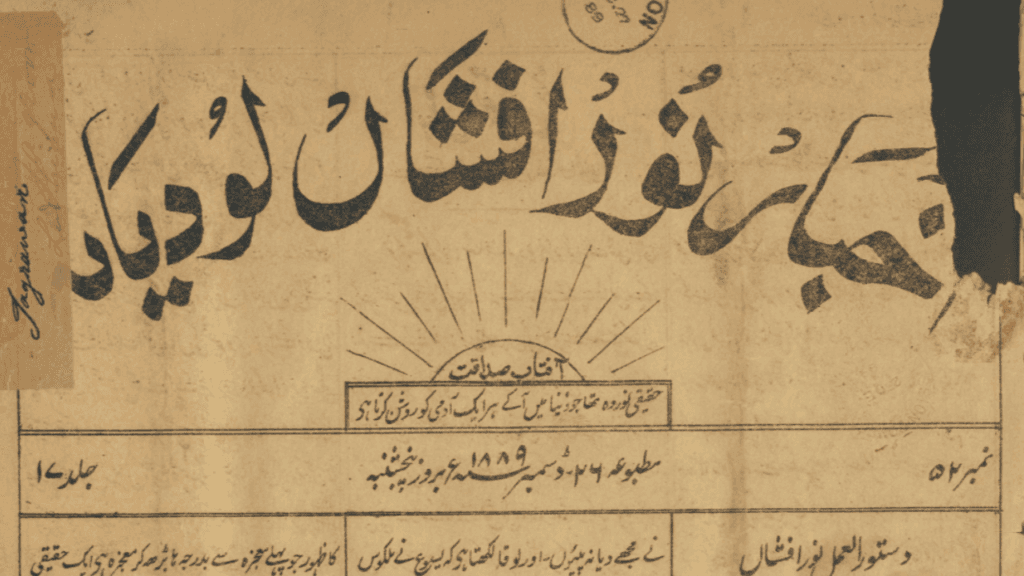
Recently, the Ahmadiyya Archive & Research Centre came across an old postcard – dated 29 January 1894 – from Rev Hassan Ali Safir, Editor of Nur-i-Afshan. This Ludhiana-based Christian newspaper had left no stone unturned in opposing Hazrat Mirza Ghulam Ahmad (as).
Upon searching Rev Safir’s name in the Jamaat’s literature, we found that he is mentioned by Hazrat Sheikh Yaqub Ali Irfani (ra) in an account recorded in Tarikh-e-Ahmadiyyat and also in Hayat-e-Ahmad.
It was interesting to learn that the young Yaqub Ali (ra), during his school days, had an encounter with Rev Hassan Ali Safir – then Assistant Editor of Nur-i-Afshan.
It must be noted that the young Yaqub Ali (ra) had seen1 Barahin-e-Ahmadiyya in 1887 through Maulvi Ghulam Mohiyuddin Sahib – his teacher and headmaster at the Vernacular Middle School – and even met Hazrat Mirza Ghulam Ahmad (as) in 1889. However, he had not done the bai‘at until February 1892.2

It was in 1889 when Hazrat Mirza Ghulam Ahmad (as) established Jamaat-e-Ahmadiyya and took bai‘at (pledge of allegiance) in Ludhiana, the town where Nur-i-Afshan was based and the young Yaqub Ali (ra) was studying.
In March 1889, Nur-i-Afshan mentioned Hazrat Ahmad’s (as) visit to Ludhiana and his announcement to take bai‘at from those who wished to join his Jamaat. In one of its articles, the newspaper questioned the Muslims as to what was the need to pledge allegiance to Hazrat Ahmad (as).3 The Nur-i-Afshan published more comments in the coming issues and used foul language against Hazrat Ahmad (as).4
Without going into details of that episode, this article only intends to narrate the young Yaqub Ali’s (ra) encounter with Rev Hassan Ali Safir, the subsequent interaction with Nur-i-Afshan and the response from the Christian missionaries.
Who was Rev Hassan Ali Safir?
Rev Munshi Hassan Ali Safir was originally a Muslim from the Alwar State in the Rajputana area of British India. He was well-versed in various languages, such as Urdu, Arabic, Persian and English. He later converted to Christianity and actively preached the Christian faith in the Rajputana areas alongside Rev Dr Colin S Valentine.5 He was well-versed in poetry, as evident from various issues of Nur-i-Afshan. A compilation of his ghazals was published entitled Guldasta-e-Safir.6

Rev Imad-ud-Din Lahiz, in the appendix of his paper for the 1893 Parliament of the World’s Religions, has included Safir’s name among the prominent clergy in Punjab Missions as follows:
“Sayad Hassan Ali, Safir. Baptized, American Presbyterian Mission, Lahore. A Christian poet, a descendant of Mohammed, Editor of The Nur Afshan; American Presbyterian Mission, Ludhiana.”7
Mentioning the missionary activities in the Rajputana areas, John Robson DD has written about the conversion of Hassan Ali Safir in the 1860s. He wrote that the first convert at the Nasirabad Mission, named Lachman, was “not a man of brilliant parts”, however, “the next convert was quite a contrast. His name was Hassain [sic.] Ali; he was a Mohammedan, of considerable genius and force of character. His conversion and baptism produced a great sensation in the native community.”8
John Robson DD continued by stating that Hassan Ali Safir “did good service with his pen even more than with his word. Some of the most poetic and literary of the hymns sung by the native Christians throughout the north-west are ‘ghazals’ (a species of Urdu poem) composed by him.”9
Hassan Ali Safir’s early connection with the Nasirabad Mission is evident from Nur-i-Afshan’s 2 March 1876 issue, wherein he has been associated with the said Mission while publishing his ghazal.
John Robson DD further mentioned that in Jaipur, Rev Dr Colin S Valentine was joined by Hassan Ali Safir10 and thereafter, in Alwar State, Rev Henry D St Dalmas “gathered a few native converts, and organised school and other missionary work” where “his chief coadjutor” was Hassan Ali Safir.11
Rev Hassan Ali Safir had been stationed at the Ajmer Mission House,12 before joining the Nur-i-Afshan as the Assistant Editor in October 1889.13 He passed away on 12 August 1895.14 Upon his demise, it was expressed by a Christian writer that “it seems difficult for the newspaper to retain its status after Hazrat Safir.”15
Young Yaqub Ali (ra) and Rev Hassan Ali Safir

Narrating about how he developed an interest in reading the newspapers and writing articles, Hazrat Sheikh Yaqub Ali Irfani (ra) states in his account – recorded in Tarikh-e-Ahmadiyyat – as follows:
“It was due to the editor of Nur-i-Afshan, Mr Hassan Ali Safir, that I grasped a great opportunity to read newspapers.”16
He has explained this point with more detail in Hayat-e-Ahmad, where he states:
“There was an editor of Nur-i-Afshan, namely Hassan Ali Safir. He was around 60 years of age and a very well-versed poet and writer. Once an article was published about him in Manshur-i-Muhammadi. I took that issue to him and asked, ‘Are you the same Safir Sahib who has been mentioned here or someone else?’ He felt a bit embarrassed [mahjub] and said, ‘Sahibzada! You seem to be fond of reading newspapers. I receive many newspapers here, so you may take them [to read].’ In this way, I built some frankness with him and hence, I submitted to him a question to be published [in Nur-i-Afshan].”17
A series of correspondence in Nur-i-Afshan

Mentioning the question, Hazrat Sheikh Yaqub Ali Irfani (ra) did not state the date of Nur-i-Afshan’s issue which published it, however, further research revealed that it was the 26 December 1889 issue. The wording of the question, as published in the newspaper, was as follows:
سوال
توحید کے ماننے والوں کی نجات ہوگی یا نہیں؟ بر تقدیر اول تثلیث ماننے کی ضرورت نہیں اگر نہیں تو انبیائے سابقین مسیح اور اُن کی نجات کا کیا حال ہوگا؟
راقم ایک مستفسر
“Question:
“Will those who believe in Tawhid [Oneness of God] attain salvation or not? If the answer is ‘yes’, there is no need to believe in the Trinity; if the answer is ‘no’, then what will be the status of the previous Prophets prior to Masih [Jesus (as)] and their salvation?
“Author, an inquirer.”
We can make an estimate of the time frame as to when that encounter between the young Yaqub Ali (ra) and Rev Hassan Ali Safir may have taken place.
Rev Hassan Ali Safir took charge as the Assistant Editor of Nur-i-Afshan in October 1889 and the question was published on 26 December 1889, so the meeting might have taken place between early October and 25 December 1889.
Interestingly, there was an announcement on the same page about an incident at the Municipal Board High School Ludhiana, sent by a student named “Muhammad Yaqub Ali”. It is evident from the autobiography of Hazrat Sheikh Yaqub Ali Irfani (ra) that after passing the Vernacular Middle School in 1888, he joined the “Board School of Ludhiana” in 1889.18
Coming back to his question, we learn from Hazrat Sheikh Yaqub Ali Irfani (ra) the following:
“This question got published which initiated a debate in the newspaper. Rahmat Masih Waiz [1857-1935] of Narowal had started a magazine Mubashar [originally started by him entitled ‘Mubashar Injeel’ as a supplement to Nur-i-Afshan and later published separately from Batala as “Mubashar”19], wherein he began publishing articles of Ishaq Kindi which contained a debate on Tawhid.
“Therefore, he posed a question in response to my question as to ‘what kind of Tawhid you believe in?’ My response to it got published […]. At last, Reverend [EP] Newton [Superintendent of Nur-i-Afshan] compelled Munshi Hassan Ali Safir to halt the series [of correspondence].”20
Now, there is no mention of the date on which the response from Rahmat Masih Waiz was published. However, upon looking at the subsequent issues, we find that a response from the said Christian was published in the 9 January 1890 issue, which stated:
“In the previous year’s 26 December issue of Nur-i-Afshan, an inquirer asked whether or not the believers of Tawhid will attain salvation? The inquirer is kindly requested to elaborate as to what he means by believing in Tawhid? In your view, what is meant by believing in Tawhid? […] As long as these points are not explained in detail, this question would be deemed inappropriate. If you explain it, I will be ready to answer.”21
This was followed by an article by Boota Singh Peter from RP Mission Roorkee, who mentioned the question by the young Yaqub Ali (ra) and while answering it, he asserted that “in my view, anyone who believes in Tawhid and rejects Trinity has not truly recognised God.” He concluded by saying that since the beginning of this world, “all those who have attained salvation were believers of the Trinity.”22
In the 13 February 1890 issue, Rahmat Masih Waiz published an article, entitled “Ba-Jawab Khat Muhammad Yaqub Ali, Mut‘allam Board High School Ludhiana” (lit., In response to a letter from Muhammad Yaqub Ali, a student at the Board High School Ludhiana).

Rahmat Masih first mentioned his earlier response to the young Yaqub Ali’s (ra) question about salvation and then stated that he had received a letter from Yaqub Ali (ra). According to Rahmat Masih’s statement, the letter stated that a response was sent to the editor of Nur-i-Afshan, however, the editor returned it without publishing due to prejudice and opposition against Islam.
Rahmat Masih quoted a part from that alleged letter and then wrote that the letter did not define Tawhid, rather, it just says that the Muslims believe in the same Tawhid which was believed by Abraham (as). Rahmat Masih wrote that it is not what he had asked, but rather, he needs to know that in view of Yaqub Ali (ra), what is the definition of Wahid (One) and in what way God is Wahid.
Rahmat Masih concluded his article by saying that once the answer is received, he will request the editor to publish it; however, he has no time to continue this debate back and forth in the personal correspondence.23
The Christian missionaries and their leading newspaper Nur-i-Afshan hesitated in answering the question raised by a 14-year-old Muslim student and – according to the statement of Hazrat Sheikh Yaqub Ali Irfani (ra) – Rev EP Newton instructed Rev Hassan Ali Safir to discontinue the correspondence.
The young Yaqub Ali (ra) later pledged allegiance to the Promised Messiah (as) in 1892 and after a few years, served as the founding editor of the Jamaat’s first-ever newspaper, Al Hakam.
The official records (year 1912) of the Home Department of the British Indian Government, provide a detailed introduction of Hazrat Sheikh Yaqub Ali Irfani (ra) in the following words:
“Yakub Ali, Sheikh, Torab, son of Sheikh Muhammad Ali. He passed his Entrance Examination as a private student in 1893. His father was a subordinate teacher in the Adampur Vernacular Middle School. Resident of Ludhiana, now of Qadian. Worked as a candidate for a Zilladarship in the Irrigation Department. Got employment as a Patwari in that Department, but resigned. In 1894 commenced work as Editor in Amritsar of the Riaz-i-Hind, Feroz, Ahluwalia Gazette, Jahan Numa and Punjab. In 1896 was selected as a special Police Officer to supervise Muharram arrangements. In 1897 started the Hakam [sic.] newspaper in Amritsar, and in 1898 transferred it to Qadian. Was for some time [a] translator in the Paisa Akhbar Office. Age 36 years.”24
Endnotes
1. Maktubat-e-Ahmad, 2008, Vol. 2, p. 499
2. Tarikh-e-Ahmadiyyat, Vol. 18, pp. 637-639
3. Nur-i-Afshan, 14 March 1889, p. 6
4. Ibid., 21 March 1889, 4 April 1889 and 18 April 1889
5. Ibid., 20 March 1896, p. 6
6. Ibid., 9 October 1890, p. 3
7. The Church Mission Intelligencer, Vol. XLIV, London, 1893, p. 585
8. Missions of the United Presbyterian Church, Edinburgh, 1896, Offices of United Presbyterian Church, p. 86
9. Ibid.
10. Ibid., p. 100
11. Ibid., pp. 113-114
12. Nur-i-Afshan, 22 August 1889
13. Ibid., 9 January 1890, p. 3
14. Ibid., 23 August 1895, p. 11
15. Ibid., 13 September 1895, p. 5
16. Al Fazl, 6 May 1958, p. 4
17. Hayat-e-Ahmad, Vol. 3, pp. 213-214, footnote
18. Al Fazl, 6 May 1958, p. 4
19. Nur-i-Afshan, 15 January 1891, p. 5
20. Hayat-e-Ahmad, Vol. 3, pp. 213-214, footnote
21. Nur-i-Afshan, 9 January 1890, p. 12
22. Ibid., 23 January 1890, pp. 5-6
23. Ibid., 13 February 1890, pp. 5-6
24. National Archives of India, Home Department, Political, 1912