
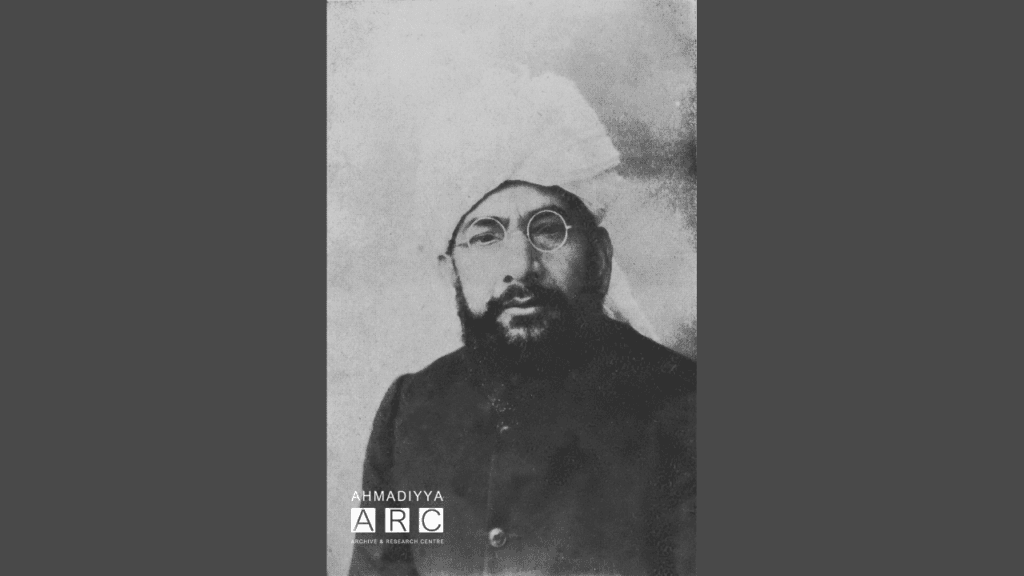
Hazrat Chaudhry Fateh Muhammad Sayal (ra)
أَشْهَدُ أَنْ لَّا إِلٰهَ إِلَّا اللّٰهُ وَحْدَهُ لَا شَرِيكَ لَهُ وَأَشْهَدُ أَنَّ مُحَمَّدًا عَبْدُهُ وَرَسُولُهُ أَمَّا بَعْدُ فَأَعُوذُ بِاللّٰهِ مِنَ الشَّيْطَانِ الرَّجِيمِ
[“I bear witness that there is none worthy of worship except Allah; He is One and has no partner. And I bear witness that Muhammad (sa) is His servant and Messenger. After this, I seek refuge with Allah from Satan the accursed.”]
بِسۡمِ اللّٰہِ الرَّحۡمٰنِ الرَّحِیۡمِ اَلۡحَمۡدُ لِلّٰہِ رَبِّ الۡعٰلَمِیۡنَ الرَّحۡمٰنِ الرَّحِیۡمِ مٰلِکِ یَوۡمِ الدِّیۡنِ ؕ اِیَّاکَ نَعۡبُدُ وَاِیَّاکَ نَسۡتَعِیۡنُ اِہۡدِنَا الصِّرَاطَ الۡمُسۡتَقِیۡمَ صِرَاطَ الَّذِیۡنَ اَنۡعَمۡتَ عَلَیۡہِمۡ ۬ۙ غَیۡرِ الۡمَغۡضُوۡبِ عَلَیۡہِمۡ وَلَا الضَّآلِّیۡنَ
[“In the name of Allah, the Gracious, the Merciful. All praise belongs to Allah, Lord of all the worlds, The Gracious, the Merciful, Master of the Day of Judgment. Thee alone do we worship and Thee alone do we implore for help. Guide us in the right path – The path of those on whom Thou hast bestowed (Thy) blessings, those who have not incurred (Thy) displeasure, and those who have not gone astray.”] (Surah al-Fatihah, Ch.1: V.1-7)
Memories from years of close company
Regarding the Promised Messiah (as), based on the opportunity I had of keeping his company and staying with him, I will share a few matters. It is possible that the things I recount may have been written or related by others previously, but this does not diminish their importance, for this topic is Zikr-e-Habib [remembrance of the beloved]. The purpose of remembrance or zikr is to recount a matter time and again, so that those very traits, habits and, as it were, that very spirit which surged in the heart of the Promised Messiah (as) may be awakened within us.
Always in a state of wudu
I had the opportunity to remain in the service of the Promised Messiah (as) and in the years 1903, 1904 and 1905, when Huzoor (as) would travel to Gurdaspur for the Karam Din case, I would frequently accompany him. Based on this, it is my experience or this is my testimony, that the Promised Messiah (as) remained in a state of wudu [ablution] at all times.
Now, one might say this is no great matter, but it is worth mentioning and reflecting upon how the Promised Messiah (as) followed the sunnah of the Holy Prophet (sa) even in the smallest of matters. Moreover, this serves as an answer to those who object against Huzoor (as), claiming that he had no love for the Holy Prophet (sa) nor any regard for Islam. […]
True waza’if and the remembrance of Allah
After this, I will speak about certain waza’if and devotional practices of Huzoor (as) which I happened to learn about. The Promised Messiah (as) did not approve of the waza’if prevalent among the general public and the Sufis. He would say that Muslims have split into two groups. First are those dry clerics who believe that man simply cannot reach Allah the Almighty. This is despite the fact that it is repeatedly mentioned in the Holy Quran:
فَاذْكُرُونِي أَذْكُرْكُمْ
[“Therefore remember Me and I will remember you.” (Surah al-Baqarah, Ch.2: V.153)]
So, if He does not speak, if we have no connection with Him and if we cannot attain that nearness in this world, then what is the point of remembering Him? That is to say, we keep silently repeating “Allah, Allah” in our hearts and God keeps saying “My servant, My servant” in His, yet we never hear that voice; we never hear that sound, nor do we manifest any of the signs that are born within a person through divine nearness. So, they are the kind of people who simply do not turn towards this.
On the other hand, there are certain sufis who have established new, innovated waza’if. Both these approaches are wrong. One must remember Allah and remember Him frequently, but this does not mean we should invent new waza’if from ourselves. Rather, the waza’if should be those proven from the sunnah of the Holy Prophet (sa). Accordingly, Huzoor (as) would advise us to recite durood sharif and to invoke blessings upon the Holy Prophet (sa) abundantly, for there are immense blessings in it. He would say to recite Surah al-Fatihah, to recite istighfar, seeking forgiveness from Allah, and to observe salat with care and beauty. He would explain that this is the foremost thing; if a person does not supplicate during salat, then his outward waza’if hold no meaning at all.
Salat as the moment of nearness
I mentioned this last year as well, that when my father reached Qadian to request Huzoor (as) for prayers, having been entangled in a particularly dangerous court case, Huzoor (as) said to leave someone behind to remind him and he would pray for him. He then told him to instruct this person that when he stood for salat, he should remind him that Nizamuddin is facing such and such court case, so that Huzoor (as) may pray for him. “So that I may pray for you during salat.”
The Promised Messiah (as) used to say that the time of greatest nearness for a person is the time of salat. For the sajdah in salat is, as the Holy Prophet (sa) stated, مِعْرَاجُ الْمُؤْمِنِ [the ascension of the believer]. (Sahih Muslim, Kitab as-salat, Hadith 482; Tafsir al-Kabir by Fakhr al-Din Al-Razi, Vol. 1, Beirut: Dar Ihya al-Turath al-Arabi, pp. 233-236) That is to say, when a believer sincerely prostrates on the earth, his prostration takes place, as it were, on the Divine Throne. If he does not ask at that moment, if he does not pray then, but begins his prayers once he has departed from the Divine Court, what use is it? Therefore, waza’if can only be beneficial if, first and foremost, salat is observed beautifully and with true presence of mind and with the intention and hope that I am conversing with God and God is listening to my words. And it is no wonder that His voice might even reach my ears. Rather, it is essential for it to be so.
Service to Islam as the need of the age
And after making the prescribed supplications in salat, one should then pray in their own language, so that tenderness may arise in the heart and so that a person understands what they are asking for. After this, Huzoor (as) would say that the greatest wazifah for our Jamaat, our specific wazifah and the wazifah suited for this era [is the service of Islam] – as Huzoor (as) would say, work is done according to the need. If a man is thirsty and you place food before him, what benefit is that food to him? If a man needs a quilt and is dying of the cold and instead of giving him a quilt you tell him to drink ice water, he will derive no benefit. So, the need of this time is the service of Islam.
This is our special wazifah. The service of Islam is a vast undertaking. Do it in an academic manner, do it in a practical manner, go out and do tabligh and propagation of Islam; write books; respond to the objections of opponents and highlight the spiritual insights and verities of Islam that establish its superiority over other faiths. For today, the Holy Prophet Muhammad, peace and blessings of Allah be upon him, is being attacked. Christians, Aryas and atheists are launching these attacks; they are attacking Islam, attacking the Holy Quran. And if a person neither defends the Holy Quran nor defends the Holy Prophet (sa), nor goes out to answer these people, nor responds to their missionaries, but instead sits inside his hujrah [small room] repeating “Allah, Allah”, then he is, in a sense, committing a kind of treachery.
Thus, he would say that to traverse spiritual ranks and attain the nearness of Allah the Almighty, the greatest wazifah today is to give one’s time for Islam, to offer one’s life for Islam, to spend one’s wealth for Islam, to expend one’s faculties for Islam, to use one’s intellect for Islam and to pray with heartfelt anguish for Islam. This, as it were, is the wazifah that is the fruit of today’s season. Through this, you will reach Allah the Almighty very quickly.
Supplications in sajdah
Then, I sometimes had the opportunity to observe that when the Promised Messiah (as) would go into sajdah during salat, after the common prayer we recite:
سُبْحَانَ رَبِّيَ الْأَعْلَىٰ
[“Glory to my Lord, the Most High.”]
Huzoor (as) would also recite the prayer – that is, in ruku‘:
سُبْحَانَ اللّٰهِ وَبِحَمْدِهِ سُبْحَانَ اللّٰهِ الْعَظِيمِ
[“Holy is Allah and worthy of all praise; Holy is Allah, the Great.”]
And in sajdah, after reciting SubhanAllah…, he would say:
يَا حَيُّ يَا قَيُّومُ بِرَحْمَتِكَ أَسْتَغِيثُ
[“O Living and Self-Subsisting God, I seek Thy help through Thy mercy.”]
And he would recite this prayer with almost the same regularity as he recited سُبْحَانَ رَبِّيَ الْأَعْلَىٰ in sajdah. Sometimes, he would also add to it:
رَبِّي رَبُّ السَّمَاوَاتِ وَالْأَرْضِ
[“My Lord is the Lord of the heavens and the earth.”]
The Promised Messiah’s noble character
Now, I will mention a few things about the pure and captivating morals of the Promised Messiah (as). I shared some things last time as well and later some people remarked to me that I had only been talking about myself. The truth is, in the matters I related, I was not expressing any greatness of my own;
من آنم که من دانم
[“I know well what I truly am.”]
I am fully aware of my own reality. I consider my status to be nothing at all. I mentioned those things because, despite being a deeply insignificant person, without any special merit or particular distinction, just a mere student and a child, Huzoor (as) treated a person like me in such a manner. This was a reflection of Huzoor’s (as) excellent and lofty morals; it was not because of any merit in me.
So, if I relate a few things now, it does not imply any excellence on my part. Rather, it highlights the excellence of the Promised Messiah (as). It shows how a person and a being who is renowned in the world for his knowledge, his capability and his piety and righteousness – one who claims to be the commissioned one of Allah the Almighty, the Mahdi, the Messiah, Krishna and Dhul-Qarnain, who has a connection with Allah the Almighty, whose prayers Allah accepts and who has hundreds of thousands of devoted followers ready to lay down their lives for him – his mind should be loftier than even that of kings and rightly so. Yet, for such a grand and magnificent being to console and care for an ordinary child is a testament to incredibly lofty morals.
Among the incidents I remember, which have left a deep mark on my heart, is that when I passed my matriculation from Qadian, I went on to study at Government College. In those days, whenever the Promised Messiah (as) published a new book, he would sometimes send it to me as well. Look at how extraordinary this is.
It should be noted here that whenever the Promised Messiah (as) published books, a portion of every single book was always distributed for free among the people. Certain friends were selected or certain Christian leaders, Hindu leaders, Muslim leaders or scholars were chosen and those books were sent to them free of charge. This happened with every book. The remaining copies were sold to cover the expenses, but this selling and distribution was not done in the manner of shopkeeping. Rather, the very first task was always to distribute it for free – send it to so-and-so, send it to so-and-so, send it to so-and-so, send it to so-and-so.
At that time, Hazrat Mir Mahdi Hasan Sahib was appointed by Huzoor (as) for this task and he used to send books to me. Thus, when the book would arrive, it would be accompanied by his letter stating that among those to whom the Promised Messiah (as) has distributed books for free, your name is also included and so we are sending these books for you.
His affection for guests
Similarly, one aspect of Huzoor’s (as) morals was something that was, for others, an entirely novel thing. And if that person were an impostor – God forbid, God forbid – as some of our [non-Ahmadi] people believe, he simply could never act in such a way. That matter was that whenever a guest arrived, Huzoor (as) would be immensely delighted. It was as though a rose had blossomed. Meeting them with such a cheerful countenance, conversing with them and making it clear that the mere arrival of that person was considered a matter of great joy by Huzoor (as).
Alongside this, I always observed keenly that whenever a friend was about to leave, Huzoor’s (as) disposition would become sorrowful. It seemed as if someone were suffering a loss, as if something were being wasted. In his voice, his gaze, his conversation and his gestures, a kind of grief could be felt, as if to say, “This person came and now he is leaving.” And then, along with this, Huzoor (as) would say, “Stay one more day, stay two more days or stay three more days.”
I observed this, that for a person who receives thousands of guests, it would be natural to think, “This person has come, a new expense has fallen upon me and for as long as he stays, the expense will continue.” Yet, to the contrary, Huzoor (as) would be joyful at their arrival, grieved at their departure and would urge every single person who was leaving, in one way or another, to stay.
However, this encouragement was given in such a manner that he also remained mindful that the person should not suffer any loss back home or feel any undue burden in their heart, thinking, “I had this task to do and that task to do and that task to do and if I stay here in Qadian, I will suffer a loss.” He took care of this aspect as well, whilst still urging them to stay. Even though I was a child at the time, this is such a clear matter: God forbid, God forbid, if Huzoor (as) had even the slightest thought that “I am being deceitful or I am being fraudulent or I am deceiving people,” he would have thought, “Now that these people have come, it is possible they might spot some flaw in me; it is better if they leave quickly.”
Accordingly, I have seen that people who make false claims remain shut away inside their hujrahs and do not meet people at all. For if they were to meet, their secret would be exposed to the people regarding how much knowledge they possess, how much piety they have and what the nature of their worship is. They stay inside and people assume that the pir does not come out because he is engaged with Allah the Almighty – since he is conversing with God, how can he converse with men?
But here, with Huzoor (as), it was the exact opposite. Whenever a person arrived, Huzoor (as) believed that if they stayed here, their knowledge would benefit, their morals would benefit, their faith would benefit and perhaps, while staying here, they might witness such a sign of Allah the Almighty that their faith may rise to the lofty Throne. This is why Huzoor (as) would urge them and call people, saying, “Come and stay with me.” And not only his disciples, but non-disciples too, Muslims, Christians, Jews, atheists – he would tell them, “Come and stay with me and see; if you stay for these many days, you will surely witness some sign and faith will be born in your hearts.”
‘Has Fateh Muhammad not come?’
Relating to this, the incident concerning myself is that when I moved away from here to Lahore, I used to generally visit Qadian on Sundays. On a day that I did not come, some friends would later tell me, “You did not come on such and such Sunday and the Promised Messiah (as) enquired, ‘Has Fateh Muhammad not come?’” Now, look at this. A mere student, just studying along, a farmer, not some wealthy nobleman, not from a great scholarly family – yet when he did not show up, Huzoor (as) cared enough to ask whether he had come or not.
An informal majlis filled with love
Then, there was the fact that his gatherings were free from formality. I related an incident about this before, which was that when I was staying there in a room downstairs, there was a very large hall where Hazrat Mirza Bashir Ahmad [ra] stayed towards the end. Above that was a room where Huzoor (as) used to sit. Some people arrived and went upstairs for a meeting. I thought perhaps it was some special work, so I should not go. Then some others came and went up and then some others came and went up. At that point, I realised that this was an open gathering, nothing exclusive and that I should go too.
So, I climbed the stairs and went forward. The entire room was full. The Promised Messiah (as) was seated on a charpoy and friends were sitting on the floor, engaged in conversation. I went and stood in the doorway. When I stood in the doorway, Huzoor (as) saw me and said, “Fateh Muhammad, come forward,” and gestured for me to sit near him on the charpoy. I sat down there, even though highly respectable elders were seated on the floor; yet the Promised Messiah (as) seated me beside him.
This was no special distinction of mine; rather, it was a general display of Huzoor’s (as) character. Whoever it was, Huzoor (as) would call them and seat them near him. Indeed, I have read in certain books that Hazrat Hafiz Ibrahim Sahib (ra) narrated a similar incident happening to him – I believe it was likely the same room. He went and stood in the doorway and Huzoor (as) called him forward, took his hand and seated him beside himself on the charpoy.
Every disciple felt uniquely loved
So, this was not due to any personal distinction or rank, but rather due to the noble character of the Promised Messiah (as) and the result of this was – as you must have read many times and as Hazrat Mufti Muhammad Sadiq (ra) has described – that every individual of the Jamaat had a profound love for Huzoor (as).
And it is an astonishing thing, an undeniable fact – how can I even describe it? – that every single disciple and Ahmadi believed that Huzoor (as) loved them the most. “He treated me like this or he treated me like that and he did not do this with others.” Every single person believed, “He treated me this way or he treated me that way; I am the most beloved.” Every person felt that the Promised Messiah (as) loved them more than anyone else.
Now, when people told me this upon my arrival, saying that Huzoor (as) had asked, “Has Fateh Muhammad not come this time?”, I could hardly contain my joy, thinking, “Look how much Huzoor (as) cares for me; I did not come and Huzoor (as) missed me” – that is to say, he noticed my absence. Thus, Huzoor (as) held great love for me in his heart. […]
(Delivered on 26 December 1955 at Jalsa Salana Rabwah and translated by Al Hakam)