
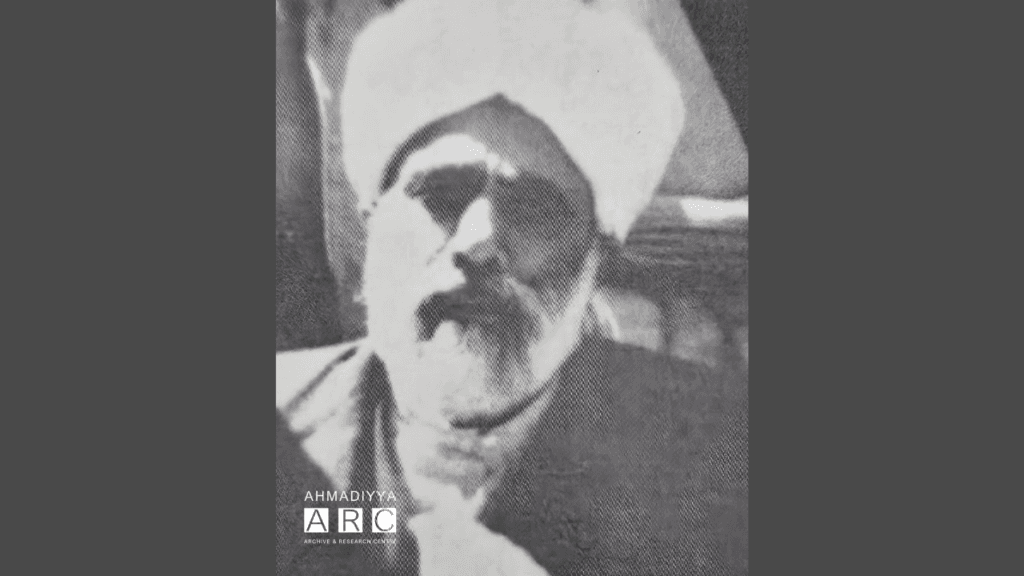
Hazrat Dr Hashmatullah Khan (ra)
اَشْھَدُ اَنْ لاَّ اِلٰہَ اِلاَّ اللّٰہُ وَحْدَہٗ لَاشَرِیْکَ لَہٗ وَاَشْھَدُ اَن مُحَمَّدًا عَبْدُہٗ وَرَسُوْلُہٗ
[“I bear witness that there is none worthy of worship except Allah; He is one and has no partner. And I bear witness that Muhammad (sa) is His servant and Messenger.”]
Respected friends!
ٱلسَّلَامُ عَلَيْكُمْ وَرَحْمَةُ ٱللَّٰهِ وَبَرَكَاتُهُ
[“May the peace, mercy and blessings of Allah be with you.”]
I have to present a few matters before you by way of Zikr-e-Habib وباللہ التَّوْفِيق [and with Allah rests all true enablement]. The truth is that I do not consider myself worthy to speak of that exalted being whose majestic status is ‘جري اللهِ في حُللِ الأنبياء’ [The Champion of Allah in the mantles of the Prophets] (Tadhkirah [English], p. 100). My heart trembles at the very word Habib [Beloved] – for where stands this insignificant being and where stands that holy personage! I am merely one whose association with the footsteps of Mahmud [Hazrat Musleh-e-Maud (ra)] goes back to half a century and I say:
پاؤں ترے کہاں، مرا ناچیز سر کہاں
[How far beyond is your exalted station, and how lowly bows this head of mine?] (Kalam-e-Mahmud, p. 189)
At this moment, the cry of my heart is:
پہنچائیں در پہ یار کے وہ بال و پر کہاں
دیکھے جمالِ یار جو ایسی نظر کہاں
[Where are the wings that might bear me to the threshold of the Beloved? Where is the vision worthy to behold the Beloved’s radiant grace?] (Ibid.)
Early memories of bai‘at
I was only twelve years old when I had the privilege of joining my grandfather and my father in that bai‘at [pledge of allegiance] which Hazrat Maulvi Abdul Qadir Sahib Ludhianvi (ra) had taken on behalf of the Promised Messiah (as) in 1899 at Patiala.
When I developed some understanding and reached the age of about 15, I wrote a letter of bai‘at to Huzoor (as) out of my own volition so that I might attain this blessing and his prayers. Consequently, within a few days, I received a letter written in the hand of Hazrat Maulvi Abdul Karim (ra) stating that Huzoor (as) had accepted my bai‘at and prayed for me. A similar request for bai‘at had also been made by two of my elder companions, Sheikh Muhammad Afzal Sahib and Mian Khuda Bakhsh Sahib. Thus, the names of all three of us were published in the list of nau-mubai‘een [new initiates] in the 17 June 1902 issue of Al Hakam. By the grace of Allah, both of these elders are still alive.
A passion for faith
The impact of this bai‘at and that prayer was such that a fervour for salat and a taste for du‘a and supplications awakened within me, as did a deep desire to read the books of the Promised Messiah (as). Consequently, even at a young age, I read and comprehended a profound book like Surma-e-Chashm-e-Arya.
During that same period, when the plague was raging, I had the fortune of reading the sacred treatise Kashti-e-Nuh. It had a profound effect on my heart, revealing to me the transient nature of this world. This is evident from the following [Urdu] couplets of mine composed during those very days, even though my education was minimal at the time, as I was only studying in the sixth grade. The couplets are as follows:
ہم تو بندے ہیں ترے عاجز، غریب و بے نوا
ہم غریبوں پر تیری اک مہربانی چاہیے
اس جہانِ فانی سے کچھ بھی ہے نہیں لے جانا ساتھ
اک سند تیری رضا کی ہم کو پانی چاہیے
کچھ نہیں مقصود یہاں اس تنگنائے دہر میں
اک جھلک تیری نگاہ کی ہم کو آنی چاہیے
[We are but Your servants – helpless, poor, and destitute; Upon us lowly souls, a measure of Your grace is all we seek. From this transient world, we shall carry naught away; The seal of Your divine pleasure is the only decree we pray. Within the narrow confines of this earthly age, no other ambition remains; Save that a single, fleeting glimpse of Your gaze falls upon us.]
These verses fully represent the condition that had developed in the heart of a child due to the teachings, attention and prayers of Huzoor (as).
A longing to see the Promised Messiah
When I turned eighteen, an aching desire to behold the Promised Messiah (as) arose in my heart, but due to a lack of means, travelling to Qadian was difficult. In this state, I began to pray, weeping bitterly: “O my God, grant me the blessing of seeing Huzoor (as).”
Barely a few days of prayer had passed when Allah the Almighty granted me a vision of Huzoor (as) through a dream right there in Patiala. I saw that I was lying down in the small room of our mosque in Patiala and saw the door open as the Promised Messiah (as) stepped inside. Overwhelmed with love, I rose from my bed and clung to Huzoor (as), as if I had become entirely his. Upon seeing this dream, my heart became filled with gratitude to Allah and my absolute conviction in Him being the All-Hearing, the All-Seeing and the Cherisher of the poor was firmly established.
Hardly two or three months had passed since witnessing this dream when my Gracious Lord, who was well aware of the condition of my heart, granted me the opportunity to travel to Qadian in the company of a caravan. This journey took place in August 1905.
First arrival in Qadian
My very first sight of Huzoor (as) took place in Masjid Mubarak just after the sun had set and Huzoor (as), his face shining like the moon, emerged from his inner quarters into Masjid Mubarak for the Maghrib prayer. Alhamdulillah, that first sight was a source of immense joy.
After the prayer, when Huzoor (as) held a gathering on Shah Nashin, the raised platform, I had the opportunity to draw near, shake his hand and gently press his feet. And when Huzoor (as) took the bai‘at of the new initiates, I had the supreme fortune of taking the pledge at his blessed hand. الْحَمْدُ لِلَّهِ عَلَى ذَلِكَ [All praise belongs to Allah for this].
We stayed in the guest house for ten days. Before our arrival, a new Muslim convert named Abdul Haq, formerly Bishan Das, was already staying there as a guest. He claimed to have spent sixteen years seeking spiritual knowledge with Pandit Dayanand. He told us on the very first day, “I have been here for several days and have asked Hazrat Sahib twice to accept my bai‘at, but Huzoor simply replies, ‘Wait, do not be in a hurry.’” Yet, driven by the [fear for his life due to the plague], he partook in the bai‘at that very evening – the same evening that we took our pledge.
The following morning, we saw Huzoor (as) step out from his home and stand at the spot where the foundation of the house of Hazrat Mirza Bashir Ahmad (ra) was being laid. All of us guests were standing in the street before him. Meanwhile, Abdul Haq also arrived and called out from a distance, “Huzoor, congratulations; I too took the bai‘at last evening.” At that moment, signs of displeasure appeared on the face of Huzoor (as) and speaking with a certain majestic awe, he stated, “My placing a hand upon someone’s head yields no benefit unless the one taking the pledge brings about a transformation within himself and adopts true taqwa [righteousness and fear of Allah].”
That very evening, we heard him complaining and the next morning we witnessed him uttering many harsh words as he boarded a horse carriage and departed from Qadian. For us, this served as a profound proof of the believer’s deep insight possessed by Huzoor (as).
The character of Hazrat Maulvi Abdul Karim (ra)
By the grace of God Almighty, we would offer our prayers in the company of Hazrat Sahib (as) and behind the lead of Hazrat Maulvi Abdul Karim (ra) in Masjid Mubarak. Thus, we had the repeated honour of seeing Huzoor (as).
When Huzoor (as) would hold a gathering, we would get the opportunity to hear his pure words. In the assembly of Huzoor (as), all worries and sorrows would vanish and true peace of heart was attained. Generally, from the time of the Maghrib prayer until Isha, Huzoor (as) would sit on the raised platform on the upper roof of the mosque. Hazrat Maulvi Abdul Karim (ra) could also be seen sitting at his side; in his devotion, he was like a moth drawn to a flame, yet to us, he also appeared as a close and informal friend.
During those days, Huzoor (as) received the ilham and divine revelation: فزعَ عیسٰی وَمَنْ مَّعَہٗ [‘Isa and those with him are worried.], which I have remembered ever since. (Tadhkirah [English], p. 765) Little did we know then that this prophetic news would be fulfilled so swiftly and that only two months later, that very Abdul Karim, that very Abdul Karim who would sit alongside his beloved Master (as) on the raised platform, that very moth of the radiant flame, that very nightingale of Ahmadiyyat’s garden, who was the beloved Companion of his beloved Master (as), would leave us with the wound of separation – leaving behind for us the ultimate example of how one must burn out of devotion to the flame of guidance.
The Promised Messiah (as) truly suffered a severe shock at the passing of Hazrat Maulvi Abdul Karim (ra), which is a testament to the love Huzoor (as) held for his Companions. It was this profound heartfelt affection that, in a short span of time, clothed more than four hundred thousand individuals in the garment of utter devotion.
I am a witness to this deep, heartfelt love of Huzoor (as), for one day during my youth, I was sitting alone in the mosque reading one of his books. Its effect on my heart was so profound that I was compelled to pledge that I would never abandon this holy personage, even if the entire world were to forsake him. After the demise of Hazrat Maulvi Abdul Karim (ra), Huzoor (as) held his gatherings [with the Companions] as usual for a few days at the mosque. However, he soon ceased doing so, stating, “When I sit in the mosque and do not see Maulvi Sahib, my heart begins to sink.”
The revival of modesty and faith
We also offered a Friday prayer in the company of Huzoor (as) and led by Hazrat Maulvi Abdul Karim (ra) in Masjid Mubarak. The sermon delivered by Hazrat Maulvi Sahib (ra) was full of grandeur and majesty. I remember his statement to this day: “The Prophets of God possess a very shy disposition, much like a newlywed bride.” At that time, Huzoor (as) was sitting directly in front of Maulvi Sahib (ra). True modesty was radiant upon his face. This statement of Hazrat Maulvi Sahib (ra) was proof of extreme love and informality and a perfect depiction of the innate modesty of Huzoor (as). We never once saw Huzoor (as) stare fixedly in any direction.
This humble one submits that, to my mind, this very innate modesty was infused into those who took the bai‘at at his hands, due to which all members of the Jamaat became practitioners of ghadd-e-basar [lowering of the gaze]. This habit of lowering the gaze subsequently engendered a natural modesty within them. In turn, this modesty became the source of the modesty of faith in hundreds of thousands of people. Just as, in accordance with the sayings of Huzoor (as), we refer today to the death of Jesus (as) as the life of Islam, in the exact same manner, I call ghadd-e-basar and innate modesty the revival of faith. Based on my own observation and experience, I state that the degree to which one was blessed with the habit of lowering the gaze and exhibiting modesty, to that same degree did they attain the light of the heart. Today’s Ahmadis, who carry thousands of spiritual lights and blessings, are the result of that very seed of modesty sown into the hearts of their elders by the hands of the Promised Messiah (as).
I state this with absolute certainty: had the Promised Messiah (as) not possessed the highest degree of innate modesty and had a Jamaat characterised by ghadd-e-basar and innate modesty not been raised at that time, then that faith which had ascended to the heavens due to the shameless deeds of men would never have returned to the earth. Therefore, blessed is that Jamaat through whose existence the habit of lowering the gaze, the system of purdah [Islamic veil] and true natural modesty were firmly established and who were made the foundational exemplar of true Islam for the world and the instrument of its revival.
Jalsa Salana 1907
For my second opportunity to behold him, God Almighty enabled me to travel to Qadian on the occasion of Jalsa Salana in 1907. On this occasion, alongside having the privilege of listening to the sacred words of Huzoor (as), I also witnessed several signs of mercy. The very first sign of mercy was that we saw Huzoor’s (as) prayer for the safety and well-being of the friends travelling to attend the Jalsa fulfilled in our own persons.
The incident is such that for this blessed Jalsa, we three real brothers – Muhammad Yusuf Sahib, Hafiz Malik Muhammad Sahib and this humble one – departed from Patiala. By divine intervention, instead of taking the evening train on 24 December, which was generally used to travel to the Jalsa, we departed 12 hours earlier on the morning train. This was so we could spend a night staying with an acquaintance in Amritsar for the purpose of tabligh [preaching]. We spent the night in Amritsar. The next morning on 25 December, when we reached the station to head towards Batala and Qadian, we learned that a severe collision between two trains had occurred near the Ladowal station the previous night, resulting in the loss of two hundred and fifty to three hundred lives. Among those was the very train we would have been travelling on had we departed from Patiala on the evening train. While this news caused us immense grief and cast a pall of horror over our hearts, it also evoked deep gratitude to Allah within us, for the lives of three poor souls had been saved.
A glimpse of the Promised Messiah’s humility
On 26 December, the first day of the Jalsa, we had the privilege of accompanying Huzoor (as) on his morning walk. That day, Huzoor (as) walked towards the north of the town. A large crowd surrounded him. Huzoor (as) had purposefully chosen to walk through the Hindu bazaar so that those people might witness how the prophecy made 25 years prior – that people would come in large numbers from every distant track and bring gifts – was being outstandingly fulfilled today. (Tadhkirah [English], p. 1005)
Huzoor (as) was walking swiftly and his devoted lovers were engaged in a struggle to walk as close to him as possible. The matter reached such a point that, due to the carelessness of one or two of his devotees’ footsteps, Huzoor’s (as) shoe – which was of local make [and the heel of which was pressed down] – came off his foot twice. I noticed that there were no signs of displeasure on the face of Huzoor (as), nor did he utter a single word of complaint; in fact, Huzoor (as) did not even glance back, so as to ensure no one felt embarrassed.
On this occasion, Hazrat Mufti Sahib (ra) cried out: “What else are the people to do? God’s Prophet has arrived after such a long time.”
However, the organisers requested Huzoor (as) to pause beneath a tree, which was an Indian cherry tree and after forming a protective circle, allowed the devotees to shake his hand. An incident from this handshaking session remains before my eyes to this day. When it was his turn, an elderly farmer approached Huzoor (as). Yet, instead of extending his hand for a handshake, he began untying a knot at the corner of his tahband [a traditional lower garment]. He took so long doing this that the patience of the waiting friends began to overflow. But Huzoor (as) stood there in total serenity, like a younger brother standing before an elder brother. Finally, our elderly friend succeeded in untying the knot, extracting a rupee, presenting his offering and shaking hands. Thousands of blessings be upon that elder, through whom we were granted the fortune of witnessing the devotion of lovers, the patience they exercised and a magnificent display of the sublime morals of Huzoor (as).
Spiritual nourishment and prophetic wisdom
After the handshakes, Huzoor (as) continued his walk towards the north for half a mile. There, in a clean, open spot basking in the sun, friends laid down blankets to create a seating area where Huzoor (as) took a seat. This was likely the very blessed plot of land where, just a few years later, the grand building of the High School was constructed. On this occasion, Hazrat Maulvi Mubarak Ali Sahib (ra) recited Persian poetry in praise of Huzoor (as).
On the second day of the Jalsa, 27 December, while all the friends had gathered in Masjid Aqsa for the Friday prayer, I was sitting in the back row near the door. A desire welled up in my heart to behold Huzoor (as) up close. However, there seemed to be no apparent hope of this. A short while later, I saw that as soon as the Promised Messiah (as) entered the mosque, he sat down in the row just ahead of me. My heart became filled with gratitude to Allah that He had fulfilled my desire so swiftly.
Huzoor’s (as) choosing to sit at that spot was seemingly because the path forward to the mihrab was blocked by friends offering their sunnah prayers. But it is my faith that God Almighty had brought Huzoor (as) to that spot for my sake alone, because I was the very one whose weeping and wailing had moved God Almighty to bring Huzoor (as) to Patiala in a vision and I was the very one whose spiritual hunger was destined to move the spread of divine blessings the following day.
After the Asr prayer, Huzoor (as) delivered an address, the opening part of which was: “Firstly, I am thankful to God Almighty that He guided the hearts of all you gentlemen and gave you the ability to join this Movement despite the fact that thousands of Muslim clerics of India and the Punjab occupied themselves in denouncing me and kept maligning me as a dajjal [deceiver] and an apostate. It is also a great miracle of God Almighty that, despite this much rejection and vilification, and despite the intense efforts of my opponents day and night, this Jamaat keeps growing. In my estimation, our Jamaat must be in excess of four hundred thousand at this point. It is a great miracle that while our opponents are toiling day and night, ardently devising schemes and exerting the utmost to put an end to this Movement, yet God continues to expand our Jamaat.” (Malfuzat [English], Vol. 10, p. 32)
Guidance on accepting the truth
I now present one or two matters related to the account of my elder and mentor, Sheikh Muhammad Karam Ilahi Sahib of Patiala, by way of remembrance. The Promised Messiah (as) travelled to Ludhiana again in 1891. On that occasion, an elderly friend of Hazrat Sheikh Sahib (ra) from Ambala took him along to Ludhiana and submitted before Huzoor (as), “This young man is very intelligent and is also a believer in Huzoor (as), but he hesitates to take the bai‘at.” At this, Huzoor (as) asked, “Why, young man, why do you not take the bai‘at?”
Sheikh Sahib (ra) submitted, “Firstly, I have already taken the bai‘at elsewhere. Secondly, I hold back because I fear I may not be able to act upon the instructions of Huzoor (as).” Huzoor (as) replied, “If you have taken the bai‘at elsewhere, there is no harm; you may take my bai‘at as well. Consider how a student, when he goes to school, studies under one teacher, then another and then a third. And as for your concern that acting upon our teachings will be difficult, when you take the bai‘at and form the sincere intention to act upon them, God Almighty will Himself grant you the ability. Our task is merely to instruct people to shun evils and to guide them to the path of righteousness; we certainly cannot say that you may take the bai‘at and then do whatever you please.”
Hearing this, Sheikh Sahib (ra) became ready to pledge allegiance. He later told us, “Huzoor (as) took me into a room alone, latched the door with his own hands and took my bai‘at.”
He related a second incident to us, saying, “Once, in the early days, I was present in Qadian. When Huzoor (as) learned about me that I used to study the literature of Sir Syed Ahmad, he asked me, ‘Tell me, what is the difference between the literature of Sir Syed Ahmad and our literature?’”
“I submitted, ‘The literature of Sir Syed Ahmad is like a morsel of dry bread that is difficult to swallow, whereas the literature of Huzoor (as) is like an exquisitely delicious and moist dish that goes down the throat with absolute ease.’ Upon hearing this answer, Huzoor (as) was highly pleased.”
اللَّهُمَّ صَلِّ عَلَى مُحَمَّدٍ وَعَلَى عَبْدِكَ المَسِيحِ المَوْعُودِ وَبَارِكْ وَسَلِّمْ
[O Allah, send blessings upon Muhammad and upon Your servant, the Promised Messiah and send peace and blessings].
(Delivered on 28 December 1964 at Jalsa Salana Rabwah and translated by Al Hakam)