
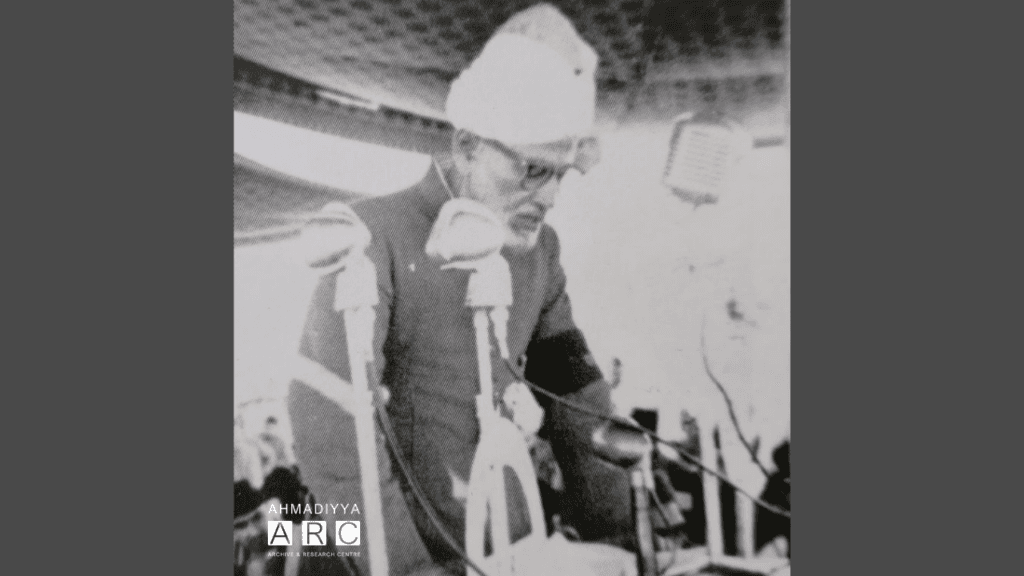
Hazrat Mirza Sharif Ahmad (ra)
أَشْهَدُ أَنْ لَّا إِلٰهَ إِلَّا اللّٰهُ وَحْدَهُ لَا شَرِيكَ لَهُ وَأَشْهَدُ أَنَّ مُحَمَّدًا عَبْدُهُ وَرَسُولُهُ أَمَّا بَعْدُ فَأَعُوذُ بِاللّٰهِ مِنَ الشَّيْطَانِ الرَّجِيمِ
[“I bear witness that there is none worthy of worship except Allah; He is One and has no partner. And I bear witness that Muhammad (sa) is His servant and Messenger. After this, I seek refuge with Allah from Satan the accursed.”]
بِسۡمِ اللّٰہِ الرَّحۡمٰنِ الرَّحِیۡمِ اَلۡحَمۡدُ لِلّٰہِ رَبِّ الۡعٰلَمِیۡنَ الرَّحۡمٰنِ الرَّحِیۡمِ مٰلِکِ یَوۡمِ الدِّیۡنِ ؕ اِیَّاکَ نَعۡبُدُ وَاِیَّاکَ نَسۡتَعِیۡنُ اِہۡدِنَا الصِّرَاطَ الۡمُسۡتَقِیۡمَ صِرَاطَ الَّذِیۡنَ اَنۡعَمۡتَ عَلَیۡہِمۡ ۬ۙ غَیۡرِ الۡمَغۡضُوۡبِ عَلَیۡہِمۡ وَلَا الضَّآلِّیۡنَ
[“In the name of Allah, the Gracious, the Merciful. All praise belongs to Allah, Lord of all the worlds, The Gracious, the Merciful, Master of the Day of Judgment. Thee alone do we worship and Thee alone do we implore for help. Guide us in the right path – The path of those on whom Thou hast bestowed (Thy) blessings, those who have not incurred (Thy) displeasure and those who have not gone astray.”] (Surah al-Fatihah, Ch.1: V.1-7)
My subject today is entitled Zikr-e-Habib [remembrance of the Beloved]. Its purpose is to present before the audience, within the allotted time, a few aspects from the life and character of our master, the Promised Messiah and Mahdi (as). Through these, a glimpse of Huzoor’s (as) morals, manners and pure life may come before friends in such a way that, not only should a brief picture of his blessed life be formed in their minds and not only should they come to know how that being lived in this world, acted upon the teachings of Islam and remained engaged in its propagation, eventually becoming, in accordance with the prophecies of his guide and master, Hazrat Muhammad al-Mustafa (sa), the means of a new life for his faith, but that, through this blessed remembrance itself, a pure and righteous transformation may begin to take root in their own hearts.
May they and after them their children, generation after generation, reach ever higher stations of faith and sincerity. May their own lives be so moulded in the form of Islamic teaching that their sitting and rising, their walking and moving, their sleeping and waking, in short, their every word and deed, become a practical commentary and living image of the Islamic Sharia.
It is a common practice in the world that the circumstances of a great person or of one who has passed away, are narrated so that people may either applaud them, or in an emotional state, shed a few tears of joy or sorrow. In reality, however, such a remembrance contains no real benefit. True benefit lies in listening to a person’s life with the thought of assessing how far they proved successful or truthful in the aims they expressed or the claims they made in their lifetime and how far their life corresponded to the principles they themselves had set forth. Or else, one should look at it from the perspective that, if that person were truthful and righteous, then the very example and pattern by which they achieved success, manifested truthfulness and attained their objectives should be adopted and the events of their life should be made a guiding light for oneself.
In this gathering of ours, there will certainly be some friends present who have not entered Ahmadiyyat and who do not hold the same belief in the person of our master, Hazrat Mirza Ghulam Ahmad of Qadian, the Promised Messiah and Mahdi (as), as Ahmadis do. If they listen to this remembrance with the thought that, through it, they may examine the life of Hazrat Mirza Sahib and judge how far his life conformed to the teachings of Islam and the sayings of the Holy Prophet (sa), they will certainly derive true spiritual benefit from it. If they have come here with sincerity of heart in search of the truth, then Allah the Almighty will open their hearts through this remembrance as well.
Similarly, those friends who are Ahmadis and who hold true belief in the person of our master, the Promised Messiah (as) and consider Huzoor (as) to be truthful and sincere in his claims, if they listen to these circumstances from the perspective that they themselves are to adopt these very qualities in their lives and through them advance towards the destination shown by Allah and His Holy Messenger, Hazrat Muhammad al-Mustafa (sa), then this alone can polish their spirituality and faith and prove beneficial for them in the true sense.
If, overcome by emotion, we merely listen to a few things or if some temporary and fleeting zeal is created in our hearts, then this will not lead to any real and lasting benefit. I request friends that, while listening to this address, they keep these matters in view and prepare their hearts for the purpose of seeing how Allah the Almighty’s chosen and commissioned one lived his life before us in this age. In accordance with that very example, we are to bring about a pure and righteous change within ourselves. In truth, this is the sole and only purpose of this title and this address.
A life that reflected the Holy Quran
Our master, the Promised Messiah and Mahdi (as), was born in 1250 AH and, on 24 Rabi‘ ath-Thani 1326 AH, met his True Master. This life of 76 years was, in reality, a practical commentary on the Holy Quran. Sleeping or waking, sitting or rising, walking or moving, eating or drinking, in anger or in joy, in short, in every state, Huzoor (as) always kept the teachings of Islam and the Holy Quran in view. He lived his life in accordance with the great responsibilities that Allah the Almighty had placed upon his shoulders in the form of the revival of Islam.
There was not the slightest trace of affectation or artificiality in his life. Rather, just as Hazrat Aisha (ra) says regarding the Holy Prophet (sa):
كَانَ خُلُقُهُ الْقُرْآنُ
[“His character was the Quran.”] (Sahih Muslim, Kitab salati l-musafirina wa qasruha, Hadith 746)
In the same way, Hazrat Mirza Ghulam Ahmad of Qadian (as), the servant and slave of the Holy Prophet (sa), followed his beloved master and lived in that very manner, presenting a practical commentary of the Holy Quran. As I have already said, this was in no sense the result of affectation or pretence. Rather, God Almighty Himself supported Huzoor (as) and placed his life upon the path on which He had previously caused other Prophets and the Chief of all Prophets, Hazrat Muhammad al-Mustafa (sa), to walk.
The life that Huzoor (as) lived before his claim to being commissioned was so pure, faultless and stainless that every enemy and every friend bears witness to it. His indifference towards all besides Allah and towards worldly ties was such that the Hindus, Sikhs and all other people living around Qadian used to call him a secluded saint of God. The kind of relations he maintained with his friends, his relatives and those who met him and the excellent treatment he showed them in that state, was in itself proof that, from the very beginning, the will of God was preparing his body and soul and his morals and habits, for the heavy responsibilities for which Allah the Almighty was later to raise him.
After his claim to being commissioned, the way Huzoor (as) discharged his responsibilities and the manner in which he served the faith of Islam were acknowledged orally and in writing by thousands and hundreds of thousands of friends and foes. The practical testimony to this is your very existence, for you have gathered here today from far-off places only to witness the growing progress of the mission brought by this commissioned one of God and to give thanks to Him.
Certainty in divine revelation
The purpose of the advent of our master, the Promised Messiah (as) and the objective of his coming, according to the prophecies of the Holy Quran and the Hadith, was the service and propagation of the faith of Islam. His own revelation states:
یُحْیِی الدِّیْنَ وَ یُقِیْمُ الشَّرِیْعَۃَ
[“He will revive the faith and will establish the Law.”] (Tadhkirah [English], p. 87)
For the fulfilment of such a magnificent objective, Allah the Almighty had granted him, in full measure, the sincerity, courage and firm resolve that were required. Huzoor (as) had such trust in Allah the Almighty and such certainty in his success through His grace that the greatest mountain in the world could have moved from its place, but no change could come over Huzoor’s (as) certainty and steadfastness.
The certainty and conviction that the Promised Messiah (as) possessed regarding divine glad tidings and the promises of God Almighty may be broadly gauged from the following passage of his book Tajalliyat-e-Ilahiyyah. Huzoor (as) states:
“The Divine converse which I experience is unequivocal. If I were to doubt it even for an instant, I would become a disbeliever and my afterlife would be ruined. The Word that is revealed to me is certain and definite. Just as no one can doubt the sun and its light when he has seen it, in the same manner, I cannot doubt the veracity of the Word which is revealed to me from God. I believe in it just as I believe in the Book of God. It is possible that, for a time, I might misunderstand the meaning of a particular revelation, but it is impossible for me to have any doubt about it being the Word of God.” (Divine Manifestations [Tajalliyat-e-Ilahiyyah], p. 29)
The kind of certainty Huzoor (as) had regarding the success of the message he had brought and the trust he had in Allah the Almighty in this regard, is made very clear from this simple Urdu couplet of Huzoor (as). He says:
ہر طرف آواز دینا ہے ہمارا کام آج
جس کی فطرت نیک ہے وہ آئے گا انجام کار
To call out in every direction is our mission today;
Those of righteous nature will ultimately join us. (Barahin-e-Ahmadiyya Part V, p. 184)
This spirit of trust and certainty in Huzoor (as) reached such a degree that, at times, when mentioning his prophecies, he would say that since they had issued from the mouth of God, they would certainly be fulfilled. If they were not fulfilled, he was prepared for this: that he should be declared an impostor and hanged publicly, so that his existence might become a lesson for others.
On the one hand, this conduct of Huzoor (as) shows how much certainty he had in the word of Allah the Almighty. On the other hand, it is also proof of how truthful and sincere Huzoor (as) was in his claim. Otherwise, no false person could ever say:
اے قدیر و خالق ارض و سماء
اے رحیم و مہربان و رہنما
اے کہ بینائی تو بر دلہا نظر
اے کہ از پوشیدہ چیزے مستتر
گر تومے بینی مرا پُر فسق و شر
گر تو دید استی کہ ہستم بدگہر
پارہ پارہ کن من بدکار را
شاد کن ایں زمرہ اغیار را
آتش افشاں بر در و دیوار من
دشمنم باش و تباہ کن کار من
O the Powerful, the Creator of heaven and earth
O the Merciful, the Benevolent, the Guide;
O the One Who knows what is in the hearts;
O the One, from Whom nothing is hidden;
If You see that I am but the embodiment of disobedience, and mischief;
If You have witnessed that I am of an evil nature;
Then, smash into pieces this evil one;
And thus make happy my enemies;
And let my dwelling be gutted in a blazing fire;
Be my enemy, and let my works go to waste.
(The True Nature of the Mahdi [Haqiqat-ul-Mahdi], pp. 11-12)
Love for the Holy Prophet (sa)
Apart from this spirit of trust in Allah the Almighty and certainty in the truth of His revelations, the second quality that flowed through Huzoor’s (as) entire life and which always supported him in fulfilling his objectives, was his love for the Pure Messenger, the Chief of the Universe, Hazrat Muhammad al-Mustafa (sa). In reality, this was the very treasure through which he entered the lofty and exalted station of the love of God. Through this very means, Huzoor (as) attained the station of fana fillah [annihilation in Allah].
In Huzoor’s (as) heart, love for the Pure Messenger (sa) was such a magnificent driving force that it awakened his dormant powers and strengthened his weaker capacities. As a result, Huzoor (as) performed that outstanding service to Islam which granted him the highest and most prominent rank among the “servants of Muhammad (sa)”. In one of his Urdu poems, Huzoor (as) expresses this feeling as follows:
وہ پیشوا ہمارا جس سے ہے نور سارا
نام اس کا ہے محمدؐ دلبر مرا یہی ہے
اس نور پر فدا ہوں اس کا ہی میں ہوا ہوں
وہ ہے میں چیز کیا ہوں بس فیصلہ یہی ہے
وہ دلبر یگانہ علموں کا ہے خزانہ
باقی ہے سب فسانہ سچ بے خطا یہی ہے
He is our leader, who is the source of all light;
His name is Muhammad (sa); he alone is my beloved.
May I be sacrificed for that light; I belong entirely to him;
He is all, what worth do I possess? This is the final verdict.
That Unique Beloved is the source of all learning;
All else is a mere tale, this is the truth unblemished.
(Ahmadis and the Aryas of Qadian [Qadian Ke Arya Awr Hum], pp. 63-64)
There are two couplets from one of Huzoor’s (as) Persian poems:
بعد از خدا بعشق محمدؐ مخمرم
گر کفر ایں بود بخدا سخت کافرم
جانم فدا شود برہ دین مصطفےٰ
اینست کام دل اگر آید میسرم
Next to God, I am inebriated with the love of Muhammad (sa);
If this be disbelief, then by God I am a great disbeliever.
May my life be sacrificed in the path of the faith of Muhammad (sa);
This indeed is my heart’s desire, if only I am fortunate enough to realise it.
Elsewhere, Huzoor (as) mentions this same love and devotion, saying:
جان و دلم فدائے جمال محمدؐ است
خاکم نثار کوچہ آل محمدؐ است
دیدم بعین قلب و شنیدم بگوش ہوش
در ہر مکان ندائے جمال محمدؐ است
I am ready to offer my heart and soul
For the beauty of Muhammad (sa);
My body is merely the dust, sacrificed in the lane
Trodden by the progeny of Muhammad (sa).
I have seen with my heart’s eye
And heard with perceptive ears–
The trumpet of the grandeur of Muhammad (sa)
Echoes everywhere.
(The Mirror of the Excellences of Islam [Aina-e-Kamalat-e-Islam], p. 669)
These are the sentiments of love and devotion for the Holy Prophet (sa) that the Promised Messiah (as) expressed in words. Hundreds of examples of this kind are found throughout Huzoor’s (as) poetry and prose in the most sublime form. Yet this love was not confined merely to words. Rather, Huzoor’s (as) practical condition also shed a great deal of light on the extent to which feelings of love, protective honour and devotion for his master and chief, the Chief of the Universe (sa), surged within his pure heart.
A very well-known incident from Huzoor’s (as) life is that once, when the famous Arya Pandit Lekhram used extremely abusive language regarding the blessed person of the Holy Prophet (sa) and made opposition to the Holy Prophet (sa) the purpose of his life, Huzoor (as) did not even wish to accept Pandit Lekhram’s greeting. He turned his face away and remained silent. When one of his companions drew his attention to it again, Huzoor (as) said, in words of protective honour and anger: “He abuses our master and then greets us.”
Apparently, this is a small incident. However, in the case of a chosen being like the Promised Messiah (as), whose conduct towards both friends and enemies was marked by the highest degree of good manners, this attitude in fact casts light on the boundless ocean of love that existed in Huzoor’s (as) heart for his master and guide (sa).
Similarly, I remember that once the Aryas held a gathering in Lahore, in which Hindus, Christians and all Muslim sects were invited to take part. Regarding this gathering, the Aryas had promised that they would say nothing that would hurt the feelings of people belonging to other religions or raise any improper objection against their elders. Rather, every speaker was told to confine themselves to describing only the merits of their own religion. The Promised Messiah (as) also accepted this invitation. Accordingly, on that occasion, Huzoor (as) sent Hazrat Maulvi Noor-ud-Din Sahib (ra), who was later elected as his first Khalifa, to attend.
However, in accordance with their old practice, the Aryas began, in their lectures, to mock, ridicule and raise improper objections against Islam and the founder of Islam. Hazrat Amirul Momineen, Khalifatul Masih II (ra), was also present on this occasion. He stated that at that time he thought of standing up and leaving the gathering. However, since Hazrat Maulvi Noor-ud-Din Sahib (ra) was present there, he did not consider it appropriate to rise and leave on his own in his presence.
When this group returned to Qadian and news of the incident reached the Promised Messiah (as), Huzoor (as) was so angry and grieved that there had been no example of it before. He instructed Maulvi Syed Muhammad Ahsan Sahib Amrohi (ra) to recite the verse in which it is mentioned that when the Signs of Allah are mocked, one should rise and leave from there. Accordingly, Maulvi Syed Muhammad Ahsan Sahib Amrohi (ra) recited the following verse:
وَقَدۡ نَزَّلَ عَلَیۡکُمۡ فِی الۡکِتٰبِ اَنۡ اِذَا سَمِعۡتُمۡ اٰیٰتِ اللّٰہِ یُکۡفَرُ بِہَا وَیُسۡتَہۡزَاُ بِہَا فَلَا تَقۡعُدُوۡا مَعَہُمۡ حَتّٰی یَخُوۡضُوۡا فِیۡ حَدِیۡثٍ غَیۡرِہٖۤ
[“And He has already revealed to you in the Book that, when you hear the Signs of Allah being denied and mocked at, sit not with them until they engage in a talk other than that.”] (Surah an-Nisa, Ch.4: V.141)
Upon this, Huzoor (as) expressed severe displeasure towards Hazrat Maulvi Noor-ud-Din Sahib (ra) and said, “Why did you not get up and leave?”
This is an example of the fact that a person whose disposition possessed the highest degree of forbearance even towards enemies and who never became angry, could not tolerate, under any circumstances, any disrespect towards the teachings of Islam, the pure Prophet of Islam and its symbols. If such an act occurred, even in a minor form, at the hands of even the dearest of his disciples, he would not remain without expressing strong displeasure and anger towards them.
Hazrat Mirza Sultan Ahmad Sahib, who was from our first mother, had not yet taken the bai‘at of Huzoor (as) when one day he said to me that he was convinced that the degree of love and devotion that Father, meaning the Promised Messiah (as), had for the Holy Prophet (sa) was such that no example of it could be found before him, nor would any be found after him. This impression of Mirza Sultan Ahmad Sahib belongs to a time when he had not yet become an Ahmadi and did not support the claims of Hazrat Sahib. Yet despite this, after carefully observing Huzoor’s (as) life, he could not help acknowledging that Huzoor (as) was the greatest lover of the Holy Prophet (sa).
Love for the Holy Quran
After love for Allah and love for the Messenger (sa), the third prominent quality that we see throughout Huzoor’s (as) life and which in fact formed the foundation of his mission, was “love for the Holy Quran”. The service and propagation of the Holy Quran was, in reality, Huzoor’s (as) objective. He possessed the deepest love and attachment that one ought to have for this divine Book in order to attain and fulfil that purpose.
In his writings, Huzoor (as) praised the Holy Quran and expounded its truths in hundreds of places. This is a matter that requires great detail and you will also realise that to go into that detail is not my task at this time. However, a small glimpse of the feeling Huzoor (as) had in his heart in this regard can be seen from this single couplet:
دل میں یہی ہے ہر دم تیرا صحیفہ چوموں
قرآں کے گرد گھوموں کعبہ مرا یہی ہے
My heart yearns every moment to kiss Thy Book;
And to perform circuits around the Quran, for this is my Ka‘bah
(Ahmadis and the Aryas of Qadian [Qadian Ke Arya Aur Hum], pp. 65)
How much practical love Huzoor (as) had for the Holy Quran and how much reverence for it existed in his heart, may be understood from this apparently small incident of his life. Huzoor’s (as) youngest son, Hazrat Mirza Mubarak Ahmad Sahib, who passed away in childhood in accordance with a divine prophecy and whom Huzoor (as) loved greatly, once, due to unawareness and carelessness, did not properly observe the respect due to the Holy Quran. The incident was that Hazrat Ummul Momineen (ra) was reciting the Holy Quran when Hazrat Mirza Mubarak Ahmad Sahib asked for something and gestured with his hand for the Holy Quran to be moved aside.
The Promised Messiah (as) felt this so deeply that, despite knowing that the child had no understanding in this matter and was of a very young age, Huzoor (as) remained displeased with him for a long time and expressed strong displeasure. On that same day, Huzoor (as) was going somewhere outside Qadian. It was Huzoor’s (as) practice that whenever he went out, he would meet the children before leaving. However, the effect of this displeasure was so great that Huzoor (as) did not meet Hazrat Mirza Mubarak Ahmad Sahib on that occasion before departing. We understood that this displeasure of Huzoor (as) was solely and entirely because Hazrat Mirza Mubarak Ahmad Sahib had shown this carelessness with regard to the Holy Quran.
Similarly, I remember that once the Promised Messiah (as) was reciting from a very large-sized copy of the Holy Quran. He was reciting aloud and placing his finger upon each word, as though, while the tongue was attaining the blessing of reciting the Holy Quran, the eyes were receiving the reward of looking at it, the ears were receiving the reward of hearing it and the finger and hand too should not remain deprived of this blessing.
Love for Allah, love for the Messenger (sa) and love for the Book of Allah were the three feelings upon which, in reality, all of Huzoor’s (as) works were founded. They were, as it were, the axis around which his entire life revolved. Within this very framework come Huzoor’s (as) forbearance, sociability, labour and dedication, steadfastness and courage, treatment of his wife and children, relations with friends, conduct towards enemies and all other morals of this kind. The circumstances of Huzoor (as) that are still preserved in the hearts of those friends who lived in his time and which we hear from them or those that have been transferred into books and which we read, each and every part of them confirms and supports what I have said.
Affection for friends, disciples and servants
As an ordinary example of the kindness and love that Huzoor (as) showed towards his friends, disciples and servants, I wish to present a narration of Hazrat Mufti Muhammad Sadiq Sahib (ra), which he recently dictated in the following words:
“Once, my mother and I had gone to Qadian. In those days, I was employed in Lahore. When we were about to return from Qadian, an ekkah [horse-drawn carriage] was brought before us in the courtyard of Masjid Ahmadiyya and the Promised Messiah (as) came out of his room in order to bid us farewell. At that same time, a servant of Huzoor (as) brought a few rotis for my food, so that I might eat them on the journey. When Huzoor (as) saw this, he said that the roti should have been brought in some vessel or cloth. ‘Where will Mufti Sahib carry these rotis around? At the very least, there should have been some cloth in which the rotis could have been wrapped.’ Then Huzoor (as) took off his turban, tore from it a piece of cloth the size of a handkerchief, placed these rotis in it with his own blessed hand, tied them up, gave them to me and said, ‘Take this with you.’”
In addition to this narration of Hazrat Mufti Muhammad Sadiq Sahib (ra), I present another narration of Hazrat Bhai Abdur Rahman Sahib Qadiani (ra). This too is in his own words:
“On 6 March 1897, when, in accordance with the prophecy of the Promised Messiah (as), Pandit Lekhram became the victim of the ‘sword of the proof of Muhammad (sa)’ at the hands of an unknown person, a storm of opposition against Huzoor (as) arose among the Hindu people after this. Those were days of great danger. Accordingly, in view of the sensitivity of the time, we servants collectively requested permission to arrange a guard for Huzoor (as), which Huzoor (as), out of kindness, accepted.
“Thus, in the beginning, a few young men had the blessing of keeping guard by patrolling different lanes around the houses of Huzoor (as). However, another method of guard duty, which began after the completion of the houses, was that Huzoor (as) instructed us to sleep in certain parts of his houses. In those places, the respected Hazrat Mian Abdur Rahim Sahib and this humble one would, at first, both go to one place after the Isha prayer and return from there at the time of the morning prayer. Later, both of us also had the opportunity to perform guard duty while staying in separate sections. These changes used to take place because of the demolition, repair and alteration of the buildings. According to need, we used to perform duty in different sections at night, sometimes remaining awake and, more often, sleeping. This arrangement of guard duty continued regularly for around two or three years and various friends had the blessing of performing this service.
“The final period of my guard duty was when repair, cleaning and plastering work was being carried out on the residential veranda of the Promised Messiah (as). This is the very veranda situated wall to wall on the eastern side of Baitul Fikr, inside which the door of Baitud Dua opens. I slept in this veranda for a long time. In those days, Huzoor (as), from the old hujrah below, would first come up into this very veranda and then pass through Baitul Fikr into Baituz Zikr, meaning Masjid Mubarak.
“It was winter and my bedding was light. At first, I managed somehow, but when the cold increased and on the other side the veranda had been plastered with lime, the room became even colder. I recall one night when, due to the severity of the cold, I could not sleep all night. I spent the night turning from side to side or sitting up. It was the latter part of the night, around two o’clock, when, shivering, I lay down. Only a few minutes had passed when the window opened and the Promised Messiah (as) entered the veranda. But instead of standing up and offering salam, as was my usual practice, I remained curled up on the cot. Usually, as soon as I heard the sound of the window opening, I would become alert and stand up. Today, because of what was apparently a small lapse, Huzoor’s (as) attention was drawn towards me. He came near my cot, looked at me carefully and gently took down his own posteen [sheepskin coat], which was hanging on a peg above my cot and placed it over me.
“I remained lying there motionless, neither moving nor speaking. Huzoor (as) departed. As soon as I became warm, I fell into a deep sleep and then awoke only with the morning azan. I performed wudu and was ready to go to the mosque for prayer when Hazrat Aqdas came through the same window for the morning prayer. I offered salam and Huzoor (as), smiling, came towards me and said:
“‘Mian Abdur Rahman, you endured hardship out of formality. If your bedding was insufficient, why did you not inform us? To claim love while showing the colour of estrangement is not right. If it is a matter of two or four days, a person may bear estrangement, but to stake one’s whole life and remain bound by formality and estrangement is a cause of suffering. When you have left your home, left your parents, left your homeland and tribe and come to us, then your needs are our responsibility. But until we are informed, we are helpless. What can we do?’
“Bhai Sahib says, ‘I lowered my neck in shame, bowed my head and became the very picture of supplication. After the morning prayer, as soon as the salam had been said, Hazrat Aqdas called for Hafiz Haji Fazluddin Sahib Bherwi, deceased. He came. Huzoor (as) instructed him: “Mian Abdur Rahman has no bedding. Have bedding prepared for him today itself. Take him with you and have it made just as he likes. It seems that he also has few clothes to wear. Have one or two sets made according to need.” No sooner had the instruction been given than Hazrat Hakim Sahib took me by the arm and brought me along. A shop was opened and several fabrics were brought before me. Each time I was asked, but I kept completely silent. With repeated insistence, something came to my mind and my heart filled up. I began to weep bitterly. Seeing this condition, the respected Hazrat Hakim Sahib was compelled to arrange, on his own, the best clothes and bedding and emphasised that they be prepared immediately. He then comforted me and brought me back with him. Before evening, very good bedding had been prepared. Hazrat Aqdas also saw it that night and was very pleased. The clothes also arrived on the second or third day.’”
Kindness towards opponents
These examples relate to those who were included among Huzoor’s (as) servants and who regarded Huzoor (as) as their leader and guide. Yet Hindu gentlemen such as Lala Malawamal and Lala Sharmpat were also such that their entire lives bore witness to how Huzoor (as) would treat them with affection and love and how he would maintain regard for old relations. These people were also such that, at the very least, they were not among Huzoor’s (as) opponents.
However, the reach of Huzoor’s (as) affection was not limited only to such people. Even those who were severe opponents and enemies of Huzoor (as) received a share of his kindness. Who does not know how opposed Maulvi Muhammad Hussain Batalvi was to Huzoor (as) and that he was the first to issue the edict of disbelief? Yet Huzoor (as) did not forget his old ties with him.
I remember that once Maulvi Muhammad Hussain Sahib wrote a card to Mian Ghulam Ahmad Sahib Amritsari, the scribe of the Promised Messiah (as) in Qadian, saying that he wished to dictate an article and that, for this reason, Mian Sahib should obtain permission from Huzoor (as) and come to Batala for a few days. When Mian Ghulam Ahmad Amritsari asked Huzoor (as) about this, since Huzoor (as) too was having some important articles written at that time and the work was urgent, Huzoor (as) did not say that permission could not be granted. Rather, he said, “Send him a message that he should come here himself. We will offer him full hospitality and we will also pay the expenses of his travel to and from here. He may come and stay here and in this way, have his work done by the scribe as well.”
I was only nine or ten years old at the time, but this is an incident I witnessed with my own eyes, showing that Huzoor (as) still felt the effect of his former relationship with Maulvi Muhammad Hussain Sahib Batalvi and that its influence remained.
There is another example of Huzoor’s (as) excellent treatment of Maulvi Muhammad Hussain Sahib Batalvi. In the Henry Martyn Clark case, when Maulvi Muhammad Hussain Sahib Batalvi appeared as a witness against Huzoor (as) and wished to portray Huzoor (as) in the eyes of the court as an oppressor and criminal, Huzoor’s (as) lawyer sought to weaken his testimony by having Maulvi Muhammad Hussain Sahib himself describe his family circumstances. However, Huzoor (as) immediately stopped him from doing so very firmly and disliked it.
This may appear, outwardly, to be a small matter. But the true measure of such morals can only be understood by those whom Allah the Almighty has enriched with insight and understanding. To behave in this way towards one’s severe enemy, to take account even of his feelings and sensitivities, indeed, beyond this, to maintain regard for old ties with him, was proof of Huzoor’s (as) extremely noble nature and high-mindedness, which Allah the Almighty had especially granted him after appointing him to the station of a commissioned one.
Compassion within the home
The treatment Huzoor (as) showed towards friends, servants, disciples and those who had even an ordinary connection with him and indeed towards enemies and opponents as well, has hundreds of clear and shining examples in his life. This picture and this glimpse of Huzoor’s (as) pure life, was not the result of pretence or affectation. Rather, all of this was in accordance with Huzoor’s (as) ordinary practice and natural disposition. Accordingly, the same colour would also appear within Huzoor’s (as) own household in the form of this same affection and love.
Huzoor (as) would always advise friends to treat their household members well and to observe the Islamic shariah fully in the upbringing of their children and others. In fact, Huzoor (as) would become very displeased with those who treated children with extraordinary harshness and would say that, in our view, this too is a form of shirk [associating partners with Allah].
Similarly, since there is a prohibition in the Hadith of the Holy Prophet (sa) against kissing children on the mouth, Huzoor (as) would always forbid this as well and would always keep this matter in view himself. I remember that once, when I was still very young, I made a mistake. Even in a state of anger, instead of slapping me, Huzoor (as) struck me in the form of a light pat on the back.
Huzoor (as) loved children greatly. For the sake of encouraging them and comforting their hearts, he would pay attention to what they said. Many times, in order to please children, Huzoor (as) would also relate moral and religious stories at night. I remember that once, during our childhood, Huzoor (as) told us the story of “the good and the bad”, in which one person’s character was described as very good and pure, while the other’s was bad. The story taught the lesson of how a person, having the choice between virtue and evil, can choose virtue.
Mian Ghulam Ahmad Amritsari, who was the scribe of Huzoor’s (as) books and whom I have already mentioned, had come to Qadian in connection with the copying of one of Huzoor’s (as) books. He had been accommodated in one part of the house belonging to Hazrat Mirza Bashir Ahmad Sahib (ra). His small child was also with him. By chance, the child lost his shoe, which was fairly new. Upon this, his father, Mian Ghulam Ahmad Amritsari, scolded him harshly and began beating him. When the Promised Messiah (as), hearing the cries of the child, looked down from above and asked why the child was being beaten, Mian Ghulam Muhammad said that he had lost his new shoe. Huzoor (as) said:
“Do not beat the child. We will get him a new shoe” or he said, “We will give him the money for it.”
Accordingly, upon Huzoor’s (as) instruction, Mian Ghulam Muhammad stopped beating his child in that manner.
Huzoor (as) also always paid attention to the general cleanliness and appearance of children. I remember that in 1902, when the Financial Commissioner came to Qadian and arrangements were made for his reception, Huzoor (as) had a new turban placed on me especially.
Huzoor’s (as) treatment of the women of the household and the servants was always one of love, affection and gentleness. There is a Hadith of our master, Hazrat Muhammad al-Mustafa (sa):
خَيْرُكُمْ خَيْرُكُمْ لِأَهْلِهِ
[“The best of you is the one who is best to his family.”] (Sunan at-Tirmidhi, Kitab al-manaqib, Bab fadli azwaji n-nabiyyisa, Hadith 3895)
The Promised Messiah (as) always kept this saying of the Holy Prophet (sa) in view through both his actions and words. Thus, as far as my knowledge extends, I fully realise that in the home, there was never even the occasion for a minor complaint. The same was the case with the servants of the household.
Hafiz Hamid Ali Sahib, who was a servant of Huzoor (as), was once given some important letters by Huzoor (as) to post. By chance, those letters were lost by him somewhere. A few days later, those important letters, for the replies to which Huzoor (as) had been waiting anxiously, were found in a heap of rubbish. When Huzoor (as) came to know of this, he merely said, “Hamid Ali, nowadays you have begun to become forgetful. Work with a little more attention.” Apart from this, not even a frown appeared on Huzoor’s (as) face and he showed no displeasure whatsoever.
The value of remembering the beloved
The events of the Promised Messiah’s (as) life and events of this kind, have reached into the hundreds and thousands. In my view, it is beyond anyone’s ability, within this fixed and limited time, to present even a few incidents properly according to their own desire and choice. Merely two or four incidents, according to my own taste and knowledge, I have placed before friends with the expectation that:
در خانہ کس است حرفے بس است
[If there is someone in the house, a single word is enough.]
This address is by no means sufficient for learning the circumstances of the Promised Messiah’s (as) life. Friends should search for the sources from which these treasures of knowledge and understanding may be obtained. Many books have been published on this subject. Then, those people who saw Huzoor’s (as) blessed face and were honoured with his company and companionship are still present among us, though in accordance with the divine will, their number is decreasing day by day. Nevertheless, it is the duty of friends to benefit from these people as much as possible and to acquire as much knowledge as they can regarding the sacred life of the Promised Messiah (as).
This line is based on a profound truth:
ذکر حبیب کم نہیں وصل حبیب سے
[Remembrance of the beloved is no less than union with the beloved.]
Those people who were not blessed with the time of Huzoor (as) must feel an intense longing in their hearts: if only they too had lived in that blessed age and had been honoured with his company. Though this longing can no longer be fulfilled in that form, nevertheless, if, as a result of it, they listen to and read as many incidents of Huzoor’s (as) life as possible and strive to mould themselves accordingly, then certainly the true and noble result of their longing can still come to pass.
Closing exhortation and prayer
Before concluding my address, I wish to present one more narration of Huzoor (as) before friends. But before that, I would also like to express gratitude to a few Companions of the Promised Messiah (as) from whom I gathered material for this address. May Allah the Almighty reward them with the best reward and bless their lives. As a request for prayers from friends, I will also read out their names. They are:
Hazrat Mufti Muhammad Sadiq Sahib (ra), Hazrat Mirza Bashir Ahmad Sahib (ra), Hazrat Bhai Abdur Rahman Sahib Qadiani, respected Chaudhry Fateh Muhammad Sahib Sial (ra), respected Maulvi Ghulam Rasul Sahib Rajeki (ra), respected Maulvi Muhammad Ibrahim Sahib Baqapuri, respected Maulvi Qudratullah Sahib Sanori, respected Dr Syed Ghulam Ghaus Sahib, respected Babu Faqir Ali Sahib and respected Maulvi Muhammad Hussain Sahib.
May Allah the Almighty bestow His grace upon all these friends and grant them ever greater ability to serve the faith.
I now conclude my address and before concluding, I will also narrate to friends the incident that, in fact, ought to have been narrated here as a prayer.
A friend of Huzoor (as) once asked what method should be adopted for sending durood upon Huzoor (as). Huzoor (as) said, “The same durood is enough which we send upon Hazrat Muhammad al-Mustafa (sa). I too receive a share from that prayer.”
In accordance with this narration, friends should pay great attention to sending durood in abundance. The favours we owe to the blessed person of the Holy Prophet (sa) are countless and without measure. It is, in reality, through his grace and favour that today we are upon the path of guidance and salvation through one of his servants and slaves. Otherwise, who knows in what darknesses of misguidance and error we would be wandering at this time? Thus, friends should always keep this matter in view and continue to send durood in abundance upon the Holy Prophet (sa) and the Promised Messiah (as), for in durood itself lies the means of reforming the soul of the one who sends it and the cause of their spiritual progress.
اللّٰھُمَّ صَلِّ عَلٰی مُحَمَّدٍ وَّعَلٰی آلِ مُحَمَّدٍ وَّعَلٰی عَبْدِکَ الْمَسِیْحِ الْمَوْعُوْدِ وَبَارِکْ وَسَلِّمْ
[O Allah, send blessings upon Muhammad (sa) and upon the people of Muhammad (sa) and upon Your servant, the Promised Messiah (as) and bestow blessings and peace.]
(Delivered on 26 December 1956 at Jalsa Salana Rabwah, published in the Daily Al Fazl of 1 & 7 January 1957 and translated by Al Hakam)