
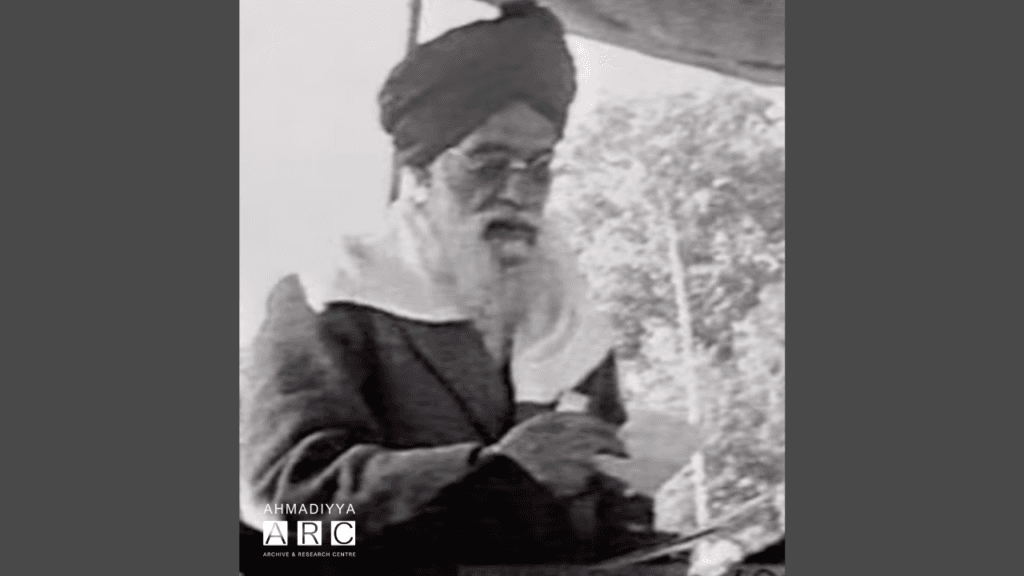
Hazrat Mufti Muhammad Sadiq (ra)
بِسۡمِ اللّٰہِ الرَّحۡمٰنِ الرَّحِیۡمِ اَلۡحَمۡدُ لِلّٰہِ رَبِّ الۡعٰلَمِیۡنَ الرَّحۡمٰنِ الرَّحِیۡمِ مٰلِکِ یَوۡمِ الدِّیۡنِ ؕ اِیَّاکَ نَعۡبُدُ وَاِیَّاکَ نَسۡتَعِیۡنُ اِہۡدِنَا الصِّرَاطَ الۡمُسۡتَقِیۡمَ صِرَاطَ الَّذِیۡنَ اَنۡعَمۡتَ عَلَیۡہِمۡ ۬ۙ غَیۡرِ الۡمَغۡضُوۡبِ عَلَیۡہِمۡ وَلَا الضَّآلِّیۡنَ
[“In the name of Allah, the Gracious, the Merciful. All praise belongs to Allah, Lord of all the worlds, The Gracious, the Merciful, Master of the Day of Judgment. Thee alone do we worship and Thee alone do we implore for help. Guide us in the right path – The path of those on whom Thou hast bestowed (Thy) blessings, those who have not incurred (Thy) displeasure and those who have not gone astray.”] (Surah al-Fatihah, Ch.1: V.1-7)
Introductory remarks
I am unwell. There is much cloudiness before my eyes and I cannot see anything. My back is aching. I did not think that I would be able to deliver any speech today, but the organisers of the Jalsa insisted that I must deliver some sort of speech. At this time, I can neither write nor read anything. I could not prepare any subject. There are a few matters by way of Zikr-e-Habib [remembrance of the Beloved], for which it is not necessary for me to prepare, as they are already committed to memory. I will relate a few matters by way of Zikr-e-Habib. Besides this, I cannot deliver any other speech. Friends, please forgive me.
The essence of taqwa
Once in Qadian, a gentleman who lived in Bhera, district Shahpur, whose name was Islam Din, came to visit the Promised Messiah (as). He stayed for a few days and then prepared to leave. At the time of departure, he presented himself before the Promised Messiah (as) and submitted to Huzoor (as), “Huzoor, I am leaving now. Please give me some advice.”
As a piece of advice, Huzoor (as) said, “The advice is simply this: adopt taqwa [righteousness and fear of Allah].”
That person submitted, “Huzoor, I am unlettered. I do not know how to read or write; I do not know Persian and I do not know Arabic. I do not know what taqwa is. Huzoor commands that I adopt taqwa and so I shall, but I simply do not know or understand what taqwa is.”
Then Huzoor (as) said, “Taqwa is that whatever work you set out to do in this world, whether of a religious or worldly nature, you should reflect upon it and ask yourself whether Allah the Almighty will be pleased by it or not. Or might it incur the displeasure of God? If there is any displeasure of God in that matter, then abandon that work. Only do those deeds that will certainly attain the pleasure of Allah the Almighty.”
The Promised Messiah (as) would repeatedly state that the purpose of his advent and the reason he had come to the world was to form a Jamaat that would attain the pleasure of Allah the Almighty. “This is the very task I have come for. As for the fatwas and squabbles of the clerics and the disputes over the death of Jesus (as), the clerics have imposed these upon us; this is not the primary purpose of our advent. Our primary purpose is not found in this. Rather, our main objective is simply that I bring people towards God so that they may attain the pleasure of Allah the Almighty and to firmly establish people upon this.” The greatest joy of the Promised Messiah’s (as) heart was in seeing the religion of Islam spread, in the propagation of Islam.
The propagation of Islam and the dream of white birds
Once, I was sitting in Qadian in the room of the Promised Messiah (as), inside the house. Someone knocked on the door from the outside and Huzoor (as) told me, “Go and see who it is.” I went outside and saw [a gentleman who informed me that] Maulvi Muhammad Ahsan Sahib (ra) had held a debate with a cleric in Amritsar. In this debate, Maulvi Muhammad Ahsan Sahib (ra) had “so thoroughly defeated and routed that cleric” and whatever other Hindustani words he used, I do not remember. In short, he utterly humiliated him and this was the good news. I returned and submitted this matter before Huzoor (as).
Huzoor (as) smiled and said, “I thought he had brought the good news that [all of] Europe has accepted Islam.”
Thus, in the heart of Huzoor (as) was always the desire for Europe and for America to become Muslim. Today, Hazrat Khalifatul Masih [may Allah be his Helper], who is sending missionaries to all countries, is fulfilling this very desire of the Promised Messiah (as). The desire of Huzoor (as) was simply that all people become Muslims and adopt the religion of Islam.
Once, the Promised Messiah (as) saw in a dream that he was in England, catching white birds. (Tadhkirah [English], p. 239) He stated that its interpretation was that the English people would accept the religion of Islam through the people of our Jamaat. It is the grace of God and His immense favour and blessing that God also granted me the opportunity, through the kindness of Hazrat Khalifatul Masih II (ra), to go to England.
The very first English person to accept Islam at my hands in London was also named Sparrow. ‘Sparrow’ is the English word for a bird. Thus, in the fulfilment of that dream of the Promised Messiah (as), in which he was catching white birds, Allah the Almighty granted me a share as well.
Arabic as the mother of languages
The Promised Messiah (as) would bring forth ever-new signs and profound arguments to prove the truthfulness of Islam. Arguments that no one else had ever presented were expounded by Huzoor (as). At that time, in those days, a question arose. The question was that the earlier scriptures and holy books that were revealed were meant solely for the country they were revealed in; they were in the language of that country and did not go to other countries. For example, when the Torah was revealed, it was for the Jews. The language of the Jews was Hebrew, so the Torah was in Hebrew. That Torah was not for other countries; it was not for the Hindus, nor for the Chinese. If a book was revealed in India, it was revealed in Sanskrit because Sanskrit was the language in India.
So what is the reason that when Allah the Almighty revealed the Holy Quran for the whole world, He revealed it in Arabic? This was a question that arose. It should have been in a language known to people of all countries. Or, if it was in Arabic, then it would only be for the Arabs, solely for the Arabs. But the Holy Quran was not merely for the Arabs; rather, it was for the entire world. Why, then, was it in Arabic?
Thus, the Promised Messiah (as) answered this. The reason for this is that Arabic is a language that is umm al-alsinah [the mother of languages]. All the languages in the world have originally descended from Arabic. The first Adam appeared in Mecca, which is why Mecca is called umm al-qura [the mother of all towns]. And the first language of Mecca, which God taught to mankind through divine revelation, was Arabic. That is why Arabic is called umm al-alsinah, meaning the mother of languages. Arabic is the mother of all languages; all languages have originated from it.
To prove this fact, Huzoor (as) had several thousand words from different languages compiled in those days. God also granted me the opportunity to partake in this compilation; I too would work while presenting myself before Huzoor (as). So, at that time, Huzoor (as) had several thousand English words compiled and proved that all these words had originated from such and such Arabic root words. Several thousand words of the Turkish language, several thousand words of the Sanskrit language and several thousand words of the Persian language and he proved for each word that it had originated from a specific Arabic word.
Thus, all languages have in fact descended from Arabic. The original language of mankind, the revealed language that was taught or imparted to the first Adam, was the Arabic language. This is why Arabic is called umm al-alsinah. On this subject, Huzoor (as) also wrote a book, Minan-ur-Rahman. Those extensive lists that Huzoor (as) had compiled were with Khwaja Kamal-ud-Din Sahib and he had published a portion of them in the form of a book. It might still be available in Lahore even today. Therefore, to prove this point, Huzoor (as) conclusively established that all the languages in the world have originated from Arabic. This is exactly why the Final Book that was revealed, the Holy Quran, for the whole world and for people of all languages, was revealed in the Arabic language.
Searching for someone who knew Hebrew
In those days, I lived in Lahore. I was a clerk in the office of the Accountant General in Lahore. From time to time, I would come here to Qadian and bring some references for Huzoor (as), having searched for them in various books. For the books that Huzoor (as) was authoring, whenever references were needed to be included, I would search for those references in the libraries of Lahore and bring them to Huzoor (as).
Sometimes on a Sunday or on another day when I had leave from the office, I would travel to Qadian. Every time I came to Qadian and was about to return, Huzoor (as) would give me two rupees. I would earnestly submit that I already had the travel fare. In those days, travelling from Lahore to Qadian and from Qadian to Lahore cost two rupees; it was not more than that. Huzoor (as) would say, “This work that you are doing, searching for references, is a task of great effort and it carries a great reward. And it is such a reward that we also wish to partake in your reward.” This was simply his own gracious way of putting it, for what was I and what was any reward of mine? But this was his profound kindness. Every time, without fail, he would give me two rupees.
So, I used to visit in this manner. Once, when I went to Qadian during the days when this matter was being discussed – that all languages originated from Arabic – Huzoor (as) said to me, “Mufti Sahib! We have proven that English has originated from Arabic, Sanskrit has originated from Arabic, Persian has originated from Arabic and other languages have also originated from Arabic. However, there is one language that we have not yet been able to prove and the reason for this is that there is no one here who knows this language.”
I submitted, “Huzoor, what language is that?”
He replied, “The Hebrew language. The language in which the Torah was revealed, the Psalms were revealed and the Gospel was revealed. It is also necessary to prove that the Hebrew language originated from Arabic, but there is no one here who knows Hebrew who could read it to us. If we had someone who knew Hebrew and could read it to us, we would see whether Hebrew too has originated from Arabic or not. Since you live in Lahore,” he said to me, “go and search in Lahore; there must be someone who knows Hebrew in Lahore, as it is a large city.”
I submitted, “Very well, Huzoor.”
I returned and searched in Lahore. After a great deal of searching, I found out that a Jewish woman lived there. There was no man. Since Hebrew is the holy language of the Jews, it was possible she might know it. So I inquired about who she was and where she lived […].
One day, while returning from my office, I went [to meet her]. She brought a chair for me and set it down. She asked, “What do you want?” I replied, “I want to ask, are you Jewish?” She said, “Yes, I am Jewish.” I asked, “Do you know the Hebrew language?” She replied, “I do not know the Hebrew language.” […] However, she said, “I have a brother who knows the Hebrew language very well; he is a scholar. And he is due to arrive here soon from an Arab country. When he arrives, I will inform you and you can meet him. He will teach you Hebrew, help you learn it or do whatever you require.”
I was very pleased. I said, “Very well, this is exactly my purpose.” Then I left. […]
The Hebrew reading before the Promised Messiah
Then, when her brother arrived a few days later, she sent me word. Her brother had arrived and I went to meet him. He was a great expert in the Hebrew language, a great scholar. Having learned some Hebrew from him […] the Hebrew language, I then came to Qadian. I submitted before Huzoor (as), “In accordance with Huzoor’s command, I have learned the Hebrew language.”
Huzoor (as) had Lisan al-Arab brought out. Lisan al-Arab is a comprehensive Arabic lexicon in multiple volumes. Huzoor (as) opened it and I began reading the Hebrew before him bit by bit. I started with the opening verse of Genesis in the Torah:
בְּרֵאשִׁית בָּרָא אֱלֹהִים אֵת הַשָּׁמַיִם וְאֵת הָאָרֶץ
[“In the beginning God created the heaven and the earth.”] (Genesis, 1:1)
Starting from here, I continued reading that Hebrew to Huzoor (as) and taking it word by word, the Promised Messiah (as) kept proving that this too originated from Arabic, that word too originated from Arabic. Thus, Hebrew was proven to have originated from Arabic.
Khutbah Ilhamiyyah and the Jewish convert
When our work was completed, through this Jewish man, so I did tabligh to this Jewish man and through this tabligh, God Almighty bestowed His grace and he was granted the guidance to accept the religion of Islam. I then took him with me to Qadian and presented him before the Promised Messiah (as). He took the bai‘at at the hands of Huzoor (as) and was named Muhammad Islam. Huzoor (as) was extremely pleased by this.
On the day Huzoor (as) delivered the Khutbah Ilhamiyyah [the revealed sermon] standing in Masjid Aqsa [11 April 1900], I was present there and that Jewish man had also gone there with me. He was also present there and he too witnessed the sign of the Khutbah Ilhamiyyah and God moved his heart, so he accepted Islam and took the bai‘at at the hands of the Promised Messiah (as).
After he had taken the bai‘at and we were preparing to depart from Qadian, I went to meet Huzoor (as). Huzoor (as) said to me – that Jewish man was also with me – Huzoor (as) said to me, “Mufti Sahib, I had received a revelation to deliver the Khutbah Ilhamiyyah, so I made a vow in my heart that if I am able to deliver the Khutbah Ilhamiyyah, I will give ten rupees to a poor person. So today, the Khutbah Ilhamiyyah has been delivered. God granted me the ability and in accordance with what God had revealed, the matter has been fulfilled. That entire sermon was delivered purely through divine revelation; none of its text was written down, nothing was prepared in advance.”
The entire text of the Khutbah Ilhamiyyah was solely through divine revelation. Hazrat Khalifatul Masih I (ra) and the late Hazrat Maulvi Abdul Karim (ra) were writing it down simultaneously. […] In any case, he proved it; the matter was established that the Hebrew language too has originated from Arabic.
The tomb of Jesus (as) and Kashti-e-Nuh
So on that day when I had that Jewish man with me, around the same time, a friend from Kashmir had taken a photograph of the tomb of Jesus (as) and sent it to Huzoor (as). Huzoor (as) showed that photograph to this Jewish man and asked him, “Are Jewish graves like this as well?” He replied, “Yes, they are like this; Jewish graves are exactly like this tomb of Hazrat Isa [Jesus (as)] in Kashmir.”
Huzoor (as) told him, “Write this down.” So he provided his testimony in the Hebrew language, stating, “Today I have seen a photograph of the tomb of Jesus (as) which is in Srinagar and Jewish graves are indeed exactly like this.” He wrote this down in the Hebrew language.
Huzoor (as) said, “Include his testimony in our book that is currently being printed.” In those days, the book Kashti-e-Nuh [Noah’s Ark] was being printed, so Huzoor (as) had that statement included in Kashti-e-Nuh. It was written in his own hand; a portion of the Hebrew was written by my hand and a portion of the Hebrew was written in his hand. That book was published and is available to this day. This too was a mighty sign and a prophecy that was fulfilled.
A closing appeal to read Kashti-e-Nuh
Since the book Kashti-e-Nuh has been mentioned, I wish to submit to my friends that Kashti-e-Nuh is a book that Ahmadis must read. They should read it time and again. In it, Huzoor (as) has outlined who an Ahmadi is and who is not an Ahmadi. Those who do these deeds are Ahmadis; those who do these deeds are Ahmadis. It is a short book, but Ahmadi brothers should read it with great attention.
(Delivered on 26 December 1952 at Jalsa Salana Rabwah and translated by Al Hakam)