

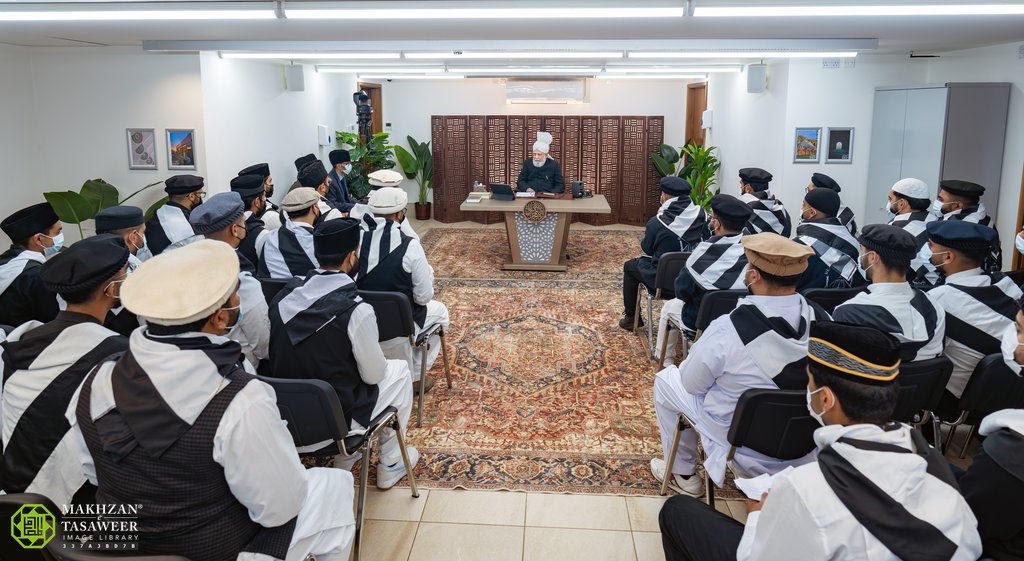
Islamabad, Tilford, 26 October 2025: A delegation of 44 khuddam, comprising 37 members from the Schleswig-Holstein Region of Majlis Khuddam-ul-Ahmadiyya Germany and seven from Dietzenbach, had the blessed opportunity of a mulaqat with Hazrat Mirza Masroor Ahmad, Khalifatul Masih Vaa.
The meeting commenced as Huzooraa graced the hall with his presence and extended his salaam. The Regional Sadr of MKA Schleswig-Holstein briefly introduced the delegation. Following this, each of the khuddam had the opportunity to introduce himself. Huzooraa then graciously granted the khuddam permission to ask questions for their moral and spiritual guidance.
The essence of salat as an expression of gratitude
The first khadim noted that the motto for Khuddam-ul-Ahmadiyya Germany this year is “Salat is the pillar of faith.” He sought guidance on how they could truly act upon this and instil the love of prayer in their hearts.
Huzooraa explained that the foundation of prayer lies in gratitude. He drew an analogy, stating that if a human being gives us a small gift or does us a favour, we naturally feel thankful. Allah the Almighty, however, is the Lord of all the Worlds (Rabb al-Alamin). His favours are boundless. He provides for us even from the time we are in our mother’s womb, ensuring our healthy birth and nourishment. Our parents, who raise us and provide for our education and clothing, are themselves a gift from Him. Since all these blessings originate from Allah, Huzooraa guided, our gratitude must be directed primarily towards Him.
The prescribed method for showing this gratitude is the five daily prayers. When we go before Allah five times a day to thank Him, He promises in the Holy Quran that He will bestow even more upon us. (Surah Ibrahim, Ch.14: V.8) Huzooraa clarified that Allah is not in need of our worship or thanks; rather, this system is for our own benefit. He rewards our gratitude with even greater rewards. If one offers prayers with this mindset – as a humble expression of thankfulness for innumerable divine bounties – then one’s focus in prayer will naturally increase and one will become a truly grateful servant of Allah, attracting even more of His grace.
Maintaining sibling bonds after marriage
A khadim asked how one can maintain the love and harmony between siblings after marriage, as this bond often weakens and can sometimes lead to discord.
Huzooraa stated that the core Islamic principle is to fulfil the rights of every individual. Allah the Almighty has commanded us to fulfil the rights of our parents, our siblings and also our wives, who are someone’s daughters whom we have brought into our home. Huzooraa mentioned his own series of Jalsa Salana addresses on the vast topic of human rights in Islam, noting that if a person truly focuses on fulfilling the rights of all, conflicts do not arise.
The first step, he advised, is to pray that Allah instils a love in our hearts that never fades. Secondly, all parties must demonstrate wisdom and a spirit of accommodation. Siblings must realise that their brother is now married and must help his new wife adjust to the family. The wife, in turn, must understand that she needs to adjust to her new home and family. The husband must be wise enough to strike a delicate balance between fulfilling the rights of his wife and those of his parents and siblings. If a person acts with wisdom and controls their emotions, fights will not occur. Such disputes, Huzooraa remarked, are a sign of ignorance, not education. He advised them to be educated in their conduct and to support this effort with prayer.
The harmony of science and the Holy Quran on the universe’s fate
A young khadim noted that science predicts the universe will end in either a “Big Crunch” or a “Heat Death” and asked how Islam’s concept of the Day of Judgement understands this.
Huzooraa explained that the Holy Quran contains profound truths that are in perfect harmony with scientific discovery. He guided that the Holy Quran describes the end of the universe in a manner strikingly similar to the Big Crunch theory, stating that the heavens will be rolled up “like the rolling up of written scrolls by a scribe” (Surah al-Anbiya’, Ch.21: V.105), with everything collapsing into what science calls a black hole.
Similarly, the Quran describes the universe’s origin in a way that corresponds to the Big Bang theory. Huzooraa cited the verse: “Do not the disbelievers see that the heavens and the earth were a closed-up mass, then We opened them out?” (Surah al-Anbiya’, Ch.21: V.31). He explained that Islam’s teaching is comprehensive, describing both the Big Bang and the eventual collapse.
Huzooraa then stated a fundamental principle: science is the action of God, while the Quran is the word of God and there can be no contradiction between the two. He narrated an incident from a trip to Australia, where he met with a high-ranking Christian priest who claimed that science and religion were incompatible. Huzooraa explained to him that it was Islam that revealed these profound scientific truths 1400 years ago – from the Big Bang to the fact that all life was created from water. He then gifted the priest a copy of the Holy Quran so he could read these verses for himself. The priest was astonished that these facts were present in the Quran and not in other religious scriptures. This, Huzooraa remarked, is one of the proofs of Islam’s truth.
Managing differences of opinion within an amila
A khadim serving on an executive committee (amila) asked for guidance on how to handle differing opinions among its members.
Huzooraa advised that having a difference of opinion is not a bad thing in itself. The correct procedure is to discuss the matter in a consultative meeting. If another person’s argument is better, one should accept it with an open heart. If one’s own reasoning is stronger, it should be presented with evidence. If a consensus cannot be reached, the majority opinion should be accepted and acted upon. If there is still a serious concern that the majority decision could be harmful, the matter can be referred to the Markaz for guidance from the Khalifatul Masih.
The crucial point, Huzooraa stressed, is that a difference of opinion must never be allowed to become a matter of personal ego. The goal must always be to work together to find the best solution for the benefit of the Jamaat, humanity and the social fabric of the larger community.
On the ceasefire between Israel and Hamas
A question was asked about Huzoor’saa perspective on the recent ceasefire between Israel and Hamas and the future of the Middle East.
Huzooraa began by stating that Israel’s aggression never truly stopped for a new phase to “begin,” noting that even the US Vice President had stated that Israel’s actions were undermining President Trump’s peace plan. Huzooraa pointed out that there is a growing realisation even among some Americans that Israel cannot be fully trusted.
At the same time, Huzooraa expressed regret about the state of the Muslim world. If they possessed true faith, they could become a powerful, unified force, but this unity is absent. Each Muslim nation pursues its own vested interests. He also highlighted the historical hypocrisy of the West, noting that the historic persecution of the Jews was perpetrated by Germans, yet the price for this crime is being paid by the Palestinians.
Huzooraa then referenced a report by a UN-affiliated body which concluded that 60 countries were complicit in the oppression of the Palestinians. This list, he noted, includes not only Israel and Western nations but also Arab countries. If the Arab nations had shown unity and, at the very least, blocked some of the trade routes, Israel would have been forced to change its behaviour. Their failure to do so means they are indirectly complicit. Huzooraa concluded with the poignant metaphor: when the fire is started from within one’s own house, how can an outsider be expected to extinguish it?
Identifying a righteous spouse
A khadim asked that while the Holy Prophetsa advised us to give preference to faith when seeking marriage, how can one truly know if a potential partner is righteous?
Huzooraa explained that since only Allah knows the unseen reality of a person’s heart, the first and most crucial step is sincere du‘a and supplications. One should pray that if the prospective match is righteous and good for them, Allah should create ease and grant contentment to both hearts; otherwise, He should create a block. True, lasting love is the love that is for the sake of Allah.
The second step is to conduct a practical investigation through the Jamaat’s system. One can inquire through the Lajna and Khuddam organisations to learn about a person’s character. Key indicators include the regularity of prayer in their household, the emphasis on religious education, whether the girl observes modest and dignified dress and whether the family has a materialistic outlook. For instance, some families immediately make demands for a separate house. Such things should be clarified beforehand.
Huzooraa acknowledged that no one is perfect; both men and women have weaknesses. One should be willing to overlook minor faults in a partner and appreciate their good qualities. While it is difficult to find a “perfectly” righteous person, one must investigate to the best of their ability and then, above all, seek the help of Allah through prayer.
Guarding against the distractions of social media
The final questioner asked how, in an age where social media and worldly pursuits cause one to become heedless of faith, a khadim can maintain a strong connection with Allah.
Huzoor’saa advice was direct: if you know the harms of social media, then do not expose yourself to them. He counselled them to use social media purposefully – for news or academic knowledge – but to consciously avoid the vast amount of useless and vulgar content that is prevalent. One must be determined, especially at prayer times, to put away all distractions. The pledge to give precedence to one’s faith over the world is tested in these very moments.
Huzooraa reminded them that the first question on the Day of Judgement will be about salat. (Jami’ at-Tirmidhi, Kitab as-salat, Hadith 413) Therefore, one must guard their prayers. By combining the protection of prayers with frequent istighfar and the intelligent, disciplined use of social media, one can remain safe. He warned that one link often leads to a list of other, often inappropriate, content and that even children’s programmes are now polluted with vulgar advertisements. The solution is to remain vigilant, to pray and to use these tools only for benefit, abandoning them the moment one sees harm.
The mulaqat concluded with the khuddam having the honour of a group photograph with Huzooraa and each attendee was graciously gifted a pen before he took his leave.
(Summary prepared by Al Hakam)