

Guidance regarding basic Islamic issues that Hazrat Amirul Momineen, Khalifatul Masih Vaa, has given on various occasions in his written correspondence and during MTA programmes is being published officially below for everyone’s benefit.
Is getting a tattoo haram in Islam?

Someone from Türkiye asked Hazrat Amirul Momineen, Khalifatul Masih Vaa, whether getting a tattoo is haram. He also asked whether it is permissible to include photographs of the Promised Messiahas and his Khulafa in videos that also feature music.
Huzoor-e-Anwaraa, in his letter dated 12 October 2023, provided the following guidance regarding this matter:
“To make or get a tattoo is not permissible. It has been prohibited in ahadith, where Allah the Exalted has condemned, in very strong terms, those who practise tattooing and those who get themselves tattooed for the sake of beauty. (Sahih al-Bukhari, Kitab al-libas, Bab al-mutafallijati li l-husn)
“The objective behind getting a tattoo is to show it off or to beguile the opposite sex in an impermissible manner. That is why people usually get tattoos on body parts that they may then expose and exhibit to the public. However, even if someone gets a tattoo on parts of the body that must be covered, the mindset behind it is the same: to display the tattoos made on these hidden parts to the opposite gender at the time of committing evil deeds and immorality. Both of these methods are impermissible, as they are contrary to Islamic teachings.
“Furthermore, tattoos have also been linked to a host of physical and health issues. For instance, the sweat glands under the skin are badly affected in the areas of the body that have tattoos; that is, having a tattoo reduces the sweating in the concerned parts of the body, which is harmful to one’s health. Similarly, since tattoos become permanent features on the skin, sometimes as the body grows or shrinks, so does the shape of the tattoo, which makes the tattoo look ugly instead of ‘beautiful’. Then such individuals begin to think of them as a plague that they cannot get rid of. Thus, for these reasons alone, it is futile and absurd to get a tattoo.”
Can we use photos of the Promised Messiah or his Khulafa in videos with music?
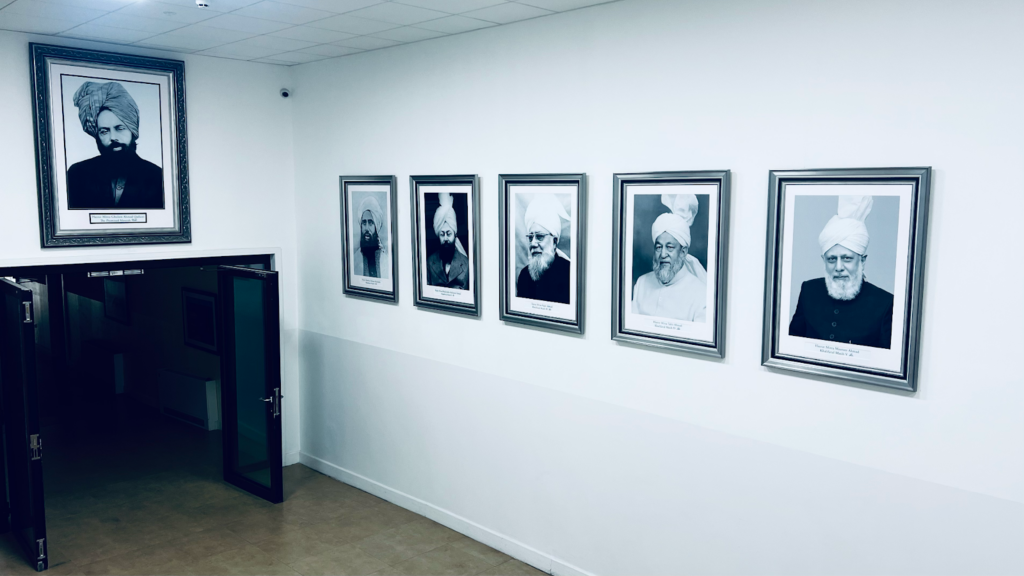
“The answer to your second question is that it is absolutely not permitted to include photographs of the Promised Messiahas or his Khulafa in videos where music, etc., is playing. Music is considered among vain or laghw things and Allah the Exalted mentions in the Holy Quran as a sign of the believers that they shun vain acts and frivolous matters (Surah al-Mu’minun, Ch.23: V.4) Thus, how can it be permissible to mix something good with something vain?”
Should one perform qasr prayer when visiting one’s son’s or parents’ house?

Someone from Germany wrote to Hazrat Amirul Momineen, Khalifatul Masih Vaa, stating: “I live in a city in Germany and one of my sons has a home in another city. When I visit that son’s home, should I shorten [qasr] the salat and when my son visits my home, should he offer the full salat or shorten it?”
Huzoor-e-Anwaraa, in his letter dated 14 October 2023, replied to this question as follows:
“In my view, these are one’s own homes; there is no need to shorten the salat in them. However, as you have written that you have a separate home and your son also has a separate home, in such a situation, according to some Islamic jurists, a person would be considered a traveller and would shorten the salat. Whereas, according to the Ahmadiyya jurisprudence, in such a case, a person has the choice to either shorten the salat or offer it in full. Accordingly, it is written in Fiqh-e-Ahmadiyya that if a person is staying at the home of such a relative, which he considers his own home – such as the parents’ home, the in-laws’ home, or a religious centre like Mecca, Medina, Qadian, Rabwah, etc. – then during a stay of less than 15 days, he may choose to avail himself of this concession and offer two rak‘ats, or he may choose to offer the full salat, i.e., four rak‘ats. (Fiqh-e-Ahmadiyya, ‘Ibadaat, p. 189)” […]
What is the punishment for adultery in Islam?

Someone wrote to Hazrat Amirul Momineen, Khalifatul Masih Vaa, asking whether the punishment for adultery [zina] mentioned in the Holy Quran is only for premarital intercourse, or if the same punishment applies if a man or woman commits adultery with someone other than their spouse during marriage. Furthermore, if the one who committed adultery realises their sin, can they hope that Allah will forgive them?
Huzoor-e-Anwaraa, in his letter dated 16 October 2023, provided the following guidance regarding this issue:
“Where the punishment for adultery is mentioned in the Holy Quran, no such distinction has been made as to whether this punishment is for premarital adultery or for adultery committed after marriage. Rather, the punishment for adultery has been stated generally: that whether the adulterer is a man or a woman, when their sin is proven through four witnesses in accordance with the conditions of testimony established by Islam, they should be administered 100 lashes. Regarding the punishment for adultery, Hazrat Khalifatul Masih Ira states:
“‘When the charge of adultery is proven against a man and a woman, their punishment is that the man should be given 100 lashes and the woman should also be given 100 lashes.’ (Haqaiq-ul-Furqan, Vol. 3, p. 200)
“Hazrat Musleh-e-Maudra states with reference to verse 3 of Surah an-Nur:
“‘It is manifestly proven from this verse of the Holy Quran that the punishment for an adulterous man and an adulterous woman is 100 lashes.’ (Tafsir-e-Kabir, Vol. 8, UK, 2023, p. 423)
“Thus, whether a person is married or unmarried, when they commit a heinous act like adultery, in both cases, their punishment is 100 lashes. However, this punishment is for such a habitual criminal who has become so involved in this evil that there exist witnesses against him, for whose testimony Islam has set extremely strict conditions (Sunan Abi Dawud, Kitab al-hudud, Bab fi rajmi l-yahudiyyain); or [it is for one who] commits this lewd act so publicly as to outrage public decency and thus encourages its spread in society. Accordingly, explaining this matter with reference to verse 3 of Surah an-Nur, Hazrat Musleh-e-Maudra states:
“Thus, by al-zaniyah and al-zani, a perfect [complete] adulterer is meant, who is either habitual in adultery or has become so fearless that he commits this act openly or is muhsan, i.e., married, or elderly and yet commits adultery. Regarding all such people, the Holy Quran states the same: Upon their crime being proven, administer 100 lashes to them.” (Tafsir-e-Kabir, Vol. 8, UK, 2023, p. 435)
“The answer to your second question is that in the Holy Quran and the ahadith of the Holy Prophetsa, there is abundant mention of God Almighty’s mercy with reference to His attributes of Rahman [Gracious], Rahim [Merciful], ’Afuww [The Effacer of Sins], Ghafoor [Most Forgiving], Ghafir [Forgiver] and at-Tawwab [Oft-Returning with Compassion], etc. Just as Allah the Exalted states in the Holy Quran: ‘O ye who believe! Turn to Allah in sincere repentance. It may be that your Lord will remove the evil [consequences] of your deeds and make you enter Gardens through which rivers flow.’ (Surah at-Tahrim, Ch.66: V.9) Similarly, the Holy Prophetsa stated that the one who sincerely repents after committing a sin is like one who has not committed the sin at all. (Sunan Ibn Majah, Kitab az-zuhd, Bab zikri t-tawbah)
“Hazrat Ubadah bin Samitra narrates that, ‘On one occasion, the Holy Prophetsa said to the Companions present around him: ‘Take a pledge of allegiance with me that you will not associate anything with Allah, will not commit theft, will not commit adultery, will not kill your children, will not bring any calumny which you have deliberately forged and will not disobey in any good matter. Thus, whoever among you fulfils [this pledge], his reward is with Allah; and whoever becomes involved in any of these [evils] and receives its punishment in this world, that punishment will be an expiation [kaffarah] for him. And whoever becomes involved in any of these [evils] and Allah veils his sin in this world, then his matter is with Allah; He may forgive him if He wills, or punish him if He wills.’’ (Hazrat Ubadah bin Samitra says,) ‘So we all pledged allegiance to the Holy Prophetsa on these matters.’ (Sahih al-Bukhari, Kitab al-iman, Bab ‘alamati l-imani hubbu l-’ansar)
“Thus, when Allah the Almighty, Who is the Master of everything, continues to overlook the sins of His weak servants, if any party among a husband and wife falls prey to such an evil and subsequently repents – and they are granted sincere repentance such that they never turn back to this evil again – then the other party should also overlook the one who has repented and leave the matter to Allah the Almighty.”
[Note: The above response is provided for theological understanding only and is not legal advice. It must not be construed as endorsing any private enforcement, accusation, coercion or punishment, nor as encouraging conduct contrary to the laws of the land. Any discussion of prescribed punishments in classical Islamic law pertains to lawful judicial authority and due process, not individual action. —Editor, Al Hakam]
(Compiled by Zaheer Ahmad Khan, Head of Records Department, Private Secretariat, London and translated by Al Hakam)