

Atif Rashid, Journalist, UK
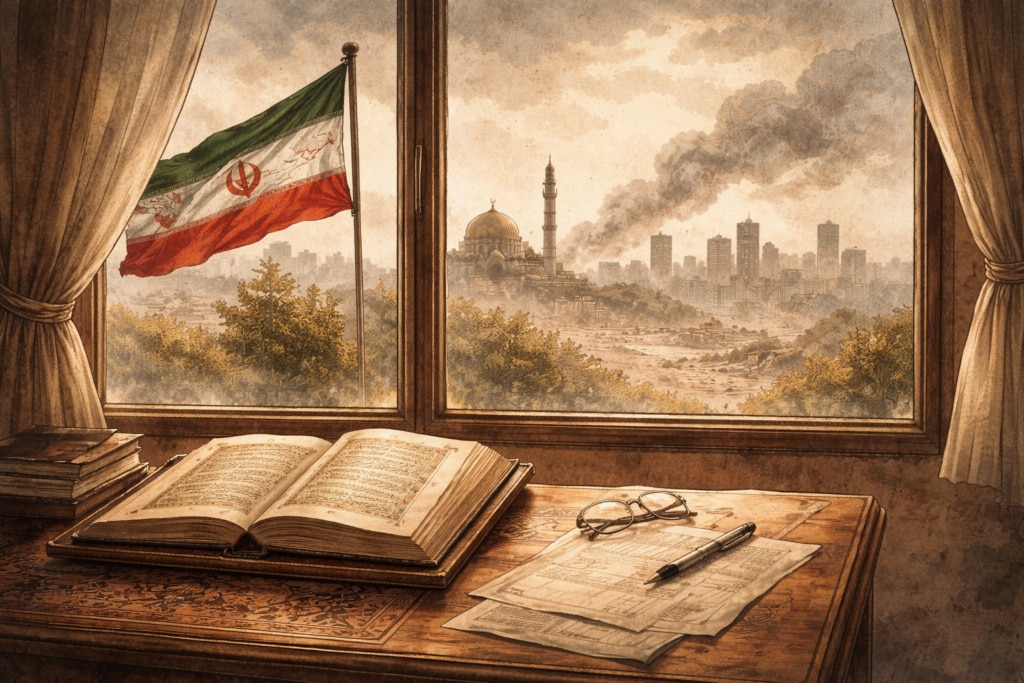
In any war, the first casualty is the truth. If we view the current Middle East conflict through the fog of war, it’s impossible to determine the realities and motives on the ground.
Warmongering propaganda has been the wont of Western nations interfering in the Middle East for decades. Muslim nations are painted as “backward” and “barbaric” in need of “democracy” and being saved from their ruthless leaders. This was just some of the rhetoric being used in the build-up to the illegal Iraq War in 2003. That, and the false claim of weapons of mass destruction. Similar arguments are now being used against Iran.
Every effective propaganda must indeed have an element of truth. Many Muslim leaders have been dictators and have oppressed their own people and their Muslim neighbours, abandoning Islamic principles. Such propaganda also serves to further dangerous colonial narratives by Western nations seeking to subjugate Muslim states.
Iran, a nation of 90 million people and a civilisation going back 2500 years, cannot be reduced to simple good or evil narratives. Every nation has its flaws and weaknesses, as well as its positive and praiseworthy qualities. No government on earth is perfect or free from some sort of criticism.
If one views the current conflict through the eyes of Islamic morality, as opposed to the fog of war and theological differences, we can make better-informed and just conclusions. This would help us to understand the Islamic solutions to the tribulations facing the Muslim world.
Deceitful negotiations
The current war in the Middle East began when America and Israel attacked Iran without cause in the middle of negotiations over its nuclear programme. Oman’s Foreign Minister was mediating between Iran and America and stated publicly on 27 February 2026 that a deal was “within reach.” Literally a few hours later, America and Israel bombed Iran, killing its Supreme Leader Ali Khamenei and members of his family in a strike on his residence.
America and Israel did the same in June 2025, leading to the 12-day war. They held peace talks just days before, while planning to attack Iran at the same time.
“We have a very bitter experience of talking with Americans … We negotiated with them last year in June, and they attacked us in the middle of negotiations,” Iranian Foreign Minister Abbas Aragchi told PBS News.
“They promised us [this time] that they don’t have any intention to attack us and wanted to resolve Iran’s nuclear question peacefully … After three rounds of negotiation, and after the American team said we made big progress, they still decided to attack us,” he said.
These were duplicitous and bad-faith negotiations on the part of the United States. Behind this was Israel, which has long been pushing the US for a war with Iran. Former US Secretary of State Antony Blinken said Israel also pressured President Obama to attack Iran during his presidency, but he resisted and instead negotiated a settlement with Iran. That deal was ripped up by President Trump in 2018 for no apparent reason.
There was no imminent threat to either Israel or America from Iran, according to their own intelligence assessments. A war of aggression is as un-Islamic as it gets. The Holy Quran states that the only just wars are those of self-defence, to save people from tyranny and persecution or to protect religious freedoms. In Islam, you must treat peace talks seriously and seek every avenue for it. Iran has not attacked another country in 200 years. The United States has attacked multiple countries in the last 50 years.
Nuclear morality
America and Israel have long had concerns about Iran’s nuclear program, but there is no evidence that it is seeking to develop one. In fact, there is overwhelming evidence to the contrary. The Head of the International Atomic Energy Agency (IAEA), Rafael Grossi, plainly said there is no evidence that Iran was building a nuclear bomb.
A nuclear power itself, the US tells Iran it must not develop nuclear weapons, even though Iran has never desired to produce them. The Holy Quran says, “Why do you say that which you do not do?” This hypocrisy reveals that the motives of this war had nothing to do with Iran’s nuclear programme. The motive was always to subjugate the entire Middle East.
Should America and Israel not dismantle their own nuclear arsenals first if they are serious about nuclear non-proliferation?
Further, if the United States and Israel were so adamant that Iran should not develop a nuclear bomb, why did they kill the man who was preventing Iran from developing one? Former Supreme Leader Ali Khamenei had issued a fatwa against the development of nuclear weapons since the 1990s because they are indiscriminate bombs and therefore immoral and un-Islamic. Iran has repeatedly insisted its nuclear programme was for peaceful energy purposes only.
This is perhaps the most moral stance on nuclear weapons of any country on earth. No other nation that comes to mind has such a clear opposition to nuclear weapons that it deems them religiously impermissible. Those accusing Iran of being a nuclear threat are themselves the biggest nuclear threats. The United States is the only nation on earth to have ever used them on Hiroshima and Nagasaki in 1945. An extremely cruel and indiscriminate weapon which leaves land full of radiation, destroys crops for decades and makes generations of people at risk of radiation poisoning. It is estimated that Israel dropped the equivalent of six atomic bombs on Gaza over two years.
The position adopted by Iran on nuclear weapons was wholly Islamic, moral and commendable. If every other nation adopted such a stance, we would have eradicated the risk of nuclear war forever. Iran is also a party to the Nuclear Non-Proliferation Treaty (NPT), while Israel, Pakistan and India are not.
Relying on Western powers for defence
Just weeks ago, America was sending massive amounts of military hardware, warships and defence systems to the Middle East to intimidate Iran during negotiations and threaten it.
At this juncture, Iran clearly and repeatedly warned that if attacked, all US bases in the Middle East would be legitimate targets. The greatest folly of Arab states was to allow US bases in their region. There are at least 19 military bases with 40,000 American personnel in the Middle East – if you look at a map, they surround Iran. Many Gulf states are also friendly with Israel, despite it carrying out massacres in Gaza and killing Muslims en masse.
Did Arab states not witness the behaviour of these countries towards Iraq, Libya, Syria, Lebanon and Palestine? A believer is not bitten twice from the same hole, the Holy Prophetsa said. Yet Muslims today are bitten time and again from the exact same threat.
Commenting on this, Hazrat Mirza Masroor Ahmadaa delivered the analysis of a seasoned geopolitical expert during his Friday Sermon.
“The United States has established military bases in many Muslim countries. But for what purpose? From whom, after all, were these nations facing a threat? In reality, it was these very powers that themselves created the threats. Thereafter, the narrative was advanced that these [Muslim] countries were in danger, and therefore it was necessary to establish military bases to safeguard them.”
The Holy Quran states: “O ye who believe, take not the Jews and the Christians as your helpers, for they are helpers of one another. Whoso from among you takes them as helpers will indeed be one of them. Verily, Allah guides not the unjust people.” (Surah al-Ma‘idah, Ch.5: V.52)
These Muslim countries seek help and defence from Western Christian nations and cooperate with them against their own Muslim brethren. Iran is one of the few, if not only, Muslim countries that have stood up against the imperial and colonial motives of the United States and Israel, hence it has been targeted by them.
Hazrat Mirza Masroor Ahmadaa said: “They [Muslim countries] must not regard the great powers of the world as their gods, for the only power that endures forever is the power of God Almighty. If these great powers are regarded as the ultimate authority, they will gradually seize control of the entire Muslim world, one country after another. Even the present outward governments will eventually disappear.”
In Islamic history, even when there were disputes between Muslim leaders, the cause of the Muslim world as a whole would take priority. When Hazrat Alira and Hazrat Muawiyah were in a dispute, and the Romans felt this would be an opportune moment to attack the Muslims, Hazrat Muawiyah sent a stern message to them saying that even if there was a dispute between them, he would surely unite with Hazrat Alira against any external aggressor. (Ali Muhammad al-Sallabi, Muawiyah Ibn Abi Sufyan [His Character And Era] And The Sufyanid State, pp. 263-264.)
If Muslims adopted this stance, then Iran and Arab states would have been saved from the wars being waged on them. After all, who benefits? Neither Iran nor the Arab countries.
Inviolability of civilians
The Holy Prophet Muhammad’ssa teachings on warfare are clear and were far ahead of his time. They predated the Geneva Conventions and were actually implemented. These included, but were not limited to:
- Do not break your pledge
- Do not mutilate (the dead) bodies
- Do not kill the elderly, women, children or noncombatants
- Do not destroy property or uproot crops or fruit-bearing trees
- Leaving the monks and those in places of worship alone
Even in the midst of warfare against enemies who sought to eradicate them, early Muslims steadfastly stuck by these moral principles.
As far as current reports go, Iran has not targeted or killed many civilians. Instead, the United States bombed a school and killed around 150 schoolgirls. US-Israeli strikes killed the spiritual leader of millions of Shia Muslims and members of his family. More than 1,400 Iranians have been killed. Schools, hospitals, cultural sites and civilian areas have been deliberately targeted. Yet Iran has shown considerable restraint and been measured and proportional. Whether that is because of their limited capability or their moral stance is uncertain. In any case, we have seen extreme aggression and cruelty on one side and restraint on the other.
Hazrat Mirza Masroor Ahmadaa said in his Friday Sermon:
“When the war began, Iran was subjected to bombardment; its cities were devastated, and innocent people and children were killed. The residence of its leader was attacked, and many members of his family lost their lives. These powers believed – and openly proclaimed – that by overthrowing this regime, the Iranian people would attain freedom. However, what was the actual outcome of these actions?”
Having said all this, there is no doubt that there is legitimate criticism of Iran’s government. There have been abuses of women, crackdowns on protests, and religion has been forced down the throats of its citizens. Shia theology is at odds with the beliefs of the rest of the Islamic world. But these things are not confined to Iran – they exist in every country to a greater or lesser degree. Religious differences amongst Muslims are widespread. None of this justifies the bombing of another country unprovoked, the massacre of its civilians under the guise of protecting their freedoms and the assassination of another head of state.
What you won’t hear is that women are also highly educated in Iran and make up 70% of its STEM students. Its approach to women’s rights can often be contradictory, which is why a nuanced perspective is needed. But this article is not an analysis of the country’s internal affairs; it’s an examination of the causes of the current war and the morality of both sides.
What’s clear in this conflict is that Iran was attacked unprovoked and has taken a wholly moral stance in this war, only responding when attacked first and targeting mainly military sites. In this regard, Hazrat Mirza Tahir Ahmadrh said during the Gulf Crisis in 1991:
“I did not expect any treacherous behaviour from Iran, nor do I at the moment. That is because, as I have openly admitted a number of times that their religious differences notwithstanding, the Iranian nation does not behave hypocritically when it comes to Islam; they are the true lovers of Islam. It may be that their perception of Islam is distorted; it may be that we differ from some tenets of the Shiite dogma. It may be that their temporal perspective on Islam or their political conceptualisation of Islam may be erroneous, and I think that it is, but it is inconceivable for the Iranian nation to deliberately betray Islam. Their history is also illuminated with great deeds in the service of Islam. In fact, the academic and scholarly service of Islam conducted by the Greater Iran, some of which is now under Russian occupation, if that service is juxtaposed with the services performed by the rest of the Islamic world, there would hardly be any comparison. Iran’s services to Islam are second to none.” (The Gulf Crisis and New World Order, pp. 194-195).
Today, Hazrat Mirza Masroor Ahmadaa is perhaps the only global Muslim leader who has consistently urged Muslims to peacefully unite, adopt Islamic principles and rely on Allah for their prosperity, not Western nations.
Hazrat Mirza Masroor Ahmadaa said:
“The Muslim world must strive to become peaceful and to live as brothers among one another. This is the true teaching of Islam, not that they should become people who cut one another’s throats… Only then will we be able to safeguard ourselves from the attacks of the world, maintain our dignity and honour, and prevent the forces opposed to Islam from tearing us apart from within.”
If Arab states and the Iranian government peacefully united now and looked at common Islamic interests, rather than looking outside for help, they could much more effectively forge a path to peace and a prosperous future for the entire Islamic world.