
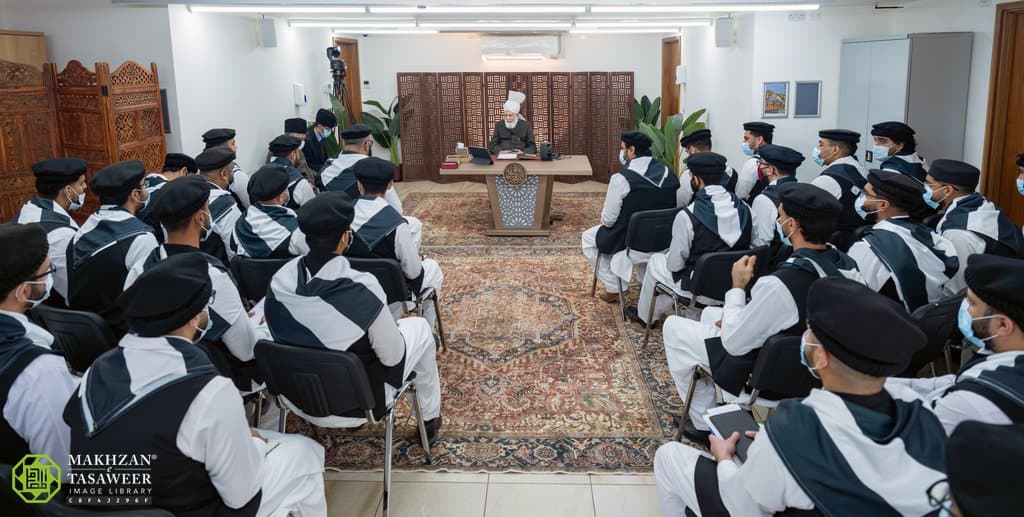
Islamabad, Tilford, 5 April 2026: Amila of the Muqami Region of Majlis Khuddam-ul-Ahmadiyya Canada had the blessed opportunity to meet Hazrat Mirza Masroor Ahmad, Khalifatul Masih V (aa).
Each of the khuddam serving on the amila introduced himself to Huzoor (aa) and briefly outlined his department and responsibilities.
Huzoor (aa) directs office-bearers to lead by personal example
Talim
During the introductory exchanges, Huzoor (aa) asked the Nazim Talim about the nature of his work. The nazim explained that his role was to encourage khuddam to study Jamaat literature, the books of the Promised Messiah (as) and the Holy Quran. When Huzoor (aa) asked how many books he himself had read, he replied that he had read 60 books of the Promised Messiah (as). Huzoor (aa) then asked whether the members of the amila were also being encouraged to read. Upon hearing that they were, Huzoor (aa) advised that the office-bearers should first be given full attention in this regard, for once the amila members themselves were reading properly, the khuddam would naturally follow their example.
Tabligh
Huzoor (aa) then asked the Nazim Tabligh what target had been set for tabligh. He was informed that the local target for the year was 100 bai‘ats. Huzoor (aa) advised that the amila members themselves should also be set clear responsibilities. He pointed out that if there were around 40 members on the amila and each was charged with striving for one bai‘at, then a substantial part of the target would already be addressed. He emphasised that the office-bearers must first present their own example.
Waqar-e-Amal
In his conversation with the Nazim Waqar-e-Amal, Huzoor (aa) asked where waqar-e-amal was being carried out. The nazim replied that priority was given to the mosque and to holding waqar-e-amal activities in Peace Village. Huzoor (aa) specifically asked whether the grounds behind the hall were also being cleaned and maintained. He was informed that they were and that a waqar-e-amal session had also been held before Eid.
Khidmat-e-Khalq
When speaking to the Nazim Khidmat-e-Khalq, Huzoor (aa) asked what kind of work was being carried out under the department. Mention was made of various forms of service, including a recent food drive. Huzoor (aa) then asked whether any project had been started in Africa. When told that none had been launched this year, Huzoor (aa) instructed that such a project should be undertaken.
Sehat-e-Jismani
Huzoor (aa) also asked the Nazim Sehat-e-Jismani what kind of work was being done in his department. He explained that weekly gym sessions were being organised by renting facilities in schools. Huzoor (aa) asked whether a gym had been opened permanently or whether premises were being rented and also enquired whether this was a daily arrangement or limited to particular days. He was informed that it was not seven days a week, but rather three days a week for the various majalis.
This was followed by a question-and-answer session.
Khuddam should be mentally trained to remain firm during an economic crisis
One questioner referred to increasing tensions between the United States and Iran, rising oil prices, inflation and the risk of recession and asked what khuddam should do to prepare.
Huzoor (aa) replied that khuddam did not control oil wells, refineries or the global oil trade and therefore the issue was not one of directly managing or international supply. Rather, the real matter was that the world may face inflation, recession and widespread economic strain and khuddam should be prepared mentally for such conditions.
Huzoor (aa) instructed that khuddam should be trained in such a way that, when crises come, they do not lose courage. He observed that many worldly people, when struck by financial loss, bankruptcy or severe economic hardship, fall into depression, despair and in some cases even attempt suicide. Referring to a well-known observation, Huzoor (aa) noted that when an economic crisis affects the world, it is called a recession, but when it comes upon an individual personally, it becomes a depression.
He said that while Ahmadis too would have to endure the broader effects of economic decline along with the rest of society, the task of khuddam was to build courage and resilience within people. In such circumstances, instead of losing hope, Ahmadis should incline even more towards Allah the Almighty, seek His help and pray that He grants them the strength to pass through the crisis with steadfastness.
The remedy for vaping lies in tarbiyat, prayer and good company
Another question was asked regarding khuddam who were involved in vaping and did not consider it to be haram.
Huzoor (aa) replied that such behaviour reflected distance from Allah, weak attachment to the Jamaat and neglect of salat. He added that wasting excessive time on the internet and social media, along with falling into bad company, also contributed to such conduct.
Huzoor (aa) said that this was first and foremost a matter of tarbiyat. He instructed that the Tarbiyat Department should become more active and keep an eye on those who had fallen into harmful company. Rather than showing aversion towards them, they should be brought closer with sympathy and understanding. Those who were firm in faith and strong in character should be encouraged to form friendships with such individuals so that they might help bring about their reformation.
Huzoor (aa) acknowledged that some efforts were already being made and that a number of boys had improved. He suggested that those who had reformed could be used to help others in different cities, or that others could be brought to them for support and improvement. At the same time, Huzoor (aa) noted that true reform can only be achieved in the case of one who wishes to be reformed; where a person does not want improvement, reform cannot be forced beyond lawful restrictions.
When told that the legal age in Canada in this regard was 19, Huzoor (aa) said that attention should especially be given before that age and that parents and home conditions should also be examined. He stressed that such matters are not solved by one auxiliary alone, but require coordinated tarbiyat by the Jamaat, Khuddam-ul-Ahmadiyya, Ansarullah and Lajna, together with the home environment.
‘This world is a prison for the believer’ is a matter of perspective
A question was asked regarding the well-known hadith which states, “The world is a prison for the believer and a paradise for the non-believer.” (Sahih Muslim, Kitab az-zuhdi wa r-raqa’iq, Hadith 5242) Guidance was sought on how khuddam should understand this “prison” and how they can avoid treating this world as a Paradise.
Huzoor (aa) provided a detailed explanation, clarifying that this concept is entirely about the difference between worldly perception and the spiritual reality of a believer.
Huzoor (aa) began by referencing a recurring theme in the Holy Quran regarding the Day of Judgement: humanity will be divided into two groups. Those who spent this worldly life indulging in endless luxuries and materialistic joy will find themselves in difficulty in the Hereafter (e.g., Surah al-Inshiqaq, Ch.84: V.14-15). Conversely, those who endured difficulties in this world – by strictly obeying Allah’s commands and committing themselves to His worship – will find ultimate happiness and ease in the next world.
Huzoor (aa) clarified a crucial point: the believer does not actually view his life as a prison. Instead, it is the worldly people who look at the believer and perceive him to be imprisoned.
- The worldly view: Society looks at a true believer and sees a life of heavy restrictions. They see that a believer does not dance in clubs, drink alcohol, vape, engage in addictions, pursue immoral relationships, or partake in misdeeds. To a worldly person, living without these indulgences seems like a strict, restrictive prison.
- The believer’s view: The believer, however, is deeply content. He understands that these restrictions are self-imposed to attain the pleasure of Allah. His heart finds peace not in clubs, but in good morals, righteous deeds and worship, just as Allah states in the Holy Quran: “Aye! it is in the remembrance of Allah that hearts can find comfort.” (Surah ar-Ra‘d, Ch.13: V.29)
To illustrate that this “prison” is not a source of suffering, Huzoor (aa) pointed out that no Prophet of God has ever complained, “O Allah, this is a prison, free me so I can indulge.” Instead, they find immense joy in their worship and possess a deep yearning to meet their Creator.
Huzoor (aa) cited the final moments of the Holy Prophet Muhammad (sa), whose last words were, “Ar-Rafiq al-A‘la” (To the Exalted Companion), demonstrating his ultimate desire to be united with Allah, his greatest Friend. (Sahih al-Bukhari, Kitab al-maghazi, Hadith 4463)
Similarly, the Promised Messiah (as) expressed this exact same longing and devotion in this era. The ultimate goal for all righteous people is simply to seek Allah’s forgiveness and a good end.
Contrasting this with the mindset of those who view this world as their Paradise, Huzoor (aa) quoted a famous Persian proverb attributed to Emperor Babur:
بابر به عیش کوش که عالم دوباره نیست
(“O Babur, strive for joyous indulgence, for this world is not to be experienced twice.”)
Huzoor (aa) explained that worldly people live by this philosophy, assuming that just as they enjoyed a life of ease and lack of restraint here, they will automatically be granted ease in the Hereafter. However, the Holy Quran warns that such people will face the torment of Hell. In the Hereafter, they will be shocked, questioning why they are facing punishment when they were accustomed to such ease in the world (e.g., Surah al-Haqqah, Ch.69: V.26-34).
Ultimately, Huzoor (aa) concluded that a believer happily accepts the self-imposed restrictions of this “prison” because they are fully aware that it is the only path to attaining an eternal reward and true Paradise in the Hereafter.
After global conflict, Ahmadis will need both faith and practical expertise
Another question asked what skills or traits would be most useful to the world after the end of a Third World War.
Huzoor (aa) replied that before thinking about practical skills, Ahmadis must first strengthen their own faith and relationship with Allah. Only then can they guide others to the right path. He said that after such destruction, people would need to be told that these calamities came about because of worldly conflict, worldly greed and wrong actions and that the only lasting solution lies in turning back to Allah.
Huzoor (aa) explained that, along with this spiritual guidance, worldly skills would still remain necessary. Those who already possess expertise in technology, information technology, engineering, medicine and other disciplines would need to use that existing knowledge to reorganise society according to the new conditions. He pointed out that after the First and Second World Wars, the world had rebuilt itself and he specifically referred to the rebuilding of Hiroshima and Nagasaki after the atomic bombings.
Huzoor (aa) stated that Ahmadis would have a twofold responsibility in such circumstances: first, to give people courage and hope; and second, to show them the straight path towards Allah.
Self-doubt is overcome through istighfar, trust in Allah and confidence in one’s purpose
A question was then asked about how a believer should deal with self-doubt.
Huzoor (aa) advised the frequent recitation of istighfar. He then clarified that such self-doubt often stemmed from negative assumptions and from underestimating one’s own ability. He instructed the questioner not to belittle himself, but rather to place trust (tawakkul) in Allah, use properly whatever he had studied and continue to increase in knowledge.
Huzoor (aa) said that one should pray to Allah for confidence and courage and should continue learning and building one’s knowledge. In this way, self-doubt gradually recedes. He added that when a person keeps before him the target that Ahmadis are to lead the world, confidence is naturally generated and self-doubt begins to disappear. He concluded by asking why a believer should live in fear at all.
Love for Jamaat literature should be developed through relevance, strategy and feedback
One khadim asked how love for reading Jamaat books could be developed among khuddam.
Huzoor (aa) responded by referring to the example of the khadim who had himself already read 60 books. He then said that for khuddam generally, interest must first be developed through smaller, relevant and accessible means. He advised that short extracts on subjects of interest should be selected and shared through the website or social media platforms in use. These could include quotations from the Promised Messiah (as), verses of the Holy Quran, ahadith and brief passages that take only a minute or two to read.
Huzoor (aa) said that once such interest is created, people can then be informed which book the material comes from, thereby leading them naturally to the source text. He also referred to The Essence of Islam volumes and said that topic-based material from such published collections could regularly be shared in this way.
Importantly, Huzoor (aa) stressed the need for feedback. The interests of the people should be identified: what topics they are thinking about, what contemporary issues concern them and what questions they want answered. From there, a proper plan and strategy should be developed. He said that one must understand what Islam, the Holy Quran and Hadith say about those issues and then present that material in a way that builds interest.
By way of illustration, Huzoor (aa) noted that in the world, governments, companies and researchers gather information and data before launching any major strategy. Even if a company wishes to make biscuits, it first studies what kinds of tastes appeal to children and adults, gathers information, then advertises and only afterwards launches the product more widely. Huzoor (aa) said that, in the same way, those serving the Jamaat should also work with planning, information and strategy in order to develop people’s interest in religion and Jamaat literature.
Huzoor’s (aa) Canada visits
In the final question, a khadim asked what Huzoor’s (aa) favourite memories of Canada were from his visits there.
Huzoor (aa) replied briefly that it had now been some years and that every tour had been successful. He said that the sincerity, devotion and good qualities of the members had always pleased him and that he had already mentioned such impressions in his sermons after those visits. He therefore directed the questioner to go back and read those sermons again.
Conclusion
After the question-and-answer session, the khuddam had the honour of having a group photograph taken with Huzoor (aa). Thereafter, each khadim received pens as a gift and the mulaqat came to an end.
(Summary prepared by Al Hakam)