
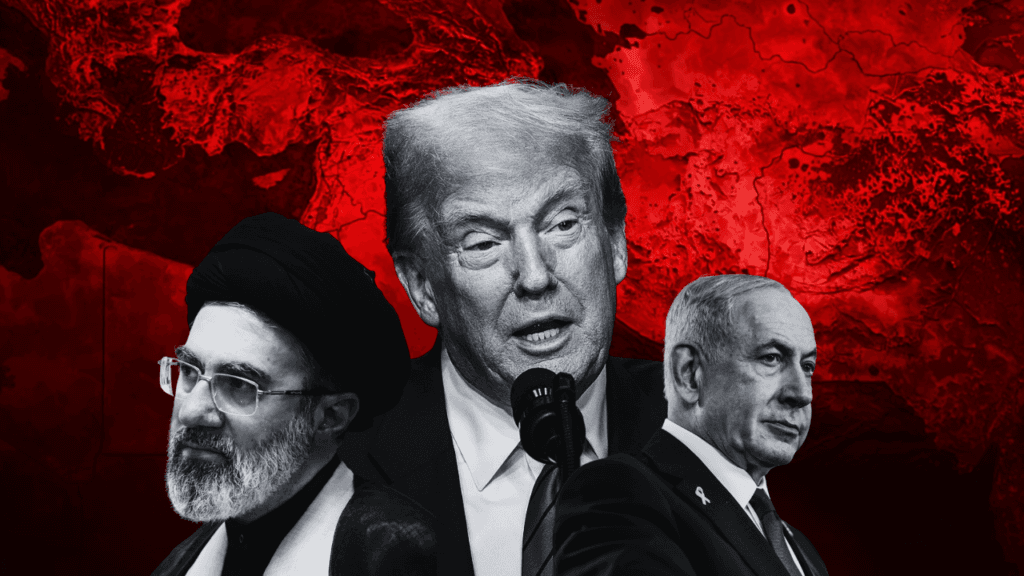
There is a well-known saying of the Holy Prophet Muhammad (sa) wherein he states that “actions are judged by intentions.” (Sahih al-Bukhari, Hadith 1) What a person or a nation truly intends eventually becomes clear and the truth becomes manifest. The ongoing situation in the Middle East painfully reflects this reality.
Powerful countries speak of peace, stability and security. Yet their actions often suggest something very different. Their statements about war seem unclear and inconsistent. US President Donald Trump, who has often spoken about ending endless wars and told his supporters, “I’m not going to start a war”, has been associated with such policies and rhetoric that reveal these contradictions.
Going against his earlier statements, Trump initiated a war with Iran under the guise of protecting and liberating citizens under oppression. However, as the situation escalated, his tone grew significantly harsher, with statements like “a whole civilisation will die tonight”, raising serious questions about the underlying intentions.
There is hope that the current US-Israel ceasefire with Iran holds. But many people now feel that the promises of major powers no longer carry the same weight. Trust has been weakened and despite Lebanon being covered in the ceasefire, the recent attacks on its territory reflect this harsh reality.
Among European countries, Spain alone issued a clear and direct condemnation of the US-Israeli strikes on Iran. A couple of others voiced limited concern without taking a firm stand against this unprovoked conflict; countries including Germany, the United Kingdom and France backed the actions or facilitated them through logistical support.
This approach suggests that the principles of humanity and human rights are sometimes applied selectively, extending only as far as national borders or the interests of allied states. It is also difficult to understand the contrast in language. On one side, Trump threatens to push a sovereign nation “back to the stone age”. On the other hand, there are claims about helping the region reach a “Golden Age”.
History tells us that the Golden Age of Islamic civilisation came at a time when societies were allowed to grow without constant outside interference. If there is a genuine desire to see progress in the Middle East, then perhaps the first step is to respect the sovereignty of its people.
There is a hope that leaders who speak of change will move towards reducing interference rather than increasing it. The people of Iran, like all people, deserve the chance to shape their own future. The war has already taught harsh lessons to both East and West. Economies have suffered. Innocent lives have been lost. Families have been broken. The damage is not only physical but also emotional. In the end, humanity as a whole has paid the price.
Serious questions are now being asked. Who should truly be called a terrorist – those who attack unarmed civilians or those who bomb schools and kill innocent children in violation of international law? These are not easy questions, but they cannot be ignored.
At the same time, Muslims in the Middle East face an important responsibility. Internal divisions have often made the region weaker. Rising above theological differences could be a step towards unity and strength.
There are also questions about foreign military presence. Are military bases in the region truly there to protect local interests or do they serve other purposes? People are beginning to question long-held assumptions.
Another important issue concerns public opinion. Do the majority of people in Iran actually want a change in their leadership through external intervention? “The Iranian people don’t want regime change forced by external powers”, Germany’s defence minister Boris Pistorius warned at a joint press conference with EU foreign policy chief Kaja Kallas, following their meeting in Berlin. If this is the case, then harming innocent civilians in the name of “liberation” raises serious moral concerns.
Likewise, surveys in the United States show that a clear majority of the public does not support the war with Iran, with many believing that the decision to strike was wrong. If people do not want conflict, why do their leaders continue to move in that direction?
It is also worth asking what the real objectives of this war were. How many of those goals have been achieved? If the answer is none, then the cost becomes even harder to justify. Lives have been lost and uncertainty has spread across the world.
This uncertainty has only increased since the first round of talks between Iran and the US ended without reaching a deal. Trump’s response to the scrapped talks was to announce a blockade of some shipping in the Strait of Hormuz, a vital trade route that most of the world relies on. Although a second round of negotiations is under discussion, it remains to be seen whether it will be more successful than the first.
The ceasefire ends on 21 April, but even now, there is still time to choose a different path. A path based on justice, fairness and the equal value of every human life. Because if this lesson is not learned, the consequences may be far greater than any nation expects. And in the end, there may be little left to govern at all.