
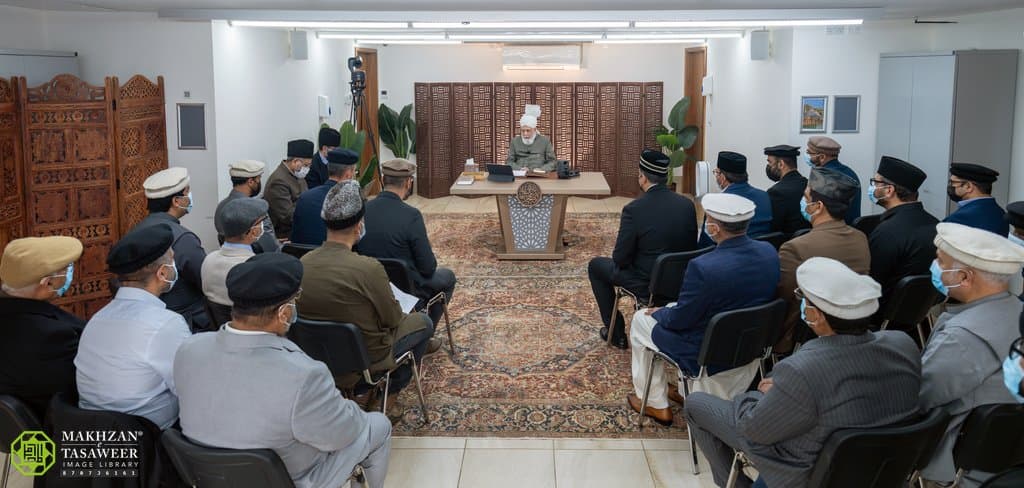
Islamabad, Tilford, UK, Tuesday, 14 April 2026: A delegation of members of Majlis Ansarullah from the Chicago and Seattle regions of the United States of America had the blessed opportunity to meet Hazrat Mirza Masroor Ahmad, Khalifatul Masih V (aa).
Upon entering the hall, Huzoor (aa) conveyed his salaam and asked the attendees to be seated. The mulaqat began with introductions, during which members introduced themselves, their majalis, professional backgrounds and Jamaat responsibilities. The delegation included members serving in various local and regional capacities, including Nazim-e-A‘la, Za‘im Majlis, Secretary Maal, Secretary Tahrik-e-Jadid, Secretary Jaidad, Secretary Umur-e-Kharijiyya and other roles.
During the introductions, Huzoor (aa) asked members about their work, family backgrounds, places of origin and Jamaat responsibilities. The professions represented included data science, cybersecurity, radiochemistry, IT, software engineering, hotel management, travel, appliance repair, cardiology and other fields. In the course of conversation with members from Seattle, Huzoor (aa) also enquired about the size of the local jamaat, the distance from the mosque or centre, attendance at prayers and plans for the future development of the mosque. Huzoor (aa) encouraged that a proper mosque should be established there.
Following the introductions, members were granted the opportunity to ask questions.
The struggle against sin is lifelong
The first question was about how one can continue to love Allah after committing sins and struggling with sin, while still believing in Him.
Huzoor (aa) explained that this is part of human life and that no one can claim to have purified themselves completely. He said that Satan continually attacks human beings and seeks to pull them away from goodness. Therefore, a believer’s duty is to keep praying to Allah, seeking His help and asking Him for strength to remain protected from Satan and from sin.
Huzoor (aa) said that this struggle continues until the last day of a person’s life. (Surah al-Hijr, Ch.15: V.100) If a person struggles sincerely and honestly, Allah rewards that effort. However, one must never become relaxed or give up, nor should one say that reform is impossible. Rather, the believer must continue striving.
Loyalty to one’s country and concern for justice
A member asked how Ahmadis who had migrated to Western countries should balance gratitude for the peace, stability and opportunities they had received with concern over unjust international policies or conflicts involving those same countries.
Huzoor (aa) replied that conflict and destruction were not limited to Western nations. He pointed out that if one migrated to Africa, many countries there were also affected by war and that several Muslim and Middle Eastern countries had also suffered destruction through conflict, including places such as Sudan, Somalia, Eritrea, Syria, Iraq, Libya and others. He said that one could certainly say that there were double standards in Western countries, yet many people had come here to improve their own economic circumstances.
Huzoor (aa) observed that certain policies being adopted in the United States were also causing economic difficulty, inflation and decline. He said that in whatever environment Ahmadis live, they should try to create awareness and warn people that the path they are taking is wrong. At the very least, such circumstances provide an opportunity for tabligh. Huzoor (aa) noted that, “There is a vast number of Americans who do not agree with the [US] President’s policies. Recently, he used Al to depict himself as the second coming of Jesus (as), which led Christians to raising their voices. People have said that this is blasphemy and that it is wrong. I’ve heard that he has deleted the post but has not made any sort of apology. The fact that he has deleted it alone is an act of great civility for his standards.” Huzoor (aa) explained that such people do not remain permanently.
Huzoor (aa) further explained that Satan has always tried to mislead mankind. When Allah created Adam, Satan declared that he would continue to misguide human beings. (Surah al-Hijr, Ch.15: V.40-41) Such satanic and Dajjal-like influences continue to appear in different forms. The duty of Ahmadis is to protect themselves while living in such environments and to explain the truth to the world. This, Huzoor (aa) said, is the real work of tabligh: when opposition arises and questions are raised, Ahmadis should provide answers and convey the true message of Islam.
At the same time, Huzoor (aa) made clear that this does not mean fighting against one’s country or government. If a person is not satisfied with living in a country, Islam permits them to leave it, but it does not allow rebellion or unlawful action against the state.
Instilling love for the Holy Quran in children
A member asked how love for the Holy Quran could be developed in the hearts of children.
Huzoor (aa) said that parents must first create that love in their own hearts; then it will also be created in the hearts of their children. If children see their parents reciting the Holy Quran daily, for example, after Fajr prayer, they naturally begin to develop an interest.
Huzoor (aa) advised parents to spend time with their children and discuss the teachings of Islam with them. They should explain that the Holy Quran is the foundation of Islam, that it contains the Sharia revealed to the Holy Prophet (sa) and that it teaches moral duties, domestic responsibilities, obligations towards children, dealings with society and the manner of worshipping Allah.
Huzoor (aa) said that if parents sit with their children even for half an hour and discuss such matters, children will not remain absorbed only in mobile phones, tablets or other devices. Their interest will develop and they will begin to think about and read the Holy Quran themselves.
Huzoor (aa) also addressed the point that some children say they do not understand the English translation of the Holy Quran because it is written in older scriptural English. He said that parents should explain that apart from a few words such as “thou”, “thee” and “thy”, the rest is normal English and can be understood. He emphasised that unless parents sit with their children, the children will not come to understand religion, the Quran, Islam or even their own roots.
Maintaining ties with non-Ahmadi relatives and those who have drifted away
A member asked how non-Ahmadi relatives, or Ahmadis who had become distant from the Jamaat due to marriage outside the Jamaat, could be brought closer.
Huzoor (aa) said that one should maintain ties with non-Ahmadi relatives. If relations are severed, they will not come to know what Islam Ahmadiyyat truly is. He said that nowhere is it written that such family ties should be broken.
Huzoor (aa) referred to the Quranic principle that even enemies can become close friends through good conduct. (Surah Ha Mim as-Sajdah, Ch.41: V.35) If enemies can become friends through excellent morals, then relatives too can be brought closer through good treatment. He said that Ahmadis should show good morals and maintain relations.
Huzoor (aa) also pointed to the example of the Promised Messiah (as), who maintained close relations with non-Ahmadi relatives, including relatives from his in-laws. This example showed that one’s duty is to maintain ties and display good conduct.
Regarding Ahmadis who had become distant due to marriage or due to the behaviour of the office-bearers, Huzoor (aa) said that they should be treated with love and be counselled appropriately. If a boy or girl has obtained permission and the nikah is being performed by an Ahmadi, then generally no punishment is given. If such people are pushed away, they will become even more distant. The duty of Ahmadis is to act upon good morals and Islamic teachings; this itself is the means of tabligh. Huzoor (aa) said that it is through morals that effective tabligh can take place.
Office-bearers are helpers of the Nizam-e-Jamaat, not the Nizam itself
A member asked about those who confuse the shortcomings of office-bearers with the Nizam-e-Jamaat itself and how such people could be guided so that the system is strengthened and weaknesses caused by human shortcomings are addressed.
Huzoor (aa) said that office-bearers who do not understand their office or their responsibilities within the system should have refresher courses every three months or twice a year, so that office-bearers are reminded what the Nizam is and what their duties are. Huzoor (aa) said he had already explained the responsibilities of office-bearers in sermons, including how they should reform themselves and deal with people.
Huzoor (aa) said that many people become upset because of the conduct of office-bearers. Therefore, office-bearers must first reform themselves. Their role is to advise and explain; Allah has instructed believers to admonish and remind, but understanding and opening one’s mind depends on Allah’s grace and on how much a person himself wishes to understand. (Surah adh-Dhariyat, Ch.51: V.56; Surah al-Qasas, Ch.28: V.57)
Huzoor (aa) then explained that members should also be taught that office-bearers are not the Nizam-e-Jamaat itself. Rather, they are helpers of the system and helpers of the Khalifa of the Time. Office-bearers should understand that, as helpers, their standards of taqwa, worship and morals should be high. When these qualities are present, they will better understand what the Nizam-e-Jamaat truly is.
Huzoor (aa) said that awareness of the Nizam-e-Jamaat must be continually given. Members should be taught that the Jamaat system revolves around Khilafat; Khilafat is centred around the Promised Messiah (as); and the Promised Messiah (as) came to establish the religion of the Holy Prophet Muhammad (sa) and the sovereignty of Allah in the world. He said that he was explaining these matters in his sermons as well and that if people listened carefully, they would understand.
Huzoor (aa) added that, after one of his sermons about office-bearers, many had written to him saying that they had come to understand both the Jamaat system and where office-bearers, as well as ordinary members, had been mistaken. Huzoor (aa) explained that this process of teaching and reminding must be ongoing. Just as in the world, even those with PhDs continue to attend workshops, seminars and meetings to renew their knowledge and share new research, so too in the Jamaat, repeated guidance and training is necessary.
Ansar should establish brotherhood through service, sacrifice and personal example
A member from Seattle asked what role Ansarullah should play in promoting unity and brotherhood within the Jamaat.
Huzoor (aa) asked what the word “Ansarullah” means and indicated that it means helpers of Allah. He explained that Allah desires the establishment of brotherhood. Therefore, ansar should establish brotherhood by showing their own example and helping others.
Huzoor (aa) said that ansar should treat children as their own children and younger khuddam as their brothers. They should set a good example in their homes before their children. They should also remind one another of what it means to be ansar and how they should help each other.
Huzoor (aa) again referred to the Quranic teaching that even enemies can become friends through good conduct; therefore, those who already belong to the Jamaat should certainly be made friends and brothers.
Huzoor (aa) mentioned that he had recently been asked about what should be done during crisis or war-like conditions, including the storing of three months’ food or rations. He had advised that people should do whatever they were able to do and those who lacked the means should be helped by other ansar and Jamaat members. Such mutual support would create brotherhood.
Huzoor (aa) then referred to the model of mu’akhat established by the Holy Prophet (sa) in Medina, where one brother was joined with another and the highest standards of sacrifice were displayed. (The Life & Character of the Seal of Prophets [sa], Vol. 2, pp. 22-24) He said that if ansar serve one another, give gifts, greet one another with salaam, visit one another at Eid and maintain close relations, brotherhood will be established.
Members should be utilised according to their abilities and interests
A member asked how ansar could balance worldly responsibilities and spiritual duties in today’s fast-paced life, especially when many are occupied with work and daily responsibilities.
Huzoor (aa) said that everyone has 24 hours in a day. A person may sleep for six hours and work for eight hours and those running businesses may work for 12 hours. Yet some are not prepared to give even two hours a week or a month for the Jamaat.
Huzoor (aa) said that the pledge to give precedence to faith over the world should lead a person to reflect on how, according to his own circumstances, he can give precedence to faith. When this thought arises sincerely, he will also find time for Jamaat service.
Huzoor (aa) then advised that office-bearers should study who is doing Jamaat work and who is not, to what extent people are already serving, what additional capacity they have and how they can be utilised better.
He said that work should be assigned according to a person’s education, ability, capacity and interest. If someone with a PhD is merely asked to sit and write addresses on envelopes, he may feel his abilities are not being used. Such people should instead be given work suited to their skills, such as research. Huzoor (aa) said that research should be done in Ansarullah and in the Jamaat and educated members can also assist with translation work. Many people in America are already part of translation teams and more educated people can be included.
Huzoor (aa) said that serving the Jamaat does not only mean attending Ansarullah meetings or helping collect chanda. Every person has his own potential, capacity and interest and work should be assigned accordingly. If people are given work that matches their interests, they will be more likely to do it.
Regarding the fast-paced world, Huzoor (aa) said that members should be reminded of their pledge to give precedence to faith over the world and asked how they themselves think they can fulfil it. Instead of simply accusing them of not doing Jamaat work, it is better to involve them in reflection and ask how they can contribute and how their example can help guide others. He said that this approach can create a sense of responsibility within them. A proper strategy is needed and one should also understand human psychology.
Mental peace is found in the remembrance of Allah
A member asked what the best way was to convey Islam’s message at a time when the world is deteriorating and people are searching for mental peace.
Huzoor (aa) said that people should be told to turn towards Allah. He referred to his recent sermons on love of Allah, worship and Tawhid, explaining that these sermons contained points related to mental peace. Members should listen to them, absorb their message, note the relevant points, act upon them personally and then convey them to others.
Huzoor (aa) cited the Quranic teaching that it is in the remembrance of Allah that hearts find comfort. (Surah ar-Ra‘d, Ch.13: V.29) He said that this is Allah’s claim and Allah’s claim cannot be false. Therefore, if people do not experience that peace, the weakness lies in their own understanding and practice, not in the Divine teaching.
To illustrate this point, Huzoor (aa) narrated the incident of a man who came to the Holy Prophet (sa) complaining of stomach trouble. The Holy Prophet (sa) instructed that he should be given honey. When the man returned saying that the problem had worsened, the Holy Prophet (sa) again instructed that honey be given. This occurred more than once, until eventually the man recovered. Huzoor (aa) explained that the Holy Prophet (sa) said, in effect, that the man’s stomach could be wrong, but the word of Allah could not be wrong, for Allah had stated that honey contains healing for mankind. (Sahih al-Bukhari, Kitab at-tibb, Bab ad-dawa’i bi l-‘asl, Hadith 5684)
Huzoor (aa) said that the same principle applies to conveying the message of Islam. Members should not give up after presenting the message once or twice. They should continue, again and again, to tell people that the zikr of Allah is the path to peace, survival and salvation. If someone rejects the message and turns away, they should continue to present it patiently on another occasion. Their duty is to keep conveying the message so that they themselves gain mental peace and others may also find it. Those who do not wish to reform remain responsible for their own choice.
Conclusion
Before the group photograph, Huzoor (aa) enquired where the members were staying and was informed that they were staying at the Baitul Futuh complex in Morden. The delegation then had the opportunity to have a photograph with Huzoor (aa). At the end of the mulaqat, Huzoor (aa) conveyed his salaam and took leave.
(Summary prepared by Al Hakam)