
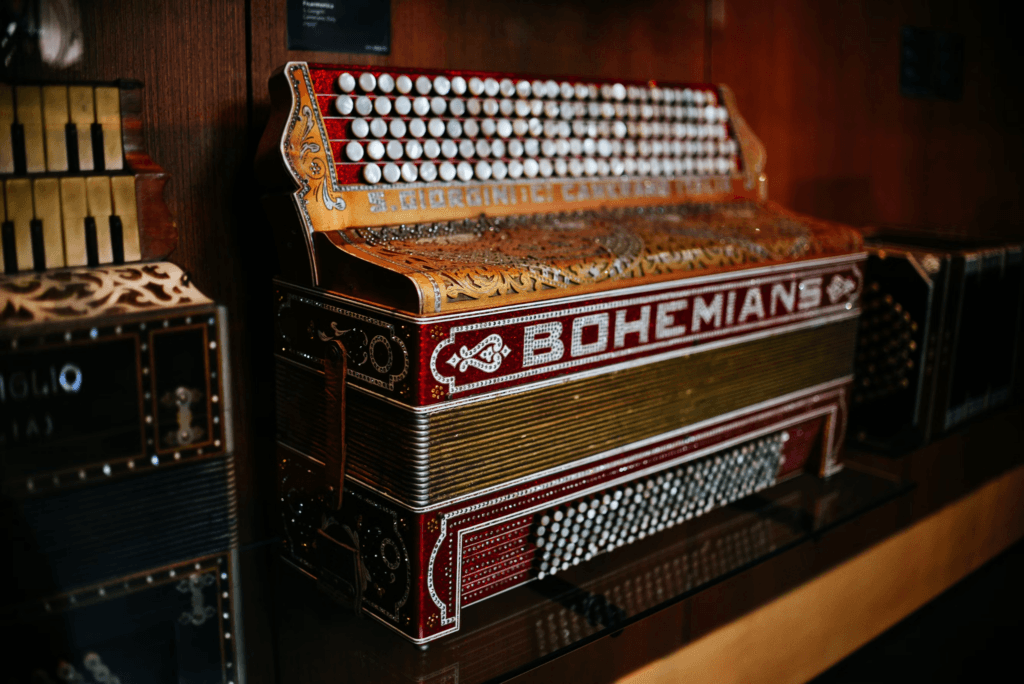
Is playing musical instruments haram in Islam?
Someone from Syria wrote to Hazrat Amirul Momineen, Khalifatul Masih V (aa), stating that he was learning to play a musical instrument and asked whether this was forbidden [haram].
In his letter dated 18 December 2023, Huzoor-e-Anwar (aa) gave the following answer to this question:
“An Ahmadi should engage only in such pursuits as are free from doubtful matters that are susceptible to wrong interpretation. In this regard, the Holy Prophet (sa) has guided us by stating that the lawful is clear and the unlawful is clear and between the two are certain doubtful matters which many people do not discern correctly. Thus, whoever avoids doubtful matters safeguards his faith and his honour. And whoever falls into such doubtful matters is like a shepherd who grazes his flock near a protected pasture and his animals may at any moment stray into it. Beware! Every king has a protected preserve and Allah’s protected bounds upon the earth are the things He has forbidden. (Sahih al-Bukhari, Kitab al-iman, Bab fadli mun istabra’a li dinih)
“Therefore, playing musical instruments and learning to play them falls, in my view, within the category of doubtful matters. It is therefore better to avoid it. Playing a musical instrument at home once in a while is a different matter; however, learning to play these instruments and then going out to perform in markets, at various functions and at concerts can open the door to many improprieties and lead one into various other wrongs. It is therefore better to refrain from it.”
Why did Prophet Muhammad (sa) forbid tampering with or clipping coins?

Someone from the UK wrote to Hazrat Amirul Momineen, Khalifatul Masih V (aa), asking whether the prohibition mentioned in the hadith against tampering with coins might have been intended to prevent inflation.
In his letter dated 22 January 2024, Huzoor-e-Anwar (aa) provided the following guidance regarding this issue:
“The ahadith you mentioned in your letter concerning the prohibition against tampering with coins are recorded in Sunan Abi Dawud (Kitab al-buyu‘) and Sunan Ibn Majah (Kitab at-tijarat), in a narration from Hazrat Abdullah bin Mas‘ud (ra), which states that the Holy Prophet (sa) forbade tampering with coins in circulation among Muslims without a valid necessity.
“In fact, at that time, transactions involving official coins – the dirham, which was generally of silver and the dinar, which was generally of gold – were conducted by count, rather than by weight. Therefore, some people would wrongfully clip the edges of these coins, keep the gold or silver for themselves and then pass those coins in the market by count. Similarly, some people would melt them down into lumps of silver or gold and keep them, which reduced the circulation of currency in the market, caused loss to the state and created a shortage of currency for the people. Thus, with a view to the moral training of Muslims, the Holy Prophet (sa) instructed them to refrain from this wrongdoing, fraud and loss to the state, just as they were instructed to refrain from other evils.
“However, where it became necessary to melt these coins down – for instance, where coins had become worn and unsound with age or where their value had been reduced due to tampering or where, following a change of government, the incoming government wished to put its own coins into circulation in the market – then, in all such cases, this prohibition did not apply to the relevant authority and the authority could remint those old coins into new ones.
“Hence, this injunction of the Holy Prophet (sa) has nothing to do with inflation. In those days, a temporary shortage of foodstuffs and rising prices generally occurred as a result of famine. And when the period of famine passed and the economy recovered, that temporary shortage would also come to an end and prices would return to their previous level.”
Why are premarital relations considered wrong in Islam?

A non-Ahmadi woman from Germany wrote to Hazrat Amirul Momineen, Khalifatul Masih V (aa), asking why sexual relations before marriage are considered wrong and whether the Ahmadiyya Muslim Jamaat also regards them as wrong. She further asked: “Why is emphasis placed on a woman remaining a virgin, yet no similar emphasis is placed on men? In the Jamaat, is a woman checked by a doctor before marriage to confirm that she is a virgin, even though the hymen may tear during sport and exercise? Can anyone claim that Ahmadi men do not watch obscene material or do not engage in premarital sexual relations? Can rape occur within marriage […] and why is this not discussed? If two people love one another, why must they marry? Does this mean that marriage is contracted because of sexual need rather than mutual love? And are there men who can wait until marriage?”
In his letter dated 25 January 2024, Huzoor-e-Anwar (aa) gave the following guidance in response:
“The questions raised in your letter generally arise as a result of distance from Allah the Exalted and a failure to understand the teachings of His religion. Therefore, remember that the God Who created mankind sent His Prophets, along with His teachings, at different times and in different lands, in order to set forth for mankind the principles of life and the various rules and regulations by which to live. Then, by sending our master and guide, the Holy Prophet Muhammad al-Mustafa (sa), He perfected the religion and taught us the ways and modes of living until the Day of Judgement.
“Within this religious teaching, Allah the Exalted has also laid down a principle for social life: that a physical relationship between a man and a woman without nikah [marriage] is unlawful and falls within the category of disobedience to Allah the Exalted. Islam calls such a relationship zina [illicit sexual relations] and declares it to be a sin. Therefore, it is regarded as wrong in Islamic society and according to the Ahmadiyya Muslim Jamaat as well – which is the standard-bearer of the true teachings of Islam – this act is wrong and incurs the displeasure of Allah the Exalted.
“Your second question – that Islam does not emphasise the moral reform of men and only insists that women remain virgins before marriage – is incorrect. The Sharia teaches both men and women alike that they must refrain from every form of evil. In the Holy Quran, where women are commanded to lower their gaze and guard their chastity, men are given the same command: to lower their gaze and guard their chastity. Indeed, in terms of sequence, this command is first addressed to men and only thereafter are women mentioned. (Surah an-Nur, Ch.24: V.31-32)
“Furthermore, with regard to unlawful sexual relations, in the Holy Quran, where the punishment of the woman guilty of zina is mentioned, the punishment of the man guilty of zina is mentioned alongside it in exactly the same manner; no distinction whatsoever has been made between them. (Surah an-Nur, Ch.24: V.3) Moreover, when we look at the time of the Holy Prophet (sa), we find several instances in which men were punished for zina, whereas only one or two such cases are found regarding a woman and even in that case it is expressly mentioned that the woman repeatedly presented herself before the Holy Prophet (sa), insisting that she be punished. (Muwatta Imam Malik, Kitab al-hudud, Bab al-rajm)
“Thus, Islam has consistently taught equality between men and women in the reward for virtue and the punishment for vice. However, in the Western society in which you live, equality in matters relating to men and women is merely claimed, but by no means practised. As a result, the balance of life has been disturbed and the human race is moving towards ruin both materially and spiritually.
“As for your third question – whether a woman should be examined by a doctor before marriage in order to ascertain her virginity – let it be clear that this is an absurd notion and an entirely wrong practice and it has not even the remotest connection with Islamic teaching. If such a practice exists in any society, it is merely a custom devised by the people of that society themselves; it has no connection with religion. Moreover, according to medical science, a woman’s hymen may be torn through various forms of sport and exercise, such as cycling, horse-riding, gymnastics and using climbing frames, as well as during certain medical examinations carried out for illness.
“As for your fourth question, regarding men committing immoral acts or engaging in unlawful sexual relations before marriage, the answer is that no human being can guarantee another person’s virtue or vice. Allah the Exalted alone is the Knower of the Unseen and He alone knows what lies within a person and what that person’s hidden deeds are. As for anyone who commits a sin, Allah the Exalted reserves the right to punish such a person; He may punish them in this world or in the Hereafter or He may forgive them as a result of their repentance.
“As for your question concerning ‘rape’ between husband and wife after marriage, the answer is that, according to Islamic teachings, such a notion is entirely baseless, because nikah is a contract between husband and wife, as a result of which both are bound to be mindful of one another’s rights and feelings. Therefore, without any valid reason, neither may the wife refuse the husband in this regard, nor may the husband refuse the wife. Allah the Exalted has made this physical relationship between husband and wife a source of comfort and tranquillity. (Surah ar-Rum, Ch.30: V.22)
“Thus, the Islamic teaching is that husband and wife, while being mindful of one another’s physical needs, should become a source of comfort and reassurance for one another and should not establish unlawful relations with other men or women outside the home. However, those who have ignored this beautiful teaching have destroyed their religious as well as worldly peace.
“In response to your question concerning marriage and sexual need, Allah the Exalted has made the relationship between husband and wife a means not only of chastity and purity, but also of the continuation of the human race. Love alone cannot carry human posterity forward and the very concept of continuation would disappear. If by love one means establishing a physical relationship between a man and a woman without marriage or nikah, then religion does not permit this, for it has established a distinction between animals and human beings and has raised the human being to the rank of the noblest of creation (ashraf al-makhluqat).
“As for your question of whether there are men who wait until marriage before entering into sexual relations, it should be clear that such men certainly do exist; indeed, they exist in large numbers and they establish such relations only after marriage, not before. It would be unfairly cynical to say that nowadays no one remains free from this filth.”
What are the fundamental attributes of God in Islam?

Someone from Germany wrote to Hazrat Amirul Momineen, Khalifatul Masih V (aa), that the Promised Messiah (as) has written in I‘jaz-ul-Masih that all the attributes of Allah the Exalted flow forth from the fountain of rahmaniyyat and rahimiyyat. However, in another book, Huzoor (as) has described ar-Rahman, ar-Rahim, Rabb al-‘Alamin and Malik Yawm ad-Din as four foundational attributes. How, then, are we to understand the mutual relationship between these divine attributes? He further asked how new converts could better serve the Jamaat.
In his letter dated 27 January 2024, Huzoor (aa) gave the following guidance regarding these matters:
“With regard to your question about the divine attributes, the answer is that the Promised Messiah (as) has expounded this profound subject of the divine attributes at various places in his books and Malfuzat, expressing it in different ways. Thus, concerning the four fundamental attributes of Allah the Exalted, which are also called umm as-sifat, Huzoor (as) states:
“‘Let it be clear that some of Allah the Exalted’s attributes are essential attributes, arising from the very demands of His Being and upon them rests the order of all the worlds. These are four: rububiyyat [creation, nurturing and sustaining], rahmaniyyat [universal grace], rahimiyyat [mercy associated with faith], and malikiyyat [divine sovereignty and judgement]. As Allah the Exalted has indicated them in this Surah (al-Fatihah), saying: رَبِّ الۡعٰلَمِیۡنَ الرَّحۡمٰنِ الرَّحِیۡمِ مٰلِکِ یَوۡمِ الدِّیۡنِ [Lord of all the worlds, the Gracious, the Merciful, Master of the Day of Judgement]. Thus, these essential attributes take precedence over everything and encompass everything. The existence of all things, their capacities, their capabilities and their attaining their perfections are all through them.’
(Karamat-us-Sadiqin, Ruhani Khazain, Vol. 7, p. 128)
“Apart from Karamat-us-Sadiqin, this subject has also been explained in great detail, in varying modes of expression, in Barahin-e-Ahmadiyya, Chashma-e-Ma‘rifat, Islami Usul ki Falasafi, I‘jaz-ul-Masih, Ayyam-us-Sulh, Minan-ur-Rahman and Paigham-e-Sulh, as well as in Malfuzat. You may study those works for a fuller exposition of this subject.
“As for the passage in I‘jaz-ul-Masih where the Promised Messiah (as) has described the other divine attributes as branches of rahmaniyyat and rahimiyyat, there too Huzoor (as) had in fact described rububiyyat as the source of these two attributes. Thus, Huzoor (as) states:
“‘Now we shall once again set forth the summary of the commentary of bismillah. So, know that the name “Allah” is a non-derived name, the true meaning of which is known only to God, the All-Knowing, the All-Aware. Allah, exalted be His name, has explained the reality of this name in this verse, and has indicated that Allah is that Being Who is characterised by rahmaniyyat and rahimiyyat, that is, by beneficent mercy and by mercy associated with the state of faith. These two mercies are like pure water and sweet nourishment issuing forth from the source of rububiyyat. Apart from these two attributes, all other attributes are branches of them. And the root attributes are only rahmaniyyat and rahimiyyat. And these two are manifestations of the mystery of the Divine Being.’
(I‘jaz-ul-Masih, Ruhani Khazain, Vol. 18, pp. 115-116)
“If you read this passage carefully, you will find the answer to your question yourself. Firstly, the Promised Messiah (as) has clearly stated these two attributes – rahmaniyyat and rahimiyyat – to proceed from the fountain of rububiyyat. Secondly, Huzoor (as) is here speaking with reference to the verse of bismillah. Since in that verse only these two essential attributes of Allah the Exalted are mentioned, Huzoor (as) is, in fact, explaining here that the other divine attributes are branches of these two essential attributes, while the source of these two essential attributes is, in reality, another, greater essential attribute of His, namely Rabb al-‘Alamin. Thirdly, before and after explaining this theme, Huzoor (as) is discussing how the Holy Prophet (sa), in his capacities as Muhammad and Ahmad, was a manifestation of these two attributes of Allah the Exalted – rahmaniyyat and rahimiyyat – and likewise how, as his heirs, the Companions, may Allah be pleased with them, and, among the latter ones, his spiritual son, the Promised Messiah (as), were manifestations of these two attributes of Allah the Exalted. It is for this reason that Huzoor (as) has mentioned only these two attributes here and has not discussed the attributes of Rabb al-‘Alamin and Malik Yawm ad-Din.
“As for the remainder of your question concerning new converts, the answer is that nau muba’i‘in should, alongside progressing in righteousness and taqwa, strive their utmost to increase their religious knowledge, and, through engaging in tabligh as much as possible, they should endeavour to bring other receptive souls as well towards the true religion of Allah the Exalted. May Allah the Exalted grant everyone the ability to do so. Amin.”
(Compiled by Zaheer Ahmad Khan, Head of Records Department, Private Secretariat, London and translated by Al Hakam)