
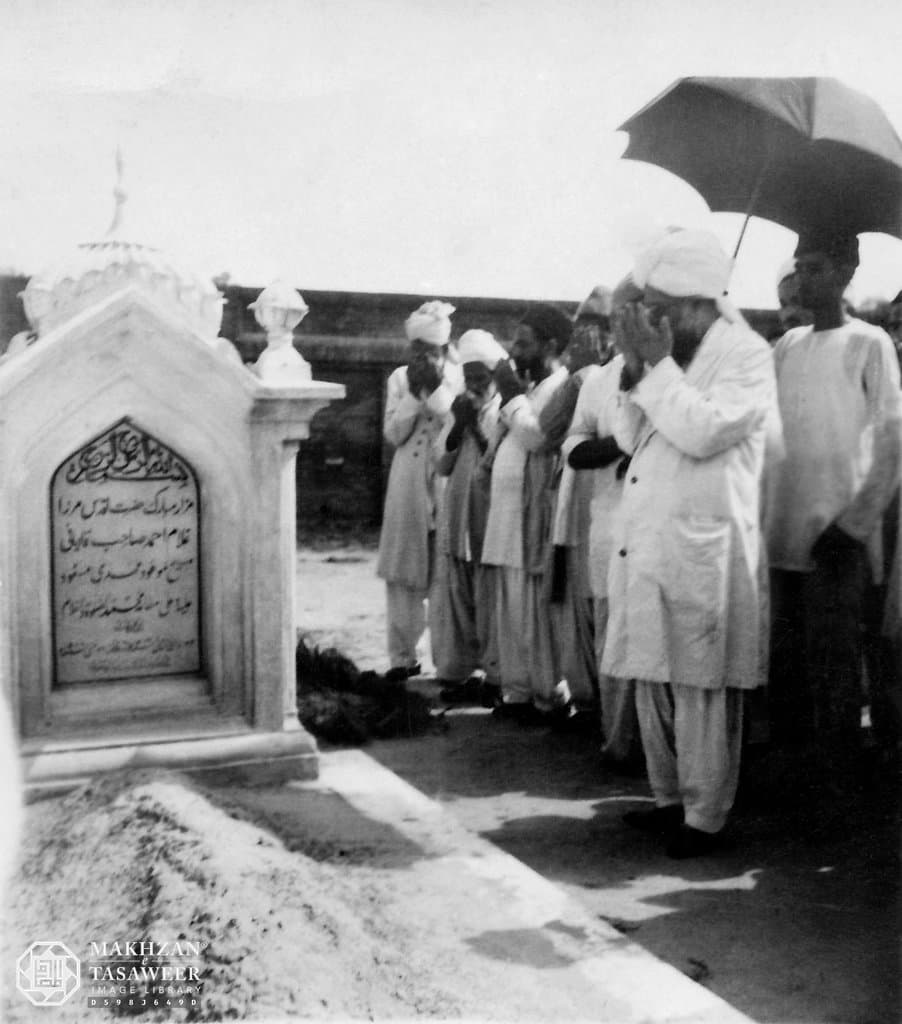
How should one pray at the graves of holy personages?
A lady from the USA wrote to Hazrat Amirul Momineen, Khalifatul Masih V (aa), enquiring how one should pray in one’s own language when visiting the blessed resting places of the Holy Prophet (sa) and the Promised Messiah (as).
In his letter dated 23 February 2024, Huzoor-e-Anwar (aa) gave the following guidance in this regard:
“Recite Surah al-Fatihah and durud sharif [invoking blessings and peace upon the Holy Prophet (sa)], for within these all prayers are contained. Then, in your own language, pray to Allah the Exalted for the elevation of the ranks of these revered personages and also pray that Allah the Exalted may enable their followers to remain steadfast upon the virtues and truths with which they came. Thereafter, pray for the attainment of religious and worldly blessings for yourself and ask of Allah the Exalted whatever you desire.
“For the guidance of members of the Jamaat, Hazrat Musleh-e-Maud (ra) once delivered an address on the subject of ‘Mazar Hazrat Masih Mau‘ud (as) par Du‘a aur us ki Hikmat’ [Supplication at the grave of the Promised Messiah (as) and its wisdom], which has since been published in book form. In that address, Huzoor (ra) drew the attention of members of the Jamaat to many important matters. You should study it as well. Regarding his own manner of prayer, Huzoor (ra) states:
“‘I shall tell you about myself. Whenever I come to pray at the grave of the Promised Messiah (as), I have adopted the practice of first praying for the Holy Prophet (sa) and then praying for the Promised Messiah (as). The prayer I make is this: “O Allah, I possess nothing worthy of presenting as a gift in honour of these revered ones. What I do possess can be of no benefit to them. All things, however, are in Your power. I therefore beseech You, out of Your grace, to bestow on them from me such a gift in Paradise as they have not received there before.”
“‘They will then surely ask, “O Allah, from whom has this gift come?” And when Allah informs them, they pray for that person. Thus, the ranks of the supplicant, too, are elevated. This is established by the Quran and the ahadith.
“‘It is a well-established principle of Islam, one which no one can deny, that the prayers of the living do indeed benefit the deceased. The Holy Quran has also drawn attention to this principle in the words فَحَيُّوا بِأَحْسَنَ مِنْهَا (Surah an-Nisa’, Ch.4: V.87), from which we learn that when someone presents you with a gift, you should return it with one better than it or, at the very least, with one equal to it. Accordingly, when we pray for the Holy Prophet (sa) or the Promised Messiah (as) and invoke blessings and peace upon them, Allah the Exalted bestows upon them, as a result of that supplication, a gift on our behalf.
“‘We do not know what bounties Paradise contains, but Allah the Exalted knows them full well. Therefore, when we pray, “My Lord, grant to the Noble Messenger (sa) such a gift as he has not received before”, it necessarily follows that when that gift is bestowed upon him, Allah the Exalted will also inform him that it has come as a gift from such-and-such a person. How, then, can it be imagined that, having come to know this, he would remain silent and not pray for the one who sent that gift? At such a moment, his blessed soul cannot but fall at the threshold of Allah and cry out, “O God, now do You, on our behalf, grant this person an even better reward.”
“‘Thus, in accordance with فَحَيُّوا بِأَحْسَنَ مِنْهَا, that prayer returns to the one who invoked blessings and becomes the means of elevating their rank. This, then, is a means by which, without any trace of shirk, we ourselves may benefit and the nation may benefit as well.’”
(Mazar Hazrat Masih Mau‘ud (as) par du‘a aur us ki hikmat, Anwarul-Ulum, Vol. 17, pp. 182-183)
Why are only two fardh rak‘at prescribed in the Fajr prayer?

Someone from Canada asked Hazrat Amirul Momineen, Khalifatul Masih V (aa), why only two fardh rak‘at are offered in the Fajr prayer, whereas the other obligatory prayers consist of more than two rak‘at.
In his letter dated 25 February 2024, Huzoor-e-Anwar (aa) gave the following answer to this question:
“This is Allah the Exalted’s will. As Allah the Exalted instructed His Messenger (sa), so the Holy Prophet (sa) informed us of and taught us the prescribed rak‘at of the prayers. Moreover, one who offers tahajjud has already performed a lengthy supererogatory prayer in the latter part of the night, shortly before Fajr. Therefore, for the ease of such a person, Allah the Exalted has prescribed fewer rak‘at for Fajr than for the other prayers.
“Moreover, Hazrat Musleh-e-Maud (ra) has, in various sermons, explained the wisdom underlying the timings of the prayers and their rak‘at. In one place, while explaining the rak‘at of Fajr, Huzoor (ra) states:
“‘The fundamental point is that when a person rises from sleep, a new phase of life begins for them. At the beginning of a new phase, it is necessary that one should form lofty resolves within oneself and say: I shall do this; I shall do that. Since all these matters are contained in the Holy Quran, when a person’s new phase of life begins after rising from sleep, Islam has prescribed a lengthy recitation of the Holy Quran at that time in order to draw their attention towards their spiritual programme. Thus, it has been ordained that the Holy Quran should be recited at length in the Fajr prayer. And since God Almighty’s way in His commandments is founded upon ease and not hardship, He made the Fajr prayer shorter than all the other prayers so that the recitation might be lengthened. Thus, He shortened the Fajr prayer, but lengthened the recitation of the Quran. This is because, at that time, there is a need for the themes of the Holy Quran to come before one again and again. Hence, it was necessary that the Fajr prayer be shortened so that the recitation might be lengthened. This prayer is, in fact, the counterpart of the Asr prayer and even outwardly its number comes to resemble that of Asr in this way: no sunnah mu’akkadah is attached to Asr, whereas the morning prayer is accompanied by two sunnah mu’akkadah. Thus, the rak‘at of the morning prayer also become four, just as the rak‘at of Asr are four.’”
(Khutbat-e-Mahmud, Vol. 20, Friday sermon delivered on 17 March 1939, p. 172)
Are the well-known supplications for Ramadan’s three ashrahs established by the sunnah or Hadith?

Someone from Australia wrote to Hazrat Amirul Momineen, Khalifatul Masih V (aa), asking whether the well-known supplications associated with the three ashrahs [ten-day periods] of Ramadan are established by the sunnah or Hadith. They also enquired about the source of اَسْتَغْفِرُ اللهَ رَبِّيْ مِنْ كُلِّ ذَنْبٍ وَّاَتُوْبُ اِلَيْهِ [I seek forgiveness from Allah, my Lord, for every sin and I turn to Him]. According to Hazrat Aisha (ra), the Holy Prophet (sa), after saying سُبْحَانَ اللهِ وَبِحَمْدِهِ [Holy is Allah and all praise belongs to Him], would say only اَسْتَغْفِرُ اللهَ وَاَتُوْبُ اِلَيْهِ [I seek forgiveness from Allah and turn to Him]. Moreover, the Holy Quran also uses the words أَنِ اسْتَغْفِرُوا رَبَّكُمْ ثُمَّ تُوبُوا إِلَيْهِ [Seek forgiveness of your Lord and turn to Him in repentance]. (Surah Hud, Ch.11: V.4) Guidance was requested in this regard.
In his letter dated 29 February 2024, Huzoor-e-Anwar (aa) gave the following guidance:
“The supplications attributed to the ashrahs of Ramadan are not established as being specific to those periods from the sunnah of the Holy Prophet (sa) or from any authentic hadith. It appears that, at some later time, people attached these supplications specifically to those ashrahs. The Holy Prophet (sa) only described these ashrahs of Ramadan as periods of mercy, forgiveness and deliverance from the Fire. (Shu‘ab al-Iman, Al-Bayhaqi, Kitab fada’ili shahri Ramadan, Bab azallakum shahrun ‘azim, shahrun mubarak)
“Among the supplications attributed to the ashrahs of Ramadan is رَبِّ اغْفِرْ وَارْحَمْ وَأَنْتَ خَيْرُ الرَّاحِمِينَ [‘My Lord, forgive and have mercy, and Thou art the Best of those who show mercy.’] (Surah al-Mu’minun, Ch. 23: V. 119) This is a Quranic supplication. With regard to the prayer اللَّهُمَّ إِنَّكَ عَفُوٌّ تُحِبُّ الْعَفْوَ فَاعْفُ عَنِّي [‘O Allah, Thou art Oft-Pardoning; Thou lovest to pardon, so pardon me’], it is mentioned in a hadith that when Hazrat Aisha (ra) asked, ‘If I come to know that this night is Laylat al-Qadr, what should I pray in it?’ the Holy Prophet (sa) taught her this supplication. (Sunan Ibn Majah, Kitab ad-du‘a, Bab ad-du‘a’i bi l-‘afwi wa l-‘afiyah) However, the istighfar formula is also not transmitted in these exact words in any authentic hadith.
“For istighfar, the Holy Prophet (sa) used various expressions and forms of wording, which are narrated in the ahadith. As I have said, the istighfar containing the words اَسْتَغْفِرُ اللهَ رَبِّيْ مِنْ كُلِّ ذَنْبٍ وَّاَتُوْبُ اِلَيْهِ [I seek forgiveness from Allah, my Lord, for every sin and I turn to Him] is not related in any authentic hadith. However, the Promised Messiah (as) recited this istighfar while taking the pledge of allegiance [bai‘at]. (Maktubat-e-Ahmad, Vol. 3, 2013, p. 247) This would certainly have been on account of the command of Allah the Exalted. Besides this, the words رَبِّيْ [my Lord] and مِنْ كُلِّ ذَنْبٍ [for every sin] in this istighfar create a sense of a personal bond with Allah the Exalted, as well as the thought of seeking forgiveness for every kind of sin. Thus, this istighfar becomes a means of drawing a person closer to Allah the Exalted. Therefore, there is no harm in reciting such an istighfar. One should instead refrain from things that lead to shirk and that take a person away from Allah the Exalted.
“Alongside these matters, one should always keep in view that a person ought not to become embroiled in such idle and meaningless scholarly debates merely to parade their learning and make an undue display of it.”
Did Prophet Muhammad (sa) foretell the discovery of oil and fossil fuels?

Someone from the UK wrote to Hazrat Amirul Momineen, Khalifatul Masih V (aa), asking whether the prophecy concerning the Fire of Hijaz, mentioned in the Hadith and also referred to by the Promised Messiah (as), could indicate the discovery of oil and fossil fuels.
In his letter dated 12 March 2024, Huzoor-e-Anwar (aa) provided the following guidance on this matter:
“The fundamental point is that the various prophecies which Allah the Exalted conveys to the world through the mouths of His loved ones have different aspects. At times, they are fulfilled in a manifest and outward manner and at other times, they also contain meanings in which there is an element of hiddenness.
“The prophecy concerning the Fire of Hijaz is narrated in the books of Hadith from Hazrat Abu Hurairah (ra) in the following words: The Holy Prophet (sa) said, ‘The Hour will not be established until a fire emerges from the land of the Hijaz which will illuminate the necks of camels in Busra.’ (Sahih al-Bukhari, Kitab al-fitan, Bab khuruji n-nar; Sahih Muslim, Kitab al-fitani wa ashrati s-sa‘ah, Bab la taqumu s-sa‘atu hatta takhruja narun min ardi l-hijaz)
“Most scholars agree that this prophecy foretold by the Holy Prophet (sa) was fulfilled in 654 AH. It is also said that this fire lasted for three months. [Ibn Hajar al-‘Asqalani, Fath al-Bari bi Sharh Sahih al-Bukhari, Kitab al-fitan, Bab khuruji n-nar, 13:79-80; Muhammad Siddiq Hasan Khan, al-Siraj al-Wahhaj min Kashf Matalib Sahih Muslim ibn al-Hajjaj, Bab la taqumu s-sa‘atu hatta takhruja narun min ardi l-Hijaz, quoting Abu al-Falah in Shadharat al-Dhahab] Likewise, it is recorded that on the night of Wednesday, 3 Jumada al-Akhirah 654 AH, a terrifying rumbling was heard in Medina. Thereafter, an earthquake occurred, which shook everything violently. This continued until Friday, after which a great fire appeared from the Harrah of Medina. It spread like flowing water and was casting out enormous sparks. [Ibn Kathir, al-Bidayah wa al-Nihayah, ed. ‘Abd Allah ibn ‘Abd al-Muhsin al-Turki (Cairo: Dar Hajar, 1417-1420 AH / 1997), 17:328-330] Imam Nawawi writes that in 654 AH, a very great fire blazed forth from behind the Harrah on the eastern side of Medina and the people of Syria and other lands have received uninterrupted reports of it. [Al-Nawawi, al-Minhaj fi Sharh Sahih Muslim ibn al-Hajjaj (Beirut: Dar Ihya’ al-Turath al-‘Arabi, 2nd ed., 1392 AH), Kitab al-fitan wa ashrati a-sa‘ah, 18:28-30]
“The Promised Messiah (as) also spoke of the fulfilment of this prophecy in various places. Thus, while explaining to young people the enlightening truth of Allah the Exalted’s infinite, never-ending and boundless powers and the profound reality of His law of nature, the Promised Messiah (as) states:
“‘For example, fire is, by its very nature, endowed with the property of burning and this is a property which we have tested time and again. Indeed, it forms part of our repeatedly verified experiences and recurrent observations. Yet, for all that, it is possible that some medicine or ointment may come into being such that, when applied to a limb or to some other object, fire is unable to manifest upon it its property of burning. It is likewise possible that within fire itself, by the leave of Allah the Exalted, certain inward or outward contingencies may arise whereby such a condition comes into being. In like manner, it too lies within the range of possibility that a kind of fire may emerge from the earth or from the heavens which differs in its properties from the fire familiar to us – such as the Fire of Hijaz, the appearance of which was foretold by the Holy Prophet (sa) 652 years before it came to pass and which had already been recorded and published in Sahih al-Bukhari and Sahih Muslim 500 years before its manifestation. In short, through terrestrial or celestial influences and through inward or outward causes, hundreds of such conditions may arise as can interfere with the presently recognised and empirically established properties of a thing. Indeed, it is upon this very principle that the door of the modern sciences, which stands open in so vast and boundless a manner, rests. I do not say that you should, without thought or understanding, make my words the basis of your opinion. Rather, I say that you should examine carefully, test thoroughly, distinguish the genuine from the false and look with open eyes upon whatever this age is showing you. Then, if this view appears to you to be the stronger and more cogent one, (O youth of our land), accept it.’
(Surma-e-Chashm-e-Arya, Ruhani Khazain, Vol. 2, p. 102)
“Then, while mentioning this very hadith containing the prophecy of the Fire of Hijaz and while setting out the criterion for the authenticity of Prophetic ahadith, the Promised Messiah (as) states:
“‘Every sane person agrees that even if a hadith is ahad and has not been widely acknowledged but contains a prophecy that is fully or partly fulfilled at its appointed time, there remains no doubt about the authenticity of such a hadith. For example, the hadith recorded in Sahih al-Bukhari and Sahih Muslim that a fire will break out in the Hejaz is undoubtedly among the ahad. But after the passing of nearly 600 years, this prophecy was fulfilled clearly, and even the British admit it. This prophecy was fulfilled hundreds of years after the compilation and publication of the books in which it was recorded. Can we now declare such ahadith to be absolutely unacceptable on account of their being ahad? It is extremely vile and abhorrent ignorance to entertain such a thought after the authenticity of such ahadith has been established so clearly.’
(Shahadat-ul-Quran, Ruhani Khazain, Vol. 6, p. 305)
“So this is the outward fulfilment of that prophecy and it was fulfilled exactly in accordance with the words of the Holy Prophet (sa). However, as I have already said, prophecies have several inner layers which continue to manifest in their appointed time by the leave of Allah the Exalted. The discovery of oil and fossil fuels is certainly another aspect of the fulfilment of this prophecy. As is indicated in the Promised Messiah’s (as) passage from Surma-e-Chashm-e-Arya, the powers of Allah the Exalted are infinite and limitless, and in this connection, he has also spoken of different forms of fire. Oil and fossil fuels are likewise a form of fire, which, although they do not outwardly burn the vehicles and other inventions in which they are used, nevertheless play a fundamental role in enabling them to run and function.
“Furthermore, if this prophecy is considered alongside the signs associated with the age of the Promised Messiah (as), in which the invention of new means of transport was foretold and, in particular, the abandonment of camels was mentioned – even though in the blessed age of the Holy Prophet (sa), the camel was the most useful means of transport – then another aspect of the fulfilment of the prophecy of the Fire of Hijaz comes to light. Moreover, the illumination of the camels’ necks by this fire also indicates that, as a result of this fire, such an extraordinary revolution will be brought about in the means used for travel and other purposes that light will spread everywhere, for the illumination of the camels’ necks points to light spreading in every direction.
“Thus, the point you have raised is correct. This prophecy does indeed contain an indication towards the discovery of oil, fossil fuels and the like.”
(Compiled by Zaheer Ahmad Khan, Head of Records Department, Private Secretariat, London and translated by Al Hakam)