
If Satan was created from fire, how can Hell cause him pain?
A student from Jamia Ahmadiyya Ghana asked Hazrat Amirul Momineen, Khalifatul Masih V (aa), about the following incident: someone asked a [non-Ahmadi] cleric, “If Satan is made of fire, how will he experience pain in Hell?” The cleric slapped the person and said, “The skin on your cheek is the same as the skin on my hand, so I thought you would not feel any pain from my slap.” The student requested guidance on this matter.
Huzoor-e-Anwar (aa) provided the following guidance in his letter dated 27 March 2024:
“That was the cleric’s answer, as it occurred to him. However, the reality of the matter is that the Holy Quran and the sayings of the Holy Prophet (sa) describe angels as beings of light and Iblis or Satan as a being of fire. Angels are beings who are submissive and obedient to Allah the Exalted and inspire human beings towards goodness. Concerning them, Allah states:
لَا يَعْصُونَ اللَّهَ مَا أَمَرَهُمْ وَيَفْعَلُونَ مَا يُؤْمَرُونَ
“‘[They] disobey not Allah in what He commands them and do as they are commanded.’ (Surah at-Tahrim, Ch.66: V.7)
“In other words, they do not disobey the commands Allah gives them and do whatever they are instructed to do. By contrast, Iblis or Satan is a being who rejects religion, incites human beings to sin and wrongdoing and prompts them towards evil. Concerning him, Allah states:
إِنَّ الشَّيْطَانَ كَانَ لِلْإِنْسَانِ عَدُوًّا مُبِينًا
“‘Surely, Satan is an open enemy to man.’ (Surah Bani Isra’il, Ch.17: V.54)
“He also states:
كَانَ مِنَ الْجِنِّ فَفَسَقَ عَنْ أَمْرِ رَبِّهِ
“‘He was [one] of the Jinn; and he disobeyed the command of his Lord.’ (Surah al-Kahf, Ch.18: V.51)
“That is, he was among the jinn and, in accordance with his nature, disobeyed his Lord’s command.
“Similarly, the Holy Prophet (sa) said concerning Satan:
إِنَّ الشَّيْطَانَ يَجْرِي مِنَ الْإِنْسَانِ مَجْرَى الدَّمِ
“‘Indeed, Satan courses through a human being as blood does.’ (Sahih al-Bukhari, Kitab al-i‘tikaf, Bab ziyarati l-mar’ati zawjaha fi i‘tikafih, Hadith 2038)
“In other words, Satan moves through the human body just as blood circulates through it.
“This establishes that these are all metaphors. Otherwise, if Satan were actually made of fire, how could he move through a person’s blood? His body would burn. Thus, these matters are expressed metaphorically and require explanation. Describing the nature of angels and Satan, the Promised Messiah (as) states:
“‘What is Satan? Let them remember that two attractions continually act upon the human heart in turn: an attraction towards good and an attraction towards evil. The Islamic Sharia attributes the attraction towards good to an angel and the attraction towards evil to Satan. The point intended is simply that human nature contains these two attractions: at times a person inclines towards good and at others towards evil.’
(Lecture Lahore, Ruhani Khazain, Vol. 20, p. 179)
In verse 13 of Surah al-A‘raf, Satan says:
خَلَقْتَنِي مِنْ نَارٍ وَخَلَقْتَهُ مِنْ طِينٍ
“‘Thou hast created me of fire, while him hast Thou created of clay.’ (Surah al-A‘raf, Ch.7: V.13)
“Explaining this verse and the meaning of the metaphor concerning humanity’s creation from clay and Satan’s creation from fire, Hazrat Musleh-e-Maud (ra) states:
“‘That is, like wet clay, a human being can be moulded into different moral dispositions and, if he chooses, can also submit to a higher power. But, [Satan says,] “Thou hast placed a fiery quality in my nature, so I cannot submit to anyone.”
“‘There is an Arabic expression, خُلِقَ مِنْ عَجَلٍ, “created of haste?”. This does not mean that haste is some substance from which a human being has been created. Rather, it means that human nature contains a propensity towards hastiness.
“‘Likewise, this verse does not mean that human beings have been created from clay and Satan from fire. Rather, it means that human nature possesses the capacity to adapt to different circumstances, whereas Satan’s nature contains a quality resembling fire and he disobeys.’
(Tafsir-e-Saghir, p. 189, footnote)
“Thus, creation from fire, clay and light are all metaphorical expressions intended to convey the nature of these beings and the actions they perform. It is incorrect to interpret these words literally.”
Can women take medication to delay menstruation for Ramadan fasting?

Someone from Bangladesh asked Hazrat Amirul Momineen, Khalifatul Masih V (aa), whether women could take medication to suppress menstruation in order to observe the fasts of Ramadan, adding that some people claimed Hazrat Khalifatul Masih IV (rh) had permitted this.
Huzoor-e-Anwar (aa) provided the following guidance in his letter dated 14 April 2024:
“Menstruation is also part of a woman’s natural constitution, so suppressing it can cause various illnesses and complications. How can something that causes illness be permissible? Therefore, this is not permitted at all.
“Even in earlier times, there would surely have been various methods and medicines for suppressing menstruation and similar conditions. However, Islam nowhere instructs women to use these to suppress menstruation. Rather, a hadith relates that during the Farewell Pilgrimage, Hazrat Aisha (ra), the blessed wife of the Holy Prophet (sa), began menstruating. The Holy Prophet (sa) therefore instructed her not to perform Umrah during those days. Once her menstruation had ended, he sent her with her brother, Hazrat Abdur-Rahman ibn Abi Bakr (ra), to perform Umrah. (Sahih al-Bukhari, Kitab al-hajj, Bab taqdi l-ha’idu l-manasika kullaha illa t-tawafa bi l-bayt, Hadith 1651)
“Moreover, Islam already instructs those who are ill not to fast and commands them to make up the missed fasts later. Rather than developing a lasting illness through the use of such medicines and consequently being deprived of fasting permanently, it is better to benefit from the concessions Islam has granted and receive spiritual reward, instead of trying to please Allah the Exalted through one’s own insistence.
“As for the claim that Hazrat Khalifatul Masih IV (rh) permitted the use of these medicines, that too is incorrect. Huzoor (rh) did not permit this at all. Rather, he regarded it as impermissible on grounds of health and as harmful, and advised against such practices. He explained that they sometimes cause lasting harm to women and that the possibility of cancer developing as a result of such practices could not be ruled out. (Question-and-answer session, 10 January 1997, Al Fazl International, 29 August-4 September 1997, p. 13)
“It therefore appears that either someone conveyed an incorrect translation of Huzoor’s (rh) guidance to you or you did not understand what he said.”
What is the relationship between the soul and the heart in Islam?

Someone from the UK asked Hazrat Amirul Momineen, Khalifatul Masih V (aa), about the relationship between the soul and the heart, referring to the following verse:
“O mankind! there has indeed come to you an exhortation from your Lord and a cure for whatever [disease] there is in the hearts, and a guidance and a mercy to the believers.” (Surah Yunus, Ch.10: V.58)
Huzoor-e-Anwar (aa) gave the following answer in his letter dated 14 April 2024:
“The soul and the heart have a profound relationship. Heavenly light from God Almighty first descends upon the soul and then reaches the heart. This is why the Promised Messiah (as) said:
“‘The human heart is like the house of God.’
(Malfuzat, Vol. 10, UK, 2022, p. 63)
“He also said:
“‘The heart is Allah the Exalted’s casket, and He holds its key.’
(Malfuzat, Vol. 8, UK, 2022, p. 239)
“However, worldly knowledge cannot disclose the relationship between the soul and the heart. Understanding this also requires spirituality. Explaining this subject, Hazrat Musleh-e-Maud (ra) states:
“‘Spiritual matters have a subtle relationship with the heart, and all people of spiritual experience have found that the heart has a profound connection with spirituality. Just as knowledge of the soul, and of its relationship with the body, cannot be obtained through the study of material phenomena, so too the relationship between the heart and the soul cannot be discovered through physical principles. In this matter, therefore, we must place our trust in the observations of those who have experience of these realities, all of whom testify that the heart certainly has a connection with spiritual matters.’
(Tafsir-e-Kabir, Vol. 4, UK, 2023, p. 132)
“It should also be remembered that it is incorrect to understand ‘heart’ as referring solely to a physical piece of flesh in the body. It also refers to the mind, which is the ultimate centre of human thought. The Holy Prophet (sa) likewise used ‘heart’ in this sense when he said:
“‘Indeed, there is a piece of flesh in the body: when it is sound, the whole body is sound, and when it becomes corrupt, the whole body becomes corrupt. Listen well: it is the heart.’ (Sahih al-Bukhari, Kitab al-iman, Bab fadli mani istabra’a li dinih, Hadith 52)
“Explaining the meanings of heart and mind in connection with the relationship between the soul and the heart, Hazrat Khalifatul Masih III (rh) states:
“‘In English, there are the words “mind” and “heart”. These are not used merely to denote the piece of flesh that beats within our chest. Rather, the centre and source of understanding, from which the springs of knowledge flow, is also referred to in English as the “heart” and “mind”, and in Arabic as “aql”.
“‘The organ beating within our chest is called the heart, or qalb; these terms are also used for that which becomes the source of understanding and knowledge. Thus, the soul’s relationship is not with the beating of the heart. Its relationship is with God-given reason, insight and knowledge: knowledge that nourishes the soul, guides it towards the paths Allah the Exalted has set out in the Holy Quran for its growth and sustains its striving along those paths.’
(Khutbat-e-Nasir, Vol. 9, Friday sermon, 10 July 1981, p. 182)
“Thus, the soul has a profoundly subtle spiritual relationship with the heart. This cannot be understood through worldly knowledge and the material sciences. Rather, understanding it requires spiritual progress and the development of a relationship with Allah the Exalted.”
Do eye drops break the fast?

A missionary from Canada asked Hazrat Amirul Momineen, Khalifatul Masih V (aa), for guidance concerning Hazrat Musleh-e-Maud’s (ra) statement that applying eye drops does not break the fast, whereas an [MTA] programme on Islamic jurisprudence had stated that using eye drops while fasting was prohibited.
Huzoor-e-Anwar (aa) gave the following answer in his letter dated 15 April 2024:
“It is correct that applying medicine to the eyes does not break the fast. However, alongside the statement of Hazrat Musleh-e-Maud (ra) that you mentioned in your letter, he also stated that, concerning kohl [surmah], the Promised Messiah (as) had said that applying it during the day is disliked [makruh]. (Farmudat-e-Musleh-e-Maud Darbarah Fiqhi Masa’il, p. 160)
“Since applying kohl to the eyes while fasting is makruh, it follows that applying medicine to the eyes in this state is likewise makruh. Why, then, render one’s fast objectionable by applying medicine?
“Moreover, the Just Arbiter [Hakam ‘Adl] of this age has already guided us concerning the application of medicine to the eyes while fasting. When asked whether a person observing a fast could apply medicine to an ailing eye, he said:
“‘The question itself is flawed. A person who is ill is not commanded to fast.’”
(Malfuzat, Vol. 9, UK, 2022, p. 75)
Can one pray to Allah for worldly needs at the Promised Messiah’s (as) grave?
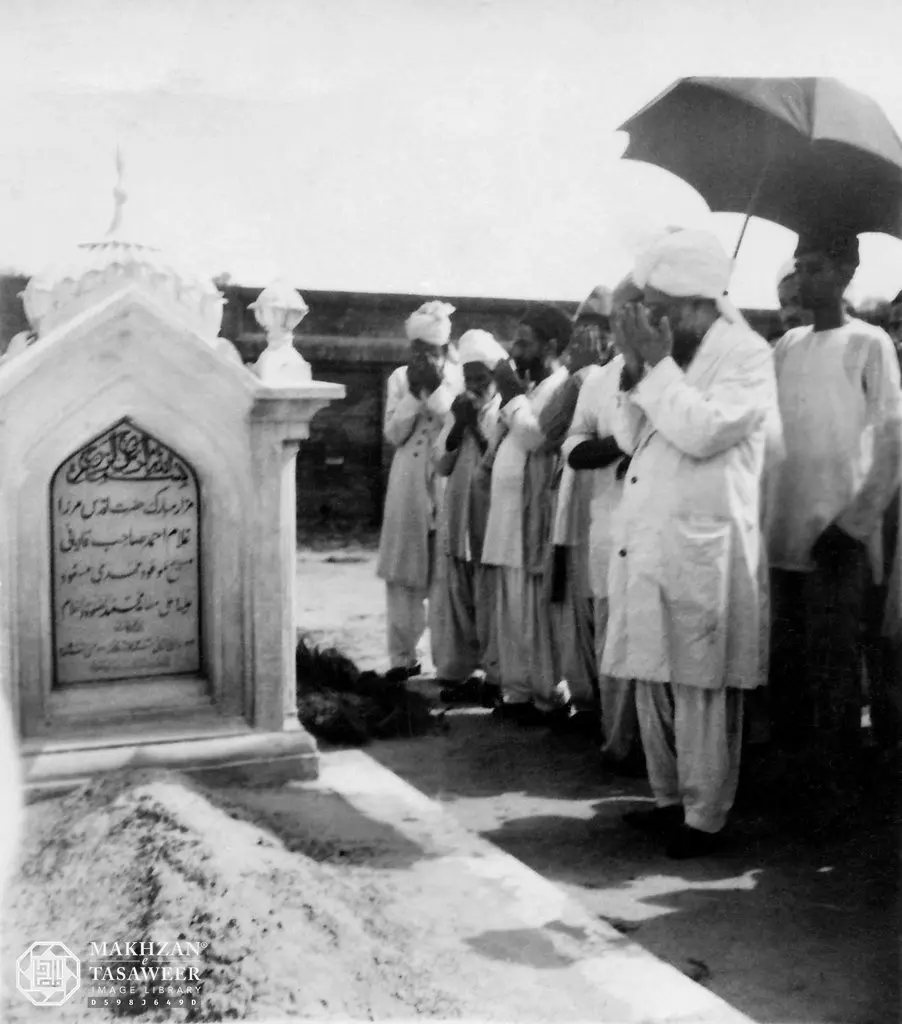
Someone from India asked Hazrat Amirul Momineen, Khalifatul Masih V (aa), whether, when visiting the grave of the Promised Messiah (as), one could also pray to God Almighty for worldly needs, such as success in examinations or blessings in business.
Huzoor-e-Anwar (aa) provided the following guidance in his letter dated 15 April 2024:
“The places where righteous and holy people, and those sent by God Almighty, are buried are also places where His grace and mercy descend. Therefore, when praying at such places, one should first praise and glorify God Almighty. For this purpose, Allah the Exalted has bestowed upon us such a great surah as Surah al-Fatihah.
“One should then invoke blessings and salutations of peace upon the benefactor of humanity, the Holy Prophet Muhammad, the Chosen One (sa), as every believer has been commanded to do. (Surah al-Ahzab, Ch.33: V.57)
“Next, pray for the elevation of the spiritual ranks of the revered persons buried there. Also pray, ‘O Allah, keep their followers steadfast in the virtues and teachings they brought.’ Then offer prayers for spiritual and worldly blessings for yourself and ask Allah the Exalted for whatever you wish. There is no harm in this.
“To guide members of the Jamaat, Hazrat Musleh-e-Maud (ra) delivered an address entitled Mazar Hazrat Masih-e-Maud Par Du‘a aur Is Ki Hikmat, which has been published in book form. In this address, Huzoor (ra) drew the attention of Jamaat members to many important matters. You should read it as well. Describing his own practice in prayer, he states:
“‘I shall describe my own practice. Whenever I come to the grave of the Promised Messiah (as) to pray, my established practice is first to pray for the Holy Prophet (sa) and then for the Promised Messiah (as). This is the prayer I offer:
“‘“O Allah! I possess nothing that I can present as a gift to these revered personages. Whatever I possess cannot benefit them. Thou, however, possessest all things. I therefore pray and beseech Thee that, out of Thy kindness to me, Thou bestow upon them, on my behalf, a gift in Paradise such as they have never received there before.”
“‘They then surely ask, “O Allah! From whom has this gift come?” When God tells them, they pray for that person, and in this way the spiritual ranks of the person offering the prayer are also raised. This is established by the Quran and the Ahadith. It is an established principle of Islam, which no one can deny, that prayers certainly benefit the deceased.
“‘The Holy Quran, too, draws attention to this through the words فَحَيُّوا بِأَحْسَنَ مِنْهَا, “greet ye with a better prayer” [Surah an-Nisa’, Ch.4: V.87]: when someone presents you with a gift, give them a better gift in return or at least give them as much as they gave you.
“‘In accordance with this Quranic verse, when we pray for the Holy Prophet (sa) or the Promised Messiah (as) and invoke blessings and peace upon them, God Almighty will, as a result of that prayer, bestow a gift upon them on our behalf. We do not know all the blessings that exist in Paradise, but Allah the Exalted knows them well.
“‘Therefore, when we pray, ‘O God! Bestow upon the Holy Prophet (sa) a gift such as he has never received before,’ it necessarily follows that, when the gift is bestowed upon him, Allah the Exalted will also inform him that it is a gift from such-and-such a person.
“‘How, then, could he remain silent after learning this and not pray for the person who sent the gift? At such a moment, his soul will spontaneously fall in supplication at Allah the Exalted’s threshold and say, “O God! Now grant this person, on our behalf, a better reward.”
“‘In this way, in accordance with فَحَيُّوا بِأَحْسَنَ مِنْهَا, “greet ye with a better prayer”, that prayer will return to the person who invoked blessings and will become a means of raising their spiritual rank. This, then, is a means by which both we ourselves and the Jamaat can benefit, without any act of associating partners with Allah [shirk] being involved.’
(Mazar Hazrat Masih-e-Maud Par Du‘a aur Is Ki Hikmat, Anwar-ul-Ulum, Vol.17, pp. 182-183)
“Thus, it is permissible to visit the graves of the righteous and pray to Allah the Exalted for those revered persons, as well as to offer various supplications to Allah the Exalted alone for one’s own spiritual and worldly progress and the attainment of blessings. This does not constitute shirk in any way.
“However, petitioning those revered persons, asking them to fulfil one’s wishes or believing that those buried there can fulfil our wishes are all acts of shirk and sin.”
(Submitted by Ehsan Ahmad, Murabbi-e-Silsilah, Private Secretariat, Islamabad and translated by Al Hakam)