
Hazrat Maulana Jalaluddin Shams (ra) (1901-1966)
War and destruction
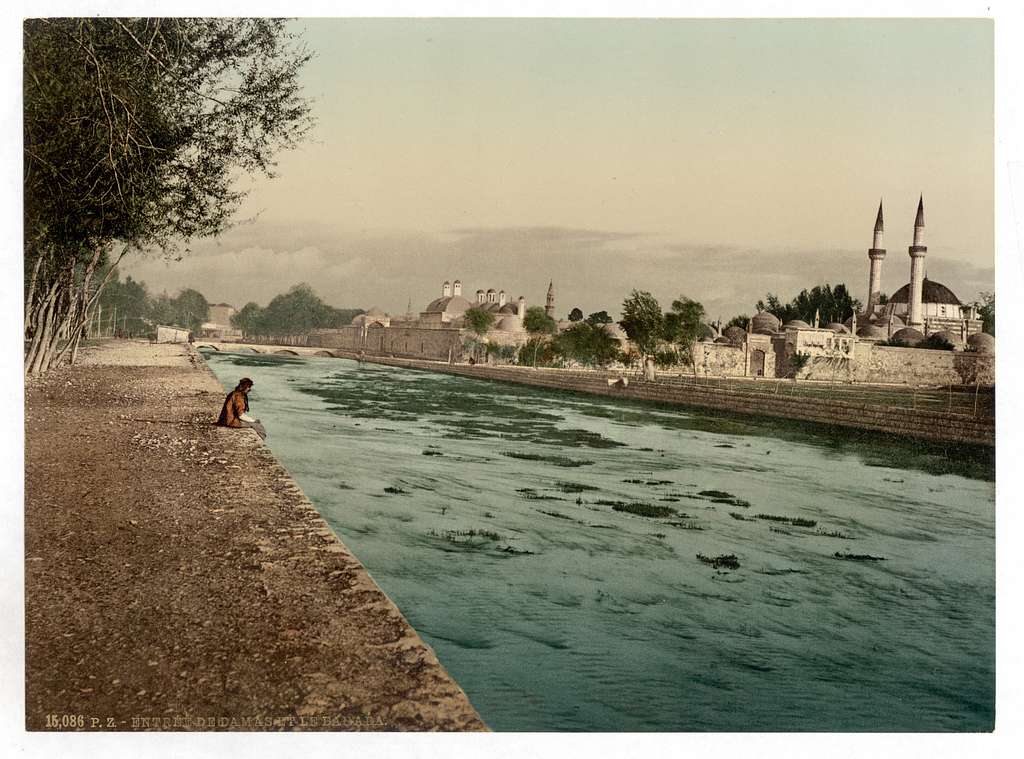
Thus far, the situation in Damascus remains unchanged. The war continues, and there appears to be no prospect of peace. All the former members of the government have been placed under arrest and sent away somewhere, while new members have been appointed. Other prominent people are also being detained. Bunkers have been constructed throughout the city and cannons thunder daily.
‘I see cities falling and habitations in ruin’
The Promised Messiah (as) had said, “I see cities falling and habitations in ruin”; thus, we witnessed this scene with our own eyes. Entire neighbourhoods in Damascus were demolished and reduced to heaps of dust, while the settlements surrounding Damascus were ruined.
The revelation concerning the calamity of Damascus
In this way, the revelation concerning the “calamity of Damascus” was fulfilled as clearly as the midday sun. The word “calamity” indicated that the affliction would not last merely a day or two, but would endure for a considerable period, and so it proved to be.
Other prophecies fulfilled through this war
This was not the only revelation. Other revelations were also fulfilled through this event, among which our beloved master, Hazrat Khalifatul Masih II [ra] recorded in Tuhfa Amir-e-Kabul [Da’watul Amir]. They are as follows:
آتش فشاں۔ مصالح العرب۔ مسیر العرب۔ عفت الدیار کذکری
That is, following the great war, avenues would emerge for the Arabs, the pursuit of which would prove beneficial to them and the Arabs would leave their homes. Their homes would be blown apart in the same manner as My [God’s] mention was erased from there.
The ‘volcanic eruption’ and the Arab awakening
Explaining this, Hazrat Musleh-e-Maud [ra] stated:
“The revelations indicate that a volcano will erupt and the interests of Arabia will be connected with it and they will leave their homes. This subject cannot, by any means, be applied to a physical earthquake. It is therefore clear that the ‘volcano’ refers to that hidden fervour in the dispositions which will erupt in response to an event. At that time, the Arabs too will realise that remaining silent is contrary to their interests and they will leave their homes and take advantage of the opportunity.”
The Arabs turning towards national progress
Similarly, among the revelations of the Promised Messiah (as) recorded in Tohfa Shahzadah Wales [A Present to His Royal Highness – The Prince of Wales] is the following revelation:
“The Arabs would strive for their national progress.”
The hidden fervour that erupted
Thus, all these prophecies were fulfilled by the grace of Allah the Almighty. The cause of this war was precisely that hidden fervour in the dispositions which erupted in response to a single event. The event was that the chief of Jabal al-Druze, in accordance with the wishes of the people of Druze, sought the replacement of the French ruler of Jabal al-Druze.
The revolt in Jabal al-Druze
However, the French governor dealt with the matter harshly and paid no attention to his request. As a result, the hidden fervour against the government that existed in the dispositions erupted like a volcano and the whole of Jabal al-Druze turned against the government. Then the people of Syria also responded to their call and left their homes. Houses were destroyed and a war for independence began.
Thus, through the present war, the aforementioned revelations of the Promised Messiah (as) were fulfilled to the letter.
Obstacles to tabligh
As conditions continued to deteriorate, obstacles to tabligh [preaching] increased. Perhaps some friends are unaware of the religious conditions here.
There is no lecture hall where religious lectures can be delivered, nor are religious lectures given here and there is no public dars gah [religious institution] where lessons could be conducted.
As for the mosques, they are the retreats or estates of the religious leaders, upon which they depend for their livelihood. They regard the mosque not as the House of God, but as their own personal property and they do not fear the warning:
وَمَنۡ اَظۡلَمُ مِمَّنۡ مَّنَعَ مَسٰجِدَ اللّٰہِ اَنۡ یُّذۡکَرَ فِیۡہَا اسۡمُہٗ وَسَعٰی فِیۡ خَرَابِہَا
“And who is more unjust than he who prohibits the name of Allah being glorified in Allah’s temples and seeks to ruin them?” (Surah al-Baqarah, Ch.2: V.115)
No one can say anything in refutation of their unreasonable beliefs. It is an incident from two years ago that Sheikh Rashid Rida, editor of Al-Manar in Egypt, came here. At the request of some people, he delivered a lecture on a religious matter in the Umayyad Mosque. Some point in it was contrary to the views of the religious leaders of Damascus. They created an uproar over it and incited the ignorant against him, who became ready to attack him. There were also some newly educated young men present. With great difficulty, they rescued him and took him away from there.
Absence of religious newspapers
There is no religious newspaper in which religious articles can be published. There are dozens of newspapers and magazines in the region of Syria, but they all discuss politics or are humorous publications, such as the Panj Akhbar in Urdu.
I asked the editors why they did not publish a religious newspaper. They replied that no buyers could be found. This shows how far these people have drifted from religion.
Moreover, the managers and editors are such that they refrain from publishing religious articles. Only a few days ago, I changed my residence and an announcement was required. It contained a sentence stating that anyone wishing to discuss religious matters could come to our residence, regardless of their religion. According to the prescribed rate, the announcement would have cost approximately one rupee, but the manager said that since the announcement was religious in nature, its charge would be one pound. I therefore had the announcement published in another newspaper.
Prejudice and blind following
I had the opportunity to speak with some of the religious leaders. Some among them are extremely prejudiced and blind followers. Some were found to be completely devoid of faith. Apparently, they affirm that the Holy Prophet (sa) is true and that the Holy Quran is the Word of Allah, but when one probes a little deeper and asks questions, their hearts are found to be completely devoid of faith. Those among them who are righteous are very few in number and they are afraid of the other religious leaders.
The newly-educated
Approximately 80 per cent of the newly-educated group are such as have an aversion to religion and regard religious matters with ridicule and derision. Most of them are materialists and call themselves Muslims only because their forefathers were Muslims.
A conversation with a secularist
For instance, a young man who had been educated in Paris said during a conversation that he was a secularist and was called a Muslim because his parents were Muslims. I asked him why he had abandoned Islam and adopted the secular belief. What quality had he found in it that was not found in Islam? He said that there is prejudice in the religion of Islam, whereas the secular belief regards prejudice as wrong, does not repay evil with evil and enjoins good treatment.
I told him, “You have made a great mistake by leaving Islam. Before going to others, you should have investigated at home whether the thing for which you were going to someone else was already present in your own home or not.”
The Holy Quran has presented this teaching in the best possible manner. Allah the Almighty says:
لَا یَنۡہٰٮکُمُ اللّٰہُ عَنِ الَّذِیۡنَ لَمۡ یُقَاتِلُوۡکُمۡ فِی الدِّیۡنِ وَلَمۡ یُخۡرِجُوۡکُمۡ مِّنۡ دِیَارِکُمۡ اَنۡ تَبَرُّوۡہُمۡ وَتُقۡسِطُوۡۤا اِلَیۡہِمۡ ؕ اِنَّ اللّٰہَ یُحِبُّ الۡمُقۡسِطِیۡنَ
[“Allah forbids you not, respecting those who have not fought against you on account of your religion, and who have not driven you forth from your homes, that you be kind to them and act equitably towards them; surely Allah loves those who are equitable.” (Surah Al-Mumtahinah, Ch.60: V.9)]
Look, in this verse, good treatment towards people of other religions has also been enjoined. Then God says:
اِدۡفَعۡ بِالَّتِیۡ ہِیَ اَحۡسَنُ فَاِذَا الَّذِیۡ بَیۡنَکَ وَبَیۡنَہٗ عَدَاوَۃٌ کَاَنَّہٗ وَلِیٌّ حَمِیۡمٌ
[“And lo, he between whom and thyself was enmity will become as though he were a warm friend.” (41:35)]
If someone causes you harm, you should repel it in the best manner. By adopting this approach, the benefit will be that the person who was previously your enemy will, upon witnessing your kind treatment, become a sincere and compassionate friend.
Then, in the Holy Quran, Allah the Almighty judges between two religiously prejudiced groups and says:
وَقَالَتِ الۡیَہُوۡدُ لَیۡسَتِ النَّصٰرٰی عَلٰی شَیۡءٍ ۪ وَّقَالَتِ النَّصٰرٰی لَیۡسَتِ الۡیَہُوۡدُ عَلٰی شَیۡءٍ ۙ وَّہُمۡ یَتۡلُوۡنَ الۡکِتٰبَ ؕ کَذٰلِکَ قَالَ الَّذِیۡنَ لَا یَعۡلَمُوۡنَ مِثۡلَ قَوۡلِہِمۡ ۚ فَاللّٰہُ یَحۡکُمُ بَیۡنَہُمۡ یَوۡمَ الۡقِیٰمَۃِ فِیۡمَا کَانُوۡا فِیۡہِ یَخۡتَلِفُوۡنَ
[“And the Jews say, ‘The Christians stand on nothing;’ and the Christians say, ‘The Jews stand on nothing;’ while they both read the same Book. Even thus said those who had no knowledge, like what they say. But Allah shall judge between them on the Day of Resurrection concerning that wherein they disagree.” (Surah al-Baqarah, Ch.2: V.114)]
That is, the Jews, because of religious prejudice, say that there is no virtue in the Christians, while the Christians, in opposition to them, say that there is no virtue in the Jews. Allah the Almighty says that both are mistaken. At the very least, they acknowledge one Book, the Torah, so why do they completely deny one another’s virtues?
Allah the Almighty says that ignorant people, who possess religious prejudice, are those who deny the virtues of others. This demonstrates the purity of the underlying principle. Thus, Islam does not teach prejudice; rather, it removes it. If anyone displays prejudice, it is their own error.
The general public
The third group consists of the general public, the ignorant, who are generally followers of the religious leaders and regard them as lords besides Allah. Among them is a group consisting of traders and professionals, some of whom are educated. Among all of them, if there were any possible means of preaching, it would be through gatherings and tracts.
During the day, most people are occupied with their work. At night, there is a custom here of remaining awake until late and gatherings are held in homes. However, ever since this war began, martial law has been in force. For this reason, no one can leave their home at night.
Difficulties in distributing religious literature
Tracts also cannot be published because military law is in force. No tract, newspaper or magazine can be printed by the printers without being reviewed by the director of publications and under the prevailing circumstances, the director of publications does not permit religious tracts to be published under military law on the grounds that they would cause an uproar.
Under these circumstances, members of the Jamaat can estimate how conveying the message [of Islam Ahmadiyyat can be a really challenging task…]. – Jalaluddin, Damascus
(Translated by Al Hakam from the original Urdu, published in the 3 August 1926 issue of Al Fazl)