
Tahmeed Ahmad and Awwab Saad Hayat, Ahmadiyya Archive & Research Centre
At the Ahmadiyya Archive & Research Centre, we are always on the lookout for historical accounts that shed light on the early days of the Ahmadiyya Muslim Jamaat. Recently, we came across a fascinating piece in an Egyptian weekly magazine, Misr Al-Hadithah Al-Musawwarah, edited by Tawfiq Al-Bazji, published on 19 February 1930 (Vol. 3, Issue No. 33, pp. 5-6).
This article offers a rare glimpse into the day-to-day activities of Hazrat Maulana Jalal-ud-Din Shamsra, a devoted missionary of the Ahmadiyya Muslim Jamaat. Known for his pioneering efforts, he not only helped establish the Jamaat’s chapters in Damascus and Haifa, but also spent nearly five months in Egypt (7 December 1929 – 1 May 1930), where he worked tirelessly to spread the message of Islam Ahmadiyyat, support new converts, and strengthen the faith of local Ahmadis.
Let’s experience this unique moment in history through the words of an eyewitness account from nearly a century ago. Misr Al-Hadithah Al-Musawwarah reports as follows:
The article
I attended a literary gathering to listen to a sermon on morality, the subject of which was the supreme ideal of friendship. That gathering included a large crowd of people from all races and continents of the world. This is not surprising, as Cairo – and Egypt along with it – is the mother of wonders.
At the end of the gathering, the customary exchange of greetings took place among the attendees. The American lady singer approached, shaking hands with the attendees as an encouragement for their participation. She extended her fair hand to an Indian man from Punjab. The man responded to the lady’s gesture with great courtesy, but he withdrew his hand and refused to shake hers with his right hand.
Our astonishment was no less than that of the refined lady, who, for the first time in her life, encountered an Eastern man who refused to shake her hand.
The man was neither rude nor fanatical, nor was he ignorant. On the contrary, he was a well-mannered individual with a pleasant demeanour, noble character, bright eyes, a beautiful soul, a smiling face, and a gentle nature.
So why did he refuse to shake her hand?
We raised this question to him in a simple, inquisitive manner, and he answered:
“It is not permitted in my faith to shake hands with a lady.”
This response surprised us more than before, and we asked him:
“So what is your faith?”
He replied, “I am an Ahmadi.”
We asked, “Are you a Muslim?”
He said, “Yes, praise be to Allah.”
We said, “But Muslims shake hands with women and respect them.”
He said, “And I respect them, but in my faith, it is not permissible to shake hands with them.”
I asked, “Which sect do you belong to?”
He then added, “I am an Ahmadi.”
I assumed he was an Ismaili, a follower of Aga Khan.
So I asked him, “Are you an Ismaili?”
He smiled and said, “No, I am a Muslim.”
I asked, “Then how do you say you are an Ahmadi?”
He replied, “I am from the Ahmadiyya sect.”
We asked, “And what is this sect?”
He said, “The followers of Ahmadas: the Messiah.”
The combination of these two words – Ahmad and Messiah – amused us greatly when referring to a single person.
So we asked him, “Is Ahmad the Messiah one historical figure?”
He said, “Yes.”
We asked, “Where was he born and when?”
He replied, “He was born in Qadian, Punjab, in the year 1836 [sic., 1835].”
I asked, “Is he merely a human?”
He replied, “Of course, he is just a human.”
We asked, “Then how do you claim that he is the Messiah?”
He replied, “He is the awaited Messiah.
“He is the one whom people call the Mahdi, who is destined to appear in the last days, reform religion, spread justice, and guide people back to the right path.”
I was astonished by this matter and wanted to learn more about this strange news. We agreed to meet again, and the next day, we gathered at a café. The notebook was in front of me on the table, next to the cups of tea and a milk jug.
The man then began recounting astonishing details about the birth of Mirza Ahmadas, the Messiah – how he prophesied, how people gathered around him, and how the Ahmadiyya sect was organised. He showed me some of its books and explained some of its doctrines.
That evening, I was at the American missionaries’ temple in Azbakeya, where public speeches were permitted. Suddenly, I saw the same man standing on the podium, responding to the Christians with arguments as powerful as a torrential flood. He recited verses from all the books of the sacred scriptures fluently, without hesitation, and compared them like a great theologian. He analysed them in a way that supported his views, delivering one of the most beautiful interpretations of Quranic verses I had ever heard in my life.
All of this was surprising to me.
Even more astonishing was the fact that these people did not accept large payments for their preaching.
And that they maintained unity despite the presence of potential disputes.
And that they refused to shake hands with women, no matter who they were.
And that they did not practice polygamy except for compelling reasons.
And that they believed in the continuity of prophethood even today and beyond.
And that they believed their message would spread across the world.
I asked, “In which parts of the world is your message spreading?”
He replied, “In all parts of the world.”
I asked, “Do you have missionaries in London?”
He said, “Of course.”
“In London, England?”
“Yes, in London, England.”
“And has it yielded results?”
“How could it not, when we have established the first mosque in the capital of England?”
I asked, “Was it built by you or by Muslims?”
He replied, “We are the Muslims.”
Then he began telling the story of the mosque:
“It was built with funds collected by devoted women who believed in Ahmadas, the Messiah. When this Ahmadiyya mosque was established, it was decided that it would be inaugurated with a grand ceremony. Prince Faisal, son of King Abdulaziz of Saudi Arabia, was invited to deliver a speech at the inauguration. He wrote to his father, King Saud, informing him of the event. His father was very pleased, but our opponents alerted him that this was an abomination. He then wrote back to his son, forbidding him from participating because the mosque was not exclusively for Muslims but was open to people of other faiths as well.
We explained to the prince that, according to Wahhabi principles, the mosque welcomed all who worshipped ‘God alone.’ The phrase ‘God alone’ moved the heart of the King of Hejaz.
He saw that he could not forbid his son from dedicating a mosque that was open for the worship of God alone.
I asked, ‘So did he attend?’
The king wrote again to his son, Prince Faisal, giving him the authority to decide whether or not to speak at the mosque’s inauguration. However, the prince hesitated, fearing that some Muslim scholars might disapprove. For this reason, he did not deliver the speech.”
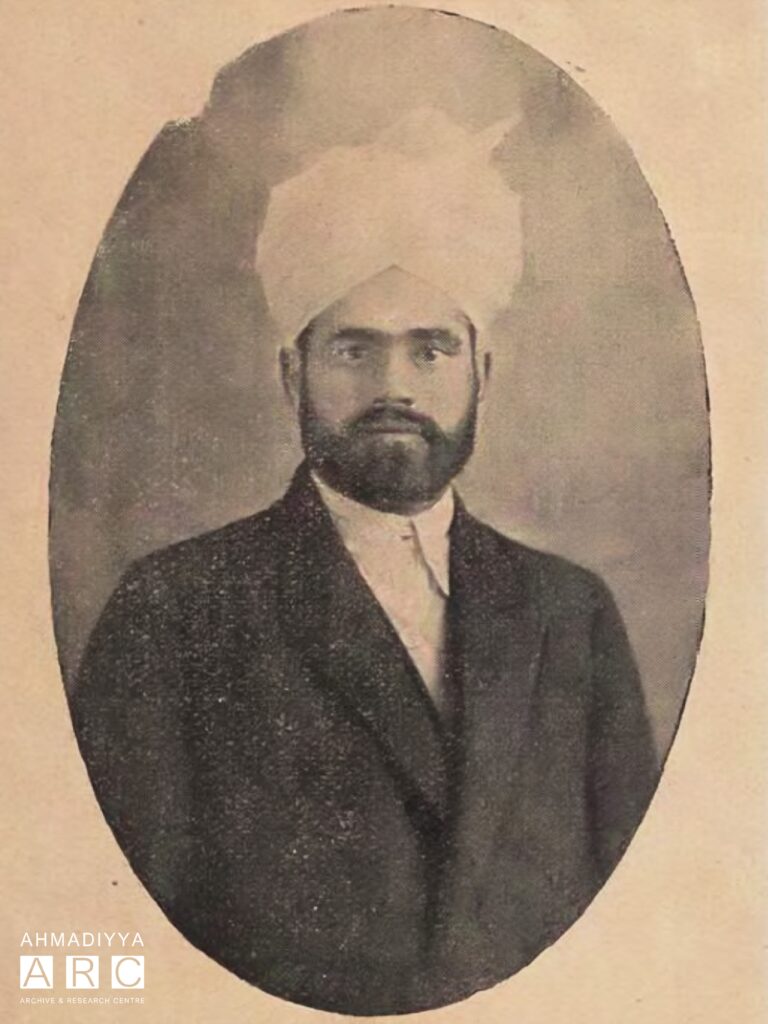
I then learned from him that his name was Jalal al-Din Shams, the man in the photograph, and that he was 29 years old. He inherited Ahmadiyya from his father – not because he was born Ahmadi, but because his father embraced the faith while he was still an infant. Thus, he grew up as an Ahmadi from childhood.
He said, “At the age of twenty-five, I was in Syria preaching Ahmadiyya. Scholars and dignitaries rose against me and sought to expel me from the country, but they failed. I remained there for over two years, and I have more than fifty students there who believe in Ahmadiyya and in the prophethood of Mirza Ghulam Ahmadas, who is Ahmad the Messiah.”
“Then I went to Haifa, where I stayed for over a year. There, I also had a similar number of followers. And today, I am in Egypt for the same purpose.”
I asked, “Do you truly believe that all people will follow your movement?”
He said, “Indeed, our message will spread to all nations of the earth.”
I asked, “And what is your evidence for this?”
He cited a verse, which they claim to be a prophecy revealed by God to Mirza Ghulam Ahmad, the Messiah, in which God tells him that his message will spread across all nations of the earth.
I asked, “Do you believe in this prophecy?”
He said: “Absolutely. It is not merely a prophecy of Ahmadas the Messiah – it has been fulfilled in every detail. And this prophecy will continue to be fulfilled in the near future. Soon, everyone will come to know the Lord and His true religion, which was brought by Jesusas and Muhammadsa and completed by Ahmadas the Messiah, who united both missions. He is destined to bring all religions together under his teachings.”
This faith is now spreading across all parts of the world – in England, France, America, and many parts of Asia and Africa. They are gaining followers from both Christians and Muslims. They have a well-organised system, a strong religious bond, and they hope to lead the most educated and elite members of society to their beliefs in many advanced nations.