
Annual Jalsa of Ceylon Jamaat
On 29 December 1925, the annual gathering of the Ahmadiyya Jamaat Ceylon was held in Colombo, one of the well-known cities of the island. Ahmadi members assembled from Gampola, Negombo, Kandy, Chilaw and other towns. The venue selected for the gathering was the spacious residence of a sincere member, Mr TK Lai (Tabligh Secretary). Non-Ahmadi guests also attended the proceedings. Arrangements for purdah were made for women.
The first session was held under the chairmanship of O Abdul Majeed Sahib, Editor of Tutan. In this session, Brother Muhammad Sadiq Sahib delivered a reasoned address on the truthfulness of the Promised Messiahas. Thereafter, this humble one (DK Mach) spoke on the same subject. Following this, Maulvi AP Ibrahim Sahib delivered a lecture on the excellences of Islam. Subsequently, Abdul Aziz presented, in the Tamil language, a translation of an address of Hazrat Khalifatul Masih II[ra] on the subject of national character. This was followed by a Tamil tract presented by a sixteen-year-old boy named Muhammad Ibrahim. The session then concluded and guests were served a meal at around 2 pm.
The second session commenced under the chairmanship of Muhammad Abu Bakr Sahib, in which ALM Muhyiddin Sahib, a student named Abdul Bari and Habibullah Khan Sahib delivered speeches.
The third session was held between Maghrib and Isha under my chairmanship of this humble one. Addresses were delivered by O Abdul Majeed Sahib, Muhammad Abu Bakr Sahib, Maulvi Ibrahim Sahib and G Bustan Khan Sahib. Mr TK Lai then expressed thanks to the audience, after which the gathering concluded with a silent prayer. – DK, Mach Ahmadi (Brother)
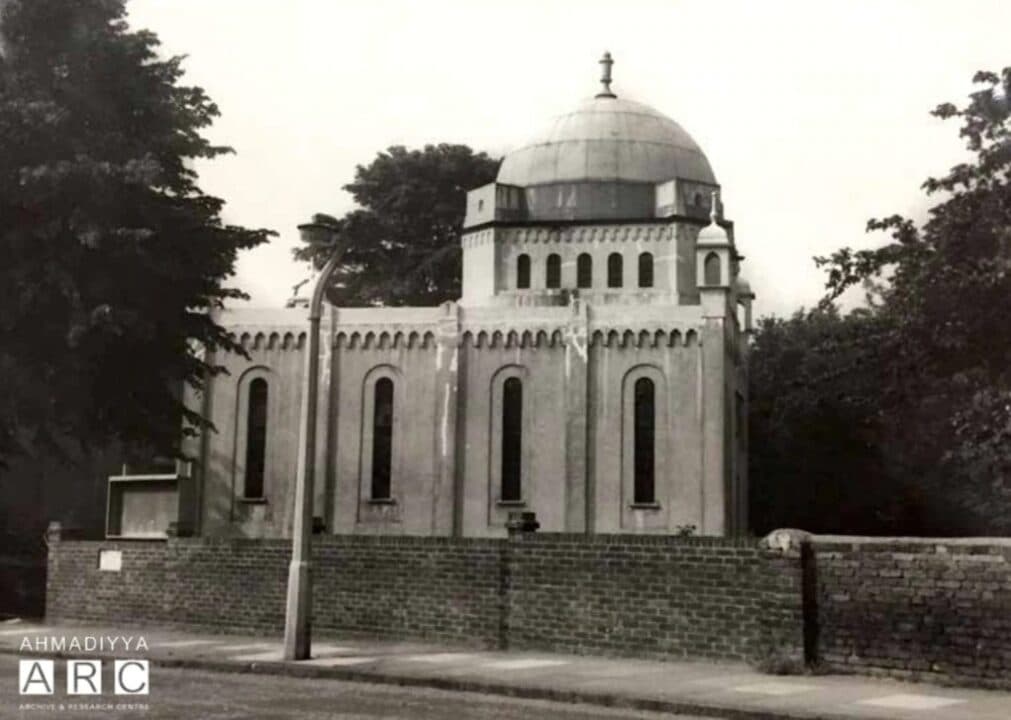
The first mosque in London
The Pioneer, an English-language newspaper of Allahabad, in its issue of 20 January 1926, quoting the Sunday Express, wrote:
“In a garden at Southfields, near Wimbledon, the first mosque to be constructed in London is gradually rising. It is being built by the Ahmadiyya Muslim Community for religious purposes. At present, the total number of Muslims in England is estimated to be around one thousand souls, the majority of whom are English Muslims. In the architectural design of the mosque building, there is (as yet) no minaret from which a muezzin may ascend to call the faithful to prayer; rather, the call to prayer will be given from the entrance hall of the mosque.”
By the grace of God Almighty, the construction of the Ahmadiyya Mosque in London is becoming a source of particular renown for the Jamaat and it is hoped that, through its blessings, it will also produce eminent results in the propagation of Islam.
The sincerity of new English converts
Hazrat Maulana Abdur Rahim Dardra(1894-1955)
All praise belongs to Allah, then again, all praise belongs to Him, that Mr William Barker – whose acceptance of Islam has already been reported in Al Fazl – came to London last week and formally declared his adherence to Islam.
In Europe, there are many who associate themselves with Islam; however, the spirit of sacrifice for the sake of Islam is entirely absent in them. The sincerity that our new brother possesses for Islam and for Ahmadiyyat may be gauged from the following letter, which he wrote to Malik Ghulam Farid Sahib[ra] after returning from London. His devotion is not confined merely to verbal expression; rather, immediately upon professing Islam, he contributed two pounds as a financial contribution [chanda]. At the time, he stated – and has also written subsequently in his letter – that he would continue to offer regular contributions from his income in the future. This friend serves as a second engineer on a ship.
Another of our Muslim brethren is Mr Plant of Manchester, who likewise contributes his chanda regularly. Perhaps this may appear an ordinary matter to the devoted servants of the Promised Messiahas in India; yet those who are acquainted with the conditions of Western countries know well the degree of attachment that exists there to wealth. In such circumstances, for individuals to contribute regularly is not possible without genuine sincerity.
Regarding the first part of the Holy Quran, which had been presented to him, he (Mr William Barker) writes that it is a treasury of knowledge and that within the few pages he has thus far studied, he has learned many commandments of Islam. He further writes that whenever he returns from his voyages, he will certainly come to London and join the prayers there. Owing to his occupation as an engineer on a ship, he remains at sea most of the time, returning home only for a few days every month or two.
Wassalam, Dard.
Letter of Mr William R Barker to Malik Ghulam Farid MA
“My dear brother,
“I am studying the English copy of the Holy Quran, which you so kindly presented to me and it is, in reality, a most excellent translation of the Holy Book. Although it may not be appropriate for me to compare the contents of this sacred scripture with any other book, yet if its English translation be set alongside the translation of the Bible commissioned by King James or even compared with the literary works of the renowned English author Shakespeare, I still find it superior to them. It is, indeed, a complete masterpiece of English literature.
“Through its study, I have gained, far more than from the many books I have previously read, a true understanding of Islam as taught by the Ahmadiyya Jamaat. I am astonished that anyone who has had the opportunity to read this commentary of the Holy Quran could deny that it is the Word of God or hesitate to act in accordance with its teachings.
“I am convinced that if certain selected portions of it, together with its commentary, were published in the form of small tracts, it would serve as an excellent means for the exaltation of the Word of God and would greatly help in calming the fervour of opposition that is generally directed against Islam.
“Even Surah al-Fatihah alone, if issued in the form of a tract, would constitute a most magnificent publication. Apart from the supplication of Jesus, son of Mary – known as the Lord’s Prayer – nothing can equal its beauty, grandeur and majesty; and, to speak truthfully, even that appears inferior before it. If a person were to read, with sincerity, the linguistic and spiritual excellences of this Surah, he would find himself more spiritually enriched than by the Lord’s Prayer; and if anyone were to reflect upon its meanings with a pure heart, he would surely discover that the message of Jesusas of Nazareth, the Holy Prophet Muhammadsa and Hazrat Mirza Ghulam Ahmadas were one and the same – that all of them were guides leading mankind towards God.
“For my future life, I make this pledge: that I shall strive earnestly to become a worthy member of the Ahmadiyya Jamaat. As soon as my ship reaches England, I shall discharge all outstanding chanda contributions incumbent upon me in accordance with the salary I shall have received up to that time. Moreover, I shall endeavour to learn all the noble teachings of Islam while I am there.
“Whatever I have written at present – or have written from time to time in my previous letters – if it may in any way be useful to you, you are at liberty to use it as you wish. I feel no embarrassment in this matter; rather, I derive true happiness from the world coming to know that I have accepted Islam and entered the Ahmadiyya Jamaat.
“When next I have the honour of paying a visit, I am confident that I shall be able to offer the prescribed prayers in the mosque, for four months still remain before my arrival and I believe that by then the mosque will have been completed.
“Your brother in faith, William R Barker.”
(Translated by Al Hakam from the original Urdu, published in the 5-9 & 26 February 1926 issue of Al Fazl)