
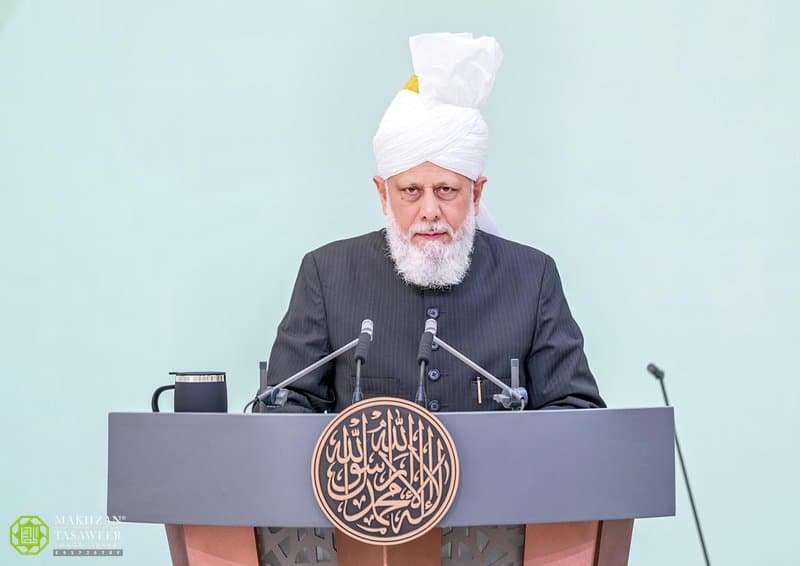
After reciting the tashahhud, ta’awwuz and Surah al-Fatihah, Hazrat Khalifatul Masih V (aa) stated:
While describing the life and character of the Promised Messiah (as), Hazrat Sheikh Yaqub Ali Sahib Irfani (ra) writes that another aspect of the generosity and beneficence of the Promised Messiah (as) is manifest in his life, which is demonstrated by his personal assistance and recommendations.
At times, someone would come to him seeking assistance with a matter that was beyond his power to resolve, as it depended on others. In such cases, he would gladly recommend even such individuals for the person’s benefit, whom he would never approach for a personal matter. In other words, while he would request others to help someone [in need], he would never ask them to do anything for him personally. He writes that this is such a noble and sincere quality that it is very rarely found in the world.
Mentioning Mirza Imamuddin Sahib, he further writes that it is no secret that he was a fierce opponent of this Jamaat and harboured enmity towards the family of the Promised Messiah (as). Nevertheless, the Promised Messiah (as) would always overlook his enmity in worldly matters. It was different in religious matters, as the Promised Messiah (as) would not tolerate his enmity toward him in matters of faith. However, in worldly matters, he remained unconcerned. In other words, regarding his treatment with kindness, the Promised Messiah (as) made no distinction. On many occasions, he sought financial assistance from the Promised Messiah (as), yet despite these favours, he continued his opposition and remained a bitter enemy.
On one occasion, he wished to sell a horse and thought the best opportunity would be to send it to Jammu and sell it through Hazrat Hakeem Maulvi Noor-ud-Deen Sahib, Khalifatul Masih I (ra), to secure a reasonable price. Hazrat Khalifatul Masih I (ra) was acquainted with the rulers and chiefs there, who might purchase the horse. With this proposal in mind, Mirza Imamuddin personally requested the Promised Messiah (as) to write a letter of recommendation to Hazrat Maulvi Noor-ud-Deen Sahib (ra). The Promised Messiah (as) did not reject this request and without any hesitation, he gave him a letter of recommendation addressed to Hazrat Maulvi Sahib (ra).
He writes that it is clear that the enmity and hostility of Mirza Imamuddin were no secret. However, whenever the opportunity presented itself to act with virtue and kindness, the thought of his enmity never crossed the mind of the Promised Messiah (as), and he never hesitated in helping him. (Sirat Hazrat Masih-e-Maud [as], Vol. 2, pp. 296-297)
The letter that the Promised Messiah (as) wrote to Hazrat Maulvi Noor-ud-Deen Sahib (ra) was as follows:
بِسْمِ اللّٰہِ الرَّحْمٰنِ الرَّحِیْمِ۔ نَحْمَدُہٗ وَنُصَلِّیْ عَلٰی رَسُوْلِہِ الْکَرِیْم
[“In the name of Allah, the Gracious, the Merciful. We glorify Him and send blessings upon His noble Messenger (sa).]
“My revered and honoured brother, Maulvi Hakeem Noor-ud-Deen Sahib. May Allah the Almighty protect you.
اَلسَّلَامُ عَلَیْکُمْ وَرَحْمَةُ اللّٰہِ وَبَرَکَاتُہٗ
“[May the peace, mercy and blessings of Allah be on you].
“The purpose of writing this letter is to trouble you with a request. I hope you will not withhold your attention and earnest efforts in this matter. (He placed great attention and emphasis on this.) And that is that Mirza Imamuddin Sahib, who is my paternal cousin, owns a valuable horse that is swift and worthy to be the mount of rulers and chiefs. He now wishes to sell it. Since ordinary people cannot afford such an expensive horse, while chiefs are often in search of such animals, I request that you kindly inform the Raja of Jammu or one of his brothers and make every effort to persuade them to purchase the horse at a fair price. If they seriously intend to buy it, the horse will be sent to you. After making your utmost efforts, please inform me of the outcome.
“Wassalam.
“Humbly,
“Mirza Ghulam Ahmad.” (Sirat Hazrat Masih-e-Maud [as], Vol. 2, pp. 297-298)
This incident took place in 1888. Although Mirza Imamuddin had already become hostile, the Promised Messiah (as) had not yet made his claim [of being the Messiah]. Nevertheless, in this manner he even assisted his hostile brother.
Hazrat Sheikh Muhammad Naseeb Sahib (ra) relates:
“At one time, I was living in a rented house owned by Sikh carpenters. It was situated next to the residence of Mirza Nizamuddin Sahib, the village head. Over some issue, the landlady unnecessarily picked a quarrel with me and demanded that I vacate the house. I replied, ‘We have a written tenancy agreement on stamped paper, and I am paying the rent due, so I will not leave the house.’
“She sought the support of Mirza Nizamuddin Sahib in the matter. Through Khairuddin Sahib, the village watchman, he repeatedly summoned me. Sometimes I went, and sometimes I did not. In any case, they wanted to intimidate me into leaving the house by creating trouble, but I refused to vacate it.
“Mirza Nizamuddin Sahib then sought the assistance of Sheikh Yaqub Ali Sahib. Sheikh Sahib advised me, ‘It would be better if you vacated the house.’ At that time, however, a daughter had just been born to me, making it very difficult to move. I mentioned my situation to Hazrat Maulvi Noor-ud-Deen Sahib. Maulvi Sahib became upset with Sheikh Yaqub Ali Sahib and wrote to him, saying, ‘First arrange another house for him, and only then ask him to vacate this one.’ After Maulvi Sahib expressed his displeasure, Sheikh Sahib remained silent, but Mirza Nizamuddin continued pressing me to leave.
“Eventually, I wrote the entire matter to the Promised Messiah (as). He was deeply grieved and said, ‘Reading your letter has caused me great distress. If I had a vacant house, I would certainly give it to you. I shall bear this in mind in the future.’ He then said, ‘When I come for the Zuhr prayer today, and if Sheikh Yaqub Ali Sahib is also present, remind me about this matter.’
“In those days, the Mubarak Mosque was being expanded, so the prayers were being offered in the house that later belonged to Hazrat Mirza Bashir Ahmad Sahib (ra). When I went for the Zuhr prayer, the Promised Messiah (as) arrived. Before I had the chance to say anything, he saw me and himself said, ‘A woman from Mirza Nizamuddin’s household came to see me. I have sent them a message. You will not be troubled any longer.’
“Thereafter, no one ever raised the matter with me again. I remained in that house until Sadr Anjuman Ahmadiyya later allotted me official accommodation, at which point I vacated it. By then, the woman’s attitude had changed completely. Such was the kindness the Promised Messiah (as) had shown her that she no longer wanted me to leave. She wept profusely, asking, ‘Why are you going?’ The situation had completely transformed because of the Promised Messiah’s (as) gracious conduct and the kindness he had shown.”
He further writes, “The Promised Messiah’s (as) compassion and kindness towards one of his humble servants was extraordinary, especially considering that the Promised Messiah (as) no longer had any ties whatsoever with Mirza Nizamuddin Sahib. Everyone knew that there was a complete severance of relations between them, yet despite that, he still showed me this great favour.” (Riwayat Ashab-e-Ahmad, Vol. 5, pp. 445-446)
Hazrat Sheikh Yaqub Ali Sahib Irfani (ra) writes:
“I should also mention the incident of Mirza Muhammad Baig, the son of Mirza Ahmad Baig of Hoshiarpur. Relations with Mirza Muhammad Baig’s family were also strained, yet the Promised Messiah (as) dealt with them solely for the sake of seeking Allah’s pleasure. (This was the same family of Ahmad Baig and Muhammadi Begum, who were intensely irreligious and had become deeply hostile to the Jamaat.)
“Mirza Muhammad Baig wished to obtain employment in Jammu and requested the Promised Messiah (as) to write a letter of recommendation to Hazrat Hakeem-ul-Ummat. Without the slightest hesitation, the Promised Messiah (as) wrote the following recommendation, for he never turned away a legitimate request.
“In the letter he wrote:
“‘The respected Muhammad Baig, the young man who is with you – you will already know that his father, Mirza Ahmad Baig, because of his ignorance and prejudice, bears intense hostility and resentment towards this humble one. Nevertheless, there is no harm in responding to their harshness with kindness, thereby acting upon the divine injunction:
اِدْفَعْ بِالَّتِیْ ھِیَ اَحْسَنُ
“‘“Repel evil with that which is best.” Why should I not seek the reward of following this command of Allah by treating him with goodness in return?’
“The Promised Messiah (as) further noted that he had received several letters from Muhammad Baig requesting that Maulvi Sahib help him secure employment in the police department. As a result of this recommendation, Hazrat Maulvi Sahib arranged for him to be appointed to a position in the police service.”
These incidents demonstrate that the Promised Messiah (as) was always ready, in every possible way, to benefit the creation of Allah. He never hesitated to give generously or to intercede and recommend others on their behalf. At the same time, whenever he felt that giving something would amount to extravagance, he refrained from it, for wastefulness should be avoided. (Sirat Hazrat Masih-e-Maud [as], Vol. 2, pp. 298-299)
Hazrat Sheikh Yaqub Ali Sahib (ra) also writes:
“There was a man in Qadian named Nihal Chand, commonly known as Nihala. Nihal Chand Baharuraj was a Brahmin. In his younger days (he was a Hindu), he was well known for being habitually involved in litigation. Until the end of his life, he remained one of those people who constantly opposed the family of the Promised Messiah (as) and caused them trouble. He was also associated with the enemies of the Jamaat.
“Towards the end of his life, however, his financial condition became extremely poor. At times, he struggled even to meet his daily needs (he could scarcely afford food).
“On one occasion, he came to the door of the Promised Messiah (as) and requested an audience. (This is despite him being an opponent; such people feel no shame. He went to the Promised Messiah’s [as] house, hoping to meet him.) The Promised Messiah (as) was informed and came out immediately to meet him.
“After greeting him, Nihal Chand began explaining his circumstances. The Promised Messiah (as) not only comforted him but also brought twenty-five rupees and placed the money into his hands, saying, ‘For now, manage with this. If you need anything further, let me know.’
“Thereafter, it became his practice to visit every month or two, and each time the Promised Messiah (as) would give him a reasonable amount to meet his needs.
“Besides receiving assistance from the Promised Messiah (as), he had also borrowed a substantial sum from Hazrat Khalifatul Masih I (ra) on the understanding that he would repay it by an agreed date. When that date passed, Hazrat Khalifatul Masih I (ra) requested repayment, but Nihal Chand brushed the matter aside with evasive replies.”
The narrator says, “Eventually, Hazrat Khalifatul Masih I (ra) asked me to speak to him about it. When I did so, Nihal Chand related the incident mentioned above and said, ‘Maulvi Sahib keeps sending people to ask for repayment, but Mirza Sahib is always giving me money, and it is through his generosity that I am managing to survive.’
“When I conveyed this to Hazrat Khalifatul Masih I (ra), he simply said, ‘Very well, do not ask him again.’ After that, he never requested repayment from him.”
He further writes:
“There was also a man named Pandit Bhej Nath. I know that on several occasions the Promised Messiah (as) treated him with kindness, despite the fact that his own conduct was far from commendable.” (Sirat Hazrat Masih-e-Maud [as], Vol. 2, pp. 289-290)
Hazrat Mirza Bashir Ahmad Sahib (ra) writes that, in his English book, The Ahmadiyya Movement, the Reverend Walter MA, Secretary of the YMCA, in which he expressed the following opinion regarding the Promised Messiah (as):
“It is evident in every respect that Mirza Sahib was a man of simple habits and generous disposition. The moral courage he displayed in the face of intense opposition and persecution from his adversaries is unquestionably worthy of admiration. Only a person possessing a remarkable personal magnetism and exceptionally gracious character could have inspired such friendship and loyalty among his followers, at least two of whom laid down their lives in Afghanistan because of their beliefs.”
He was referring to the Ahmadi martyrs of Afghanistan. He said that it was due to the noble character of the Promised Messiah (as) that they never abandoned him.
The Reverend further wrote that:
“When I asked a number of the older Ahmadis why they had accepted Ahmadiyyat, most of them replied that the greatest reason was the personal influence of Mirza Sahib himself – his compelling character and the extraordinary attraction of his personality.” (Sirat-ul-Mahdi, Vol. 1, Part 4, Riwayat 297, pp. 268-269)
The Promised Messiah (as) would often say in public gatherings that he was even prepared to bear the expenses of his opponents if they came to him to have their doubts resolved by asking questions.
In this connection, Hazrat Mirza Bashir Ahmad Sahib (ra) relates:
“Mian Fakhruddin Sahib Multani told me that during the lifetime of the Promised Messiah (as), my father once came to Qadian. He was a staunch opponent and spoke very harshly against the Promised Messiah (as). Even after arriving in Qadian, he continued speaking in an aggressive manner. While still in Multan, he would say, ‘If I ever meet Mirza, I will, (God forbid), curse him to his face. I will say to him exactly what I say here.’
“I nevertheless took him to meet the Promised Messiah (as). When the Promised Messiah (as) came out, my father immediately stood up respectfully. Then, overcome with awe, he stepped back and sat down. There were others present in the gathering as well.
“Without anyone asking a question, the Promised Messiah (as) began addressing the assembly. He said, ‘Time and again, we wish that people would come to us, listen to what we have to say, and ask us questions. We are even prepared to bear their expenses. But people do not come. And if they do come, they remain silent while they are here, only to go away and speak behind our back.’
“The Promised Messiah (as) continued speaking openly and clearly, presenting the message of Islam and repeatedly encouraging those present to ask questions.
“My father was an extremely eloquent speaker, yet it was as if a seal had been placed upon his lips. He could not utter a single word.
“After we left, I asked him, ‘Why did you not say anything there?’ He gave no real answer and merely avoided the question.”
In any case, Mian Fakhruddin Sahib relates that Hazrat Sahib (as) was not addressing my father specifically in his speech; rather, he delivered a general address to the entire gathering.
He also notes, regrettably, that Mian Fakhruddin Sahib himself later left the Jamaat during the era of the Second Khalifa. (Sirat-ul-Mahdi, Vol. 1, Part 1, Riwayat 74, pp. 54-55)
Hazrat Mirza Bashir Ahmad Sahib (ra) related that “Safiyyah Begum, daughter of the late Maulvi Abdul Qadir Ludhianvi, who was a teacher at Nusrat High School, narrated to me that on one occasion a beggar came to the window asking for a kurta. The Promised Messiah (as) immediately took off his kurta and handed it to the poor man through the window. My late father remarked that he witnessed this and said, ‘Allah, Allah! What extraordinary generosity.’” (Sirat-ul-Mahdi, Vol. 2, Part 5, Riwayat 1565, p. 311)
Hazrat Mirza Bashir Ahmad Sahib (ra) relates that Rasul Bibi, the wife of the late Hafiz Hamid Ali Sahib, who was the mother-in-law of Maulvi Abdur Rahman Sahib Fazil Jatt, narrated that “all of our household expenses, including food and clothing, were provided by the Promised Messiah (as).
“On one occasion, the Promised Messiah (as) had two identical waistcoats made, one for himself and one for Hafiz Hamid Ali Sahib. It was winter, and I said to Hafiz Sahib, ‘When I wake up for Tahajjud prayers and prepare the pre-dawn meal, I feel cold.’ Hafiz Sahib then gave me the warm waistcoat that the Promised Messiah (as) had made for him, saying, ‘You should wear it.’
“While I was wearing it and lighting the stove fire, the Promised Messiah (as) came by. Smiling jokingly, he asked, ‘Rasool Bibi, have you stolen my waistcoat?’ I replied, ‘Huzoor, everything belongs to you. We eat what you provide and wear what you provide.’ Upon hearing this, the Promised Messiah (as) smiled and said, ‘Then eat well and drink well.’” (Sirat-ul-Mahdi, Vol. 2, Part 1517, Riwayat 74, p. 288)
Hazrat Sheikh Yaqub Ali Sahib (ra) writes that it was the habit of the Promised Messiah (as) that whatever he gave to anyone was never done for display or ostentation. Rather, it was solely for the pleasure of Allah the Almighty and out of compassion for His creation. This is why he generally gave in a very discreet manner. At times, however, he would give openly in order to encourage others and provide a practical example for them to follow.
One of his methods of giving discreetly was to do so in such a subtle way that even the recipients struggled to grasp it.
In this connection, he says, I will narrate an incident concerning Munshi Muhammad Naseeb Sahib, who has now severed his connection with Qadian. (He left later on). He had originally come to Qadian as an orphan and received his education there under the care and support of the Promised Messiah (as). All of his expenses and necessities were borne by the Jamaat.
When he reached adulthood and married, he worked as a clerk in a newspaper office in Lahore and later joined the office of Badr in Qadian on a salary of 12 rupees per month.
When Allah the Almighty granted Hazrat Khalifatul Masih II (ra) his first son, Naseer Ahmad – who later passed away in childhood – the Promised Messiah (as) needed a wet nurse to care for the infant. Sheikh Yaqub Ali Sahib says, “I suggested to Sheikh Muhammad Naseeb that he should offer his wife’s services on this occasion. It is a case of a two-fold reward” – meaning an opportunity that brings both worldly benefit and spiritual reward. “You will gain in two ways.”
Sheikh Sahib accepted my suggestion with appreciation and respect. Thus, he was blessed with this opportunity, and his wife was entrusted with nursing Sahibzada Naseer Ahmad Sahib.
During this period, the Promised Messiah (as), while conversing casually, enquired about Sheikh Muhammad Naseeb’s salary. When he learned that he earned only 12 rupees per month, he felt that such a modest salary might not have been sufficient to meet their living expenses, even though it was a time when the cost of living was very low, and goods were inexpensive.
One day, as he happened to pass by Sheikh Muhammad Naseeb’s room, the Promised Messiah (as) quietly threw a small pouch containing twenty or twenty-five rupees inside. At first, Sheikh Sahib wondered where the money had come from, but he eventually realised that the Promised Messiah (as), having sensed his financial hardship, had left it there so that he might live comfortably without difficulty. He later spent the money on making jewellery because at that time, all of his food requirements were already being met by the generous communal kitchen of the Promised Messiah (as). (Sirat Hazrat Masih-e-Maud [as], Vol. 2, pp. 294-295)
Hazrat Sheikh Yaqub Ali Sahib (ra) further writes that although it was the practice of the Promised Messiah (as) never to turn away anyone who asked for help, it was equally his habit to recognise the needs of people even before they made any request.
He narrates that on 28 October 1904, before the Fajr prayer, the Promised Messiah (as) gave a sincere migrant approximately eight or ten hundred rupees, saying, “Winter is approaching, and you will need clothing.” The man had not asked for anything; rather, the Promised Messiah (as) himself perceived his need and presented him with this amount.
This was not an isolated incident. Such occurrences happened repeatedly. He would quietly continue helping those in need, making no distinction between friend and foe, Ahmadi and non-Ahmadi, Hindu or Muslim. (Sirat Hazrat Masih-e-Maud [as], Vol. 2, pp. 288-289)
Hazrat Sheikh Yaqub Ali Sahib (ra) also writes that it was among the habits of the Promised Messiah (as) to often perceive someone’s need without waiting for them to ask or even mention it. Instead, he would offer assistance of his own accord.
Regarding this, Mukarrami Sheikh Fath Muhammad Sahib, a retired inspector from the State of Kashmir, who had been visiting the Promised Messiah (as) for many years, relates:
“Whenever I came to visit the Promised Messiah (as), he would always be ready to pay my travel expenses. However, as I had no need for them, I never accepted. Such was his extraordinary spirit of generosity that he would always offer without even asking whether I needed assistance. This was not something he did only with me; he regularly gave to many others as well. People would come from Syria and Arabia, and he would sometimes provide them with substantial sums of money as provisions for their journey home, knowing that they had travelled from faraway lands.” (Sirat Hazrat Masih-e-Maud [as], Vol. 3, p. 309)
Similarly, Sheikh Yaqub Ali Sahib (ra) writes that often there were also such needy people who would not openly ask for assistance, but would instead write a note and hand it over, so that no one would know they had made a request. However, when the Promised Messiah (as) sent something for the person from inside, only then would others come to know. At other times, when going inside, he would say to a person, “Wait here; I will return.” Some people would remain seated, thinking that the Promised Messiah (as) would come back, but then it would become apparent that he had gone to bring the very thing the person had requested – whether cash or clothing. (Sirat Hazrat Masih-e-Maud (as), Sheikh Yaqub Ali Irfani, Vol. 2, p. 294)
Hazrat Munshi Zafar Ahmad Sahib (ra) relates that Mian Nizamuddin Ahmadi of Kapurthala was a very poor man. He once walked all the way to Qadian and presented two annas to the Promised Messiah (as) as a gift. The Promised Messiah (as) said, “May Allah reward you,” and accepted the two annas. A few days later, when Nizamuddin Sahib was preparing to depart, the Promised Messiah (as) told him to wait. He then went inside, brought seven or eight rupees, and gave them to Mian Nizamuddin. (Ashab-e-Ahmad, Vol. 4, p. 215)
Hazrat Mirza Bashir Ahmad Sahib (ra) writes: “Munshi Zafar Ahmad Sahib of Kapurthala narrated to me in writing, ‘Munshi Ali Gohar Sahib worked in the post office in Kapurthala. When he retired, his pension was fixed at two and a half rupees, and after retirement his circumstances became extremely strained. He returned to his home in Jalandhar. He wrote to me, saying that whenever I went to Qadian, I should take him along. He was a deeply sincere Ahmadi. Accordingly, when I was about to leave for Qadian, I went to Jalandhar to take him with me. He was a very humble and hospitable man. He had an elaborate meal prepared for me, and later I came to know that he had sold one of his utensils in order to arrange that meal.’” Such was the condition of those companions who had been trained by the Promised Messiah (as).
Munshi Zafar Ahmad Sahib continues: “I purchased Munshi Ali Gohar Sahib’s ticket myself. He insisted on paying his own fare, but I knew his circumstances. I said to him, ‘You may present this amount to the Promised Messiah (as) instead.’ I bought his ticket from my own pocket, and when he insisted repeatedly, I said, ‘Very well, then present this money to the Promised Messiah (as).’ Accordingly, he presented two rupees to him.
“After staying for eight or ten days, when we went to seek permission to return, the Promised Messiah (as) granted permission and then said to Munshi Sahib, ‘Please wait a moment.’ He then brought 10 or 15 rupees and gave them to Munshi Sahib. Munshi Sahib began to weep and submitted, ‘Your Holiness, should I be the one serving you, or should I take from you?’ The Promised Messiah (as) then said to me, ‘He is your friend; you explain it to him.’ I told him, ‘There is blessing in this. Accept what the Promised Messiah (as) has given you.’ He then accepted it, and we departed.” The Promised Messiah (as) had no knowledge whatsoever of Munshi Sahib’s circumstances. (Sirat-ul-Mahdi, Vol. 2, Part 4, Riwayat 1123, pp. 96-97)
Hazrat Munshi Zafar Ahmad Sahib also writes that the Promised Messiah (as) was deeply mindful of the feelings and comfort of his devotees, and in order to care for them he would personally demonstrate every kind of sacrifice and selflessness.
He says: “Once, it was the day of Eid. My turban cloth was not clean. Whenever we came to Qadian, we usually came after finding only a day or two of leave. But when we arrived, the Promised Messiah (as) would instruct us to remain there for a few days. We would then cease to worry about returning to our employment and would stay on. In this way, Eid arrived while I was still there, and I had brought only one turban cloth with me. (That is, the cloth he brought to wrap around his head as a turban had become dirty.) I decided to go to the market to purchase another.
“As I was heading towards the market, the Promised Messiah (as) saw me. With his God-given insight, he asked, ‘Where are you going?’ I submitted, ‘It is Eid today, and my turban cloth is dirty. I am going to the market to buy one.’ Right there, while standing, he removed his own blessed turban and gave it to me, saying, ‘If you like this, you may take it. I will tie another one.’
“The effect that this love and kindness had upon me cannot be expressed in words. I accepted the turban with the utmost respect. The Promised Messiah (as), without the slightest formality, went inside his home and later came out wearing another turban.” (Ashab-e-Ahmad, Vol. 4, pp. 225-226)
Hazrat Mian Khairuddin Sahib narrates the following incident that took place before the Promised Messiah (as) made his claim. Some goats that had been grazed by a man from Nangal Bagbana had been brought for the wedding of the Promised Messiah’s (as) elder brother. One day, the Promised Messiah (as) was going out for a walk when he passed by this man, who was grazing the goats. His son was with him as well, and the boy was barefoot. The Promised Messiah (as) looked at him and said, “Mian, you are walking barefoot. Do the thorns not prick your feet?” The boy replied, “Your Holiness, I do not have any shoes, and my father is poor; he cannot buy them.” The Promised Messiah (as) removed one shoe from his own foot and said, “Wear this and see whether it fits.” The boy apologetically replied, “How can I wear your shoe?”
The Promised Messiah (as) insisted, saying, ,No, put it on., He urged him until the boy complied. When the boy had put on one shoe, the Promised Messiah (as) observed, ,Yes, it fits you well.,
He then removed the other shoe and said, “Now put this one on as well.” The boy did so, whereupon the Promised Messiah (as) expressed great happiness and said, “Very well. You may keep and use them.”
Thereafter, the Promised Messiah (as) returned home barefoot.
This incident took place at a time when the Promised Messiah (as) was approximately 20 or 30 years of age. (Riwayat Ashab-e-Ahmad, Vol. 5, p. 380)
The Promised Messiah (as), following the noble example of his Benefactor and Master, the Holy Prophet (sa), was the very embodiment of generosity and munificence. Nevertheless, on certain occasions, out of wisdom and expediency, he would refrain from giving to those who sought assistance.
In this regard, Sheikh Yaqub Ali Sahib writes that in 1889 – the year in which the Promised Messiah (as) began accepting Bai’at – he was residing in Ludhiana. On one occasion, a beggar came before him and stated that one of his relatives had passed away and that he had no means to arrange for the deceased’s shroud and burial. To support his claim, he displayed in a bowl a few copper and silver coins which, he said, had been collected through alms, adding that he was still in need of further assistance to meet the burial expenses.
The Promised Messiah (as) then instructed the respected Qazi Khwaja Ali Sahib – an extremely sincere and devoted companion – saying, “Qazi Sahib, accompany this man and arrange everything required for the burial cloth.” That is, he was asking for the arrangements for the burial cloth, and so whatever is necessary for the burial should be provided.
Generally, it was not the practice of the Promised Messiah (as) to respond in this manner. Usually, he would give something directly to anyone who asked, but he said that in this instance we witnessed something new and different. Normally, he would grant something according to what he considered appropriate. Thus, those present were surprised by this. Qazi Sahib, however, did not ask how much he should spend. He immediately complied, saying to the man, “Come, brother, and I shall arrange everything.”
The beggar departed with Qazi Sahib. After a short while, Qazi Sahib returned smiling and said, “His Holiness, the man was a great deceiver. On the way, he began pleading with me earnestly, saying, ‘For God’s sake, please do not come with me. Whatever you wish to give, simply hand it over.’ I replied, ‘I have been specifically instructed to accompany you. Show me what you have, and whatever expenses are genuinely required, I shall meet them myself.’
“When he realised that I would not relent, he folded his hands in embarrassment and confessed, ‘No one has died, nor is there any need for a shroud or burial. This is simply my trade. Please do not expose me. You may return and leave me alone. I shall not do this again.’”
Such, at times, was the state of those who begged for assistance in that time.
When Qazi Sahib related the incident, it naturally evoked laughter. However, at the same time, it left a profound impression of the Promised Messiah’s (as) insight and wisdom. Out of his sheer wisdom, the Promised Messiah (as) did not directly respond [to his request], but he adopted a course that led to the man’s reformation while also ensuring that money was not unnecessarily spent. (Sirat Hazrat Masih-e-Maud [as], Vol. 2, pp. 287-288)
The Promised Messiah (as) himself also narrated this incident – or one very similar to it. He stated:
“While I was in Ludhiana, a beggar came to me and claimed that a man had passed away and that he was collecting funds to provide a burial cloth for the deceased. He said that only four annas were still needed to complete the amount.
“One person suggested, ‘We should first ascertain where the deceased is, and then we should render him every possible assistance.’
“Accordingly, that person accompanied the beggar. However, after they had gone only a short distance, the beggar fled, for the entire story he had related was fabricated.” (Malfuzat [2022], Vol. 8, p. 15)
On another occasion, the Promised Messiah (as) received a letter from a certain place stating, “We intend to build a mosque and would like to receive a contribution from you as a token of blessing.”
The Promised Messiah (as) replied:
“We are certainly able to contribute, and doing so would not be difficult. However, at present we have before us many pressing and essential projects requiring expenditure. In comparison with these, participating in such an undertaking would amount to unnecessary spending. How, then, can we take part in it? The mosque that God Himself is establishing here is the Masjid Aqsa, and that deserves the highest priority. People should instead send their contributions for its construction and thereby share in its blessed reward.”
He further said:
“Our true friend is the one who accepts what we say, not the one who insists on giving precedence to his own opinion.”
He then cited an incident:
“A man once came to Imam Abu Hanifah and said, ‘We are building a mosque, and I would like you to contribute towards it.’
“Imam Abu Hanifah excused himself, saying, ‘At present I cannot make a contribution.’
“Although he was fully capable of giving a substantial amount, the man persisted, saying, ‘We are not asking for much. Kindly give us something, if only as a token of blessing.’
“In the end, he gave a small coin, and that same evening the man returned with it and said, ‘This coin has turned out to be counterfeit.’
“Imam Abu Hanifah was greatly pleased and remarked, ‘Excellent! In reality, I had no desire to contribute towards what you are doing. There are already many mosques, and I regard further expenditure of this nature as unnecessary. You do not offer your prayers, yet you continue to build mosques merely for show.’” (Malfuzat [2022], Vol. 2, pp. 170-171)
The Promised Messiah (as) would also grant something to the children according to their wish.
In this regard, Hazrat Mirza Bashir Ahmad Sahib (ra) writes that Bibi Rani Musiah, the mother of Azizah Begum, and the wife of Hakim Muhammad Umar Sahib of Qadian, related the following:
“I took Bai’at by written correspondence in 1901. Since my daughter, Azizah Begum, the wife of Hakim Muhammad Umar Sahib, was living in Qadian, I was also inspired to visit Qadian in 1902. My young daughter accompanied me.
“Whenever the Promised Messiah (as) would go out for his morning walk towards the garden, I would often accompany him. Owing to the passage of time and my advanced age, I no longer remember many of the details. However, there is one incident that I can recall.
“One morning, I came while the Promised Messiah (as) was having his breakfast. My little daughter began to cry. The Promised Messiah (as) inquired, ‘Why is she crying?’
“I replied, ‘She wants some bread.’
“The Promised Messiah (as) asked for some bread to be brought and gave it to her, but the child still did not stop crying. When the Promised Messiah (as) asked again why she continued to weep, I submitted, ‘She wants the very piece of bread that Huzoor is eating.’
“Thereupon, the Promised Messiah (as) gave her the piece of bread from which he himself was eating. The little girl happily took that piece of bread, became quiet, and began to eat it.” (Sirat-ul-Mahdi, Vol. 2, Part 5, Riwayat 1218, p. 188)
Whenever the Promised Messiah (as) entrusted others with a task, he was also mindful of their comfort and well-being.
Dr Ittaruddin Sahib relates:
“On one occasion, Hazrat Mir Muhammad Ishaq Sahib (ra), who was still a young boy at the time, had gone out somewhere. When the Promised Messiah (sa) was informed of his absence, he immediately became concerned. He sent one of his attendants to the Boarding House to summon the students who were the fastest runners.
“At that time, Qiblah Bhai Abdur Rahim Sahib, a recent convert to Islam, was serving as the Superintendent of the Boarding House. He sent me along with three or four other boys, appointing this humble one as the leader of the party.
“When we presented ourselves before the Promised Messiah (as), he addressed us with great affection, saying, ‘I have troubled you all by calling you here. However, you will have to undertake an important task. It is possible that your search may take some time, that you may have to travel a considerable distance, and that you may become hungry along the way.’
“He then personally gave me a number of loaves of bread. He also brought cooked lentils himself and handed them to us, saying, in effect, that since we were setting out in search of someone, we might need provisions on the way.”
He further says:
“In any case, as we were preparing to leave, Respected Sheikh Yaqub Ali Sahib Irfani (ra) arrived at that very moment with Respected Mir Sahib, and since they had found him, we did not have to go.” Nevertheless, this illustrates the affection that the Promised Messiah (as) showed even towards his servants. (Riwayat Ashab-e-Ahmad, Vol. 3, Riwayat: Dr Ittaruddin Sahib, p. 346)
Hazrat Muhammad Din Sahib, son of Bhagu Sahib, who lived in the village of Qadirabad adjoining Qadian, relates:
“On many occasions, the Promised Messiah (as) would bring food from his home and eat it in the mosque of our village, and he would also graciously give some to us.” (Riwayat Ashab-e-Ahmad, Vol. 2, Riwayat: Hazrat Mahdi (Muhammad Din) Sahib (ra), son of Bhago Sahib, p. 378)
It is essential to pay back a loan taken from one’s wife. In the previous sermon, I related the incident that when the expenses of the Langar increased, the Promised Messiah (as) met those expenses by selling the jewellery of Hazrat Amma Jan (ra). Following that, someone asked me last week whether this meant that a wife’s jewellery could, if the need arose, be used by the husband and its value spent. It should therefore be made clear that the Promised Messiah (as) would take it as a loan and would repay it. In this regard, there is another narration.
Hazrat Mirza Bashir Ahmad Sahib (ra) relates that Rasool Bibi Sahiba, the widow of Hazrat Hamid Ali Sahib, stated:
“When a famine struck, the Promised Messiah (as) borrowed money from Hazrat Ummul Momineen (ra). (Even in the earlier incident, it was a matter of a loan or of something being pledged as security, and when that pledge was redeemed, it was the Promised Messiah [as] himself who paid for it). In any case, he borrowed the money, purchased wheat, met the household expenses, and also met the expenses of the Langar. This was not merely for the household, for much of the food for the Langar was also prepared in his home.
“Thereafter, through Hafiz Hamid Ali Sahib, he requested Chaudhry Rustam Ali Sahib to send 500 rupees, along with some containers of clarified butter. When the money arrived, he repaid the loan to Hazrat Ummul Momineen (ra).
“I saw on many occasions that Hafiz Sahib would bring bags upon bags of money. During those days of famine, when there was great need, I would have to guard them during the night.” (Sirat-ul-Mahdi, Vol. 2, Part 4, Riwayat 1145, p. 117)
Those funds were loans or assistance provided by people. In any case, whether he borrowed from Hazrat Amma Jan (ra) or from anyone else, he always repaid the loan.
Hazrat Babu Ghulam Muhammad Sahib relates:
“At times in Qadian, village women would come into the presence of His Holiness (as) while their hands were covered with cow dung and their clothes were soiled. They would submit, ‘Mirza Ji, our little girl has fallen ill. She has not regained consciousness and has a very high fever.’ Then, pointing towards their hands, they would say, ‘Look, we have not even washed our hands.’
“On one occasion, a woman whose hands were covered with cow dung came to the Promised Messiah (as) and submitted, ‘My daughter is ill. She has a very high fever and is completely unconscious.’
“The Promised Messiah (as) asked, ‘Have you brought a vessel?’
“She presented a clay bowl with the same hands. The Promised Messiah (as) took the bowl, filled it with Kewra essence, gave her approximately five ratti of musk, and instructed, ‘Give her half a bowl on two occasions together with this medicine.’ He further instructed, ‘Inform me of the condition of the child.’” (Riwayat Ashab-e-Ahmad, Vol. 4, Riwayat: Hazrat Babu Ghulam Muhammad Sahib, p. 249)
This demonstrates the great kindness and gracious treatment he showed towards the poor.
Hazrat Sheikh Muhammad Naseeb Sahib relates:
“On one occasion, I was in need, so I wrote to Huzoor (as) requesting that he send me ten rupees as a loan. I wrote that I would repay it in two instalments. Huzoor (as) sent the money.” (Riwayat Ashab-e-Ahmad, Vol. 5, Riwayat: Hazrat Sheikh Muhammad Naseeb Sahib, p. 446)
In any case, it was his practice never to refuse such a request. We have also seen that he never demanded repayment. Rather, if someone did return the money, he would say, “No, my wealth and your wealth are one. Keep it with you.” Such indeed was his habit. (Sirat Hazrat Masih-e-Maud [as], Vol. 3, p. 307)
There is also an incident illustrating the blessing placed in food.
Hazrat Mirza Bashir Ahmad Sahib (ra) writes that Mian Abdullah Sahib Sanori (ra) related:
“On one occasion, the Promised Messiah (as) invited a few guests, and food was prepared at home for them. However, just as the meal was about to be served, an equal number of additional guests arrived, and Masjid Mubarak became filled with guests. It was a small mosque.
“The Promised Messiah (as) sent word inside that more guests had arrived and that additional food should be sent.
“Now it was not possible that anyone should come to his table and only some should eat while the others remained without food. Such a thing was entirely contrary to his nature and contrary to his generosity. He was determined that everyone should be fed.
“At this, Hazrat Bibi Sahiba, Hazrat Amma Jan (ra), called the Promised Messiah (as) inside and said, ‘There is only a small amount of food. It was prepared only for the few guests whom you had first mentioned. Perhaps we can somehow manage the rest of the food, but there is only a very small quantity of zardah. What shall we do about that?’
“She herself suggested, ‘I will not send out the zardah. I shall only send the remaining food.’
“The Promised Messiah (as) replied, ‘No, that would not be appropriate. Bring the vessel containing the zardah to me.’
“When it was brought, he placed a cloth over the vessel, then passed his hand beneath the cloth and inserted his fingers into the zardah. He then said, ‘Now serve the food to everyone. Allah will place His blessing in it.’
“Mian Abdullah Sahib says, ‘The zardah was served to everyone, all the guests ate from it, and some still remained.’”
Mian Abdullah Sahib further relates:
“The Promised Messiah (as) himself narrated this incident to me, explaining that when he had been informed of the situation in the house, he responded in this manner, and Allah the Almighty placed His blessing in the food.” (Sirat-ul-Mahdi, Vol. 1, Part 1, Riwayat 144, pp. 133-135)
With complete informality and without ceremony, he would also offer his friends seasonal fruits and other such things. There was never any pretence; his generosity was constant.
Hazrat Mumtaz Ali Sahib Siddiqi relates:
“I remember that there was a raised pavilion in the orchard, which has now been restored. Huzoor (as) would come there and sit with his friends, and at times they would eat seasonal fruit there together.
“I particularly remember one occasion when Huzoor (as), with his own blessed hand, graciously gave me two mangoes, and in the same way gave two mangoes to each of the other friends.” (Riwayat Ashab-e-Ahmad, Vol. 2, Riwayat: Hazrat Mumtaz Ali Siddiqi Sahib [(ra]), p. 384)
These are but a few incidents illustrating his generosity and benevolence – qualities that he demonstrated in following the perfect example of his Master (sa). Through this generosity and beneficence, not only his own people but also others, including his opponents, continued to benefit.
(Official Urdu transcript published in the Daily Al Fazl International, 1 August 2026, pp. 2-8. Translated by The Review of Religions.)