
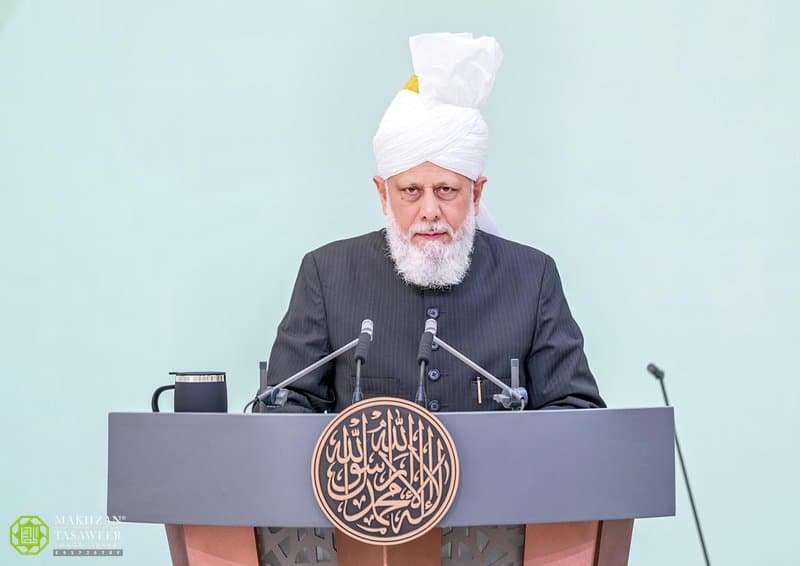
After reciting the tashahhud, ta‘awwuz and Surah al-Fatihah, Hazrat Khalifatul Masih V (aa) stated:
In the previous Friday sermon, I mentioned the level of trust the Holy Prophet (sa) had in Allah the Almighty. I will carry on discussing this topic today as well. Guiding the believers with regard to placing their trust in Allah, Hazrat Abu Darda (ra) has related that the Holy Prophet (sa) said: “Whoever recites the following seven times in the morning and evening:
حَسْبِیَ اللّٰہُ لَا اِلٰہَ اِلَّا ھُوَ عَلَیْہِ تَوَکَّلْتُ وَھُوَ رَبُّ الْعَرْشِ الْعَظِیْمِ
“‘Allah is sufficient for me. There is none worthy of worship except Him. I have placed my trust in Him, and He is the Lord of the mighty throne,’ Allah will be sufficient for him against anything that grieves him, whether he is truthful or untruthful in [reciting] this.” (Sunan Abi Dawud, Kitab al-adab, Abwab an-nawm, Bab ma yaquli idha asbaha, Hadith 5081)
How did the Holy Prophet (sa) pray for himself in relation to placing his trust in Allah? We find a narration by Jabir bin ‘Abdullah in this regard, saying that when the Holy Prophet (sa) went into ruku‘ [bowing posture during prayer], he would supplicate in the following manner:
اَللّٰھُمَّ لَکَ رَکَعْتُ وَبِکَ اٰمَنْتُ وَلَکَ اَسْلَمْتُ وَعَلَیْکَ تَوَکَّلْتُ اَنْتَ رَبِّیْخَشَعَسَمْعِیْ وَبَصَرِیْ وَدَمِیْ وَلَحْمِیْ وَعَظْمِیْ وَعَصَبِیْ لِلّٰہِ رَبِّ الْعَالَمِیْنَ
“O Allah! I bow before You, I believe in You, I submit before You and I place my trust in You. You are my Lord. My hearing, my sight, my blood, my flesh, my bones and my every fibre are humbled before Allah, the Lord of the Worlds.” (Sunan an-Nasa‘i, Kitab at-tatbiq, Bab naw‘un akhar, Hadith 1051)
Then, in another narration, Hazrat Abu Hurairah relates that the Holy Prophet (sa) said:
“Whenever I was distressed by a matter, Gabriel would appear before me and say,
O Muhammad, say:
تَوَکَّلْتُ عَلَی الْحَیِّ الَّذِیْ لَا یَمُوْتُ وَالْحَمْدُ لِلّٰہِ الَّذِیْ لَمْ یَتَّخِذْ وَلَدًا وَلَمْ یَکُنْ لَّہٗ شَرِیْکٌ فِی الْمُلْکِ وَلَمْ یَکُنْ لَّہٗ وَلِیٌّ مِّنَ الذُّلِّ وَکَبِّرْہُ تَکْبِیْرًا
“‘That I place my trust in the living [God], Who does not die. All praise belongs to Allah Who has not taken a son, nor has He any partner in His kingdom, nor has He any protector because of weakness. And glorify Him in with all your strength.’” (Al-Mustadrak ala Sahihain, Kitab ad-du‘a’i wa t-takbiri wa t-tahlili wa t-tasbihi wa z-zikr, Hadith 1876, Vol. 1, Dar Al-Kotob Al-Ilmiyah, Beirut, p. 689)
Tawus relates that he heard Hazrat Ibn Abbas (ra) say that when the Holy Prophet (sa) would wake up at night to offer the Tahajjud prayer [voluntary predawn prayer], he would supplicate the following. It is a lengthy prayer and its translation is as follows:
“O Allah! All praise belongs to You. You are the Sustainer of the heavens and the earth and all that is therein and all praise belongs to You. To You belongs the kingdom of the heavens and the earth and all that is contained within them and all praise belongs to You. You are the Light of the heavens and the earth and all therein and all praise belongs to You. You are the King of the heavens and the earth and all that is therein and all praise belongs to You. You are the Truth, Your promise is true, the final reckoning with You is true, Your word is true, Paradise is true, Hell is true, all the Prophets are true, Muhammad (sa) is true and the Hour is true.
“O Allah! I have submitted myself to You, believed in You, placed my trust only in You, turned only towards You and only for your sake have I taken up this dispute (or only with Your help have I confronted my opponents) and I have sought judgement only from You. Forgive me my earlier and latter sins, as well as those that I have concealed and those that I have disclosed. You are the One Who hastens and You are the One Who delays. There is none worthy of worship but You.” It is also narrated that he would say: “There is no God besides You.” This is a narration found in Sahih al-Bukhari. (Sahih al-Bukhari, Kitab at-tahajjud, Bab at-tahajjudi bi l-layl, Hadith 1120)
It is narrated by Hazrat Ibn Abbas (ra) that the Holy Prophet (sa) would say:
“O Allah, I obey You and believe in You. I place my trust in You, and I turn towards You. With Your help alone do I contend. O Allah, I seek refuge in Your honour lest You should declare me misguided. There is none worthy of worship except You. You are the Ever-Living, upon Whom death shall never come, while the jinn and mankind shall die.” (Sahih Muslim, Kitab az-zikri wa d-du‘ai wa t-tawbati wa l-istighfar, Bab at-ta‘awwuzi min sharri ma ‘amala wa min sharri ma lum ya‘mal, Vol. 14, Hadith 4880, Noor Foundation, p. 91)
The Holy Prophet (sa) always kept his attention fixed upon Allah the Almighty. Describing this quality of his at its highest standard, Hazrat Musleh-e-Maud (ra) has written; rather, he stated in his address:
“The Holy Prophet (sa) placed such complete trust in Allah the Almighty that whenever he faced any difficulty or hardship, he looked only towards God and turned his attention away from everything besides Him.
“There is no doubt that he was not one who abandoned the means, as some of the Sufis of today do (that is, those Sufis who say that there is no need to use the means and that only trust in God is necessary). He made use of the means, because abandoning the means is, in effect, to dishonour the creation of Allah the Almighty and to regard His creation as purposeless. However, after making all the necessary arrangements, he placed his complete trust in Allah the Almighty. Although he made use of the [available] means, he never placed his reliance and trust in them. Rather, he always remained hopeful of the grace of Allah alone.”
Hazrat Ibn Abbas (ra) relates that whenever the Holy Prophet (sa) felt distressed, he would say:
لَا اِلٰہَ اِلَّا اللّٰہُ رَبُّ الْعَرْشِ الْعَظِیْمِ لَا اِلٰہَ اِلَّا اللّٰہُ رَبُّ السَّمٰوٰتِ وَرَبُّ الْاَرْضِ وَرَبُّ الْعَرْش الْکَریْمِ…
“There is none worthy of worship except Allah, the Lord of the Mighty Throne. There is none worthy of worship except Allah, the Lord of the heavens and the Lord of the earth and the Lord of the Honourable Throne.” (Siratun Nabi [sa], Anwar-ul-Ulum, Vol. 1, pp. 496-497)
In other words, he placed his complete reliance and trust in Allah the Almighty alone.
It is narrated by Hazrat Ibn Abbas (ra) that the words:
حَسْبُنَا اللّٰہُ وَنِعْمَ الْوَکِیْلُ
“Sufficient for us is Allah and an excellent Guardian is He” – were uttered by Prophet Abraham (as) when he was cast into the fire. The Holy Prophet Muhammad (sa) also uttered these same words when the people said to him, “These people have made great preparations against you (that is, the disbelievers), so you should fear them.”
According to the commentators of the Hadith, these words were uttered on the occasion of the Battle of Uhud, or Hamra’ al-Asad, or perhaps the Battle of the Ditch. This only increased their faith and they said:
حَسْبُنَا اللّٰہُ وَنِعْمَ الْوَکِیْلُ
“Sufficient for us is Allah and an excellent Guardian is He.”
This narration is found in Sahih al-Bukhari. (Sahih al-Bukhari, Kitab at-tafsir, Bab qawluhu ‘allazina qala lahumu n-nas […]’, Hadith 4563; Fath al-Bari, Vol. 8, Qadimi Kutub Khanah Muqabil Aram Bagh, Karachi, p. 290; Ibn Kathir, Tafsir al-Quran al-Azim, Surah Aal-e-Imran, verse 174, Vol. 2, Dar Al-Kotob Al-Ilmiyah, Beirut, pp. 149-150; Tafsir al-Mazhari, Surah al-Ahzab, verse 10, Vol. 5, Dar Al-Kotob Al-Ilmiyah, p. 487; Tafsir al-Baghwi, Ma’alim al-Tanzil, Vol. 1, Surah Aal-e-Imran, verse 174, Idarah Talifat Ashrafiyah, Multan, p. 374)
On various occasions, the idolaters of Mecca made offers to the Holy Prophet (sa), presenting him with different kinds of temptations, but the Holy Prophet (sa) displayed unparalleled reliance upon Allah the Almighty while responding to them.
What events transpired? Ibn Ishaq has mentioned one such occasion. One day, the leaders of the Quraish were sitting in a gathering while the Holy Prophet (sa) was sitting alone in Masjid al-Haram. ‘Utbah bin Rabi‘ah said, “O people of the Quraish, shall I go to Muhammad (sa) and speak to him? I will put forward some proposals before him; perhaps he will accept one of them. We will fulfil his wishes and he will desist from his preaching against us.”
This was at a time when Hazrat Hamza (ra) had accepted Islam, and the Quraish were observing that the Companions of the Holy Prophet (sa) were increasing day by day. So the Quraish said, “Certainly, O Abu al-Walid. You should go and speak to him.”
Thus, Utbah came to the Holy Prophet (sa), sat down near him and said, “Nephew, you know very well that within your family, you hold a high rank and position. You are of noble descent. However, you have brought before your people such a great matter that it has torn their unity apart. You have declared their intellects deficient, spoken ill of their idols and religion, and declared their forefathers who have passed away to be disbelievers. Now listen carefully to a few things I have to say. I shall put some proposals before you. Perhaps you may accept one of them.”
The Holy Prophet (sa) said, “Speak, Abu al-Walid. I am listening.”
Utbah said, “Nephew, if the purpose of this call of yours is to acquire wealth, then we will gather our wealth and give you so much that you will become the wealthiest among us. If you desire honour and leadership, we will make you our leader and will not make any decision without consulting you. If you desire kingship, we will accept you as our king. And if some spirit or jinn has overcome you – one which you are unable to drive away from yourself (as was customary among these people, because they were superstitious, they would think that perhaps a jinn had taken possession of a person) – we will have you treated by the best physicians and spend our wealth on your treatment until you have made a complete recovery. Because sometimes such a condition overcomes a person that requires treatment.”
Utbah finished speaking and the Holy Prophet (sa) continued listening to him. He then said, “O Abu al-Walid, have you finished what you had to say?” He replied, “Yes.” The Holy Prophet (sa) said, “Then listen to what I have to say.” He replied, “Certainly, I am listening.” Upon this, the Holy Prophet (sa) recited the following verses of Surah Ha Mim as-Sajdah:
“In the name of Allah, the Most Gracious and Ever Merciful, I recite. (The attributes of the Praiseworthy and the Lord of Honour have been mentioned in this chapter.) This Quran is a revelation from the Gracious and Merciful God. It is a book whose verses have been expounded in great detail and it is a book that will be recited extensively. It is in a language that clearly explains its own meaning, but this book benefits only those who possess spiritual knowledge. It gives glad tidings to the righteous and warns those who are evil. Yet most of them turned away, and they are not even prepared to listen to it. They said, ‘Our hearts are under coverings against that to which you call us.’” That is, it cannot have any effect upon our hearts.
The Holy Prophet (sa) continued reciting these verses, while Utbah remained silent and listened with complete attention. He placed both his hands behind himself and continued listening intently to the Quran. When the Holy Prophet (sa) reached the verse of prostration, he performed the prostration. He then said to Utbah, “O Abu al-Walid, you have heard everything that you needed to hear. Now the decision is in your hands. I have heard what you had to say, and you have heard what I had to say. Now you decide as you wish.”
The perfect certainty and complete reliance upon Allah the Almighty possessed by the Holy Prophet (sa) manifested itself in a new manner every day. History tells us that when the Holy Prophet (sa) gave this reply to ‘Utbah, he remained steadfast upon his stance. After giving his answer, he did not say that he would change. Rather, he told Utbah to change himself and then decide for himself. He continued to spread the religion of Allah and invite people towards Him.
Then all the disbelievers went together to Abu Talib as a group and said to him, “We had requested you to restrain your nephew, but you have not stopped him. Either we will prevent him from speaking against us in this manner, or we will confront him and you, until one of the two parties is destroyed.”
When the Quraish said this to Abu Talib, he sent for the Holy Prophet (sa) and said to him, “O son of my brother, do not place upon me a burden that I cannot bear.”
The Holy Prophet (sa) thought that his uncle was going to withdraw his support and hand him over to the Quraish. He said, “Dear uncle, by God, even if these people were to place the sun on my right and the moon on my left, I would not desist from my duty. I shall continue with my task until God fulfils it, or I perish in the attempt.”
Then, the Holy Prophet (sa) stood up and began to leave. Abu Talib called out to him and said, “O my nephew, say whatever you wish. By Allah, I shall never hand you over to them, whatever they may offer in return.” (Ibn Hisham, Al-Sirah al-Nabawiyyah, Dar Al-Kotob Al-Ilmiyah, 2001, pp. 200-201 and 220)
Hazrat Musleh-e-Maud (ra) has mentioned these incidents – which are historical and accurate events – in the following manner:
“When the Holy Prophet (sa) began to exhort people regarding the Unity of Allah and started refuting idolatry, the people of Mecca found this extremely untenable. Eventually, one day, after reaching an agreement among themselves, they came as a delegation to the Holy Prophet’s (sa) uncle, Abu Talib and said to him:
“‘You are the chief of our people. We hold you in great respect and out of consideration for you, we have not said anything to your nephew. But the matter has now exceeded all bounds. We have come to you so that you may convey our final message to him on our behalf.’
“They then repeated the same things that ‘Utbah had said to the Holy Prophet (sa), namely, the temptation of marriage into a noble family and to the most beautiful woman, the temptation of money, wealth and kingship. They said, ‘Tell him at least to show this much consideration to not speak ill of our idols. We are not asking him to accept our idols. We are only asking him not to speak against them. If he does not accept even one of these requests, then withdraw your support from him. We shall deal with him ourselves.’
“Abu Talib was a very pious man and had great love for the Holy Prophet (sa), but he also cherished his own position of leadership. He sent for the Holy Prophet (sa) and said:
“‘Members of your tribe came to visit me today. They said that they are considerate toward me and out of regard for me, they have not said anything to my nephew until now. But the matter has gone beyond all limits. If he will not accept any other request, then he should at least be told not to speak ill of our idols. We are prepared to make him our king. If he wants wealth, we are ready to give him wealth, so that no one in Arabia will remain wealthier than him. We are prepared to provide whatever he desires. If he wants a beautiful wife, we are ready to marry him to the most beautiful woman. In short, whatever demand he makes, we are prepared to fulfil it. He should only refrain from speaking ill of our idols.’
“Abu Talib had conferred great favours upon the Holy Prophet (sa). He had brought him up with immense love and affection from childhood and had stood by him through every hardship and difficulty. When the Holy Prophet (sa) saw the condition of his uncle, he remembered his favours and tears came to his eyes. However, he said:
“‘Dear uncle, I am not asking you to support me. You may certainly support your people and leave me. By God, even if these people were to bring the sun and place it on my right, and bring the moon and place it on my left, I would still never desist from proclaiming the message of God.’
“Look at the extent of his certainty and conviction in the Being of Allah the Almighty. The movement of the sun from its place is such a great miracle that, were it to occur, a person would be left utterly astonished. Yet the Holy Prophet (sa) said:
“‘Even if they were to move the sun from its place and put it beside me and even if they were to move the moon from its place and put it beside me, I would still possess such certainty and conviction in the Being of Allah the Almighty that I would regard these things as mere sorcery. I would continue to object to their idolatry and would never desist from my mission.’” (Uswah-e-Hasanah, Anwar-ul-Ulum, Vol. 17, pp. 105-106)
This level of certainty in Allah the Almighty and complete reliance upon Him is not found elsewhere.
While mentioning this incident, the Promised Messiah (as) states:
“When the verses [of the Holy Quran] were revealed condemning the pagans as an abomination, polluted, and the worst of creation, and as ignorant and the progeny of Satan, and that their idols will be the fuel of fire and will be castigated into Hell, Abu Talib sent for the Holy Prophet (sa) and said to him: ‘Son of my brother, the people are much provoked by your abuses and are bent on killing you and me too. You have labelled their wise men as fools and have called their ancestors the worst of creation and have named their revered gods the firewood of hell and fuel for fire and have generally described all of them as an abomination, progeny of Satan, and impure. As your well-wisher, I advise you to control your tongue and stop all these insults; otherwise, I would have no power to protect you against the wrath of the people.’
“The Holy Prophet (sa) answered: ‘Uncle, I have uttered no abuse. All that I have said is a fact and is entirely relevant to the situation. This is what I have been sent for. If this should involve my death, I would gladly welcome such death for myself. My life is dedicated to this purpose and I cannot refrain from expressing the truth for fear of death. Uncle, if you are apprehensive on account of your own weakness and on account of the trouble in which may befall you, withdraw your protection from me. By God, I am in no need of you. I shall never refrain from conveying the Divine message. I hold the commandments of my Lord dearer than my life. Should I be killed in this cause, I would wish to be restored to life so that each time I should die in the cause of Allah. I am not affected by fear. Rather, I consider it most delightful to suffer in this cause.’
“While the Holy Prophet (sa) was speaking, his face shone with the light of truth. When he concluded, Abu Talib – perceiving the light in his face and overcome by emotion – said: ‘I was not aware of this exalted condition of yours. You hold a unique distinction and honour. Go and continue as you wish. So long as I am alive, I shall support you with the utmost power within me.’” (Izalah-e-Auham, Part 1, Ruhani Khazain, Vol. 3, pp. 110-111)
There is also the incident of the Holy Prophet’s (sa) trust in Allah on his return from Taif. He had left alone to preach to the chiefs of Taif, but they subjected him to the most extreme cruelty. When he returned, there seemed to be no apparent way for him to even enter Mecca. One of his followers was with him, and that follower anxiously wondered what would happen next. But the Holy Prophet (sa) had complete trust in his Lord. That very servant, Hazrat Zaid bin Harithah (ra), relates that he submitted, “O Messenger of Allah (sa), how will you enter Mecca when they have expelled you?” With extraordinary trust in Allah, the Holy Prophet (sa) replied: “O Zaid, you will see that Allah the Almighty will surely open a way. Allah is the Helper of His religion, and He will certainly grant victory to His Prophet.” Accordingly, the Holy Prophet (sa) sent messages to the chiefs of the Quraish, asking them to grant him protection and arrange for his entry into Mecca. All the chiefs refused. Eventually, a noble chief, Mut‘im bin Adi, announced that he would take the Holy Prophet (sa) under his protection and escort him into Mecca. (Al-Tabaqat al-Kubra, Zikr Sabab Rasulullah [sa] ila al-Taif, Vol. 1, Dar Al-Kotob Al-Ilmiyah, 1990, p. 165; Subul al-Huda wa al-Rashad, Vol. 2, Dar Al-Kotob Al-Ilmiyah, p. 440)
At the time of the Holy Prophet’s (sa) migration, he exhibited extraordinary examples of trust in Allah. When God granted the Holy Prophet (sa) permission to migrate, the Holy Prophet (sa) informed Hazrat Ali (ra) of his plan and entrusted him with a task requiring supreme devotion. That night he was to sleep in the blessed bed of the Holy Prophet (sa), wrapped in the same green – or, according to one narration, red – Hadrami cloak which the Holy Prophet (sa) himself used when sleeping. This was a cloak from Yemen since it originated from that region, it was known as Hadrami.
In any case, Hazrat Ali (ra) was told to lay down wrapped in that very cloak. Reassuring this devoted and self-sacrificing servant of Divine support and help, the Holy Prophet (sa) said, “Do not worry. Sleep peacefully in my bed. The enemy will not be able to harm you in the slightest.” Moreover, since the truthful and trustworthy Messenger of God (sa) was deeply conscious of the trusts which the people of Mecca had placed in his care, he instructed Hazrat Ali (ra) to return those trusts to their owners and then join him after having done so.
Thereafter, the Holy Prophet (sa) came out of his house. Outside, the chosen warriors of Mecca stood on guard, alert and ready, swords in hand, their eyes aflame with bloodlust. They were waiting for the night to darken so that they might launch a sudden attack and, God forbid, kill the Holy Prophet (sa) in a single blow. Abu Jahl, who was their ringleader, was saying with great arrogance and mockery, “Muhammad says that if you follow him, you will become kings over the Arabs and non-Arabs. Then, after your death, you will be raised again and gardens like the gardens of Jordan will be prepared for you. But if you do not do so, then killing and bloodshed will break out among you.”
The Holy Prophet (sa) stepped out to depart and said, “Yes, that is exactly what I say.” Then, reciting these verses of Surah Ya Sin, he passed by them:
The translation is: “O Perfect Leader! By the Quran, full of wisdom, Thou art indeed [one] of the Messengers, On a right path. [This is] a revelation of the Mighty, the Merciful, That thou mayest warn a people whose fathers were not warned, and so they are heedless. Surely the word has proved true against most of them, for they believe not. We have put round their necks, chains reaching unto the chins, so that their heads are forced up. And We have set a barrier before them and a barrier behind them, and have covered them over, so that they cannot see.” (The Holy Quran, 36:2-10)
He passed in front of them, reciting this and casting dust upon their heads, yet, by the power of God, none of them was able to see him as he departed. Rather, from time to time they would peer inside and satisfy themselves that Muhammad (sa) was still lying upon his bed. (Ibn Hisham, Al-Sirah al-Nabawiyyah, Bab Hijrah al-Rasulullah [sa], Dar Al-Kotob Al-Ilmiyah, 2001, p. 342; Muhammad Rasulullah Wallazina Ma’ahu, Vol. 3, Bab al-Hijrah, Egypt, p. 74; Ibn Sa’d, Al-Tabaqat al-Kubra, Vol. 1, p. 176; Imam Badr al-Din al-’Aini, Nakhb al-Afkar fi Tanqih Mabani al-Akhbar fi Sharh Ma’ani al-Athar, Vol. 6, Wizarat al-Auqaf wa al-Shu’un al-Islamiyyah, Qatar, 2008, p. 111)
Describing the migration of the Holy Prophet (sa) and his complete trust in God Almighty, Hazrat Musleh-e-Maud (ra) has related the following in light of historical accounts:
“When the Holy Prophet (sa) received the command from Allah Almighty to migrate, he took Hazrat Abu Bakr (ra) with him and proceeded towards Mount Thaur, which is situated some six or seven miles from Mecca, and concealed himself in a cave at the summit of the mountain. In the morning, when the disbelievers discovered that he was no longer in his house and that Muhammad had successfully escaped despite every kind of guard having been placed, they immediately set out in search of him. They took with them some of the finest trackers of Mecca, who possessed great expertise in recognising footprints. They followed the trail all the way to Mount Thaur and said, ‘If Muhammad, (the Messenger of Allah [sa]), is to be found anywhere, then this is the place. There are no footprints beyond this point.’
“At that time, the situation was such that the enemy had reached the very top of the cave. The mouth of the cave was not narrow or difficult to peer into; rather, it had a wide and open entrance, through which it could easily be ascertained whether or not someone was sitting inside. Yet even in such circumstances, Muhammad, (the Messenger of Allah [sa]), felt no fear. Rather, through the blessing of his spiritual power, the heart of Hazrat Abu Bakr also remained steadfast. He did not say, as the companions of Moses had said, ‘We have surely been caught.’ Rather, if he said anything, it was this: ‘O Messenger of Allah! The enemy has come so close that if they were to lower their gaze even slightly, they could see us.’ But the Holy Prophet (sa) said: اُسْکُتْ یَا اَبَابَکْرٍ اِثْنَانِ اللّٰہُ ثَالِثُھُمَا۔ ‘Quiet, O Abu Bakr. We are not two at this time; there is a third with us and that is God. How, then, can they see us?’
“And so this is what transpired; despite the enemy having reached the very top of the cave, they were not granted the opportunity to move forward and look inside. They turned back from that point, lamenting and exclaiming, ‘Destruction! Destruction!’ and futile words such as these.
“In short, one aspect of this incident is that the companions of Moses, overcome by fear, said, ‘O Moses, we have surely been caught.’ In other words, they included Moses in their own predicament and thought that they would all now fall into the grasp of Pharaoh. However, the trust in God Almighty demonstrated by Muhammad, the Messenger of Allah (sa), had such an effect upon his Companion that even he did not utter the words, ‘We have been caught.’ Rather, he merely said that the enemy had come so close that, if they wished to see them, they could do so.
“But Muhammad, the Messenger of Allah (sa), would not even tolerate this apprehension or thought. He said, ‘Do not entertain such a thought. We are not two at this time; there is another Being with us, and He is our God.’” (Tafsir-e-Kabir, 2023, Vol. 9, pp. 416-417)
Whilst mentioning the migration of the Holy Prophet (sa) and his utmost trust in Allah the Almighty and his courage, the Promised Messiah (as) states:
“The truth and sincerity of Abu Bakr Siddiq (ra) came to light as a fire was ablaze around him, at a time when the Holy Prophet, peace and blessings of Allah be upon him, was surrounded by his assailants. Although some of them were of the opinion that he should merely be banished from Mecca, most of them actually sought to put an end to his life. It was at that hour that Hazrat Abu Bakr Siddiq (ra) demonstrated his sincerity and loyalty, which will shine as an example until the end of time. In this trying hour, the very selection of the Holy Prophet, peace and blessings of Allah be upon him, is a powerful argument in favour of the excellence and supreme loyalty of Hazrat Abu Bakr Siddiq (ra).”
The Promised Messiah (as) is also mentioning the qualities of Hazrat Abu Bakr (ra) as well.
“This is also the case with the selection of the Holy Prophet, peace and blessings of Allah be upon him. At that time, the Holy Prophet (sa) had 70 or 80 Companions, and even Hazrat Ali (ra) was with him, but from all of these Companions, the Holy Prophet (sa) chose none other than Hazrat Abu Bakr (ra). What is the secret in this? The fact is that a Prophet sees through the eye of God Almighty, and his insight comes from God Almighty. Therefore, Allah the Exalted had informed the Holy Prophet, peace and blessings of Allah be upon him, by means of vision and revelation that the best and most appropriate person for this task was Hazrat Abu Bakr Siddiq (ra).
“Hazrat Abu Bakr, may Allah be pleased with him, accompanied the Holy Prophet (sa) in this difficult hour. This was a time of perilous trial. When a similar time dawned upon the Messiah (as), his disciples abandoned him and fled, and one of them even stood before him and cursed him. But each and every one of the noble Companions of the Holy Prophet (sa) demonstrated complete loyalty.
“Therefore, Hazrat Abu Bakr Siddiq (ra) stood by the Holy Prophet (sa) and gave him full support, and when they reached a cave known as the Cave of Thaur, they both took refuge in the cave. The evil disbelievers who had conspired to harm the Holy Prophet (sa) were led to this cave in their search. Hazrat Abu Bakr Siddiq (ra) submitted to the Holy Prophet (sa): ‘Now, these people are upon us, and if any one of them looks down even slightly, they will be able to see us, and we shall be apprehended.’
“At that time, the Holy Prophet (sa) said:
لَاتَحْزَنْ اِنَّ اللّٰہَ مَعَنَا
“Meaning, do not fear in the least, for Allah the Exalted is with us. Reflect on these words. The Holy Prophet, peace and blessings of Allah be upon him, joins Hazrat Abu Bakr Siddiq (ra) with himself and states: ‘Verily, Allah is with us.’ The Arabic words ma‘ana refer to both of them, i.e. ‘with you and I.’ Allah the Exalted placed the Holy Prophet, peace and blessings of Allah be upon him, on one side and Hazrat Abu Bakr Siddiq (ra) on the other. At that time, both of them were in a state of trial. For it was at this point in time that the foundation of Islam was either going to be secured or brought to an end.
“The enemy stood at the mouth of the cave and various opinions were being voiced. Some said that the cave ought to be searched because the footprints ended at the cave, while others pointed out that it was impossible for a person to pass through here and enter the cave, as a spider had woven a web at the mouth of the cave and a dove had laid its eggs. These discussions could be heard from within the cave and the Holy Prophet (sa) could also hear them clearly. In this state of affairs, the enemy had come to kill them both and had set out with immense vigour to complete their task, but just observe the remarkable courage of the Holy Prophet (sa), who says to his true friend:
لَاتَحْزَنْ اِنَّ اللّٰہَ مَعَنَا
“[‘Grieve not, for Allah is with us.’]
“These words evidently demonstrate that the Holy Prophet (sa) said the aforementioned phrase with his tongue, because such words could only be expressed with a voice and not through sign language. The enemy stood outside consulting amongst themselves, and inside the cave, both servant and master are also engaged in discourse. The Holy Prophet (sa) had no concern that the enemy would hear his voice and this is proof of his remarkable faith and his insight into Allah the Exalted. It demonstrates that he had full trust in the promises of God Almighty.” (Malfuzat, Vol. 2, pp. 91-92)
During the migration of the holy Prophet (sa), there are many other incidents which demonstrate his utmost trust in Allah the Almighty and they will, insha-Allah, be narrated in the future.
O Allah, bless Muhammad and the people of Muhammad, and bestow upon them Your blessings and peace. Surely, Thou art Praiseworthy, Glorious.
(Official Urdu transcript published in the Daily Al Fazl International. Translated by The Review of Religions.)