
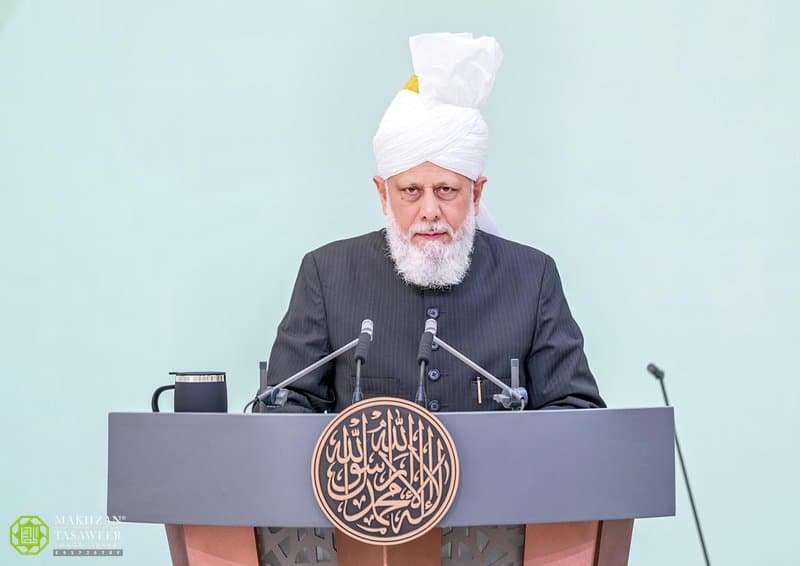
After reciting the tashahhud, ta‘awwuz and Surah al-Fatihah, Hazrat Khalifatul Masih V (aa) stated:
Two Fridays ago, I discussed the life of the Holy Prophet (sa) and his zeal for Tawhid [the Oneness of Allah]. Indeed, he was sent with the objective of establishing this. This zeal was not only manifested through his words and actions, but he also instilled this unparalleled spirit and zeal for Tawhid within his Companions and those who followed him, and to remain ever prepared to make every sacrifice for the sake of Tawhid.
Today, I will continue discussing this very aspect of the life of the Holy Prophet (sa), and some of the sacrifices made by the Companions in this regard will be mentioned as well.
It was due to the practical example of the Holy Prophet (sa), his zeal and his prayers that the Companions too were given these ranks and were prepared to offer every sacrifice.
The hardships the Holy Prophet (sa) faced for the establishment of Tawhid are recorded in one narration as follows:
Once, the idolaters said to the Holy Prophet (sa): “Do you not say such and such things about our idols?” The Holy Prophet (sa) replied: “I do.” Upon this, they gathered around him. At that time, someone said to Hazrat Abu Bakr (ra) to check on his friend. Hazrat Abu Bakr (ra) set out and reached the Sacred Mosque and found the Holy Prophet (sa) encircled by people. Hazrat Abu Bakr (ra) said: “Woe to you people!” He then said, as is also stated in the Holy Quran:
اَتَقۡتُلُوۡنَ رَجُلًا اَنۡ یَّقُوۡلَرَبِّیَ اللّٰہُ وَقَدۡ جَآءَکُمۡ بِالۡبَیِّنٰتِ مِنۡ رَّبِّکُمۡ
“Will you slay a man because he says, ‘My Lord is Allah,’ while he has brought you clear proofs from your Lord?” (The Holy Quran, 40:29)
Upon this, they left the Holy Prophet (sa) and rushed towards Hazrat Abu Bakr (ra) and started beating him. The daughter of Hazrat Abu Bakr (ra), Hazrat Asma’, relates that he returned to us in a state that if he touched his hair, it would come out in his hands. That is, they had pulled his hair so forcefully that it had been torn out from the roots. [However,] Hazrat Abu Bakr (ra) kept repeating:
تَبَارَكْتَ يَا ذَا الْجَلَالِ وَالْإِكْرَامِ
“Blessed are You, O Possessor of Majesty and Honour.”
In another narration, it is mentioned that these people pulled the blessed head and the blessed beard of the Holy Prophet (sa) so forcefully that many of his hairs fell out. Upon this, Hazrat Abu Bakr (ra) stood up to defend him and said:
اَتَقۡتُلُوۡنَ رَجُلًا اَنۡ یَّقُوۡلَرَبِّیَ اللّٰہُ
“Will you slay a man because he says, ‘My Lord is Allah?’”
Hazrat Abu Bakr (ra) was also crying [as he said this]. At this, the Holy Prophet (sa) said: “O Abu Bakr, leave them. By the One in Whose hand lies my life, I have been sent to them so that I may be sacrificed.” Upon this, they left the Holy Prophet (sa). That is, when they were oppressing and beating the Holy Prophet (sa) and when Hazrat Abu Bakr (ra) came in between, at that moment the Holy Prophet (sa) said to leave them. (Al-Sirah al-Halabiyyah, Vol. 1, Dar Al-Kotob Al-Ilmiyah, Beirut, 2002, p. 417)
Similarly, a narrator named Harith bin Harith al-Ghamidi saw injustices against the Holy Prophet (sa). He asked his father, “Who are these people?” This is not a single incident; countless incidents of this nature occurred. These are similar incidents, but many people witnessed and narrated them. There are multiple narrators. Some gave detailed accounts and some gave fewer details. In any case, when he saw this and asked his father who these people were who were committing injustices, his father replied that “These people had gathered around their Sabi.” The people of Mecca used to mockingly call the Holy Prophet (sa) and the Muslims “Sabi.” The narrator says that “When we also dismounted from our ride, we saw that the Holy Prophet (sa) was calling people to the Oneness of Allah the Exalted, inviting them to believe in Him, and they were rejecting him and were harming him until midday, and the people finally left him.” (Al-Mu’jam al-Kabir, Vol. 3, Al-Harith bin al-Harith al-Ghamdi, Hadith 3373, Ibn Taimiyah Publishers, Cairo, p. 304)
Mention of injustices against him is found in several books of history. Extracting from these, Hazrat Musleh-e-Maud (ra) has also narrated such incidents. In Introduction to the Study of the Holy Quran”, he writes in one place that “Once the Holy Prophet (sa) was passing through the market when a group of miscreants in Mecca came near him, and throughout the road they kept slapping his neck, saying, ‘People! This is the man who claims that he is a Prophet.” Stones were continuously thrown at his house from the neighbouring houses. Filthy things were thrown into his house. Even into the places where food was cooked, filthy things were thrown, including the intestines of goats and camels. When he stood in prayer, dust was thrown upon him (dirt was thrown over him) until he was forced to hide under a rock that protruded from a cliff in order to offer his prayer. (Dibacha Tafsirul Quran, Anwar-ul-Ulum, Vol. 20, p. 198)
But thousands upon thousands of salutations be upon the blessed person of the Holy Prophet (sa), that the passion which surged in his chest for the establishment of God’s Oneness never diminished even for a single moment, and he accepted all these hardships as though with a smile of cheerfulness (with great happiness). And even then, there was not the slightest decrease in his compassion and love for mankind.
Hazrat Musleh-e-Maud (ra) has also written that “When we look at the incidents of the Holy Prophet’s (sa) life, we see this claim manifesting as reality before us, and at every step we witness such incidents that testify to the immense love and compassion which he possessed for the whole of mankind. Thus, in order to convey the message of the One God, he had to pass through endless hardships for many years. Once, in the Ka‘bah, the disbelievers placed a cloth around his neck and tightened it so severely that his eyes became red and began protruding. When Hazrat Abu Bakr (ra) heard this, he came running and, seeing the Holy Prophet (sa) in such a state of suffering, tears came into his eyes, and while pushing those disbelievers away, he said, ‘Fear God! Are you committing oppression against a man merely because he says, “God is my Lord”?’” (Tafsir-e-Kabir, 2023, Vol. 9, p. 316)
On one occasion, the Holy Prophet (sa) stood in the Sacred Mosque and, addressing the polytheists of Mecca, he said, “Declare that there is none worthy of worship except Allah, and you will succeed (if you say this).” Upon hearing this, the Quraish fell upon the Holy Prophet (sa). A man came shouting loudly (intending to attack him), but Harith bin Abi Halah reached the Holy Prophet (sa) first. Harith began fighting those people and separated them from the Holy Prophet (sa). Then all of them fell upon him until they martyred him (Harith). (Imta’ al-Isma’, Vol. 6, Dar Al-Kotob Al-Ilmiyah, Beirut, 1999, p. 297)
As a punishment for proclaiming God’s Oneness, the disbelievers of Mecca also confined the Holy Prophet (sa) and his family for three years in the valley of Abu Talib. They confined them in such a manner that every form of social boycott was enforced.
And when this boycott ended, on the one hand, the Holy Prophet (sa) once again began preaching God’s Oneness throughout Mecca with even greater determination and courage than before (spreading the message of the Oneness of God more widely than ever before). On the other hand, the Quraish began committing injustices against the Holy Prophet (sa) again.
His journey to Ta’if is also a famous incident, and has been narrated many times previously. The oppression inflicted upon him there has also been described in different ways in historical accounts. Regarding this, Hazrat Mirza Bashir Ahmad Sahib (ra) has also written about it and narrated the incident in the following manner at one place:
“When the ban (on the valley of Abu Talib) was lifted, and the Holy Prophet (sa) found a sort of freedom in his movements, he decided to visit Ta’if and invite its people to Islam. (This has been mentioned previously, but there are further details here.) Ta’if is a famous place situated forty miles to the south-east of Mecca. During this era, it was home to the Banu Thaqif. Putting aside the speciality of the Ka‘bah, Ta’if was recognised as equal to Mecca and many eminent, influential and affluent people resided there. The people of Mecca themselves admitted to the importance of Ta’if. As such, it was the very Meccans who said (as is mentioned in the Holy Quran):
لَوْلَا نُزِّلَ هَذَا الْقُرَآنُ عَلَى رَجُلٍ مِّنَ الْقَرْيَتَيْنِ عظیم
“‘Why has not this Quran from God been sent to some great man of Mecca or Ta’if?’
“Therefore, in Shawwal of 10 Nabawi, the Holy Prophet (sa) took a journey to Ta’if by himself. On the authority of other narrations, Zaid bin Harithah (ra) also accompanied him. Upon his arrival, the Holy Prophet (sa) remained there for ten days, and one after another, he met with many chieftains, but like Mecca, it was not in the destiny of this city to accept Islam either. Therefore, all of them refused; as a matter of fact, they mocked the Holy Prophet (sa).
“At last, the Holy Prophet (sa) approached the grand chieftain of Ta’if named ‘Abd Yalil and invited him to Islam, but he also refused, rather, in a manner of mockery he said, ‘If you are truthful, then I have not the strength to speak to you, and if you are a liar, then to speak to you is useless.’ (This is the answer he gave to the Holy Prophet [sa].)
“Then, concerned that the youngsters of the city may become influenced by the Holy Prophet (sa), he said, ‘It is best that you leave this place, for there is nobody here who is willing to listen to you.’
“After that, this evil man had the miscreants of the city start off behind the Holy Prophet (sa). When he left the city, this rabble chased the Holy Prophet (sa) and began to bombard him with rocks, due to which the entire body of the Holy Prophet (sa) became drenched in blood. These people pursued the Holy Prophet (sa) for three miles, more or less, and cursed at him and threw stones at him continuously.
“At a distance of three miles from Ta’if, there was an orchard, which belonged to a Chieftain of Mecca named Utbah bin Rabi‘ah. The Holy Prophet (sa) took refuge in this orchard, and his ruthless enemies returned exhausted. Standing beneath a shadow, the Holy Prophet (sa) prayed before Allah in the following words:
اللَّهُمَّ إِلَيْكَ اَشْكُوْ ضُعْفَ قُوَّتِي وَقِلَّةَ حِيْلَتِي وَهَوَانِي عَلَى النَّاسِ اللَّهُمَّ يَا أَرْحَمَ الرَّاحِمِينَ أَنْتَ رَبُّ الْمُسْتَضْعَفِينَ وَانْتَ رَبِّي
“‘O My Lord, I complain to you of my helplessness, and my inability, and my helplessness before the people. O My God, You are the Most Merciful, for You are the Guardian and Protector of the feeble and helpless – You are my Lord. (He also further said, the translation of which is:) I seek refuge in the light of Your countenance. It is You Who dispels all darkness, and it is You Who bestows the inheritance of favour in this world and in the next.’
“At this time, ‘Utbah and Shaibah were in their garden. When they saw the Holy Prophet (sa) in this state, perhaps moved by emotions of near or far relations, or perhaps national responsibility, they sent the Holy Prophet (sa) a tray of grapes in the hand of their Christian slave named Addas. The Holy Prophet (sa) took them and addressed Addas, saying, ‘Where are you from, and a follower of which religion?’ ‘I am from Nineveh,’ responded Addas, ‘and a Christian.’ The Holy Prophet (sa) inquired, ‘The same Nineveh, which was home to the righteous servant of God, Jonah (as) son of Matthew?’ ‘Yes,’ responded Addas, ‘but how are you aware of Jonah (as)?’ ‘He was my brother,’ said the Holy Prophet (sa), ‘for he was a Prophet of Allah, and I am also a Prophet of Allah.’ Then the Holy Prophet (sa) preached the message of Islam to him, which moved him greatly. In his passion of sincerity, he moved forward and kissed the hands of the Holy Prophet (sa). Utbah and Shaibah observed this sight from afar; as such, when Addas returned to them, they said, ‘What happened to you that you began to kiss the hands of this man? This man shall ruin your faith, while your religion is better than his.’
“The Holy Prophet (sa) rested in this orchard for some time. He then departed from here and arrived at Nakhlah, which is situated at a distance of approximately one day’s journey from Mecca, and remained there for a few days. After this, the Holy Prophet (sa) departed and reached the mountain of Hira, and since the apparent failure at Ta’if entailed the possibility of the Meccans growing overly bold (and with the thought that they would increase in their cruelties), the Holy Prophet (sa) sent word to Mut‘im bin ‘Adiyy that I wish to enter Mecca. Can you help me in this regard?
“Although Mut‘im was a firm disbeliever, his disposition possessed graciousness, and in times like these, it was against the nature of noble Arabs to refuse. For this reason, along with his sons and relatives, fully armed, they stood by the Ka‘bah, and sent word to the Holy Prophet (sa) that he may enter. The Holy Prophet (sa) entered and performed the Tawaf of the Ka‘bah, and along with Mut‘im and his children, escorted under the shadow of swords, the Holy Prophet (sa) entered his home.
“On the way, when Abu Jahl witnessed Mut‘im in this state, he was astonished and enquired:
اَمْجِيرٌ أَمْ تَابِع
“‘Have you given Muhammad (sa) refuge, or have you become a follower?’ Mut‘im responded, ‘I am only one to give refuge, not a follower.’ Upon this, Abu Jahl said, ‘Alright, then there is no problem.’ Mut‘im died in a state of disbelief.” This was a good deed which he carried out.
It is narrated in a hadith that once Hazrat Aisha (ra) asked the Holy Prophet (sa), “Have you ever experienced a day more difficult than the day of Uhud?” He replied, “Aisha, I have faced very severe moments at the hands of your people.” He then related the circumstances of the journey to Ta’if and said that upon returning from there, the angel of the mountains came to him and said, “Allah has sent me to you so that, if you command, I may cause these two mountains on either side to fall upon these people and destroy them.” (i.e., I shall cause the mountains to the right and left side of them to fall upon them) and destroy them.) The Holy Prophet (sa) said, “No, no. I hope that Allah the Almighty will bring forth from among these very people those who will worship the One God.” (Life and Character of the Seal of Prophets, Vol. 1, pp. 252-255)
Compassion for the people prevailed, and along with it was complete certainty that one day their descendants would accept Islam and establish themselves upon the belief in One God.
Hazrat Musleh-e-Maud (ra) has described the incidents of hardship that the Holy Prophet (sa) endured for the sake of the unity of God. He writes that all the sufferings inflicted upon him by his enemies were due to the propagation of the unity of God. He was beaten, and dogs and boys were set upon him. On one occasion, when he went to Ta’if, the people stoned him so severely that he became covered in blood from head to foot. I have just mentioned the details of this. He would fall down from the pain, and when he rose again, they would throw stones at him once more. Yet even in that state, the words that came from his mouth were, “O my God, forgive these people, for they do not know the truth.”
Passing through all these conditions, he did not abandon preaching the unity of God and continued to say that whatever they might do, he would not cease proclaiming the Oneness of God.
Then, when the time of his demise approached, he departed from this world with the same concern upon his lips, i.e., his whole life had been about the Oneness of God, saying, “After my passing, do not commit shirk [idolatry].” Hazrat Musleh-e-Maud (ra) writes that he believes that at the time of the birth of the Holy Prophet (sa), Allah the Exalted demonstrated the proof of His Oneness by causing his father to pass away before his birth and his mother soon after his birth. In other words, through the passing of the Holy Prophet’s (sa) parents, Allah the Almighty conveyed a proof of His unity. The beginning of his life in orphanhood, without father and mother, and his magnificent end, were themselves great proofs of the Oneness of God. (Siratun-Nabi (sa), Vol. 3, p. 188)
From this, it is evident that the very God Whose Oneness he preached was the One Who sustained him from childhood until the end.
There is also mention of his preaching in the markets of Arabia. It is written that for the establishment of the unity of God, the Holy Prophet (sa) carried out both individual and collective preaching in Mecca, and besides this, he would go to certain markets of Arabia and there deliver the message of the One God, Who has no partner.
Outside Mecca, there were various places where people gathered for trade and assemblies. These were called Aswaq al-Arab [markets of Arabia]. The Arab markets were similar to fairs we commonly see in Indo-Pakistani culture. Ukkaz, Majannah, and Dhu al-Majaz were among the markets of Quraish and the Arabs. The largest of these was the market of Ukkaz, situated three nights’ journey from Mecca. The Arabs would stay in Ukkaz for the entire month of Shawwal. Then they would move to the market of Majannah, located a few miles from Mecca at Marr al-Zahran, and remain there until the twentieth of Dhu al-Qa’dah. Thereafter, they would move to the market of Dhu al-Majaz, three miles from the plain of Arafat, and stay there until the days of Hajj. In all these places, the Holy Prophet (sa) would go and preach.
It is narrated from Hazrat Jabir (ra) that the Messenger of Allah (sa) remained in Mecca for ten years. During the days of Hajj, he would go to the fairs of Ukkaz and Majannah and visit people in their homes and camps, inviting them. He would say, “Who will grant me refuge? Who will help me so that I may convey the message of my Lord, and Paradise shall be for him?” (Ibn Kathir, Al-Sirah al-Nabawiyyah, Vol. 2, Dar al-Ma’rifah, Beirut, 1976, p. 194; Imta’ al-Isma’, Vol. 8, Dar Al-Kotob Al-Ilmiyah, Beirut, p. 309; Farhang-e-Sirat, pp. 205 and 259)
Hazrat Rabi‘ah bin ‘Ibad relates that he, who lived during the age of ignorance and later accepted Islam, saw the Messenger (sa) of Allah in the market of Dhu al-Majaz with his own eyes. He was saying to the people, “O people, say, ‘There is no god but Allah, and you will succeed.” He would move through the lanes of the market while people shouted against him. Yet he did not see anyone telling others to accept his words. Despite this, he did not fall silent and continued to say, “O people, say, ‘There is no god but Allah, and you will prosper.” (Masnad Ahmad bin Hanbal, Vol. 5, Masnad Rabi’ah bin ‘Ibad, Hadith 16119, Alam Al Kotob, Beirut, 1998, p. 499)
Because of conveying this message of God’s Oneness, he faced hardships from both his own people and others. He could not even worship openly, lest they interfere or attack. Those who accepted Islam were also persecuted. Regarding prayer and the offering of worship, it is narrated that the Holy Prophet (sa) and Hazrat Ali (ra) would go to a valley in the mountains of Mecca and offer prayer hidden from the people, and they continued in this manner for some time. Then Abu Talib came to know of it and saw them praying. He asked the Messenger (sa) of Allah, “O my nephew, what is this religion that you have adopted?” He replied, “O uncle, this is the religion of God, His angels, His messengers, and our father Abraham (as). God has sent me as a Messenger to His servants with this religion. O uncle, you are most deserving that I should advise you and call you to guidance, and that you should accept it and assist me.”
Hazrat Abu Talib said, “O my nephew, I cannot abandon the religion of my forefathers, but as long as I live, no harm from the enemies shall reach you. I will support you.” Hazrat Abu Talib also asked his son Hazrat Ali (ra), “What religion is this that you have adopted?” Hazrat Ali (ra) replied, “I believe in God and His Messenger and affirm what he has brought, and I pray to God with him.” Abu Talib then said, “Indeed, he will always call you to goodness, so remain with him.” Thus, he advised his son to remain with the Holy Prophet (sa). (Tarikh al-Tabari, Vol. 1, Dar Al-Kotob Al-Ilmiyah, Beirut, 1987, p. 539)
As I mentioned earlier, the Companions also suffered severe persecution for accepting the Oneness of God. On one hand, the Quraish of Mecca used their power and leadership to exert diplomatic pressure and issue threats, attempting in every possible way to prevent the Holy Prophet (sa) from preaching Islam. On the other hand, they unleashed such cruelty and brutality upon those who accepted Islam that neither does the pen possess the strength to record its full details, nor can anyone easily muster the courage to recount it. Even the incidents that have been recorded are enough to shake a person to the core.
When Hazrat Bilal (ra) accepted the Holy Prophet (sa), he was subjected to all kinds of torment. Whenever people intensified their torture upon him, Hazrat Bilal would proclaim, “Ahad, Ahad” [“God is One, God is One.”] They would say to him, “Speak as we speak.” Hazrat Bilal would respond, “My tongue cannot properly pronounce what you are saying.” In another narration, it is reported that when Hazrat Bilal (ra) was tortured, and the idolaters attempted to turn him away from Islam, all he would say was, “Allah, Allah.”
Another narration states that when Hazrat Bilal (ra) accepted Islam, his masters seized him, laid him upon the ground, and placed stones and a cowhide upon him. They said, “Your lord is Lat and Uzza.” Yet he continued to repeat, “Ahad, Ahad.”
At that time, Hazrat Abu Bakr (ra) went to Bilal’s (ra) masters and said, “How long will you continue to torment this man?” Hazrat Abu Bakr (ra) then purchased Hazrat Bilal (ra) and set him free for seven auqiyah. One auqiyah was equal to forty dirhams; thus, he purchased and freed him for 280 dirhams. (Ibn Sa’d, Al-Tabaqat al-Kubra, Vol. 3, Bilal bin Rabah, Dar Al-Kotob Al-Ilmiyah, Beirut, 1990, pp. 175-176; Usd al-Ghabah, Vol. 1, Bilal bin Rabah, Dar Al-Kotob Al-Ilmiyah, Beirut, p. 416; Sharh al-Zarqani, Vol. 11, Dar Al-Kotob Al-Ilmiyah, Beirut, p. 197)
In addition to him, Hazrat Sumayyah (ra), Hazrat Ammar bin Yasir (ra), Hazrat Khubab (ra), and many other slaves and free men and women became the victims of the shameful and painful persecutions of the disbelievers of Mecca as a result of their belief in the Oneness of God.
The disbelievers of Mecca not only oppressed the weak Muslims, but even the blessed personage of the Holy Prophet (sa) himself was not spared from their cruelty, as has already been mentioned earlier. Indeed, if one reflects carefully, it becomes evident that the Holy Prophet (sa) himself endured the greatest suffering, sorrow, and pain.
It was no small hardship that the name of Muhammad (sa) – meaning “the most praised” – was deliberately distorted and people called him Muzammam, meaning “the most condemned.” God forbid. The most truthful man in that entire town was called a liar and an impostor. The greatest well-wisher of that nation was described as deceitful, greedy, and fraudulent. The one who had devoted his youth, his health and strength, indeed every moment of his day and night for the guidance, reform, and welfare of that very people was labelled insane, mad, and diseased.
At times, a cloth would be wrapped around his neck and pulled so forcefully that it seemed his breath might stop. At other times, stones were hurled at him, and sometimes filth was thrown upon him.
Urwah bin Zubair (ra) relates, “I asked Hazrat Abdullah bin Amr bin al-As (ra) to describe the worst treatment that the idolaters inflicted upon the Holy Prophet (sa). He replied that once the Holy Prophet (sa) was offering prayer in the Sacred Mosque near the Hatim – the empty area adjacent to the Ka‘bah enclosed by a low wall – when Uqbah bin Abi Mu‘ait came and wrapped a cloth around his neck and began to strangle him violently. Just then, Hazrat Abu Bakr (ra) arrived. He seized Uqbah by the shoulder, pushed him away from the Holy Prophet (sa), and said:
اَتَقۡتُلُوۡنَ رَجُلًا اَنۡ یَّقُوۡلَرَبِّیَ اللّٰہُ
“‘Will you slay a man because he says, “My Lord is Allah”?’ (Sahih al-Bukhari [translation], Vol. 7, Kitab manaqibi l-ansar, Bab ma laqiya n-nabiyya [sa] wa ashabihi min al-mushrikina bi makkah, Hadith 3856, Nazarat Ishaat, p. 332)
We also see – as has often been mentioned – that even during battles the Holy Prophet (sa) always demonstrated zeal for the Oneness of God.
The well-known incident of the Battle of Uhud is frequently narrated. When Abu Sufyan called out, mentioning the names of the Holy Prophet (sa), Hazrat Abu Bakr (ra) and Hazrat Umar (ra), asking, “Where are these people?” the Holy Prophet (sa) instructed everyone not to respond. At that moment, responding might have placed the Muslims in danger due to their weakened condition, so he commanded silence.
Then Abu Sufyan declared, “Glory be to Hubal!” When he said this, the Holy Prophet (sa) became restless and said, “Respond to him.” The Companions asked, “What should we say?” He said, “Say: Allah is Most High and Most Great.”
Abu Sufyan then said, “We have Uzza, and you have no Uzza.” The Holy Prophet (sa) said, “Respond to him.” They asked, “What should we say?” He replied, “Say: Allah is our Helper, and you have no helper.” Thus, whenever the honour of Allah and the principle of divine unity were concerned, the Holy Prophet (sa) did not care for any danger.
Therefore, this was the zeal for the Oneness of God at that moment when he instructed the Companions to proclaim: “Allah is Most High and Most Exalted. Allah is Most High and Most Exalted.” You are lying – Hubal is not exalted. Allah alone is without a partner, honoured and supreme. (Sahih al-Bukhari, Kitab al-maghazi, Bab ghazwati uhud, Hadith 4043)
I will now read an excerpt from the Promised Messiah (as), which we should listen to and read repeatedly. It reveals to us the rank and station of the Holy Prophet (sa) in establishing the Oneness of God and serves as guidance for us as to how we should acquire true understanding and realisation of this matter. He states:
“I always wonder what a sublime Prophet this Arabian Prophet is, whose name is Muhammad (thousands upon thousands of blessings and peace be upon him). One cannot fathom the limit of his high rank, nor of his spiritual effectiveness. It is a pity that his rank has not been recognised as it should have been. He is the champion who restored to the world the Tawhid which had disappeared from the world; he loved God to the extreme, and his soul melted to the extreme out of sympathy for mankind. Therefore, God, Who knew the secret of his heart, exalted him above all the Prophets and all the first ones and the last ones and bestowed upon him all that he desired within his lifetime.”
This is the beauty of his character: he reached the utmost heights in love for Allah the Almighty and the utmost heights in compassion for mankind, so that they might draw near to Allah, remain steadfast upon the Oneness of God, and secure both their worldly life and their hereafter.
The Promised Messiah (as) further states:
“It is he who is the fountainhead of every grace, and anyone who claims any superiority without acknowledging his grace is not a human being but is the spawn of Satan, because he (the Holy Prophet [sa]) has been bestowed the key to every exaltation and he has been given the treasure house of every understanding. He who does not receive through him is deprived forever. I am nothing and possess nothing. What am I, and what do I amount to? I would be ungrateful if I were not to confess that I have found true Tawhid through this very Prophet. I have attained the recognition of the Living God through this same perfect Prophet and through his light. The honour of converse and communion with God, through which I behold His countenance, has been bestowed upon me through the same Great Prophet. The rays from this Sun of Guidance fall upon me like sunshine, and I continue to be illumined only so long as I am facing towards it.”
Thus, in order for one to reach God Almighty, one must adopt absolute Tawhid, and the Holy Prophet (sa) is the medium through which one can achieve this.
The Promised Messiah (as) further says:
“Those who adhere to the notion that one who does not believe in the Holy Prophet, may peace and blessings of Allah be upon him, or turns apostate but remains firm in Tawhid and considers God to be One without any partner will attain salvation and shall suffer no harm on account of his disbelief or apostasy […] such people are indeed ignorant of the true meaning of Tawhid […] But mere belief that He is One is not enough for salvation; rather, salvation depends on two things:
“1. One is the absolute conviction in the Being and Oneness of God Almighty.
“2. Second is that such perfect love for the One Glorious God should be instilled in one’s heart that, as a consequence of its influence and dominance, obedience to God Almighty should truly become the delight of one’s heart, without which he could not live at all. (This should be the level of that dominance.) It should be love for the Divine that tramples and obliterates love for all besides Him.
“This is true Tawhid that can never be achieved except through following our lord and master, Hazrat Muhammad, may peace and blessings of Allah be upon him. Why can it not be achieved? The answer is that the Being of God is unseen beyond the unseen, concealed beyond concealed, and extremely hidden. The reasoning faculties of humans cannot discover Him on their own. No rational argument can constitute an incontrovertible proof of His existence, because the reach and access of reason is limited to the extent of realising the need for a Creator by reflecting upon the created beings in the universe. However, to acknowledge the need for His existence is one thing, but it is quite another to arrive at the stage of ‘ain-ul-yaqin [certainty by sight] that God, the need for whose existence has been acknowledged, does indeed exist.”
To merely say that there should be a creator for all this is not enough. If one exists, who is he? Is he a living God? If one wishes to enquire about this, then one will only gain this knowledge by following the Holy Prophet (sa).
The Promised Messiah (as) further says: “However, since the methodology of reason is imperfect, incomplete, and doubtful, not every philosopher can recognise God through reason alone. Rather, most people who seek to discover God solely through reason become atheists in the end. Their reflections on the created things in the earth and heavens cannot benefit them at all.” This is something we witness today as well: many intellectuals among the Muslims are becoming atheists. They reject the existence of God because they do not understand all of this. Despite following the Holy Prophet (sa), they failed to ponder over the directives of the Holy Prophet (sa).
The Promised Messiah (as) says:
“They ridicule and mock God’s elect, contending: There are thousands of things throughout the world whose existence we do not find useful, and our research in them does not indicate any such creativity that would prove the existence of a Creator; on the contrary, the existence of these things is entirely pointless and useless. It is a shame that these people are unaware.”
The argument they present is that there is no creator, and they do not see the need for everything. In reality, they do not know if there is a benefit in it or not, but because they do not have knowledge regarding it, they say such things. The Promised Messiah (as) says:
“It is a pity that such ignorant people do not understand that lack of knowledge about something does not entail its non-existence. (It does not mean that if a person lacks knowledge about something, it does not exist.) There are hundreds of thousands of such people in the world today who consider themselves superior intellectuals and philosophers, yet they vehemently deny the existence of God Almighty. It is obvious that if they had found any strong rational argument, they would not have denied the existence of God Almighty. Nor would they have repudiated the existence of God Almighty with extreme shamelessness, disdain, and ridicule, had they been proven wrong by an irrefutable rational argument for the existence of the Glorious Maker. So, no one can be delivered from the storm of doubts while sailing in the ark of the philosophers; rather, he would certainly drown and will forever be deprived of the elixir of pure Tawhid.
“Now ponder how false and foul the notion is that Tawhid can be achieved, and salvation can be attained, without the medium of the Holy Prophet, may peace and blessings of Allah be upon him. O ignorant ones! How can there be faith in His Tawhid until there is perfect certainty in the existence of God? Know for sure, therefore, that certainty of Tawhid can be achieved only through a Prophet, as our Holy Prophet, may peace and blessings of Allah be upon him, convinced the atheists and pagans of Arabia of the existence of God Almighty by showing them thousands of heavenly Signs. Even to this day, true and perfect followers of the Holy Prophet, may peace and blessings of Allah be upon him, present those Signs to the atheists. What is really true is that, until a person observes the living powers of the Living God, Satan does not depart from his heart, nor does true Tawhid enter into it, nor can he be convinced with certainty of the existence of God. This pure and perfect Tawhid is attained only through the Holy Prophet, may peace and blessings of Allah be upon him.” (The Philosophy of Divine Revelation, pp. 137-141)
Thus, this is true Tawhid, the pursuit of which we must strive for and seek earnestly. We should endeavour to elevate our faith to such a standard that we are prepared for every sacrifice. We must also cultivate within ourselves a true and sincere love for the Holy Prophet (sa).
In this age, Allah the Almighty has sent the True Servant of the Holy Prophet (sa) in order to continue the task of establishing Tawhid, and we have entered into his Bai‘at (pledge of allegiance) for this very purpose. Therefore, we must exert our utmost efforts to fulfil the rights of this pledge, and we should also pray for this. In the remaining days of Ramadan, especially, we should pray that we may be among those who strive foremost for the establishment of Tawhid and for upholding its honour. May Allah the Almighty grant us the ability to do so and remove our weaknesses.
As for the Muslim Ummah, I mentioned last Friday as well that prayers should be offered for them, that they, too, may come to understand the true reality of Tawhid and act upon it. Only then can their survival be ensured. Only then can they be safeguarded from the deceptive schemes of their adversaries. May Allah the Almighty grant them the ability to do so.
After the prayer, I will also lead a funeral prayer in absentia today for the respected Zikrullah Tayo Ayyuba Sahib, who was serving as a missionary of the Jamaat and passed away a few days ago at the age of 80.
اِنَّا لِلّٰہِ وَاِنَّاۤ اِلَیۡہِ رٰجِعُوۡنَ
[“Surely, to Allah we belong and to Him shall we return.”]
By the grace of Allah the Almighty, he was a musi. He was from Nigeria.
In 1965, he accepted Ahmadiyyat through a dream. In 1966, he enrolled in the Missionary Training College in Ghana. After completing his initial studies there, he returned to Nigeria in 1969. After serving there for a year, he entered Jamia Ahmadiyya Rabwah in 1970 to pursue the Shahid degree. In 1977, he also passed the Maulvi Fazil examination, and in 1979, he obtained the Shahid degree. Thereafter, he returned to Nigeria and began serving there, remaining in service until his demise. He was granted the opportunity to serve for approximately 47 years.
He served in various places throughout Nigeria and also rendered service as Naib Amir. He had also obtained a postgraduate degree in journalism and thus contributed to this field as well. He was appointed Principal of Jamiatul Mubashireen Nigeria – initially as Acting Principal and later served as Principal for three to four years.
He was also an excellent sportsman and had a great interest in sports, yet he never allowed these activities to become a hindrance to his worship. He was a good writer, a linguist and a poet. He is survived by his wife, three sons and five daughters. His youngest son, Abdul Mujeeb Sahib, is currently serving in Nigeria as a missionary of the Jamaat as well as the Coordinator of The Review of Religions in Nigeria. He is a waqif-e-zindagi (life devotee).
Missionary-In-Charge, Tahir Adnan Sahib, writes that the deceased was very righteous, obedient and ever-ready to serve the Jamaat. He says that he had the opportunity to observe him closely for more than 20 years, during which he witnessed many examples of his high moral character, humility, meekness and his extraordinary loyalty and obedience to Khilafat and the Nizam-e-Jamaat. He further writes that although the deceased was older than him in age, when he became Missionary-In-Charge, the deceased demonstrated complete loyalty, responsibility and obedience in accepting and acting upon his instructions.
Similarly, Yusuf Khaliq Sahib, missionary of the Jamaat, writes that as Principal, he paid extraordinary attention to the moral and spiritual training of the students. He instilled within them a sense of responsibility and always advised them never to present excuses for any task. He laid particular emphasis on promptly acting upon the instructions of the Khalifa of the time. For practical training, he would also send students on preaching campaigns. In every matter, he set a personal example, which left a deep impression on the lives of the students.
I myself have seen him; he was extremely sincere, loyal and a very humble individual. May Allah the Almighty grant him forgiveness and mercy and elevate his station.
(Official Urdu published in the Daily Al Fazl International, 4 April 2026, pp. 1-8. Translated by The Review of Religions.)