
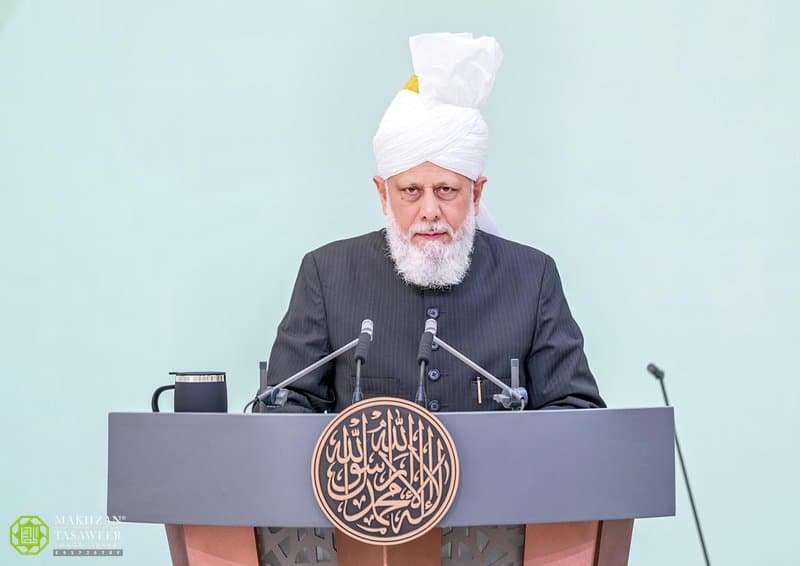
After reciting the tashahhud, ta‘awwuz and Surah al-Fatihah, Hazrat Khalifatul Masih V (aa) stated:
In the previous sermon, whilst mentioning the Holy Prophet’s (sa) trust in Allah the Almighty, I related accounts with regard to his migration from Mecca. There are some further details relating to this journey as well. They are recorded in history, and they reveal yet another magnificent aspect of the Holy Prophet’s (sa) trust in Allah.
It is narrated that on the occasion of this migration, Suraqah bin Malik intended to pursue the Holy Prophet (sa) out of greed for the [promised] reward. Suraqah bin Malik later became a Muslim, and after accepting Islam, he himself related this incident. He says, “The messengers of the disbelievers of Quraish came to us. They had fixed a blood-money for the person who would kill or capture the Holy Prophet (sa) and Hazrat Abu Bakr (ra).” Suraqah says: “I was sitting in a gathering of my people, the Banu Mudlij, when someone came to us. He stood in front of us whilst we were all sat, and he said, ‘O Suraqah! I have just seen some shadows from the coast of the sea’, or he said, ‘I have seen a caravan consisting of three people, and I believe that it is Muhammad [sa] and his companion.’” Suraqah bin Malik says: “I knew that it must be the caravan of Muhammad (sa), but I did not want anyone else to share the bounty with me. As such, I immediately took control of the delicate situation and signalled with my eye to the person who brought this news to remain quiet, and I said, ‘No, it cannot be the caravan of Muhammad (sa). In fact, the people you are referring to have just passed in front of us and belong to such and such tribe, who are searching for their lost camels.’”
Suraqah says: “I remained in the gathering for some time so that no one would become suspicious. I then told one of my maids to take my swift horse and stand with it at a particular place behind the house and wait for me.” He also arrived there after some time and further relates: “I cast lots, which turned out to be against this journey. However, I showed no concern, urged on my horse and swiftly set off. I pursued the caravan at great speed, as I believed that it was indeed the caravan of Muhammad (sa).” Suraqah says: “Covering one stage after another, I soon drew close to the caravan. When I was only a short distance away, my horse stumbled in an unusual manner, causing me to fall from it. I then got back up and cast lots again, and once again, it turned out against my intention. However, I was determined to take Muhammad (sa) back with me and obtain the reward of 100 she-camels. I got up and mounted my horse, and this time, I had reached so close that I had not only recognised that it was Muhammad (sa) and Abu Bakr (ra), but I could also hear Muhammad (sa) reciting the Holy Quran. He was not looking around, whereas Hazrat Abu Bakr (ra) would frequently turn around and look behind him.” Hazrat Abu Bakr (ra) was most probably looking around in all directions to protect the Holy Prophet (sa). He further relates: “Just then, my horse stumbled again and its legs became stuck in the sand, causing me to fall from it.
“I then rebuked the horse and stood up. She was unable to pull her legs out of the ground. Finally, when she stood upright, dust rose from both her legs and spread through the air like smoke. I then cast lots with the arrows once again, and the result was the same one that I disliked.
“I called out from there, assuring safety and protection, and said, ‘No harm will come to you from my side.’ Upon this, the Holy Prophet (sa) said to Hazrat Abu Bakr (ra), ‘Ask him what he wants.’ I replied, ‘I am Suraqah, and I wish to speak with you.’ Upon this, they stopped.”
Suraqah began to explain that the people of Mecca had offered a reward of 100 camels for capturing them, dead or alive, and that it was this temptation that had led him to pursue them. However, after what had happened to him, he had become convinced that pursuing them was not the right course.
He also offered the Holy Prophet (sa) provisions and other supplies for the journey (saying that they might take whatever food and other necessities they needed). However, the Holy Prophet (sa) did not accept them. He simply said, “Do not tell anyone about us.”
Suraqah promised to do so, and also said, “I am certain that you will one day attain kingship. Give me a written pledge that when I come to you at that time, I will be treated with honour and respect.” According to some narrations, he requested a written guarantee of safety. Accordingly, at the command of the Holy Prophet (sa), Hazrat Abu Bakr (ra) wrote it for him, while according to another narration, it was written by Amir bin Fuhairah. Suraqah took the document and returned. (Sahih al-Bukhari, Kitab manaqibi l-ansar, Hadith 3906; Subul al-Huda wa al-Rashad, Vol. 3, Dar Al-Kotob Al-Ilmiyah, Beirut, 1993, p. 248; Muhammad Rasool Allah Walazeena Ma’ahu, Vol. 3, Maktabah Misr, pp. 64-65)
This was the degree of the Holy Prophet’s (sa) trust in God. He had no fear whatsoever and continued on his journey while reciting the word of Allah.
His conviction was so strong that he knew nothing could befall him. Thus, when Suraqah asked him to give him a written guarantee of safety, he granted it to him. Suraqah had the thought that the Holy Prophet (sa) would ultimately achieve victory, while the Holy Prophet (sa) himself had even greater certainty that victory would indeed be his. That is why he even gave him the written guarantee of safety.
According to another narration, as he was returning, the Holy Prophet (sa) addressed him and said, “Suraqah, what will your condition be when the bangles of Chosroes will be on your hands?” Suraqah turned back in astonishment and asked, “Chosroes, son of Hormuz?” He said, “Yes, that very Chosroes, son of Hormuz.”
Thus, when the bangles of Chosroes, along with his crown and girdle, were brought during the Khilafat of Hazrat Umar (ra), Hazrat Umar (ra) called Suraqah and said, “Raise your hands.” He then placed those bangles on his hands and said, “Say: ‘All praise belongs to Allah, Who has taken these two from Chosroes, son of Hormuz, and granted them to us.’” (Muhammad Rasulullah Wallazina Ma‘ahu, Abdul Hameed, Vol. 3, Maktabah Misr, p. 65)
Hazrat Musleh-e-Maud (ra) has also related the incident of this journey in his own words. He says: “The event of the migration was an extraordinary and terrifying one. All of Arabia was opposed to the Holy Prophet (sa) and thirsty for his blood, yet the Holy Prophet (sa) set out for Madinah with only one companion.
“All along the route lived such tribes who, because of their opposition to his religion, were constantly seeking to kill him. They had remained silent only out of fear of the Quraish. But now the time had come when the Quraish themselves were intent upon killing the Holy Prophet (sa), and all the tribes of Arabia were reassured that if they killed this man, there would be no reason for the Quraish to be displeased with them.
“Not only was there no longer any fear of opposition from the Quraish, but the Quraish, upon finding that the Holy Prophet (sa) had left Mecca, had announced a reward for his capture and informed all the tribes settled along the route to Medina that whoever brought the Holy Prophet (sa) and Hazrat Abu Bakr (ra), dead or alive, would receive a reward of 100 camels for each of them.
“The Arab tribes, whose very lives revolved around plunder and who were already burning with the fire of jealousy, could hardly let such an opportunity slip away. The search for the Holy Prophet (sa) began everywhere. It was as though with every step he took, there was the fear that he might encounter some bloodthirsty enemy.
“On such occasions, it has often been observed that even the bravest of people lose heart and become incapable of making their final effort. Even if there is an exceptionally courageous and strong-hearted person, fear can nevertheless become so overwhelming (i.e. overpowering) that it manifests itself in every movement.”
Hazrat Musleh-e-Maud (ra) further writes, “I have read the accounts of those who displayed great courage and bravery in history, but their condition in circumstances such as these cannot even be compared with the incident of the Holy Prophet (sa).
“Historians know what happened to Napoleon as he fled and what clear signs of anguish were visible upon his face. They also know how Humayun, who was the king of India, repeatedly became ready to surrender himself into the hands of his enemies, and had there not been several exceptionally loyal generals with him, he might perhaps even have done so.
“Likewise, many other great and courageous generals have passed through history who faced difficult times. When the enemy surrounded them on all sides in search of them, they became frightened.
“But the Holy Prophet (sa) was not like these worldly people. His gaze was not fixed upon the world; rather, his eyes were raised towards God. Worldly means were not before him. He did not think, ‘What can I do at such a time, all alone with only one companion? If the enemy comes upon us on this dangerous route, what resources do I have with which to confront them?’
“Rather, he saw that God was with him – the God Who had always protected His righteous servants, and against Whose decree no enemy could prevail.
“That God was the God of Noah (as), the God of Abraham (as), the God of Moses (as), the God of Jonah (as), the God of Job (as), the God of David (as), the God of Solomon (as) and the God of the Messiah (as). He was the same God Who was his God. His powers never diminish, nor is He ever heedless even for a moment.
“Suraqah bin Jusham, driven to madness by greed and enmity, came upon them and, seeing the Holy Prophet (sa) from a distance, spurred his horse towards him.
“Hope surged through his heart like a river. He not only wished to satisfy his burning heart by staining his hands with the blood of the one whom he considered to have insulted his religion, but he also hoped to receive the reward of 200 camels (100 camels for the Holy Prophet (sa) and 100 for Hazrat Abu Bakr (ra). He said 200 camels, but in the other narration, it was 100, i.e., 100 for each. This would be sufficient to raise him to a position of great honour among his people.
“His courage was further heightened. Just as a hunter rushes towards his prey upon sighting it, he rushed towards the Holy Prophet (sa). With a bow and arrow in his hands, he intended to strike him.
“He was not alone in the sense that he could have summoned thousands of men around him with a single cry. (Had he called out, people from the surrounding tribes might have come to his aid.)
“Because the Holy Prophet (sa) was passing through his region at the time. But what does the Holy Prophet (sa) do at that moment? Does he flee? Does he become frightened and surrender himself to him? Do his legs begin to shake? Do his senses fail him? Does he intend to kill him and then flee from the scene? (He was so close and was alone, that the Holy Prophet [sa] could have shot an arrow and killed him.) No – that man who placed his complete trust in God did not do a single one of these things, nor did he show Suraqah even as much concern as one would show towards a bull. Despite Hazrat Abu Bakr’s (ra) courage and bravery, despite the faith and conviction he possessed, and despite the trust and reliance upon Allah that was found in him, he kept looking back repeatedly to see how close Suraqah had now come to them. But the Holy Prophet (sa) did not pay him any attention whatsoever. Far be it from him to become frightened or run away, or even show any sign of fear or alarm; he did not turn his face towards him even once. This left Suraqah utterly astonished and opened his eyes to the kind of man he was pursuing. He could never erase this sight from his memory for the rest of his life.
“Rather, this extraordinary incident made such an impression upon his heart that he would always recount it. He would say, ‘I continued riding my horse until I came so close to the Holy Prophet (sa) that I could hear the Holy Prophet (sa) reciting the Quran, and I saw that the Holy Prophet (sa) did not look to his right or left at all. But Hazrat Abu Bakr (ra) kept looking back repeatedly.’ Allah be praised! What extraordinary trust in God Almighty! The enemy had ridden his horse so close that his voice could reach the Holy Prophet (sa), and he had come within range of an arrow. Yet the Holy Prophet (sa) remained completely composed. Far from showing any sign of fear or alarm, he continued reciting the Holy Quran. Meanwhile, Hazrat Abu Bakr (ra) repeatedly looked back to see how close the enemy had now come. Can any other example of such complete reliance and trust be found? Is there any human being who, at such a dangerous moment, displayed such complete indifference and disregard? If the Holy Prophet (sa) had even considered making use of worldly means, then at the very least, he should have either attempted to attack Suraqah at that moment, or tried to move away from there as quickly as possible. But he adopted neither of these two options. He neither increased his pace nor intended to somehow kill Suraqah; rather, with complete tranquillity and without showing the slightest fear or alarm, he continued on at his original pace whilst reciting the Holy Quran. What was it that strengthened his heart so greatly at that moment? What power raised his courage to such heights? What spirit brought about such extraordinary life within him? These were the miracles of placing one’s trust in God – these were the results of relying upon Him. He knew that worldly means could not harm him. The powers of the world could not destroy him, because there was a God in heaven Who was watching him, and Who was the Creator of all these means. Thus, the worldly means cannot prevail against the Creator of those very means. This trust was not wasted; rather, God fulfilled it, and Suraqah – who had come out of greed for the reward of 200 camels – asked the Holy Prophet (sa) for forgiveness and turned back. And Allah cast such awe into his heart that he realised that his safest option was to quietly return home. He even caused the other pursuers to turn back. This is the kind of trust in God that cannot exist within a liar, and cannot be housed within a deceitful heart. This is a level of trust for which no parallel can be found in the world.
“An example of this kind of reliance is also found on one occasion regarding Prophet Moses (as), but that example is far inferior to this one. The reason is that when the companions of Prophet Moses (as) saw the people of Pharaoh, they said:
اِنَّا لَمُدْرَکُوْنَ
“‘We shall surely be overtaken.’ Upon this, Prophet Moses (as) replied:
اِنَّ مَعِیَ رَبِّیْ سَیَھْدِیْنِ
“[‘My Lord is with me. He will direct me aright.’]
“However, the trust of the Holy Prophet (sa) was so complete and perfect that it also had an effect upon his companion, and Hazrat Abu Bakr (ra) – unlike the companions of Prophet Moses (as) – did not become frightened and say, ‘Surely, we shall be captured.’ Rather, even while sitting inside the cave, he said that if they looked down, they would be able to see them. This faith was the result of the light of prophethood that was being cast upon his heart at that time. Furthermore, Prophet Moses (as) had an army with him, and there was certainly a place ahead to which they could flee. But the Holy Prophet (sa) had neither a group of people with him nor any other route ahead of him.” (Sirat-un-Nabi, Anwar-ul-Ulum, Vol. 1, pp. 491-496)
Thus, such was the lofty rank of his reliance upon Allah.
It is essential to make proper use of every available means, and then place one’s trust in Allah the Almighty. While speaking of the Holy Prophet’s (sa) trust in God, Hazrat Musleh-e-Maud (ra) explained this principle as follows:
“A person who truly believes in Allah, and who is equally convinced that God has created him for a particular purpose, can never abandon effort. On the contrary, such a person will be the most active of all in making efforts […]
“The actions of the Holy Prophet Muhammad (sa) were rooted in his faith. A person who believes that there is a God, and that God has created him for a particular purpose, will naturally strive to fulfil that purpose. Observe how, in the Cave of Thaur, the Holy Prophet (sa) reassures Hazrat Abu Bakr (ra), saying, ‘Abu Bakr, do not fear; God is with us, and He is our Protector.’ Yet at the same time, in every other matter connected with the faith, he laboured day and night with such intensity that it seemed as though the affairs of the whole world had been placed upon his shoulders.
“Thus, on the one hand, he possessed absolute certainty that God exists and helps His servants; on the other, he never put God to the test. He did not say, ‘Since God has promised me victory, I shall sit idly. What need is there for me to make any effort? Allah will grant victory in fulfilment of His promise.’ That was not his way. Rather, he took every practical step towards victory. He trained people in military skills, organised armies to combat the enemy, arranged mounts and transport, acquired weapons and provided food and accommodation for the soldiers. Only after making all such preparations would he set out to confront the enemy. And when the Muslims were few and the opposing force was large, he would still say with complete certainty, confidence and faith, ‘though we are few, victory will be ours.’
“So far as human effort could go, the Holy Prophet (sa) employed every possible means; beyond that, he placed his trust in Allah. His faith was therefore not the faith of ignorance or indolence. It was a faith born of certainty and experience. Such faith belongs to the person who combines trust in God with action – who holds effort and reliance upon Allah together at the same time.” (Uswah Hasanah, Anwar-ul-Ulum, Vol. 17, pp. 97-98)
The Promised Messiah (as) states:
“During the period of trials in Makkah, which extended over thirteen years, the Holy Prophet, peace and blessings of Allah be upon him, demonstrated in practice all the high qualities which a perfectly righteous person should exhibit at such a time, such as trust in God, perfect serenity under sufferings, steady and eager carrying out of duties and fearless courage. Observing his steadfastness, many of the disbelievers believed in him and thus testified that it is only the one who has complete trust in God who can display such steadfastness and endurance of suffering.” (Islami Usul Ki Falasafi [The Philosophy of the Teachings of Islam], Ruhani Khazain, Vol. 10, p. 447)
While placing his trust in God, the Holy Prophet (sa) also took every necessary precaution. As I have already mentioned, there are many incidents illustrating this. One such account is found in a Hadith narrated by Hazrat Ubayy bin Ka‘b (ra). He relates that when the Holy Prophet (sa) and his companions arrived in Medina, and the Ansar [residents native to Medina] gave them refuge, the surrounding Arabs united against them. The Muslims were in such a state that they would neither pass the night without their weapons nor rise in the morning except with their weapons beside them. (Al-Mustadrak ala al-Sahihayn, Vol. 2, Kitab at-tafsir, Tafsir Surah an-Nur, Hadith 3512, Dar Al-Kotob Al-Ilmiyah, Beirut, 2002, p. 435)
They kept them close at all times, sleeping and waking. They trusted in Allah, but they also understood that an attack could come at any moment; therefore, they had to remain vigilant and take measures for their own protection.
Hazrat Aisha (ra) provides further detail in another narration. She relates that after the Holy Prophet (sa) had arrived in Medina, there was one night when he remained awake. He then said, “If only a righteous man from among my companions would stand guard for me tonight.”
Hazrat Aisha (ra) says that while they were in this state, they suddenly heard the sound of weapons. The Holy Prophet (sa) asked, “Who is there?” The reply came, “I am Sa‘d bin Abi Waqqas.” The Holy Prophet (sa) asked, “What has brought you here?” He replied, “A concern arose in my heart for your safety, and so I came to stand guard for you.” The Holy Prophet (sa) prayed for him, and then slept peacefully.
In another narration of the same incident, Hazrat Aisha (ra) states that when she heard the sound of weapons and the Holy Prophet (sa) asked who was there, the reply was that Sa‘d and Hudhaifah had come. Two men are mentioned in this account, and they had come to guard him. The Holy Prophet (sa) then slept until Hazrat Aisha (ra) could hear the sound of his rapid breathing, the type of breathing that would occur whilst he was receiving divine revelation. At that time the following verse was revealed:
وَاللّٰہُ یَعْصِمُکَ مِنَ النَّاسِ
“And Allah will protect thee from men.”
The Holy Prophet (sa) put his head out from the tent and said, “O people, you may now go. Allah the Almighty Himself has undertaken my protection.” (Al-Jami’ Li Ahkam al-Quran [Tafsir al-Qurtubi], Surah al-Ma‘idah, V. 68, Dar ibn Hazm, p. 1104)
Before there was such a Divine assurance, and before there had been any specific promise from Allah, the Holy Prophet (sa) arranged for guards. Once Allah the Almighty Himself gave him this reassurance, he told them that they could go, saying that Allah would protect him.
When the Holy Prophet (sa) sent letters inviting various rulers to Islam, the Persian emperor, Chosroes, in his arrogance, tore the Holy Prophet’s (sa) letter to pieces. When this was reported to him, the Holy Prophet (sa), with complete trust in Allah, said, “May God Himself tear their kingdom to pieces.” Chosroes had already sent orders, through the governor of Yemen, for two soldiers to arrest the Holy Prophet (sa). They arrived carrying a letter demanding that he surrender himself to them immediately. Faced with such an apparently grave threat, the Holy Prophet (sa) showed no fear. He simply told the envoys, “Remain here tonight. Tomorrow I shall give you my answer.” The following morning he said to them, “Return to your master, the governor of Yemen (as the message had been sent through the governor of Yemen), and tell him that my Lord has killed his master, Chosroes, during the night.”
The envoys were stunned. They returned, and it later became known that on that very night, Khusrau Parvez had indeed been killed by his own son, Siroes. (Sirat Khatam-un-Nabiyyin, pp. 815-816)
This extraordinary event stands as a manifestation both of Allah the Almighty’s miraculous protection and of the unparalleled trust in God displayed by the Holy Prophet (sa).
The Holy Prophet (sa) would go forth to participate in the battles with complete reliance upon Allah the Almighty and with His permission. When setting out, he would also supplicate. Hazrat Anas (ra) relates that when the Holy Prophet (sa) would set out for a battle, he would say:
اَللّٰھُمَّ اَنْتَ عَضُدِیْ وَاَنْتَ نَصِیْرِیْ وَبِکَ اُقَاتِلُ
“O Allah, You are my support, and You are my Helper, and through You I fight.” (Sunan at-Tirmidhi, Abwab ad-da‘wat, Hadith 3584)
The Promised Messiah (as) states:
“Although a person naturally experiences anxiety in times of difficulty, he should never relinquish reliance upon Allah. The Holy Prophet (sa) became extremely anxious at the time of the Battle of Badr. He would supplicate:
یَا رَبِّ اِنْ اَھْلَکْتَ ھٰذِہِ الْعِصَابَةَ فَلَنْ تُعْبَدَ فِی الْاَرْضِ اَبَدًا
“‘O my Lord, if You destroy this group, You will never be worshipped on the earth again.’
“However, the anxiety of the Holy Prophet (sa) was merely a natural human response, because, on the other hand, he never allowed his reliance upon Allah to leave him. His gaze was turned towards the heavens, and he was certain that Allah the Almighty would never let him fail. He did not allow despair, hopelessness or despondency to come near him.
“The occurrence of such anxiousness is necessary for the completion of human morals and spiritual stages, but a person should never allow despair to come near him, because despair, that is, hopelessness and despondency, is a characteristic of the disbelievers. A person experiences all kinds of thoughts that cast anxiety and doubts into his mind, but faith drives these doubts away. Human nature experiences anxiety, while faith dispels it.” (Malfuzat, 2022, Vol. 4, pp. 271-272)
Then there is the famous incident demonstrating reliance upon Allah the Almighty, when an enemy found the Holy Prophet (sa) alone and drew his sword against him. Yet, without displaying any anxiety, he said, “Allah the Almighty will save me from you.” (Sahih al-Bukhari, Kitab al-maghazi, Hadith 4135 [Translation], Vol. 8, pp. 293-294)
While describing this incident, Hazrat Musleh-e-Maud (ra) also explains the Holy Prophet’s (sa) utmost reliance upon Allah in the following manner:
“Such was the state of his reliance upon Allah that when a person found him alone, raised a sword against him and asked, ‘Who can save you from me now?’ Despite the fact that the Holy Prophet (sa) was unarmed and, because he was lying down, was unable to move, he replied with complete composure and tranquillity, ‘Allah.’
“This word emerged from his lips with such certainty and conviction that even the heart of that disbeliever could not help but acknowledge the greatness of his faith and the perfection of his conviction. The sword fell from his hand, and the man who had come to kill him stood before him like a guilty criminal.” (Dibacha Tafsir-ul-Quran, Anwar-ul-Ulum, Vol. 20, p. 386)
During the Battle of the Confederates, the Muslims faced extremely difficult circumstances. The decision had been made to confront the enemy while remaining within Medina. This was not due to any fear or lack of reliance upon Allah, but was a matter of military strategy. A trench was dug around Medina so that the Muslims might be protected from a sudden and immediate attack by the enemy.
The Muslims were in such difficult circumstances that many of them were poor and earned their daily bread through their labour. Despite this hardship, they all joined together in digging the trench so that they could be protected from these attacks. Those who were unable to work each day would go hungry. At that time, many tribes from throughout Arabia had united and launched an attack. Different narrations give different figures for their number. In any case, the minimum number mentioned is 10,000; elsewhere it is 15,000 and elsewhere 24,000.
Even 10,000 was an enormous number in comparison with the population of Medina. For this small city, it was a very significant size of an army. (Sirat Khatam-un-Nabiyyin, p. 574)
Nevertheless, despite their difficult and impoverished circumstances, and despite being small in number, the Muslims became prepared to confront such a large army. Their strategy was that, because they were few in number, they should confront the enemy from within the city. This too was a favour of Allah the Almighty, and Allah had already informed them of what was to come.
The faith of the Muslims had also become strengthened. They were not overcome with anxiety upon seeing the enemy’s vast numbers. Rather, the Holy Prophet’s (sa) reliance upon Allah made the Muslims even stronger in their trust in Allah during that time. Despite hearing the words of the hypocrites, their courage did not falter.
Observe the arrangements Allah the Almighty made as a result of their steadfastness and reliance upon Him. A storm and violent wind terrified the disbelievers, causing them to flee. They fled in such confusion that they left behind much of their equipment, provisions and other belongings, which subsequently became useful to the Muslims. This was the result of reliance upon Allah the Almighty.
During the Battle of the Confederates, there is also the incident in which a small amount of food proved sufficient for an entire army. This indeed was a miracle, but it was also a magnificent example of reliance upon Allah the Almighty.
It is narrated by Hazrat Jabir bin ‘Abdullah Ansari (ra) that “On the day of the Battle of the Trench, while we were digging the earth, a very hard rock appeared before us. We went to the Holy Prophet (sa) and said, ‘A rock has appeared in the trench.’ He said, ‘I will come down,’ meaning, ‘I will come and break it.’
“He stood up, and there was a stone tied around his stomach. Because their stomachs were empty, they would tie stones around their stomachs in those days to provide support. We had not tasted anything for three days. Such was the severity of the hunger.
“The Holy Prophet (sa) took a pickaxe and struck the rock with it. It crumbled and became like a heap of loose sand. I said, upon seeing the condition of the Holy Prophet (sa), ‘O Messenger (sa) of Allah, permit me to go home.’
“I went and said to my wife, ‘I have noticed something about the Holy Prophet (sa) that I cannot bear to see. I saw that, because of hunger, he had tied a stone around his stomach. Do you have any food?’
“She replied that they had some grains and a small goat. I therefore slaughtered the goat, and while she milled the grains, we placed the meat in the stone cooking pot. Then I came to the Holy Prophet (sa). By that time, the flour had been kneaded and had risen, and the pot was on the stove, nearly ready.
“I said, ‘O Messenger (sa) of Allah, I have some food. O Messenger (sa) of Allah, please come and bring one or two men with you so that you may eat.’
He asked, ‘How much food is there?’
“I told him the quantity. The Holy Prophet (sa) said, ‘It is plenty. There is the meat of a goat and a little barley. It is enough. It is plenty, and it is good.
Then he said, ‘Tell your wife not to remove the pot from the stove, nor take the bread out of the oven, until I arrive.’
“Then the Holy Prophet (sa) said to the Companions (ra) to come with him.
The Muhajirin and the Ansar stood up. When Hazrat Jabir (ra) went to his wife, he said, ‘May you be blessed! The Holy Prophet (sa) has come with the Muhajirin and the Ansar and all those who are with them.’
“His wife said, ‘Did the Holy Prophet (sa) ask you anything?’
“I replied, ‘Yes.’
“She then said, ‘What did he ask?’
“I told her what had happened, including what he had asked about how much food there was and what I had told him.
“The Holy Prophet (sa) then took the Companions (ra) with him and said, ‘Enter. But do not crowd together,’ meaning that there was no need to rush; they should sit down calmly inside the house.
“He began breaking pieces of bread, placing meat upon them and giving them to the Companions (ra). The bread was covered with a cloth. He would break off a piece, take it out and place a little broth upon it, then give it to the Companions. Whenever he took something from the pot or the oven, he would cover it again. He continued in this manner until the Companions had eaten their fill. Everyone’s stomach was satisfied, and some food still remained.
The Holy Prophet (sa) said to Hazrat Jabir’s (ra) wife, ‘Take this and eat it yourself, and also send some as a gift, for the people are very hungry.’” (Sahih al-Bukhari, Kitab al-maghazi, Hadith 4101, [Translation], Vol. 8, pp. 240-241)
This incident demonstrates the reliance upon Allah, together with a prayer for blessings, and blessings were indeed bestowed upon the food.
Then, it is narrated that a person asked Hazrat Bara bin ‘Azib (ra), “Did you flee, leaving the Messenger (sa) of Allah behind, during the Battle of Hunain?” He replied, “Yes, but the Messenger (sa) of Allah did not leave the battlefield. The people of Hawazin were skilled archers, and when we confronted them, we attacked them, and they were defeated. The Muslims then began gathering the spoils of war, but they started shooting arrows at us from the front. The Messenger (sa) of Allah did not move from his position. I saw that he was mounted upon his white mule, while Abu Sufyan bin Harith bin Abdul Muttalib was holding its reins and the Holy Prophet (sa) was reciting the following couplet:
اَنَاالنَّبِیُّ لَاکَذِبْ
اَنَاابْنُ عَبْدِالْمُطَّلِب
“‘I am the Prophet whose advent was foretold – there is no falsehood in this;
I am the son of Abdul Muttalib.’” (Sahih al-Bukhari, Kitab al-jihadi wa s-siyar, Hadith 2864, [Translation], Vol. 5, p. 226)
Hazrat Musleh-e-Maud (ra) has also mentioned this incident and explained it in some detail. He states: “When the Holy Prophet (sa) said, ‘I am the son of Abdul Muttalib,’ it did not mean that, at that moment, when the enemy’s attack was so intense and 4,000 archers were raining down arrows upon him, his advancing forward in such circumstances was something beyond the capacity of human beings and that he had no fear. Rather, the Holy Prophet (sa) recited this couplet so that no one would be deceived by this and think that he possessed some divine power. He was merely the son of Abdul Muttalib and a human being. The only support he had was the help of Allah the Exalted, which was with him by virtue of his being a prophet.” (Khauf Aur Umeed Ka Darmiyani Rasta, Anwar-ul-Ulum, Vol. 19, p. 47)
Such was his reliance upon Allah the Exalted that when Allah the Exalted had promised him success, He would grant him success even amidst this rain of arrows.
Another example of reliance upon Allah the Exalted and having firm faith in His promises is found in the following incident. If we look at the incidents from the beginning and then at those towards the end, we find examples of the same spirit of reliance upon Allah. The incident just mentioned relates to Hunain, whereas this is an incident from the Battle of Badr, the first battle. In Medina, there was a very strong and brave man named Habib bin Yasaf. At that time, the Muslims were in a very weak state. This man belonged to the Khazraj tribe and had not accepted Islam by the time of the Battle of Badr. Nevertheless, he set out for the battle along with his people, the Khazraj, in the hope that should they win the battle, he would receive a share of the spoils of war.
The Muslims were very pleased that he was also joining them in the battle. However, the Holy Prophet (sa) told him, “Only he who follows our faith shall go to battle with us.” According to another narration, the Holy Prophet (sa) said to him, “Go back; we do not wish to seek the assistance of a polytheist.” Habib bin Yasaf came to the Holy Prophet (sa) a second time, but the Holy Prophet (sa) again sent him back. Finally, when he came for the third time, the Holy Prophet (sa) asked him, “Do you believe in Allah and His Messenger (sa)?” He replied in the affirmative, after which he accepted Islam and fought with great bravery. (Al-Sirah Al-Halabiyyah, Vol. 2, Dar Al-Kotob Al-Ilmiyah, Beirut, 2002, p. 204)
Thus, despite these unfavourable circumstances and despite the dire need, the Holy Prophet (sa) did not accept the assistance of this man while he was in a state of disbelief. This was because to seek assistance from someone else would have been contrary to having faith in the promises of Allah the Exalted and placing one’s trust in Him.
The Promised Messiah (as) states:
“According to the wise people of this age, it is a mistake to make someone your enemy, but if you ask for the truth, this is also proof of godliness. The Holy Prophet, may peace and blessings of Allah be upon him, did not worry about anyone; indeed, he made everyone his enemy. (He spoke the truth and people did not want to accept what he was saying, so naturally people were going to oppose him). According to these people, he made – God forbid – a mistake, but to make enemies simply for the sake of God is manifest evidence of his veracity by which the strength of his faith can be seen […] On the one hand, look at [Jesus] the Messiah (as); that from his teaching which is found in the Gospels. (Some people question why he raised an objection against Jesus [as], however, the Promised Messiah [as] stated that he was stating this in reference to the teachings found in the gospels) It is clear that his intention was never to offend anyone.
“The Jews were told that I have not come to change even an iota of the Torah. Contrary to this, if the teachings of the Holy Prophet, may peace and blessings of Allah be upon him, are seen, it will be found that no sect or religion on the face of the earth was left that was not invited [to embrace Islam] and whose errors he did not point out (and then he also made the claim that he would be victorious and triumphant). Not only did he highlight their errors and challenge them, but he also proclaimed that owing to his utmost trust and conviction in Allah the Almighty, he would triumph, by the will of God, for I have come from Him. Therefore, tell me how someone can do this unless he has complete trust and faith in God?” (Malfuzat, 2022, Vol. 7, p. 39)
اَللّٰہُمَّ صَلِّ عَلٰی مُحَمَّدٍ وَّعَلٰی اٰلِ مُحَمَّدٍ وَّبَارِکْ وَسَلِّمْ اِنَّکَ حَمِیْدٌ مَّجِیْدٌ۔
[O Allah, send Your blessings upon Muhammad and upon the family of Muhammad, and bless them and grant them peace. Indeed, You are Praiseworthy, Glorious.]
(Official Urdu transcript published in the Daily Al Fazl International, 9 October 2026, pp. 2-8. Translated by The Review of Religions.)