
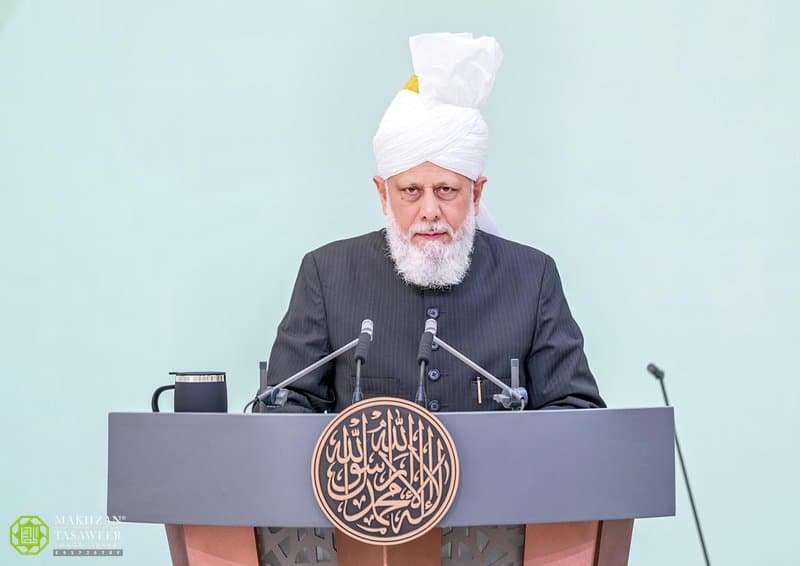
After reciting the tashahhud, ta’awwuz and Surah al-Fatihah, Hazrat Khalifatul Masih V (aa) said:
Today I have also delivered the Eid sermon, so at this time I will deliver a relatively short sermon. For this purpose, I have taken an excerpt from the writings of the Promised Messiah (as), to which we should always pay attention. He states:
“The more diverse a believer’s worldly associations, the more they advance in higher ranks, because their prime objective is religion.”
Even his worldly relationships are good and expansive only because their purpose is religion. In other words, the purpose of worldly relationships should itself be religion, and this is the hallmark of a believer.
“And the world, along with its wealth and honour, serves the Faith. Hence, the fundamental point is that the world must not be one’s ultimate objective. As a matter of fact, in pursuing worldly affairs, the primary purpose must be religion.”
Thus, the real principle is that the world should not be the ultimate objective in itself; rather, the true aim in acquiring the world should be the acquisition of faith. That is, even if you earn worldly wealth, the intention should be that our faith becomes better and that we may serve our religion. If we earn worldly means, it should be for the improvement of our faith, not by engaging in wrongful acts that ruin both our world and our Hereafter. Rather, we should earn in a way that adorns our hereafter and strengthens our faith.
“And the world ought to be pursued in a manner that serves the Faith. For example, when a person travels from one place to another, they will take a mount and pack their provisions. They do this because their actual purpose is to reach their final destination, not because they seek the mount itself or the provisions for the journey.”
All these things are taken merely to make the journey easier, so that one may travel comfortably and reach the intended destination, not so that one may simply indulge in them along the way.
“In the same manner, one ought to strive in the world, but only so that this may serve the Faith. Allah the Exalted has taught us the following prayer:
رَبَّنَاۤ اٰتِنَا فِی الدُّنۡیَا حَسَنَۃً وَّفِی الۡاٰخِرَۃِ حَسَنَۃً وَّقِنَا عَذَابَ النَّارِ
“‘Our Lord, grant us good in this world as well as good in the world to come, and protect us from the torment of the Fire.’” [Surah al-Baqarah, Ch.2: V.202]
That is, O Allah, grant us both the good of this world and that of the Hereafter.
“In this prayer, the world has been given precedence, but what ‘world’ exactly? It is the good of this world (hasanat-ud-dunya) which becomes a means by which to reap good in the Hereafter.”
Such a world, which, after attaining it, brings benefit in the Hereafter. We should obtain such things in this world which lead to the good in the next life, rather than them becoming a cause of shame and regret in the Hereafter. If a person becomes completely absorbed in the world alone, he will inevitably face regret in the Hereafter. The Promised Messiah (as) further states:
“The fact that we have been taught this prayer clearly demonstrates that in attaining the world, a believer ought to have in view the good of the Hereafter. The words hasanat-ud-dunya, as mentioned here, encompass all the best means by which a Muslim believer ought to pursue the world. Pursue the world in every such way that leads to benefit and goodness, not in a manner that causes pain to another human being, nor in a manner that is disgraceful or ignoble amongst the people. Engaging in the world in such a manner would definitely enable one to reap the good of the Hereafter (hasanat-ul-akhirah).” (Malfuzat, 1984, Vol. 2, pp. 91-91; Malfuzat [English], Vol. 2, pp. 264-265)
Earn such worldly wealth that not only benefits you, but also benefits humanity. Let there be no actions in your worldly life that become a cause of shame for you, your family or your relatives. Rather, your life should be pure and upright, a life that proceeds upon piety and righteousness. When such a life is established, and you dedicate your life to earning the world in this manner, then it will bring you blessings in both this world and the Hereafter.
Therefore, today, when the world in general has become absorbed in the pursuit of its own aims and interests and when personal interests are given priority, for example, if we look at nations, they are concerned only for their own people and not for humanity as a whole. By becoming engrossed in this attitude, they are in fact preparing the means of their own destruction.
In such circumstances, we should turn our attention toward seeking the blessings of both this world and the Hereafter from Allah the Almighty. In these conditions, we need to focus on this even more so that we may set right both our worldly life and our Hereafter and remain protected from every kind of calamity.
As I have mentioned, the world is moving toward a pit of destruction. May Allah the Almighty protect us from it. May Allah enable us to improve our deeds and grant us the ability to offer sincere prayers, as I mentioned in the sermon earlier. May Allah grant us the ability to truly attain these blessings, enable us to offer the best of prayers, and also accept them.
(Official Urdu transcript published in the Daily Al Fazl International, 10 April 2026, p. 2. Translated by The Review of Religions.)