
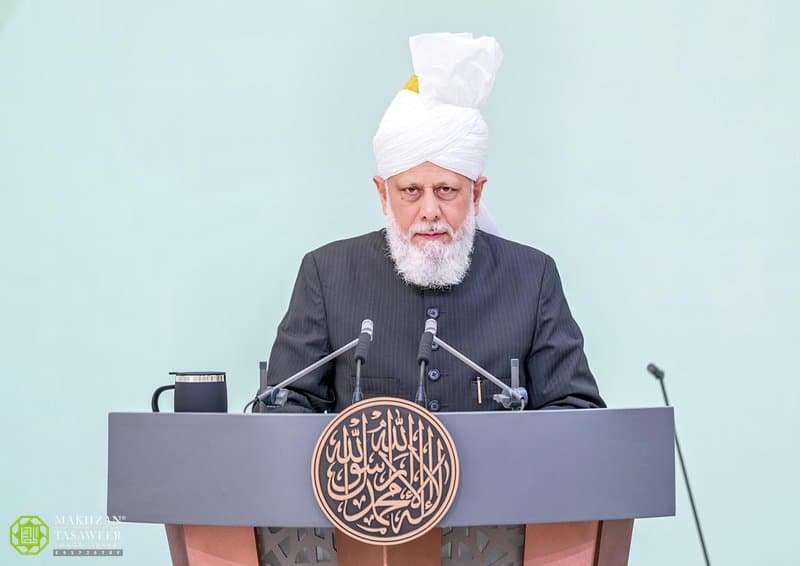
After reciting the tashahhud, ta‘awwuz and Surah al-Fatihah, Hazrat Khalifatul Masih V (aa) stated:
In relation to the life and character of the Holy Prophet (sa), his humility and meekness were being discussed. I will continue doing so today as well. What was the standard of the humility of the Holy Prophet (sa)? He would express this by giving small examples. Yahya bin Abi Kathir relates that the Holy Prophet (sa) said: “I eat just as a servant eats and I sit just as a servant sits, for I too am only a servant.” (Al-Baihaqi, Al-Jami’ li Shu’ab al-Iman, Vol. 8, narration 5572, Al-Rushd, Riyadh, 2003, p. 116)
In other words, the arrogance, self-conceit and ostentation of chiefs and rulers are not present within me.
In another narration, Hazrat Anas (ra) relates that the Holy Prophet (sa) had a she-camel named ‘Adba, and she was so fast that no other camel could overtake her. A Bedouin came riding a young camel of his and in the race, his camel overtook ‘Adba. The Muslims were displeased at the fact that ‘Adba had been left behind and that she had been overtaken by him. Or even if his camel were going to get ahead, then he should have stopped his camel since it was the camel of the Holy Prophet (sa) ahead. However, in response to their conduct, the Holy Prophet (sa) said: “It is the right of Allah that whatever He raises in this world, He also causes it to decline.” (Sahih al-Bukhari, Kitab ar-riqaq, Bab at-tawadu‘, Hadith 6501)
There is no reason, therefore, to get angry, as this is the practice of Allah the Almighty, whereby there are always highs and lows. Ordinary people would become jealous over such a matter. However, the Holy Prophet (sa) always had the Being of God Almighty in sight, and he only desired to demonstrate His superiority to the world. With what humility does he say, ‘Why do you need to get angry over this? There is no need for this, as this only manifests the superiority of Allah the Almighty.’
Hazrat Umar (ra) relates another example of his humility. He says: “I sought permission from the Holy Prophet (sa) to perform ‘Umrah. He graciously granted me permission and said, ‘O my brother, do not forget me in your prayers.’” Hazrat Umar (ra) says: “The Holy Prophet (sa) uttered such words that even if I had been given the entire world in exchange for them, it would not have given me such happiness.” (Sunan Abi Dawud, Kitab al-witr, Bab ad-du‘a, Hadith 1498)
Allah the Almighty has made it essential to invoke blessings [Durood] upon the Holy Prophet (sa) and He has also made it an essential means for the acceptance of prayers. Yet such was the height of his humility that he was asking one of his followers to pray for him.
Likewise, he did not feel ashamed of performing any task. He would perform even the smallest of tasks by himself in order to demonstrate it to others and teach them. Thus, in a narration, Hazrat Abu Sa‘eed Khudri (ra) relates: “The Holy Prophet (sa) passed by a boy who was skinning a goat. The Holy Prophet (sa) moved him aside and said, ‘Step back so that I may show you the proper method, for it appears to me that you are not skilled in skinning.’ The Holy Prophet (sa) then placed his hand between the skin and the flesh and pushed his hand inside until his whole arm, right up to his shoulder, was no longer visible. He then said, ‘This is how it should be done. Young man, skin it in this manner.’” The Holy Prophet (sa) did all his work and taught him at the same time. (Sunan Abi Dawud, Kitab at-taharah, Bab al-wudu’i min massi l-lahm… Hadith 185)
Similarly, there is another narration demonstrating how the Holy Prophet (sa), in all humility, would personally carry out tasks for others.
It is narrated by the daughter of Hazrat Khabbab (ra) that she came to the Holy Prophet (sa) with a goat to be milked. The Holy Prophet (sa) tied the goat and milked it himself. He then said to her: “Bring me your large vessel.”
She had already brought a container, but the Holy Prophet (sa) said: “No, bring a larger vessel than this.”
So she brought a larger vessel, and the Holy Prophet (sa) milked the goat into it until it became full. He then said: “Drink from it yourselves and also give some to your neighbours.” (Musnad Abi Dawud al-Tayalisi, Vol. 3, Hadith 1768, Dar Hijr, pp. 239-240)
Certainly, it would appear that through the blessings of the Holy Prophet’s (sa) prayer, the milk increased in an extraordinary manner. Thus, he instructed her to share this blessing with others as well, as twice the usual amount of milk was obtained from the goat.
There are also examples of the Holy Prophet’s (sa) humility and lofty moral character in the matter of greeting others and sitting in gatherings.
Hazrat Anas bin Malik (ra) relates:
“When a person came before the Holy Prophet (sa), he would shake hands with him, and he would not withdraw his hand until the other person himself withdrew his hand first. Nor would the Holy Prophet (sa) turn his blessed face away from the person until that person himself turned away first. And he was never seen sitting in such a way that his knees were extended before his companion.” (Jami’ at-Tirmidhi, Kitab sifati l-qiyamah wa r-riqaq, Bab 46, Hadith 2490)
Another narration from Hazrat Abu Muthanna al-Amluki states:
“The Holy Prophet (sa), as well as the prophets before him, would walk with the support of a staff and lean upon it.” (Subul al-Huda wa al-Rashad, Vol. 7, Dar Al-Kotob Al-Ilmiyah, p. 32)
This staff was not used to create awe or display greatness. Rather, it was a symbol of humility and meekness before Allah the Almighty. And the humility of the Holy Prophet (sa) surpassed that of all others.
The Holy Prophet (sa) would also advise people towards humility in a most wise and profound manner.
Accordingly, Ibn Hazm narrates that once there arose a dispute of pride and boasting between camel owners and goat owners. Each group was boasting over the other. The camel owners – those possessing many camels – would say, “We are greater than you and possess more wealth and means.” The goat owners, in turn, claimed superiority for themselves.
The Holy Prophet (sa) happened to come there while this discussion and rivalry were taking place, and he said:
“Moses (as) was sent as a prophet, and he used to herd goats. David (as) was sent as a prophet, and he used to herd goats. And I too have been sent as a prophet, and I used to herd the goats of my family at Ajyad.” (Al-Sunan al-Kubra, li al-Nisa’i, Kitab at-tafsir, Surah Taha, Hadith 11262, Vol. 10, Mu’assasat al-Risalah, Beirut, 2001, pp. 171-172)
Thus, he advised those who were boasting and, at the same time, comforted those over whom superiority was being asserted and who were being looked down upon because they tended goats.
The place mentioned by the Holy Prophet (sa), Ajyad, is an area near Safa in Mecca, also known as Jiyad. (Mu’jam al-Buldan, Vol. 1, p. 130)
There was no pride whatsoever in the Holy Prophet (sa). He would meet even the poor with humility and would comfort and honour them.
Hazrat Anas bin Malik (ra) narrates that among the Bedouins – i.e., the villagers – there was a man named Zahir. He would often bring gifts from the countryside for the Holy Prophet (sa), various items typical of village life. Whenever he prepared to leave, the Holy Prophet (sa) would also send him back with plentiful provisions and goods.
The Holy Prophet (sa) would say: “Zahir is our friend from the desert (i.e., the villager), and we are his friends from the city.”
One day, Zahir was selling some goods in the marketplace when the Holy Prophet (sa) came up behind him and embraced him from behind against his chest. Hazrat Zahir could not see who it was, so he said, “Who is this? Let me go!” But when he turned and recognised the Holy Prophet (sa), he began pressing his back affectionately against the blessed chest of the Holy Prophet (sa).
Then the Holy Prophet (sa) began saying: “Who will buy this servant?”
Hazrat Zahir replied: “O Messenger (sa) of Allah, then you will find me to be a worthless bargain. Who would buy me?”
Upon this, the Holy Prophet (sa) said: “No, in the sight of Allah you are not worthless.” Or he said: “In the sight of Allah, you are very precious.” (Sahih Ibn Haban, Kitab al-hazar wa l-abahah, Bab al-mazah wa d-dahak, Hadith 5790, Dar al-Ma’rifah, 2004, p. 1543)
While mentioning this incident in one of his sermons, Hazrat Musleh-e-Maud (ra) explained it in the following manner:
“One of the companions of the Holy Prophet (sa) had a congenital defect due to which he was extremely unattractive in appearance (i.e., he was not very attractive), and he was also exceedingly poor. His body and clothes were covered in dust, and in that condition, drenched in sweat, he was in the marketplace selling some goods for someone. However, that companion possessed something of immense value in the eyes of the Holy Prophet (sa). (The Holy Prophet [sa] held him in great esteem.)
“At that moment, while the companion himself likely felt disgusted by his own condition – thinking that he was soaked in sweat and covered in dust – the Holy Prophet (sa) approached him from behind and, in a playful manner like one plays with children, covered his eyes with his hands.
“The companion felt the hands and realised they belonged to the Holy Prophet (sa), because the Holy Prophet’s (sa) body had no or very little hair and was exceptionally soft. Upon recognising him, he, too, lovingly began rubbing his body against the blessed body of the Holy Prophet (sa), causing the Holy Prophet’s (sa) clothes and body also to become soiled. Yet, the Holy Prophet (sa) did not mind in the slightest.
“Then the Holy Prophet (sa) placed his hand upon him and said: ‘This is my servant. Is there anyone who will buy him?’
“At this, he (the companion) became emotional and said: ‘O my beloved master, this is a useless and valueless thing. Who would buy him?’
“The Holy Prophet (sa) replied: ‘Never! In the sight of Allah the Almighty, he is of immense worth.’” (Khutbat-e-Mahmud, Vol. 3, p. 663)
Whilst describing the Holy Prophet’s (sa) lofty morals, his humility and his noble character whilst dealing with people, and his beautiful appearance, Hazrat Hasan bin Ali (ra) once said: “I asked my maternal uncle, Hind bin Abi Halah, about the blessed appearance of the Holy Prophet (sa), and he used to describe the appearance of the Holy Prophet (sa) in great detail. I wished that he would mention some of it before me. Thus, he related that the Holy Prophet (sa) possessed an awe-inspiring and beautiful appearance. His blessed countenance would shine like the full moon on the fourteenth night.”
Then he narrated the entire Hadith in detail, describing everything. Hazrat Hasan (ra) says, “For some time, I concealed this narration from Hazrat Husain (ra) (i.e., the information he had received from his uncle). Later, I narrated it to him but discovered that he had already surpassed me in this matter and had asked these same questions before I did. In fact, I also learned that he had asked his father about the coming and going of the Holy Prophet (sa) within the home and about his appearance and has not left any detail unasked.” Hazrat Imam Husain (ra) states, “I asked my father about the manner in which the Holy Prophet (sa) would enter his home. (The previous discussions concerned his life outside, but regarding the matters inside the home, when he asked Hazrat Ali (ra), he replied:) ‘When the Holy Prophet (sa) would enter his home, he would divide his time into three portions. He dedicated one portion to Allah the Almighty, one portion to his family, and one portion to himself. Then he would even further divide his personal portion between himself and the people. With this, through some selected companions, he conveyed religious teachings to the general public and wouldn’t withhold anything from them. And during his life, division of his time for the Ummah was that – while granting permission for meetings – he would give preference to those among the people who possessed excellence and distinction, and they would be ranked in accordance with whose faith was greater. Among them, some had one question, some had two, and some had many. He would remain occupied in answering their questions, and upon their requests, he would engage them in matters that would reform both themselves and the community. And he informed them of things that were beneficial for them and would say: “Those of you who are present should convey these matters to those who are absent. And convey to me the needs of those who are unable to present their needs themselves, because whoever conveys the need of a person to a ruler when that person himself lacks the ability to do so, Allah the Almighty will grant them steadfastness and resoluteness on the Day of Judgment.”’” Thus, there is also a lesson in this for office bearers appointed in various places: they should certainly convey the needs of the people to the Markaz [headquarters]. The Holy Prophet (sa) would be asked about such matters, and he would not accept anyone else’s testimony aside from theirs. People came to him as seekers, and they never returned empty-handed. Rather, they departed as guides for others toward righteousness. Hazrat Imam Husain (ra) says, “Then I asked my father about the conduct of the Holy Prophet (sa) outside of his home as to what he would do during this time?”
He replied: “The Holy Prophet (sa) would not speak except for a purposeful reason. He would create harmony and peace of heart among his companions and would never alienate them. He honoured the respected person of every tribe and nation and would appoint them as leaders over the people. He cautioned the people and would remain careful around them, yet without allowing this caution to affect his cheerfulness or good character toward them.” Meaning that even when he warned others about someone or was cautious concerning a person, his outward conduct and graciousness toward that person did not change. He continued treating everyone with kindness and good manners, although, where caution was necessary, he exercised caution. He kept watch over his companions and asked people about the conditions of others. He praised good deeds and would help strengthen them, and he pointed out evil deeds and broke their influence. He was moderate in every matter and free from contradiction. He never became heedless lest others should become heedless or exhausted. He remained prepared for every situation. He neither stepped back regarding what was right nor exceeded the bounds. He did exactly as much as was his due right. Among people, those closest to him were the best among them. The most excellent in his sight was the one who was greatest in sincerity and kindness, and the one highest in rank near him was the one who showed the greatest sympathy and assistance toward others. The person who would do this the most would be closest to him, and he would like them.” Hazrat Imam Husain (ra) says, “Then I asked about the gatherings of the Holy Prophet (sa). He replied, ‘Whether sitting or standing, he remained engaged in the remembrance of God. Whenever he joined a gathering, he sat wherever there was space at the end of the assembly, and he instructed others to do the same. He gave every person sitting with him his due right, so much so that no one felt another person was more honoured than him in his presence. Whoever sat with him regarding a need or matter, he remained with that person until the person himself departed. Whoever asked him for something, he would never send them back without either receiving something or at least receiving a kind and gentle reply. (If someone came seeking assistance, he either gave him something or, if unable to do so, answered him with great gentleness.)
“‘His cheerfulness, generosity, and excellent character were for everyone. He became like a father to the people, and in matters of rights, all were equal in his sight. His gatherings were gatherings of knowledge, modesty, patience, and trustworthiness. Voices were not raised there, sacred things were not dishonoured, and the weaknesses of others were not discussed. Everyone was equal, and they would be ranked only on the basis of their level of righteousness. (The weaknesses of others would never be discussed in his gatherings.) In his gatherings, people behaved toward one another with humility. They honoured the elderly, showed mercy to the young, gave preference to those in need, and took care of strangers as well. It was not the case that if an unfamiliar person came, he would be ignored; rather, care was also shown toward him.’” (Shama’il al-Nabi [sa], Bab ma ja’a fi tawad’ui rasulillah [sa], narration 321, Noor Foundation, pp. 137-140)
The Promised Messiah (as) states:
“Those who are completely devoted to the pleasure of God do not desire for any rank or leadership to be bestowed upon them. Instead of such ranks, they greatly prefer the delights of seclusion and solitary worship. Yet God Almighty forces them to the forefront and commissions them for the betterment of humanity.
“Our Noble Prophet (sa) would also remain in a cave and wished for no one to know about him. But ultimately, Allah the Almighty brought him forth and entrusted him with the burden of guiding the world. Thousands of poets would visit the Holy Prophet (sa) and compose verses in his praise, but cursed indeed is the heart that imagines that the Holy Prophet (sa) would become elated by their praise (i.e., he became happy over this). He regarded such praises as no more than dead insects. True praise is only that which God proclaims from the heavens. Such people are wholly absorbed in the love of God and have no concern whatsoever for the praise and adulation of the world. Their station becomes such that God Himself praises and extols them from the heavens and from His Throne.” (Malfuzat, 2022, Vol. 4, pp. 338-339)
The Promised Messiah (as) further states:
“A Christian once went to the Holy Prophet (sa), who showed him great kindness and hospitality. The man was extremely hungry, and the Holy Prophet (sa) fed him abundantly to his complete fill. At night, the Holy Prophet (sa) graciously gave him his own quilt. When the man fell asleep, he suffered a severe bout of diarrhoea and was unable to contain himself, causing him to relieve himself in the quilt. The next morning, he thought to himself that the Holy Prophet (sa) would be disgusted upon seeing his condition. Out of shame, he quietly departed. When the people noticed, they informed the Holy Prophet (sa) that the Christian guest had soiled the quilt with excrement. The Holy Prophet (sa) said, ‘Bring it to me so that I may clean it.’ The people submitted, ‘O Messenger (sa) of Allah, why should you trouble yourself? We are present and can clean it.’ However, the Holy Prophet (sa) replied, ‘He was my guest; therefore, it is my duty.’ He then called for water and personally began washing the quilt himself. (With the utmost humility, he cleaned the filth left by his guest.)
“When the Christian had travelled about two miles away, he remembered that he had forgotten his golden cross upon the bed. He therefore returned, only to find the Holy Prophet (sa) personally washing the filth from the quilt. Overcome with remorse, he said, ‘Had this happened to me, I would never have washed it myself.’ As a result, the Christian man realised that a person possessing such selflessness and humility must certainly be commissioned by God Almighty. Thus, as a result of witnessing this, the Christian man accepted Islam.” (Malfuzat, 2022, Vol. 5, pp. 205-206)
The Holy Prophet’s (sa) humility and meekness were also exhibited even at the time when he received his first revelation. Hazrat Musleh-e-Maud (ra), while describing the incident at the Cave of Hira, states:
“The very first revelation descended in the Cave of Hira, when Gabriel appeared before the Holy Prophet (sa) and said, ‘Read.’ In response, the Holy Prophet (sa) said:
اِقْرَاْ بِاسْمِ رَبِّکَ الَّذِیْ خَلَقَ
“‘I do not know how to read.’” (Faz’ailul Quran II, Anwar-ul-Ulum, Vol. 11, p. 109)
By this, the Holy Prophet (sa) meant that such a burden should not be placed upon him. This did not mean that a book was placed before the Holy Prophet (sa) from which he was unable to read; rather, whatever Gabriel conveyed was to be repeated verbally by the Holy Prophet (sa), and this was something which he was certainly capable of doing. Yet the Holy Prophet (sa) expressed humility. However, since Allah the Almighty had specifically chosen him for this task, Gabriel repeatedly instructed him to read. Finally, upon the third command, the Holy Prophet (sa) recited.” Thus, Gabriel taught him the verses:
[اِقْرَاْ بِاسْمِ رَبِّکَ الَّذِیْ خَلَقَ – “Read in the name of thy Lord Who created.”]
At another instance, with regard to the same incident, Hazrat Musleh-e-Maud (ra) writes in Tafsir-e-Kabir, while explaining Surah al-Kauthar:
“When the Holy Prophet (sa) received the revelation, he demonstrated extraordinary humility. We observe that if ordinary people receive a revelation or see a dream, they hastily run to others and proclaim, ‘I have received such-and-such revelation,’ or ‘I have seen such-and-such dream.’ But when Gabriel came to the Holy Prophet (sa) and said, ‘Read,’ he replied:
مَا اَنَا بِقَارِئٍ
“‘I do not know how to read.’
“He repeated this three times. But when he realised that Allah the Almighty was insisting upon this matter, he obeyed the command. Indeed, he obeyed it with such courage that, unlike Moses (as), he did not say, ‘My Lord, appoint for me a helper.’ Rather, he shouldered the entire burden alone and did not request for a companion to assist him.” (Tafsir-e-Kabir, 2023, Vol. 15, pp. 138-139)
Hazrat Musleh-e-Maud (ra) further states:
“Another example of his humility is that one day a man from among the Ansar fell ill, and the Holy Prophet (sa) went to visit him. As the Holy Prophet (sa) was departing, the man from the Ansar gave the Holy Prophet (sa) a horse to ride and instructed his son, ‘Go with the Messenger (sa) of Allah. Perhaps he may find it difficult to find another companion on the way [meaning he may not find another travel companion). Also, bring the horse back afterwards.’
“After a short while, the boy returned home. His father asked, ‘I sent you with the Messenger (sa) of Allah so that you could accompany him on the journey and ensure his safety and that the horse remained tame. Why have you returned?’
“The boy replied, ‘I was compelled to return. When the Messenger (sa) of Allah came outside, he said to me, “Sit behind me upon the horse.” I replied, “O Messenger (sa) of Allah, I cannot commit such disrespect.” The Holy Prophet (sa) then said, “Then I also cannot bear that you should walk while I ride upon the horse. Either you ride with me or else return home.” (The boy said:) Therefore, I considered it better to return home, and the Holy Prophet (sa) rode on alone.’” (Tafsir-e-Kabir, 2023, Vol. 15, p. 157)
There is a narration in which Hazrat Abdullah (ra) relates:
“The Messenger (sa) of Allah once slept upon a reed mat. When he arose, marks from the mat were visible upon his side. We submitted, ‘O Messenger (sa) of Allah, allow us to prepare soft bedding for you.’
“The Holy Prophet (sa) replied, ‘What have I to do with this world? My example in this world is merely that of a traveller who rests beneath the shade of a tree for a while and then departs, leaving it behind.’” (Jami’ at-Tirmidhi, Kitab az-zuhd, Hadith 2377)
In Sahih al-Bukhari, there is a narration relayed by Hazrat Umar (ra), who states:
“Once I went to meet the Holy Prophet (sa). He was in an upper room, reclining upon a woven mat. There was nothing between him and the mat. Beneath his head was a leather pillow stuffed with date-palm fibre. Near his feet was a pile of acacia leaves, and near his head, some untanned leather skins were hanging. I could also see the marks of the mat upon his blessed side (due to the hard mat he was lying on). Upon witnessing this, I began to weep. The Holy Prophet (sa) asked, ‘Why are you crying?’ I replied, ‘O Messenger (sa) of Allah, Chosroes and Caesar live in great luxury, while you are the Messenger (sa) of Allah.’ The Holy Prophet (sa) responded: ‘Are you not pleased that for them is this world, while for us is the Hereafter?’” (Sahih al-Bukhari, Kitab tafsiri l-qur’an, Bab tabtaghi mardata azwajik, Hadith 4913, Vol. 12, Nazarat Ishaat, pp. 264, 267)
The Promised Messiah (as), while recounting this very incident, says:
“Such was the Holy Prophet’s (sa) contentment in his worldly provisions that on one occasion Hazrat Umar (ra) went to visit him, sending a boy ahead to seek permission to enter. The Holy Prophet (sa) was lying upon a mat of palm leaves, and when Hazrat Umar (ra) came in, the Holy Prophet (sa) sat up. Hazrat Umar (ra) looked around and found the house entirely bare, with nothing in it by way of adornment – only a sword hanging from a peg and that mat upon which he had been lying, the marks of which were imprinted upon his blessed back. At the sight of this, Hazrat Umar (ra) wept. The Holy Prophet (sa) asked: ‘O Umar, what has made you weep?’ Umar (ra) submitted: ‘Chosroes and Caesar have all the comforts and luxuries of the world, while you, who are the Messenger (sa) of Allah and the king of both worlds, live in such a condition.’ The Holy Prophet (sa) replied: ‘O Umar, what have I to do with this world? I pass through it as a traveller who journeys on camelback towards his destination – and finding along the desert road a tree, sits for a while in its shade on account of the fierce heat, and the moment his perspiration has barely dried, moves on again.’” (Malfuzat, 2022, Vol. 6, pp. 228-229)
Even with ill-mannered people, the Holy Prophet (sa) always displayed the finest qualities of gentleness and humility. It is narrated by Hazrat Abu Hurairah (ra) that a man came to the Holy Prophet (sa) to claim what was owed to him and did so in a harsh and abrasive tone. The Companions were angered by this, but the Holy Prophet (sa) said: “Leave him – for one who is owed a right has the right to speak his mind. I must give him what he is owed regardless; he has the right to express this.” He then said: “Buy him a camel and give it to him.” He had come to collect his debt, and so they were instructed to purchase a camel and give it to him. The Companions said: “We could not find a camel of equal value to what is owed – only one of greater value is available.” The Holy Prophet (sa) replied: “Then buy that one and give it to him, for the best among you is the one who is best in repaying debts.” (Mishkat al-Masabih, Kitab al-buyu’, Bab al-iflasi wa l-nzar, al-Fasl al-Awwal, Hadith 2906, Vol. 1, Dar al-Kutub al-Ilmiyyah, p. 537)
Now, in many of the disputes that arise today, people will not even pay the original amount that is owed and will instead quarrel and demand that even that be reduced. If we could only truly understand these things, a great many of our disputes would come to an end.
Similarly, another instance of his humility is found in the account of the Conquest of Mecca, when the Holy Prophet (sa) entered the Sacred Mosque. Hazrat Abu Bakr (ra) came before him bringing his father. When the Holy Prophet (sa) saw him, he said: “O Abu Bakr, you should have left this elderly man at home – I would have come to him myself.” Hazrat Abu Bakr (ra) submitted: “O Messenger (sa) of Allah, it is more fitting that he should come to you than that you should go to him.” Hazrat Abu Bakr (ra) seated his father before the Holy Prophet (sa), who passed his hand over his chest and said: “Accept Islam and you shall enter into peace.” And so Abu Quhafah accepted Islam. (Al-Asabah fi Tamyiz, al-Sahabah, Vol. 4, Dar Al-Kotob Al-Ilmiyah, 1995, p. 375)
Similarly, regarding his simple manner of living at home, it is narrated on the authority of Hazrat Hasan that the doors of the Holy Prophet (sa) were open to all – no gatekeeper stood at his door, nor were elaborate meals served to him morning and evening in large vessels; no fine food was presented to him. Whoever wished to meet the Holy Prophet (sa) could do so with ease. He would sit upon the ground and place his food on the ground as well. He wore simple, coarse garments, rode upon a donkey, would seat others behind him on his mount, and after eating would lick his fingers clean. (Al-Baihaqi, Al-Sunan al-Kubra, Vol. 10, Hadith 20838, Al-Rushd, p. 171)
On the matter of licking one’s fingers, there is a hadith in Bukhari in which the Holy Prophet (sa) said that after eating, before washing one’s hands, one should lick one’s fingers clean. (Sahih al-Bukhari, Kitab al-at’imah, Bab la’qi l-asabi‘i wa massiha… Hadith 5456)
Regarding this practice, Hazrat Zain-ul-Abidin Waliullah Shah Sahib (ra) has recorded a note in his commentary on Bukhari, in which Hazrat Sayyid Dr Mir Muhammad Ismail Sahib (ra) states: It is a matter established by the experience of all physicians and agreed upon by all practitioners of medicine that there is a particular power of touch concentrated in the fingers of the human hand. If, for example, one wishes to gauge the softness of a fabric, it cannot be assessed except through the fingers – even though the sense of touch is present throughout the entire body. If one were to try gauging softness with the foot, for instance, one would not be fully successful. There is a particular electrical quality that is confined not merely to the hand but to the fingers specifically and the fingers have a special connection to the eye, which is an instrument of focused attention. This is why those who practise focused concentration direct their gaze primarily at the fingers of the subject upon whom they are working and are able through this means to exert the influences of mesmerism most effectively and thereby achieve their purpose. Likewise, medicines prepared by hand yield greater benefit than those prepared otherwise. In our times, everything is manufactured by machines, but in those days, physicians and practitioners of medicine alike held this view – and Dr Ismail Sahib was himself a highly educated surgeon and physician – and he stated that such practices are of greater benefit than those medicines prepared by machines. In accordance with this same principle, when a person eats with his fingers, his eyes fall upon the tips of those fingers with each morsel taken. And so when, after eating, a person licks his fingers before washing or wiping them, it is evident that whatever fat has attached to them is carried directly into the stomach, thereby strengthening its function – that is, the process of digestion – so that the food is digested more readily. This was the view held by physicians and practitioners of that era; whether doctors today would agree or disagree is another matter. In any case, the Holy Prophet (sa) said that there is benefit in licking what remains on the hand after eating.
The narration in Bukhari reads:
فَلَا یَمْسَحْ یَدَہُ حَتّٰی یَلْعَقَھَا أَوْ یُلْعِقَھَا
“One should not wipe his hand until he has licked it himself or has had it licked.” Some commentators, regarding the phrase “having it licked,” have written that this means having one’s servant lick it, or one’s son, or someone who would not find the licking of fingers distasteful. Now one who has been eating has no need for that – he can perfectly well lick his own fingers. Commentators sometimes arrive at rather far-fetched conclusions. In any case, such an interpretation is unseemly and contrary to human dignity – that one should ask another person to lick one’s fingers. What it can reasonably mean is that a person should, after eating, lick his own fingers clean himself and should also instruct those in his care and under his guardianship to do likewise with their own fingers – so that they too may obtain those medical benefits and other purposes that are contained within this guidance of the Holy Prophet (sa). (Sahih al-Bukhari, Kitab al-at‘imah, Bab la‘qi l-asabi‘i wa massiha…, Islam International Publications, London)
The Holy Prophet (sa) never considered even the work of cleaning and dusting the mosque to be beneath him. Thus, there is a narration from Hazrat Ya‘qub bin Zaid that the Holy Prophet (sa) used to wipe away the dust and dirt that gathered in the mosque with a stick, i.e., perhaps it means that a cloth or something similar would be attached to the end of the stick and he would use it for dusting and cleaning. (Ibn Abi Shaibah, Al-Musannaf, Vol. 2, Hadith 4044, Al-Faruq al-Hadithiyah li al-Taba’ah wa al-Nashr, 2008, p. 321)
Hazrat Abu Hurairah (ra) relates that Gabriel was sitting with the Holy Prophet (sa) when the Holy Prophet (sa) looked towards the sky and saw an angel descending. Gabriel said, “This is an angel who, from the day of his creation until this very moment, has never descended before.” When that angel descended, he said, “O Muhammad (sa), your Lord has sent me to you. Allah the Almighty asks whether He should make you a king prophet or a servant messenger.” Gabriel said, “O Muhammad (sa), adopt humility before your Lord.” Thereupon, the Holy Prophet (sa) said, “Very well, I would prefer to be sent as a servant messenger.” (Musnad Ahmad bin Hanbal, Vol. 3, Musnad Abi Hurairah, Hadith 7160, ‘Alam al-Kutub, 1998, p. 13)
Indeed, this was the very nature of the Holy Prophet (sa). Even if Gabriel had not said this, the Holy Prophet (sa) would still have given the same reply. This is what he always taught and what he continually instructed. He also taught his followers, “I am but a man sent as a messenger.” Nonetheless, the purport of this narration is that, when such an occasion arose, the Holy Prophet (sa), out of humility, declared that he did not wish to be a messenger with the status of a king; rather, he desired to be Allah’s humble servant, a humble human being, and His messenger. This very principle is also mentioned in our declaration of faith [kalimah].
To what extent must a true Muslim adopt humility? In one narration, Hazrat ‘Iyad bin Himar relates that the Holy Prophet (sa) said: “Surely, Allah the Almighty has revealed to me that you should adopt humility to such an extent that no one should transgress against another, nor should anyone boast over another.” (Sunan Abu Dawud, Kitab al-adab, Bab fi t-tawadu’, Hadith 4895)
Whilst counselling us, the Promised Messiah (as) – the true servant of the Holy Prophet (sa) – states:
“One ought to adopt humility. Learning humility is not something difficult. Indeed, what is there to learn in it? Man himself is humble by nature, and it is for humility that he has been created.
مَا خَلَقْتُ الْجِنَّ وَالْاِنْسَ اِلَّا لِیَعْبُدُوْنِ
“That is, ‘I have not created the jinn and mankind except that they may worship Me.’
“Pride and arrogance are all artificial things. If a person casts off this artificiality, then humility alone will become manifest in his nature.” (Malfuzat, 2022, Vol. 5, p. 38)
Whilst advising us and explaining the station of humility of the Holy Prophet (sa), the Promised Messiah (as) states in one place:
“Almighty Allah is Most Merciful and Munificent. He nurtures man in every way and has mercy on him, and it is on account of this very mercy that He sends His Appointees and Messengers to deliver the people of the world from sinful life. But arrogance is a very dangerous disease. It means spiritual death for the person in whom it develops. I know for sure that this disease is worse than murder. An arrogant person becomes the brother of Satan because it was indeed arrogance that humiliated and ruined Satan. This is why it is a requirement for a believer that there should be no arrogance in him; rather, he ought to have humility, humbleness, and meekness, and this is the distinctive nature of God’s Appointees. They possess an extreme degree of humility and meekness. The Prophet, may peace and blessings of Allah be upon him, possessed this virtue more than anyone else. One of his servants was asked how the Holy Prophet (sa) dealt with him. He replied that the truth is that he served me more than I served him.
اَللّٰھُمَّ صَلِّ عَلٰی مُحَمَّدٍ وَعَلٰی اٰلِ مُحَمَّدٍ وَبَارِکْ وَسَلِّمْ
“‘O Allah, send down Your blessings upon Muhammad and upon the progeny of Muhammad and grant him prosperity and peace.’
“This is the standard of the highest morality and meekness. And this point is also true that most of those who serve [someone] are from among their loved ones who are around them all the time. Therefore, if one wants to see the level of humility and meekness, patience, and forbearance of someone, then it can be best ascertained from them. Some men or women are such that at the slightest mistake of the servant – if, for example, there was some defect in the way the tea was made – they immediately start to verbally abuse the servant or start beating him with a whip; or, if there was a slight excess of salt in the broth, it spells disaster for the poor servants. The other occasion is in their dealings with the poor. They do not care about the poor despite knowing that they are starving and surviving only on dry bread. They put them to the test when they come seeking help. (When a poor person comes to a wealthy person seeking help, they are in fact being placed in a test at the time. And true piety is to fulfil their needs at that time.) God Almighty is the Creator of every particle; no one can compete with Him. Only through the treatment of the poor can it be known how God-fearing or non-God-fearing one is.” (Malfuzat, 2022, Vol. 7, pp. 312-313)
How God-fearing a person is, is determined by how one treats the poor and not how one deals with the rich.
May Allah the Almighty enable us to adopt the paths of humility by following the teachings of the Holy Prophet (sa) and by acting in accordance with his blessed Sunnah.
After the prayer, I shall also lead a funeral prayer in absentia for Malik Daud Mahmood Sahib, son of Muhammad Ishaq Sahib, who was originally from Vehari and later resided in Karachi. He passed away recently.
اِنَّا لِلّٰہِ وَاِنَّاۤ اِلَیۡہِ رٰجِعُوۡنَ
[“Surely to Allah we belong and to Him shall we return.”]
By the grace of Allah the Almighty, he was a musi.
His grandfather, Muhammad Din Sahib, was a resident of the village Barhtanwala in the district of Sialkot. In 1914, he had the honour of taking Bai‘at at the hand of Hazrat Khalifatul Masih II (ra).
Malik Daud Sahib had the opportunity to serve the Jamaat locally as Sadr Jamaat, Secretary Maal and also in Majlis Ansarullah.
He is survived by three daughters and four sons. One of his sons, Muhammad Akmal Sahib, is serving as a missionary of the Jamaat in The Gambia. Owing to being engaged in the field of service, he was unable to attend his father’s funeral.
His son Akmal Sahib, who is a missionary, writes:
“My father was a very cheerful, warm-hearted, and lively person. He had a great passion for tabligh. Whenever he visited his agricultural lands in Sindh, he would look for opportunities for tabligh. Until restrictive laws were enacted in Pakistan, he would even carry pamphlets with him and would continue preaching regularly. As a result, he greatly influenced many people.
“He was exceedingly hospitable. Whether guests from the Markaz or any other visitors came, he would honour them with great hospitality. In his home, he had established a Salat centre until a formal Salat centre was built, and regular congregational prayers would be held there. After the Fajr prayer, he would recite the Holy Quran in a loud and melodious voice.
“People from other jamaats would also come to his centre to offer the Jumuah prayers. He would often say that whenever he went to his fields, he would offer voluntary prayers in every corner of his land, and because of this, Allah the Almighty would bless his crops, resulting in yields twice as abundant as those of others.
“Likewise, regarding the house he built in his village, he told his children that he wished to dedicate it permanently to the Jamaat so that it could become a Jamaat centre. Subsequently, he indeed donated it.”
Hospitality was one of his most outstanding qualities, alongside serving humanity, complete obedience to the Jamaat, and regularly listening to the Friday sermons. May Allah the Almighty grant him forgiveness and mercy.
(Official Urdu transcript published in the Daily Al Fazl International, 12 June 2026, pp. 2-8. Translated by The Review of Religions.)