
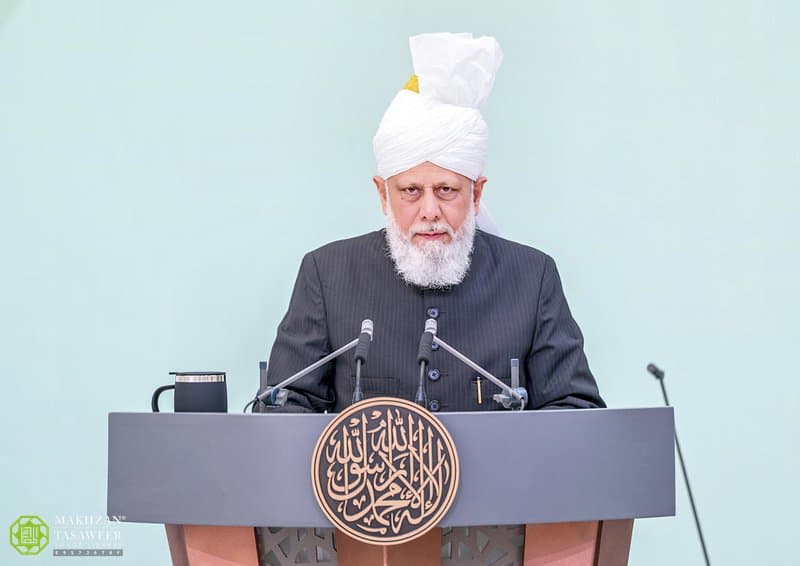
After reciting the tashahhud, ta’awwuz and Surah al-Fatihah, Hazrat Khalifatul Masih V (aa) stated:
I started discussing the simple life of the Holy Prophet (sa). One aspect of his simplicity was that at times, he would personally go to the market and purchase items he required.
In this regard, Hazrat Abu Hurairah (ra) relates that one day, he went to the market with the Holy Prophet (sa). The Holy Prophet (sa) took a seat next to the cloth merchant and purchased shalwars, or a loose type of trousers commonly worn at that time, for an amount of four dirhams.
Our translators have translated this as shalwars. However, these were not shalwars, but a loose type of trousers. In any case, the market had someone who weighed and measured items. In other words, clothes were sold based on their weight.
The Holy Prophet (sa) said to him, “Measure it and add something to it as well.” That is, you may add some weight to whatever is being purchased. The person who was weighing [the items] said, “I have never heard anyone say something like that. People usually request that the weight be reduced so it costs less.” However, the Holy Prophet (sa) said that it is okay if it costs more. The weight should be more and accurate. Caution demands that the scale of the acquired items be heavier.
Hazrat Abu Hurairah (ra) further relates that he said to him: “The fact that you do not recognise your Prophet is sufficient evidence for your religion to be harsh and lacking courtesy.” When he expressed his surprise, he started a conversation with Hazrat Abu Hurairah (ra). He then threw away the scale and rushed toward the hand of the Holy Prophet (sa), intending to kiss it. The Holy Prophet (sa) withdrew his hand and said: “What is this? Non-Arabs treat their kings in this manner. However, I am not a king!” He was a non-Arab, and the Holy Prophet (sa) sensed that his intention was of a worldly nature. As such, the Holy Prophet (sa) said, “I am not a king, and therefore I will not allow you to shake my hand in this manner and kiss it. I am just a man from among you.”
After this, he weighed the items, added something to them, and the Holy Prophet (sa) purchased the clothes from him. Hazrat Abu Hurairah (ra) says, “I advanced to carry the items for the Holy Prophet (sa). However, the Holy Prophet (sa) said, ‘It is better for things to be carried by their owner, unless they are weak and unable to carry them. In that case, his Muslim brother may assist him.’”
Hazrat Abu Hurairah (ra) further relates that he said, “O Messenger of Allah! Do you also wear these trousers?” The Holy Prophet (sa) replied, “Yes, I do so whether I am on a journey or at home, or at night or during the day. The reason is that I have been commanded to dress modestly, and I have not found anything more modest than these. This is an excellent garment!” (Majma‘ al-Zawa’id wa Manba‘ al-Fawa’id lil-Haishimi, Part 5, Hadith 8510, Dar al-Maktab al-Ilmiyyah, 2001, pp. 149-150)
Hazrat Aisha (ra) narrates, “Hazrat Abu Bakr (ra) entered my home whilst two Ansar girls were in my house, who were singing the poetry that the Ansar would recite during the Battle of Bu’ath.”
Before Islam, the people of Medina, i.e. the Aus and Khazraj, were engaged in civil war, and the final battle between them, according to Arab history, was known as the Battle of Bu’ath. This battle occurred during the prophethood of the Holy Prophet (sa), whilst he was living in Mecca. This battle started and finished prior to his arrival in Medina. Nonetheless, she stated:
“The girls who were singing were seated near me. They were no professional singers, nor employed for singing; rather, they were my friends. So Hazrat Abu Bakr (ra) said, ‘Are you all playing the flutes of Satan whilst in the home of the Holy Prophet (sa)?’ This incident took place on Eid. The Holy Prophet (sa) replied, ‘O Abu Bakr (ra)! Every nation has its Eid, and this is our Eid.’” Meaning, let them sing their songs and do not stop them. It was a simple and informal setting, and there is no mention of associating partners with God, so there was no reason to stop them. Hence, he allowed them to sing. (Sahih al-Bukhari, Kitab al-‘idayn, Bab sunnti al-‘idayn li ahli l-islam, Hadith 952, Translated, Vol. 2, Nazarat Ishaat, pp. 350-351; Sirat Khatamun Nabiyyin, Part 1, p. 263)
Hazrat Hind bin Abi Hala (ra) narrates in relation to the Holy Prophet’s (sa) quality of conveying the greeting of peace (Salaam) to others. He says, “Whenever someone met the Holy Prophet (sa), he would be the first to greet them with Salaam. In fact, he would even be the first to greet children.” (Al-Jami‘ li Sha`b al-Iman, Baihiqi, Vol. 3, Hadith 1326, Maktabah al-Rushd, 2003, p. 29)
Hazrat Anas bin Malik (ra) narrates, “When the Holy Prophet (sa) would pass by children, he would greet them with Salaam [first].” (Sahih Muslim, Kitab al-Islam, Bab istijabi al-islami ‘ala l-sibyan, Hadith 4017, Translated, Vol. 12, Noor Foundation, pp. 42-43)
Similarly, in another narration, Hazrat Anas (ra) narrates that, “When the Holy Prophet (sa) would visit the Ansar, he would greet their children, place his hand on their heads and would pray for them.” (Al-Sunan al-Kubra lil-Nasa’i, Kitab al-manaqib, Bab abna’i l-ansar [ra], Hadith 8349, Vol. 5, Dar Al-Kotob Al-Ilmiyah, 1991, p. 92)
It was a very informal environment, and whilst remaining within the confines of respect, the Companions would also express similar sentiments, and the children would also remain extremely respectful.
Whenever someone would sit close to the Holy Prophet (sa) or would speak to the Holy Prophet (sa) about his need, the Holy Prophet (sa) would calmly sit there [and listen] until the person himself would get up and leave. This simplicity and patience would also grant comfort and fortitude to the people who presented their needs, so that they could calmly present what they were saying. This is also one of the methods that our office-bearers need to adopt.
Hazrat Imam Husain (ra) states in a narration, “I asked my father regarding the gatherings of the Holy Prophet (sa). He replied, ‘The Holy Prophet (sa) would remember God whilst standing and sitting, and if he visited any other people, whenever the gathering ended, he would remain seated and would instruct others to do the same. The Holy Prophet (sa) would grant every person who spoke to him their rights. No one would ever feel that another person was more honoured than him. Whoever sat down with the Holy Prophet (sa) and stated his need, the Holy Prophet (sa) would stay with him until the other person would himself leave, and whoever asked for something they needed, the Holy Prophet (sa) would not let him return without giving it to him or speaking softly with him.” He would either give it, or if he couldn’t give it, he would speak very softly with the person.
The Holy Prophet’s (sa) cheerfulness, generosity and excellent morals extended to every person. The Holy Prophet (sa) became like a father to them. In terms of rights, everyone was equal in his eyes. His gatherings were those of knowledge, modesty, patience and trustworthiness. Voices were never raised, nor were sacred things desecrated, nor were anyone’s weaknesses mentioned. Everyone was equal to one another and was only greater than others by way of piety. They would speak to one another with humility, respect their elders, have mercy on the youth, would prefer the needy to themselves and would especially look after strangers.
Mention of simplicity in the Holy Prophet’s (sa) gatherings is found in a narration. Whilst mentioning these gatherings, Hazrat Jabir bin Samurah (ra) narrates, “I have sat with the Holy Prophet (sa) in more than 100 gatherings. His Companions would recite poetry, and would mention some things about the age of Jahiliyyah [ignorance] to one another, and the Holy Prophet (sa) would sit quietly, and would sometimes smile.” The gatherings were simple.
Similarly, in another narration, Hazrat Abu Dharr (ra) and Hazrat Abu Hurairah (ra) narrate, “The Holy Prophet (sa) would sit amongst his Companions. Whenever a foreigner or stranger would arrive, he could not determine who amongst them was the Holy Prophet (sa), and so he would ask.” (Sunan Abu Dawud, Kitab as-sunnah, Bab fi al-qadar, Hadith 4698)
We have heard the incident of the Holy Prophet’s (sa) migration to Medina many times, and it also contains an example of the Holy Prophet’s (sa) simplicity. Hazrat Musleh-e-Maud (ra) has narrated it thus:
“The utter simplicity of the Holy Prophet (ra) is illustrated by an incident which took place at this time. Most people in Medina had not seen him before. When the Holy Prophet (sa) was sitting outside Quba under a tree, and people came running from Medina to see him, many of them took Hazrat Abu Bakr (ra) for the Holy Prophet (sa) because he was sitting with great simplicity, and because Hazrat Abu Bakr (ra), though younger, had a greyer beard and was wearing nicer clothes than the Holy Prophet (sa). So they mistook Hazrat Abu Bakr (ra) for the Holy Prophet (sa), turned to him with great respect, and sat in front of him.
“When Hazrat Abu Bakr (ra) saw that the people were mistaken, he rose, took his mantle and hung it to block the sun and said, ‘Prophet of God (sa), you are in the sun. I make this shade for you.’ With tact and courtesy, he made plain to visitors from Medina their error.” (Dibacha Tafsirul Quran, Anwar-ul-Ulum, Vol. 20, p. 227)
In relation to the Holy Prophet’s (sa) simple gatherings, Hazrat Anas bin Malik (ra) relates:
“We were once sitting alongside the Holy Prophet (sa) in one of his gatherings when a man riding a camel entered and made his camel kneel down in the mosque (that is, in the open space or area just outside the mosque). He tied its foreleg, and then asked, ‘Who among you is Muhammad [sa]?’
“At that time the Holy Prophet (sa) was sitting amongst us, leaning on his arm. We replied, ‘This white, handsome man reclining on his arm.’ The man then addressed him, ‘O Son of Abdul Muttalib.’ The Holy Prophet (sa) said, ‘I am here to answer your questions.’ The man said to the Holy Prophet (sa), ‘I want to ask you something and will be hard in questioning. So do not get angry with me.’
“The Holy Prophet (sa) said, ‘Ask whatever you want.’ The man said, ‘I ask you by your Lord, and the Lord of those who were before you, has Allah sent you for all mankind?’ The Holy Prophet (sa) replied, ‘By Allah, yes.’ The man further said, ‘I ask you by Allah, has Allah ordered you to offer five prayers throughout the day and night? He replied, ‘By Allah, yes.’ The man further said, ‘I ask you by Allah! Has Allah ordered you to observe fasts during this month of the year (i.e. Ramadan)?’ He replied, ‘By Allah, yes.’ The man further said, ‘I ask you by Allah, has Allah ordered you to take alms from our wealthy people and distribute it amongst our poor people?’ The Holy Prophet (sa) replied, ‘By Allah, yes.’
“Thereupon that man said, ‘I have believed in all that with which you have been sent, and I have been sent by my people as a messenger, and I am Dimam bin Tha’labah from the brothers of Bani Sa’d bin Bakr.’” (Sahih al-Bukhari, Kitab al-‘ilm, Bab ma ja’a fi l-‘ilm, Hadith 63, Translated, Vol. 1, Nazarat Ishaat, pp. 123-124; Irshad al-Sari, Vol. 1, Dar Al-Kotob Al-Ilmiyah, 2007, p. 263)
This is a narration in Sahih al-Bukhari.
The Holy Prophet (sa) would also encourage his Companions to adopt humility. Hazrat Bara’ bin ‘Azib (ra) relates:
“The Holy Prophet (sa) ordered us to do seven things and prohibited us from doing seven other things. They were as follows: not to wear gold rings, harir and dibaj (i.e., soft silks), istabraq (i.e., thick silk), and not to use qissi (i.e., striped clothes which were brought from Egypt; special clothes which were also made of silk), or silk saddlecloth. He instructed us to follow the funeral procession, visit the sick, and pray for the well-being of each and every person.” (Sahih al-Bukhari, Kitab al-marda, Bab wujubi iyadati al-marid, Hadith 5650, Translated, Vol. 14, Nazarat Ishaat, pp. 13-14 and 253-254)
Allamah Ibn Hajar al-Asqalani, the commentator of Sahih al-Bukhari, has presented the following reasons for men being prohibited from wearing silk: one reason was that it was out of pride and arrogance. Second, it is a cloth of luxury and embellishment, not in line with a man’s dignity, but suited to beautifying women. Third, it resembles the polytheists. (Fath al-Bari, Vol. 10, Aram Bagh, Karachi, p. 351)
In relation to the prohibition of silk saddlecloth, he has stated that it is due to its resemblance to the ‘Ajamis, i.e. the kings who act in a very royal manner. That is, due to their excessive spending or unnecessary luxuries. (Fath al-Bari, Vol. 10, Aram Bagh, Karachi, p. 378)
Likewise, the commentator wrote, regarding the prohibition on wearing golden jewellery, that the men and women of Persia and Rome would be covered in golden jewellery. Furthermore, Chosroes, Caesar and the wealthy would wear golden bangles that covered their arms. They would wear golden necklaces, crowns and chains as a means of adornment, pride, affectation, arrogance and to display one’s grandeur in the land. They would eat out of bowls of gold and silver. The Pharaohs of Egypt would often do the same. (Fath al-Mun‘im: Sharh Sahih Muslim, Part 8, Dar al-Shuruq, p. 349)
It is mentioned in a narration that the Holy Prophet (sa) would visit the homes of his Companions with utmost humility and ask about their condition. Hazrat Jabir bin Abdullah (ra) states:
“I once fell ill, and when the Holy Prophet (sa) and Hazrat Abu Bakr (ra) came on foot to visit me, they found me unconscious. The Holy Prophet (sa) performed ablution, then poured the remaining water over me, and I regained consciousness.” (Sahih al-Bukhari, Kitab al-marda, Bab al-iyadati l-maghma alayh, Hadith 5651, Translated, Vol. Nazarat Isha`at, 14, p. 18)
There was no trace of pretentiousness in his life. He possessed complete humility. He would tell his Companions to also adopt simplicity, and he would explain this to them so that they too could be reformed over time.
Hazrat Anas (ra) relates that the Holy Prophet (sa) would travel on his own mount, and after the morning and evening prayers, he would even walk some distance. (Kitab al-Mu‘jam, Ibn al-A‘rabi, Vol. 2, Hadith 956, Dar Ibn al-Jauzi, 1997, p. 493)
His living in simplicity and teaching it are mentioned in a narration. Hazrat Abdullah bin Mas‘ud (ra) relates:
“On the day of [the Battle of] Badr, every three men took turns to ride upon one camel. Hazrat Abu Lubabah (ra) and Hazrat Ali ibn Abi Talib (ra) were the two riding one camel with the Messenger (sa) of Allah. It was time for the Messenger (sa) of Allah to walk, but they said, ‘We will walk and let you ride.’ The Holy Prophet (sa) said, ‘You are not stronger than me, and I am not in less need of reward than you both.’” That is, he was also in need of the blessings, and they should follow the agreed-upon rule. (Musnad Ahmad bin Hanbal, Vol. 2, Musnad Abdullah bin Mas‘ud, Hadith 3901, Alam al-Kutuh, Beirut, 1998, p. 92)
Hazrat Amr bin Harith (ra) relates:
“[When he passed away] the Messenger (sa) of Allah left neither a dinar nor a dirham nor a male slave nor a female slave, nor anything else except his white mule that he used to ride, his weapons and his land which he had given in charity to wayfarers.” (Sahih al-Bukhari, Kitab al-magazi, Bab maradi n-nabiyyi [sa] wa wafatih, Hadith 4461, Translated, Vol. 9, Nazarat Ishaat, p. 346)
Whilst describing the conditions of the life of the Holy Prophet (sa), Hazrat Musleh-e-Maud (ra) has stated:
“It is established from the life of the Holy Prophet (sa) that he would also eat exquisite food, but it is also established that he also went through periods of hunger. At times, he went hungry for so long that he had to tie a rock around his stomach.” (Khutbat-e-Mahmud, Vol. 29, p. 60)
Yet in every state, he spent every moment of his life in gratitude and humility.
In relation to the simple life of the Holy Prophet (sa), Hazrat Abu Sa’id Khudri (ra) relates:
“The Holy Prophet (sa) lived a very simple life. He never considered any work to be beneath him. He would feed his camels himself, help with the household chores, repair his shoes, patch his own clothes and milk the goat. He would sit with his assistants and eat together, and if someone grew tired from milling flour, he would offer help. He never felt embarrassed to carry household items from the market. He would shake hands with the rich and poor alike, and he was the first to offer the greeting of peace (Salaam). If someone invited him to a meal consisting simply of dates, he would not look down on it, but would accept the invitation.
“The Holy Prophet (sa) was extremely compassionate, kind and forbearing. He always took great care of cleanliness. He would meet everyone in a cheerful manner, always smiling, and he never laughed with a loud burst of laughter. He was always fearful of God, and there was not a single trace of harshness or being reserved. He possessed a very balanced disposition, with not even an iota of weakness or despondency. He was extremely generous (i.e. open-handed), yet he refrained from lavish spending. He was benevolent and kind, and he would meet every Muslim with kindness. He would never eat so much that he began belching. He never sought anything out of greed, but always remained patient and content with whatever he had.” (Hadiqah al-Salihin, Bab 5, Sardar-e-Do Jahan Hazrat Khatam an-Nabiyyin Muhammad Mustafa [sa], Hadith 43, pp. 33-34)
Hazrat Aisha (ra) relates that the Holy Prophet (sa) would accept gifts and would send gifts as well. (Sahih al-Bukhari, Kitabl al-hibah, Bab al-mukafati fi l-hibah, Hadith 2585, Translated, Vol. 4, Nazarat Ishaat, p. 631)
He would accept gifts no matter how small they were, and then he would give gifts in return as well.
Hazrat Abu Hurairah (ra) relates that the Holy Prophet (sa) used to pray, “O Allah, grant the progeny of Muhammad the means of subsistence that it requires.” (Sahih al-Bukhari, Kitab ar-Rifaq, Bab kayfa kana aishu n-nabiyyi [sa] wa ashabih wa takhallihim min ad-dunya, Hadith 6460, Translated, Vol. 15, Nazarat Ishaat, p. 227)
The Holy Prophet (sa) desired a simple means of livelihood for his children as well, and that is what he prayed for.
Hazrat Abu Hurairah (ra) relates that the Holy Prophet (sa) never expressed displeasure over a certain type of food. If he liked it, he would eat it; otherwise, he would leave it be. (Sahih al-Bukhari, Kitab al-manaqib, Bab sifati n-nabiyyi [sa], Hadith 3563, Translated, Vol. 7, Nazarat Ishaat, p. 67)
Sometimes a certain type of food may not be to one’s liking, in which case one should leave it without saying anything, and should quietly leave such food after tasting it.
Hazrat Anas bin Malik (ra) narrates that the Holy Prophet (sa) wore clothes made of bashm and wore shoes that had been mended. Bashm is a warm fabric made of coarse wool which would be worn in the winter. He also wore shoes that had been mended. He continues that the Holy Prophet (sa) always ate hard food and wore simple clothes. When asked what was meant by hard food, he said, “Thick bread made of barley which could not be swallowed without drinking water alongside it.” (Sunan Ibn Majah, Kitab al-at‘imah, Bab khubzi l-sha‘ir, Hadith 3348)
Hazrat Anas (ra) relates, “The Holy Prophet (sa) gave his armour as collateral for some barley. I took barley bread and some old fat to the Holy Prophet (sa) – as in fat that emitted a stench – and I heard the Holy Prophet (sa) saying, ‘Those in Muhammad’s (sa) home have nothing more than a sa’ for both morning and night.’” A sa’ of grain is the equivalent of 2.5 sair, or 2.5 kilograms – and this amount had to be shared among the people to eat it across nine homes. (Sahih al-Bukhari, Kitab ar-rihn, Bab ar-rihni fi l-hadar, Hadith 2508, Translated, Vol. 4, p. 539, Nazarat Ishaat; Lughat al-Hadith, Vol. 2, p. 648)
Hazrat Yusuf bin Abdullah Salam (ra) relates, “I observed that the Holy Prophet (sa) placed a date on a piece of bread and said, ‘This is the gravy.’” (Sunan Abi Dawud, Kitab al-iman, Bab ar-rajuli yahlifu anna la tata’addam, Hadith 3259)
The Holy Prophet (sa) was eating a date with bread.
Hazrat Abu Hurairah (ra) narrates that one day, a hot meal was presented to the Holy Prophet (sa), which he ate. Once he was done, the Holy Prophet (sa) said, “All praise is due to Allah, as I had not eaten a hot meal for a very long time.” It was after some time that the Holy Prophet (sa) had the opportunity to eat a hot meal. (Sunan Ibn Majah, Kitab az-zuhd, Bab ma‘ishati aali muhammad [sa], Hadith 4150)
‘Urwah relates on the authority of Hazrat Aisha (ra), who told him, “My nephew, our condition was such that there were times when two months would pass by and we would see the third moon and a flame would not have been lit in any of the Holy Prophet’s (sa) homes.” ‘Urwah asked, “How would you survive?” Hazrat Aisha (ra) said, “We survived on these two black things – dates and water. In addition, the Holy Prophet (sa) had some neighbours from the Ansar who had milk-giving camels. They would send milk from their homes to the Holy Prophet (sa), and he would give that to all of us to drink.” (Sahih al-Bukhari, Kitab ar-rifaq, Bab kayf kana ‘Ayishu n-nabiyyi [sa] wa ashabih, Hadith 6459, Translated, Vol. 15, Nazarat Ishaat, p. 226)
Hazrat Aisha (ra) narrates: “The Holy Prophet (sa) passed away at a time when we were able to consume aswadayn (dates and water) to our fill.” (Sahih al-Bukhari, Kitab al-at‘imah, Bab mun akala hatta shabi‘a, Hadith 5383, Translated, Vol. 13, p. 335, Nazarat Ishaat)
They were plentiful, and they would consume them to their fill. They would simply eat dates and drink water.
In the commentary on this hadith, ‘Allamah Ibn Hajar al-‘Asqalani writes: “Al-Aswadan – two black things – refers to dates and water. However, only dates are black, not water (water is not black). Hazrat Aisha (ra) said, ‘We sufficed upon two black things.’ This is because the prevalence of one has caused both to be described in the same manner. When two things are mentioned together, then they are both recognised by the name of that which is more prominent of the two.” (Fath al-Bari, Vol. 11, Aram Bagh, Karachi, p. 354)
Hazrat Musleh-e-Maud (ra) states:
“Those who have a deep connection with God always eat in small amounts. In other words, they eat less than those who have similar means, health, and stomachs. It cannot be said of a person who has an upset stomach and eats less as a result that he has increased in spirituality, because the condition is that all other means should be similar as well, and despite having the same means, the person with heightened spirituality eats less than others. That is why the Holy Prophet (sa) said that while a believer eats through one intestine, a disbeliever eats through ten. Upon studying the life of the Holy Prophet (sa), it is clear that he ate very little.” (Khutbat-e-Mahmud, Vol. 12, pp. 274-275)
Addressing the same subject, the Promised Messiah (as) states:
“When the pure and clean eat to their fill, it is not the same as others eating to their fill, who have been described by God Almighty as those who eat like animals, and the fire is their abode. When the Holy Prophet (sa) ate to his fill, it was in an entirely different light. If the manner in which the Holy Prophet (sa) ate to his fill was ascribed to those whose real purpose is enjoyment and to reap benefit, and in whose sight the relinquishing of carnal passions is to benefit from them and to enjoy them, then we cannot consider that satiation in the same manner.
“The meaning of being satiated for the pure and pious, compared with the impure and gluttonous, is entirely different. The pious consider satiation to be just that which essentially rids one of hunger and gives one the strength to move about (when one gains some strength and is able to carry out their work). Thus, the satiation of a believer is to eat as much as is required to maintain their strength and enable them to carry out their responsibilities. Thus, to compare the satiation of the Best of All Prophets (sa) with that of ordinary people is a flawed analogy.”
There is no comparison between him and ordinary people. His stature was entirely unique, and there was a distinct difference between the two. The Promised Messiah (as) continues:
“Similarly, many have not understood the esteemed stature of the Holy Prophet (sa). They have not maintained the proper manner of expression and have thus fallen into error. If the Holy Prophet (sa) ever said, ‘I have eaten to my fill,’ it is not at all the same as a worldly person saying the same thing; a person who has considered the very purpose of their life to consume food.
Hence, the actions and words of the righteous must be understood in accordance with their lofty status; and it is not right to compare them to others. In reality, they exist in a realm beyond this world, even if they live within the confines of this world.” (Maktubat-e-Ahmad, Vol. 1, Letter 20 to Mir Abbas Ali Shah Sahib, pp. 537-538)
Hazrat Abu Umamah Ba’li (ra) says that not even barley bread would be left over among the family of the Holy Prophet (sa). In other words, only the amount that was needed and could be eaten would be cooked. (Imam Tirmidhi, Shama’il al-Nabi [sa], Hadith 138, Noor Foundation, p. 56)
During the time of the Holy Prophet (sa), bread made of wheat flour was reserved for the wealthy, because in those days, wheat would not be cultivated in the ground and so it would have to be imported from distant places like Syria, and it would be quite expensive. That is why bread made of barley was generally available to the Holy Prophet (sa), and he would eat it with gratitude. Even the simple barley bread used to be unrefined, and that too was not available on a daily basis. (Zuhdah al-Shama’il: Sharh Shama’il Tirmidhi, pp. 109-110)
It was not just the case with the Holy Prophet (sa); his family, too, would go days on end without even barley bread, and as I just mentioned with reference to a narration by Hazrat Aisha (ra), they would rely on dates and water.
Naufal bin Iyas Hudhali relates: “Hazrat Abdur Rahman bin Auf (ra) would sit with us, and he was an exceptional friend. Once, he took us along with him to his home. When we entered, he went inside to bathe, and then came out to sit with us. A large dish was brought to us containing bread and meat. When it was placed before us, Hazrat ‘Abdur Rahman began to weep. I asked, ‘O Abu Muhammad, what causes you to weep?’ He replied, ‘The Holy Prophet (sa) has departed this world, yet throughout his life, neither he nor his family ever ate their fill of barley bread.’” (Al-Tabaqat al-Kubra li Ibn Sa‘d, Vol. 1, Dar Al-Kotob Al-Ilmiyah, 1990, p. 309)
In respect to not eating to his fill, Hazrat Aisha (ra) – a blessed wife of the Holy Prophet (sa) – states, “The Holy Prophet (sa) never ate his fill of bread and olive oil more than once a day, all the way up until his demise.” (Sahih Muslim, Kitab az-zuhdi wa ar-raqa’iq, Hadith 5269, Translated, Vol. 15, Noor Foundation, p. 173)
Hazrat Ibn Abbas (ra) relates, “The Holy Prophet (sa) would spend many consecutive nights with an empty stomach, and his family would not have dinner in the evening. Their food consisted mostly of barley bread.” (Sunan at-Tirmidhi, Abwab az-zuhd, Bab ma ja’a fi ma‘ishati n-nabiyyi [sa] wa ahlih, Hadith 2360)
Abu Hazim relates: I asked Hazrat Sahl bin Sa’d, “Did the Holy Prophet (sa) ever consume wheat flour?” Hazrat Sahl replied, “From the moment the Holy Prophet (sa) was commissioned by Allah the Almighty to the moment Allah the Almighty caused him to die, he did not consume wheat flour.”
Abu Hazim then asked, “During the lifetime of the Holy Prophet (sa), did you have any sieves?” Hazrat Sahl replied, “From the moment the Holy Prophet (sa) was commissioned by Allah the Almighty to the moment Allah the Almighty caused him to die, he did not see a single sieve.”
Abu Hazim then asked, “How would you eat of barley that you did not pass through a sieve?” Hazrat Sahl replied, “First, we would mill the barley, and then blow into it. The husks would blow away, while the flour remained. From what remained, we would knead into dough and eat it.” (Sahih al-Bukhari, Kitab al-at‘imah, Bab ma kana an-nabiyyu wa ashabuhu ya’kulun, Hadith 5413, Translated, Vol. 13, Nazarat Ishaat, pp. 361-362)
Masruq states, “I went to Hazrat A’ishah (ra). She called for food to be brought to me and said, ‘Whenever I eat my fill twice a day, I feel like crying and begin to weep.’ I asked why, to which she replied, ‘I remember the state in which the Holy Prophet (sa) departed from this world. By God, the Holy Prophet (sa) never ate bread and meat to his fill more than once a day.’” (Imam Tirmidhi, Shama’il al-Nabi, Hadith 142, Noor Foundation, pp. 57-58)
Hazrat Aisha (ra) did not say that she does not eat because the Holy Prophet (sa) could not. One should be grateful for Allah the Almighty’s bounties, and one should eat from what is granted. Otherwise, refusing to eat what one has would be a form of ungratefulness. Indeed, at such instances, she would remember the time of the Holy Prophet (sa), because he never ate to his fill more than once a day.
The fact of the matter is that one should take advantage of the blessings that are available; however, one should always bear in mind their earlier [weaker] state.
Hazrat Syed Zain-ul-Abidin Waliullah Shah writes in his commentary on Bukhari:
“What did the Holy Prophet (sa) and his Companions eat? Many narrations describe the lives of the Companions and events from Islam’s early days – their days of hunger, poverty, and financial constraint. Yet even then, their contentment and trust in God were so high that they remained satisfied with whatever Allah the Almighty granted them. Even when they were bestowed with wealth, their affluence did not diminish their contentment, trust in God, or selflessness at all. They spent both these eras in gratefulness for Allah the Almighty’s blessings, holding them in high regard, and in remembrance of His grace upon them.”
Hazrat Musleh-e-Maud (ra) states:
“When Chosroes was defeated, and the Muslims attained his spoils, they also seized some windmills that milled grains to fine flour. Before this, the people of Mecca and Medina would use grindstones (or stone slabs) to grind their grains, blow upon them to remove the husks and make bread.
“When windmills arrived in Medina and could grind grains into fine flour, Hazrat Umar (ra) instructed that the first batch of flour be presented to Hazrat Aisha (ra) so she could be the first to enjoy the soft bread made from it.
“Following his instruction, the flour was presented to Hazrat Aisha (ra). She gave it to a woman to knead into dough and prepare bread. When fresh, hot, soft flatbreads made from that flour were brought to her, she thanked Allah the Almighty and put a piece in her mouth. She had just put the bread in her mouth when tears began to drip from her eyes. The women watching were astonished by her tears. Someone said, ‘Is everything alright? The bread is quite exquisite and soft, yet you are unable to swallow it?’ She replied, ‘It is not the dryness of the bread that is preventing me from swallowing it, but rather its softness. Moments of sorrow have not made me sorrowful, but times of joy have made me mournful. This is a moment of joy, for in accordance with the prophecies, we have attained wealth and more.
“‘There was a time when the Prophet Muhammad (sa) was among us, and it is due to the blessings we derive from him that we have these bounties today. However, his state was that long periods would pass and fire would not burn in our home. If bread was made, it was prepared with flour ground on grindstones, and the husks were removed by blowing upon the flour. We would make bread in this manner. I think to myself that the person to whom we owe these blessings is not among us today, and so we cannot present these things and this wealth before him. Nevertheless, we who have nothing to do with these victories have become beneficiaries of these blessings. This thought caused me anguish and kept me from swallowing even the softest bread.’” (Sahih al-Bukhari, Translated, Vol. 13, Nazarat Ishaat, pp. 363-364)
Ali ibn Akmar narrated that he heard Hazrat Abu Juhaifah (ra) say that he heard the Holy Prophet (sa) say, “I do not eat whilst leaning back.” That is, he did not eat while reclining against a support. (Sahih al-Bukhari, Kitab al-at‘imah, Bab al-akli muttaki’an, Hadith 5398, Translated, Vol. 13, Nazarat Ishaat, p. 348)
In this regard, Allamah ibn Hajr has explained why the Holy Prophet (sa) never leaned against anything while eating. He writes, “This [i.e. leaning back to eat] was the habit of those who were arrogant and considered themselves superior. This was a custom learnt from the non-Arab kings. However, if someone is unable to eat without leaning against a support owing to an extenuating circumstance or illness, there is no harm in doing so.” (Fath al-Bari, Vol. 9, Qadimi Kutub Khanah, Aram Bagh, Karachi, p. 676)
Hazrat Abdullah bin Ubaid (ra) relates that food was once presented before the Holy Prophet (sa). Hazrat Aisha (ra) submitted, “O Prophet (sa) of Allah, it would be easier for you if you leaned back against a support and ate.” Upon this, the Holy Prophet (sa) lowered his forehead towards the ground until it almost touched it, and said, “Indeed, I shall eat as ordinary people eat and sit as they sit, for I am merely a human being.” (Subul al-Huda wa al-Rashad, Vol. 7, Dar Al-Kotob Al-Ilmiyah, 1993, p. 165)
Hazrat Musleh-e-Maud (ra) has also explained this. He writes:
“Whenever the Holy Prophet (sa) began to eat, he would turn towards the food and say, ‘I do not like the practice of the arrogant, who lean against a support whilst eating as though they have no regard for the food.’” (Dibacha Tafsirul Quran, Anwar-ul-Ulum, Vol. 20, p. 376)
As though they do not have any care.
The Promised Messiah (as) states:
“The Holy Prophet (sa) is a perfect example in every respect. Study his life and see how he treated women. In my view, an individual who stands up to contend against a woman is an unmanly coward. Study the pure life of the Holy Prophet (sa) so that you may see how kind he was. Even though the Holy Prophet (sa) was an awe-inspiring personality, if an old woman would stop him, he would stand there until the lady would permit him to leave. He would go to the market himself and bring his household items. On one occasion, the Holy Prophet (sa) purchased something from the market and a Companion submitted: ‘Your Holiness, allow me,’ but the Holy Prophet (sa) said: ‘A person ought to carry their own things.’ One should not conclude from this that the Holy Prophet (sa) would never allow others to do small tasks for him, such as bringing his firewood.”
That is, one should not infer from this that he would carry firewood back from the jungle upon his head. He would, of course, have someone else carry it for him. Rather, it means the everyday items purchased from the market. The Promised Messiah (as) further states:
“Nonetheless, these instances demonstrate the simplicity and immense informality of the Holy Prophet (sa). The Holy Prophet (sa) would go from one place to another on foot without any distinction as to who was walking ahead of him or behind him. For it is observed nowadays in the case of those who are disposed to formality that they do not appreciate it when others walk ahead of them. In fact, the Holy Prophet (sa) was so simple that, on certain occasions, people could not even identify the Messenger (sa) in a group. When the Holy Prophet (sa) arrived in Madinah, Hazrat Abu Bakr (ra) had a white beard, and so the people thought that he was the Prophet of God (sa). However, Hazrat Abu Bakr (ra), did something to serve the Holy Prophet (sa) in order to show the people that the Holy Prophet (sa) was the Messenger of God, and it was then that everyone realised the truth.”
The Promised Messiah (as) continues:
“On certain occasions, the Holy Prophet (sa) even had a race with Hazrat A’ishah (ra). On one occasion, the Holy Prophet (sa) outperformed her, and on another occasion, he went easy so that A’ishah (ra) could outpace him, and so she overtook him.
Similarly, it is also proven that on one occasion, a few Abyssinians came to show an entertaining spectacle. The Holy Prophet (sa)showed Hazrat A’ishah (ra) their demonstration. However, when Hazrat Umar (ra) arrived, the Abyssinians saw him and fled. In short, when a person closely studies the life of the Holy Prophet (sa), they learn a great deal. However, there are certain foolish, benighted individuals who do not reflect over his life, but open their mouths to raise allegations against him – this is the state of the Christians and Arya Samajists.” (Malfuzat [English], Vol. 3, pp. 296-297)
Even nowadays, people speak extremely disrespectfully against the Holy Prophet (sa). In any case, the status of the Holy Prophet (sa) is extremely lofty, and every deed of his is a model for us.
اَللّٰھُمَّ صَلِّ عَلٰی مُحَمَّدٍ وَّعَلٰی اٰلِ مُحَمَّدٍ وَّبَارِکْ وَسَلِّمْ اِنَّکَ حَمِیْدٌمَّجِیْدٌ
[O Allah, send Your blessings upon Muhammad and upon the family of Muhammad, and bless them and grant them peace. Indeed, You are Praiseworthy, Glorious.]
(Official Urdu transcript published in the Daily Al Fazl International, 13 November 2026, pp. 2-6. Translated by The Review of Religions.)